Living
Which is smaller?
The Papillon, weighing just 5-10 pounds versus the GWP's 60-70.

Quick answer
Which is smaller?
The Papillon, weighing just 5-10 pounds versus the GWP's 60-70.
German Wirehaired Pointer or Papillon? On paper they differ most on apartment suitability, and on the scales German Wirehaired Pointer is the heavier at 60–70 lbs. Here is how the two compare on everything that shapes an ordinary week.
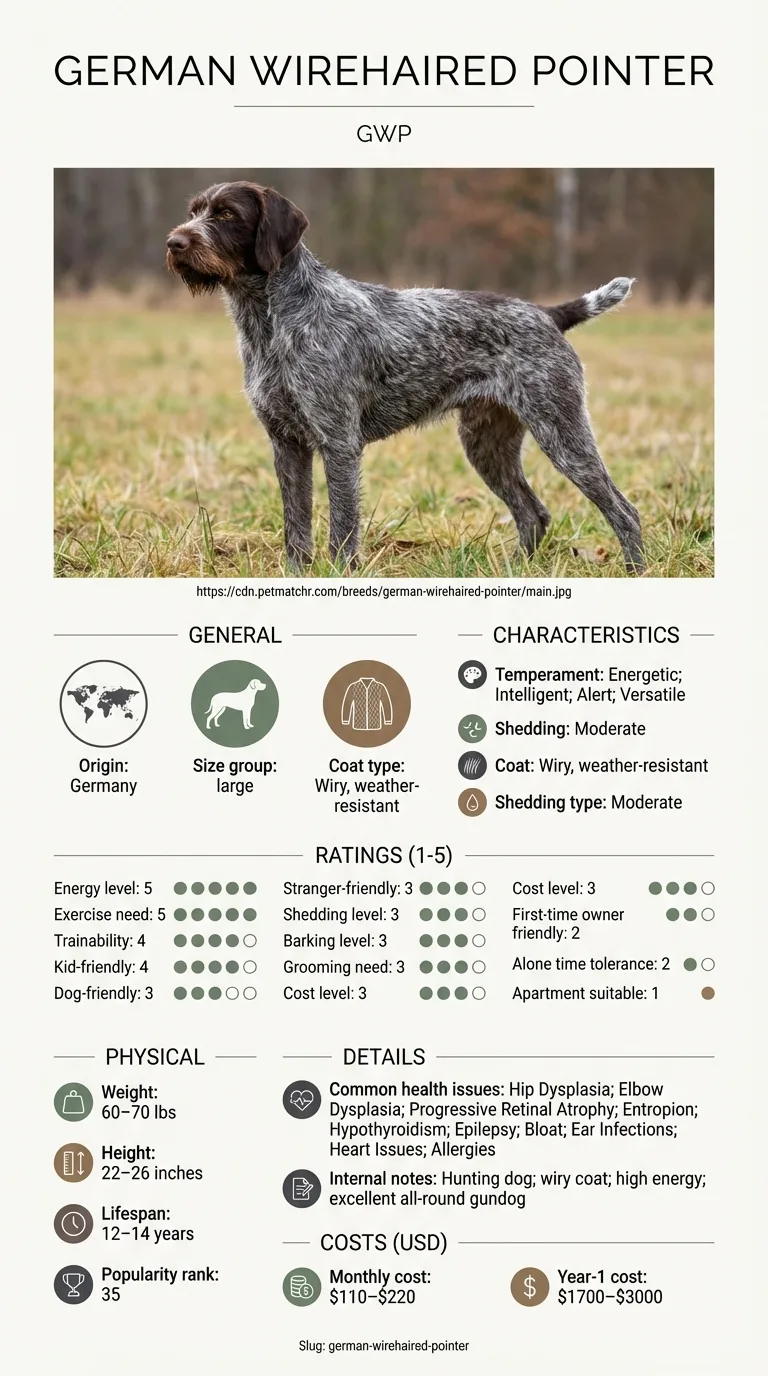
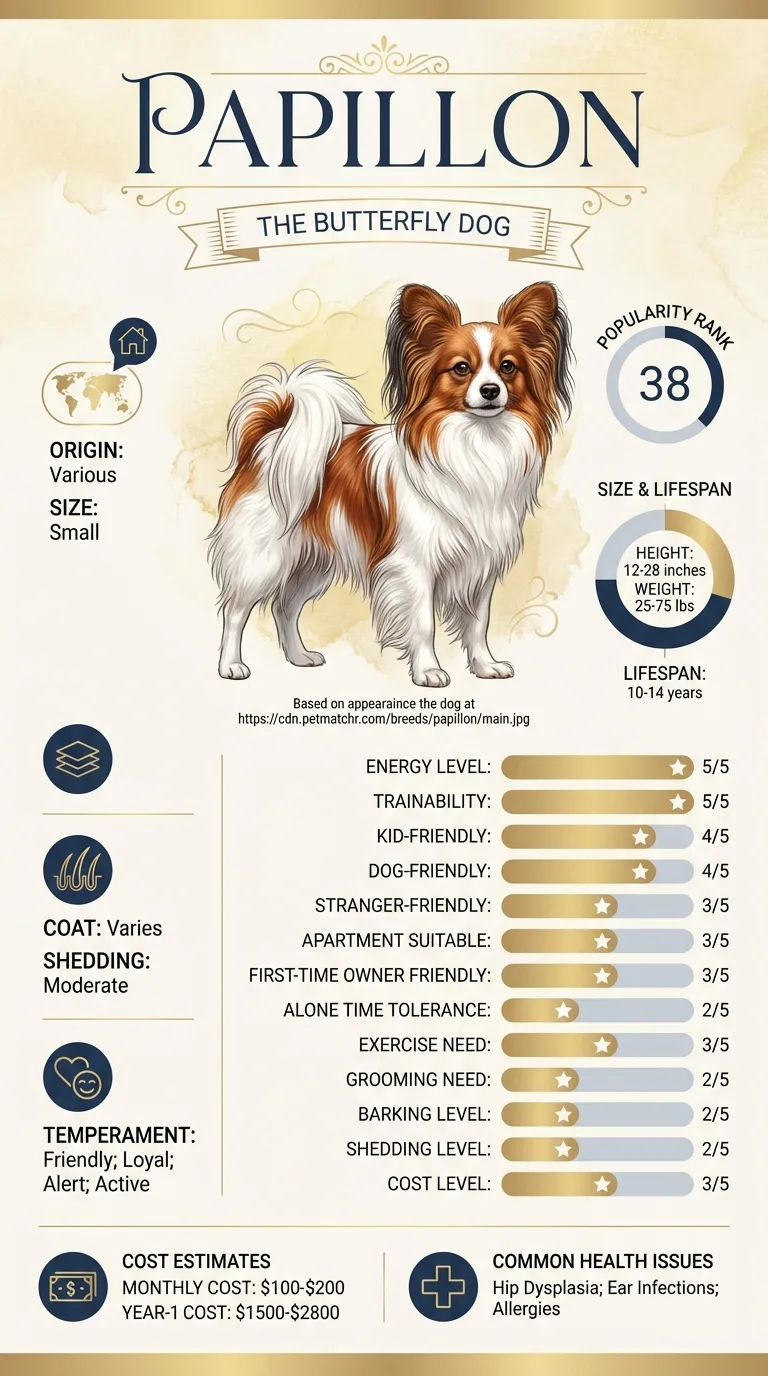
This is for someone already down to German Wirehaired Pointer and Papillon and deciding between them. For this pair the decision usually turns on apartment suitability and exercise need, so those are covered first and in most detail. Anyone choosing from a flat has a clear answer here: Papillon rates 5/5 against 1/5. There is no origin story here — only what changes about your week.
Between German Wirehaired Pointer and Papillon, apartment suitability is what separates them, and Papillon is the lower-effort dog of the two to keep.
Choose German Wirehaired Pointer if there are young children at home, you want a dog that can keep up with an active routine and you want a dog that is more watchful with visitors.
Choose Papillon if you are in a flat or a smaller home, this is your first dog and you do not want a standing grooming appointment.
| Feature | german wirehaired pointer | papillon | Winner |
|---|---|---|---|
| Size class | large | small | Equal |
| Weight | 60–70 lbs | 5–10 lbs | Equal |
| Height | 22–26 in | 8–11 in | Equal |
| Lifespan | 12–14 years | 14–16 years | papillon |
| Exercise need | Very high (5/5) | Moderate (3/5) | papillon |
| Grooming need | Moderate (3/5) | Low (2/5) | papillon |
| Shedding | Moderate (3/5) | Low (2/5) | papillon |
| Energy level | Very high (5/5) | High (4/5) | Equal |
| Barking | Moderate (3/5) | High (4/5) | german wirehaired pointer |
| Apartment suitability | Very low (1/5) | Very high (5/5) | papillon |
| Good for first-time owners | Low (2/5) | High (4/5) | papillon |
| Tolerates being alone | Low (2/5) | Low (2/5) | Equal |
| Trainability | High (4/5) | Very high (5/5) | papillon |
| Good with kids | High (4/5) | Moderate (3/5) | german wirehaired pointer |
| Good with other dogs | Moderate (3/5) | High (4/5) | papillon |
| Friendly to strangers | Moderate (3/5) | High (4/5) | papillon |
| Cost level | Moderate (3/5) | Low (2/5) | papillon |
| Coat | Wiry, weather-resistant | Long, silky single coat | Equal |
| Origin | Germany | Various | Equal |
| Typical monthly cost | $110–$220 | $80–$150 | Equal |
| Typical first-year cost | $1,700–$3,000 | $1,100–$2,300 | Equal |
Few pairings show a bigger scale mismatch than this one: a 60-70 pound German Wirehaired Pointer against a 5-10 pound Papillon, one of the smallest toy breeds around, named for its distinctive butterfly-shaped ears. Height spans 22-26 inches for the GWP versus just 8-11 inches for the Papillon -- more than double. The coats differ just as much: wiry and weather-resistant for the GWP's fieldwork needs, long and silky for the Papillon's elegant single coat. A GWP could genuinely step on a Papillon without realizing it, so this pairing, if kept in the same household, demands careful physical supervision during any shared play.
Exercise need favors a gap here -- Very high (5/5) for the GWP against Moderate (3/5) for the Papillon -- but energy level actually ties, listed as Very high versus High (4/5), reflecting the Papillon's surprisingly spirited, quick-witted nature packed into a tiny frame. Papillons are known for being far more athletic and agile than their size suggests, often excelling at agility sport despite modest formal exercise needs. Still, the GWP's fieldwork drive demands sustained outdoor exertion that a toy breed simply doesn't need. A Papillon owner can meet its needs with brisk indoor play and short walks; a GWP owner needs considerably more outdoor time and space.
The Papillon wins on both grooming and shedding here: Low (2/5) grooming against the GWP's Moderate (3/5), and Low (2/5) shedding against the GWP's Moderate (3/5). Despite its long, silky coat looking high-maintenance, the Papillon's single coat lacks a dense undercoat, so it mats less and sheds less than many long-haired breeds. The GWP's wiry coat needs occasional hand-stripping and produces moderate year-round shedding. For anyone weighing coat upkeep heavily, the Papillon is the lower-effort choice on paper, even though its flowing ear fringes and tail plume still benefit from regular brushing to stay tangle-free.
Apartment suitability heavily favors the Papillon, Very high (5/5) against the GWP's Very low (1/5), consistent with its small size and Moderate exercise needs. Barking flips the advantage to the GWP, though: Moderate (3/5) versus the Papillon's High (4/5) -- small dogs are often more vocal, and Papillons are no exception, alert-barking readily at sounds and visitors. Both breeds share Low (2/5) tolerance for being alone, so separation anxiety risk applies to either despite the size difference. A Papillon suits small-space living well overall, but owners in thin-walled apartments should factor in its barking tendency before assuming size alone settles the question.
Trainability favors the Papillon, Very high (5/5) against the GWP's High (4/5) -- Papillons consistently rank among the most trainable toy breeds, and their quick-witted, confident temperament backs that up. First-time-owner suitability tells a similar story: High (4/5) for the Papillon versus Low (2/5) for the GWP. A novice drawn to either breed's intelligence should know the GWP's version comes bundled with a Very high exercise requirement that demands real commitment, while the Papillon's comes in a compact, easier-to-manage package. Both are alert and sharp, per their temperament lists, but the Papillon's traits translate more directly into an easy training experience for beginners.
With kids, the GWP actually edges ahead, High (4/5) against the Papillon's Moderate (3/5) -- a toy breed this small can be more fragile around rough play from young children, despite its friendly nature. Everything else favors the Papillon: High (4/5) with other dogs and High (4/5) friendly to strangers, versus Moderate (3/5) for the GWP on both counts, reflecting its alert-but-friendly, confident temperament. Families with gentle older kids or no kids at all may find the Papillon's sociability a great fit; households with boisterous toddlers might lean toward the GWP's sturdier build instead, purely as a matter of physical safety.
The Papillon has a clear lifespan edge, 14-16 years against the GWP's 12-14 -- among the longer-lived toy breeds. Health profiles reflect their size categories: the GWP's ten-item list covers joints, eyes, thyroid, seizures, bloat, ears, heart and skin, while the Papillon's shorter list -- patellar luxation, progressive retinal atrophy, dental disease, open fontanel, and collapsing trachea -- leans toward classic small-breed vulnerabilities, especially dental disease and tracheal issues common in tiny dogs. Both share progressive retinal atrophy risk, so eye screening applies to either. The Papillon's open fontanel risk, most relevant in puppyhood, is worth flagging to any breeder or vet early on.
Cost level favors the Papillon, Low (2/5) against the GWP's Moderate (3/5), and the dollar figures track closely: $80-150 monthly and $1,100-2,300 first-year for the Papillon versus $110-220 monthly and $1,700-3,000 for the GWP. Food costs alone explain much of the gap given the roughly seven-to-one weight difference. Dental care may add ongoing expense for the Papillon given its listed dental disease risk, while the GWP's costs lean toward food volume and field-related gear. Overall, the Papillon is the meaningfully cheaper breed to raise and maintain, consistent with its smaller size across nearly every cost category.
German Wirehaired Pointer weighs 60–70 lbs and lives 12–14 years; Papillon weighs 5–10 lbs and lives 14–16 years. The two diverge most on apartment suitability, exercise need and good for first-time owners. Almost every rated axis separates them at least slightly. Where the table declares a winner it means less work for the owner, nothing more; descriptive rows are left as ties on purpose. The value here is in the differences between the two columns; treat any single score as approximate.

The Papillon, rated High (4/5) versus the GWP's Low (2/5) for first-time owners, thanks to its friendly, quick-witted, more manageable temperament.
The Papillon, at 14-16 years versus the GWP's 12-14 years.
The Papillon, rated Moderate (3/5) versus the GWP's Very high (5/5), though it's still a surprisingly energetic little dog.
Yes, rated Very high (5/5) for apartment suitability, though its High (4/5) barking rating is worth considering with close neighbors.
The Papillon, rated Very high (5/5) versus the GWP's High (4/5) -- it's known as one of the most trainable toy breeds.
The Papillon, with a first-year cost of roughly $1,100-2,300 versus the GWP's $1,700-3,000.
The GWP, rated High (4/5) versus the Papillon's Moderate (3/5), largely because its sturdier build tolerates rough play better.
The Papillon, weighing just 5-10 pounds versus the GWP's 60-70.
The Papillon, rated High (4/5) versus the GWP's Moderate (3/5).
The Papillon, rated Very high (5/5) versus the GWP's High (4/5).
The Papillon, at roughly $80-150 versus the GWP's $110-220.
Secure checkout on Stripe. We never see your card.
7-day money-back guarantee. Instant access.
Health information here is general and is not veterinary advice. If your dog shows pain, sudden behaviour change, or worsening symptoms, consult a licensed veterinarian.
Some links on this site are affiliate links. We may earn a commission at no extra cost to you, and we only suggest products we believe are helpful for dog owners.
We research and check what we publish, but we do not warrant that any figure, date, price, or statement is accurate, complete, or current, and we accept no liability for any loss, cost, injury, or other harm arising from the use of this site. Use it as one reference among several. You remain responsible for your own decisions and for your dog's care - confirm anything that matters with a licensed veterinarian or another qualified professional before you act on it. Full disclaimer.
Match your lifestyle to the right dog.
Take quizNot sure which breed is right for you? Take our 2-minute quiz to find out.
Take the quiz