Health
What does a carrier result mean?
The dog has one faulty and one normal copy of the gene. It will not develop that recessive condition but can pass the variant to about half its offspring.

Quick answer
What does a carrier result mean?
The dog has one faulty and one normal copy of the gene. It will not develop that recessive condition but can pass the variant to about half its offspring.
A clear result on a named variant means your dog does not have that variant. It does not mean your dog's retina is healthy, and the difference matters.
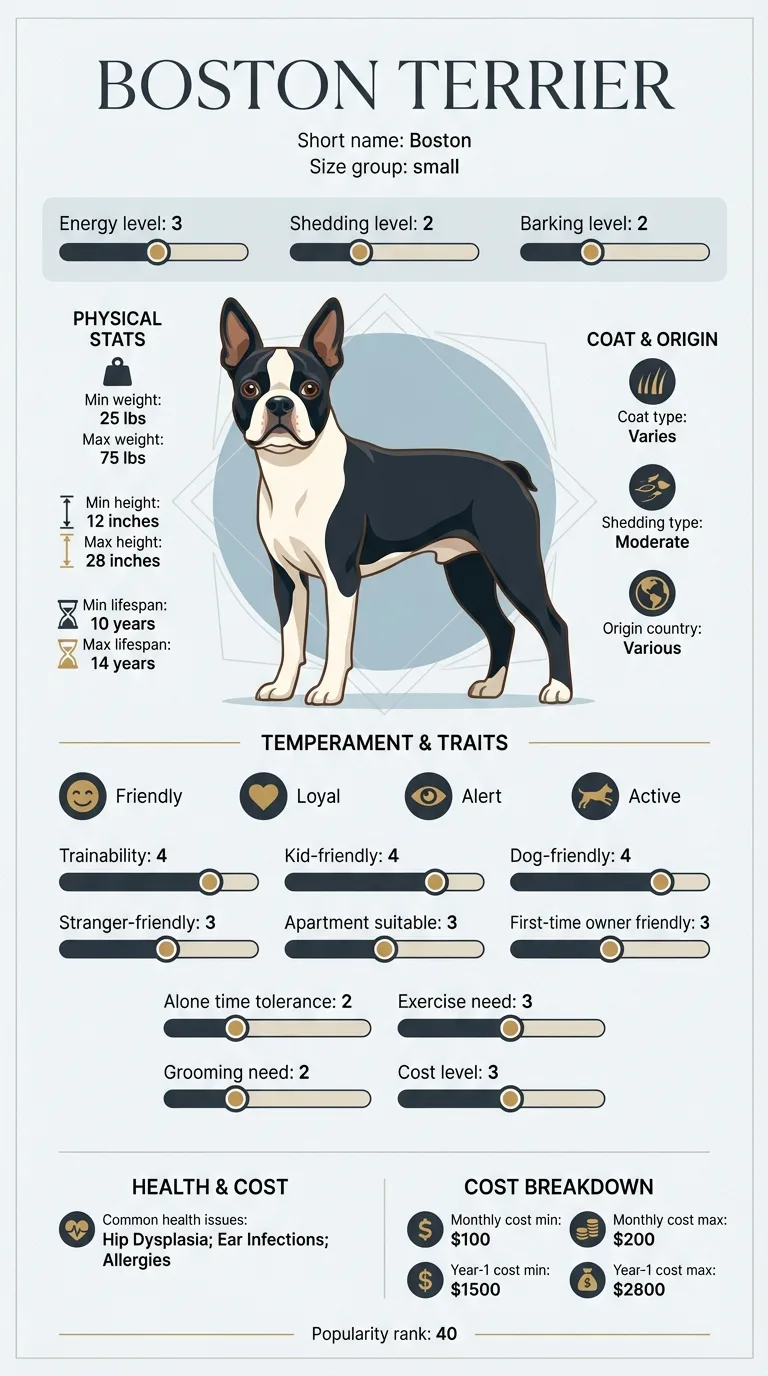
Owners who have run a commercial DNA panel on a Boston Terrier and are looking at a list of variant names, and breeders trying to work out which results should influence a pairing.
This guide is not medical advice. If your dog shows pain, sudden behavior change, or worsening symptoms, consult a licensed veterinarian.
Some links may be affiliate links. We may earn a commission at no extra cost to you. We only suggest products we believe are helpful for dog owners.
We research and check what we publish, but we do not warrant that any figure, date, price, or statement is accurate, complete, or current, and we accept no liability for any loss, cost, injury, or other harm arising from the use of this site. Use it as one reference among several. You remain responsible for your own decisions and for your dog's care - confirm anything that matters with a licensed veterinarian or another qualified professional before you act on it. Full disclaimer.
PRA-rcd3 is one named recessive variant among many that cause retinal degeneration in dogs. Understanding it is mostly an exercise in reading genetic results correctly: what clear, carrier and affected actually mean, which breeds a given variant applies to, and why a clean DNA panel is not the same as a healthy eye.
Named PRA variants are common in the breeds where they were characterised and generally absent elsewhere. In Boston Terriers, retinal degeneration is not among the documented breed problems; cataracts and corneal ulcers are. Most Boston owners running a DNA panel will find nothing actionable in the retinal section, which is the expected and reassuring result.
Recessive disease variants become concentrated in a breed through founder effects and popular sires, which is why each affected breed tends to carry its own distinct variant. The Boston Terrier is not a breed in which a specific PRA variant has been established, so its inherited eye risk sits with the lens rather than the retina. That distinction is the practical takeaway: screening effort in this breed is better spent on the conditions it actually carries.
Genotype is fixed at conception and no environmental factor changes it. Environment affects the testing process instead. Sample handling, laboratory quality and correct identification of the dog all influence whether a result is reliable, which is one argument for using an accredited laboratory and a microchip-verified sample rather than the cheapest available cheek swab.
This is a paperwork topic rather than a clinical one, but bring an unexpected affected result to your vet rather than acting on it alone. Book a proper eye examination for any dog showing hesitation in dim light, bumping into objects, persistently dilated pupils, or unusually reflective eyes. Seek same-day care instead for sudden vision loss, a painful or red eye, or an eye held closed, because those have urgent causes unrelated to inherited retinal disease.
See all Boston Terrier health problems, which breeds are prone to progressive retinal atrophy pra rcd3, or the full Boston Terrier breed guide for temperament, exercise needs and ownership costs.
A DNA result usually returns within two to four weeks of the sample being sent. Nothing about the result changes over the dog's life, since genotype is fixed. Ophthalmic examinations are repeated annually for breeding dogs because what they detect does change.
You can state, precisely, which variants your dog was tested for, what each result means for breeding, and what the panel did not cover. For a companion dog, success is usually recognising that the result changes nothing and that an eye examination would have told you more.
Most PRA variants, including rcd3, are autosomal recessive. Every dog carries two copies of the gene, one from each parent, and the disease only appears when both copies are faulty.
That produces three possible results. Clear means two normal copies: the dog will not develop this form and cannot pass the variant on. Carrier means one normal and one faulty copy: the dog will never develop this form, and passes the faulty copy to roughly half its offspring. Affected means two faulty copies: the dog is expected to develop the disease, though the age of onset varies.
The breeding arithmetic follows directly. Carrier bred to clear produces no affected puppies and approximately half carriers, which is why a carrier is not automatically removed from a well-managed breeding programme. Carrier bred to carrier is the pairing that produces affected puppies, at roughly one in four. Affected bred to anything passes a faulty copy to every puppy.
This is why a carrier result is information rather than a verdict. In a numerically small breed, excluding every carrier from breeding narrows the gene pool sharply and can concentrate other problems. Breeding away from a variant over generations, using clear mates, is generally sounder than eliminating carriers in one step.
What none of this tells you is whether a specific dog's eyes are currently healthy. That requires an examination.

Multi-variant panels test dozens or hundreds of named variants at once, and the marketing rarely makes their limits clear.
Marcus found a Boston Terrier litter advertised as fully DNA health tested, clear across the board, and asked for the certificates before travelling. What arrived was a broad commercial panel covering more than two hundred variants, almost all characterised in unrelated breeds. Both parents were clear on every one of them, which sounded impressive and told him very little about a Boston Terrier. What the paperwork did not include was an ophthalmic examination certificate, a patella evaluation or a hearing test, which are the three screens that map onto this breed's documented issues of cataracts, corneal ulcers, patellar luxation and deafness. Marcus asked for those. The breeder had the patella results and had not done the others. He waited four months and bought from a different litter where all three were in place. He does not think the first breeder was dishonest, only that she had bought the wrong test and believed it covered her.
Key takeaway: Fully health tested is a marketing phrase, not a standard. Ask which specific tests were done and check them against what the breed is actually documented for.
The rcd3 variant was characterised in the Cardigan Welsh Corgi and is not established as a Boston Terrier problem. The eye conditions documented for this breed are cataracts and corneal ulcers. If a panel returns a result for this variant in a Boston, discuss with your vet what it means in a breed where the variant is not known to circulate.
Not for the dog's own health. A carrier of a recessive variant will not develop that disease. The result matters only if you intend to breed, in which case the rule is straightforward: never pair a carrier with another carrier for the same variant.
Possibly not. Age of onset varies, and a young affected dog may not yet show changes. It is also possible for a variant to be less predictive in a breed it was not characterised in. An ophthalmic examination and, if needed, an electroretinogram tells you what is actually happening in the retina.
Annual ophthalmic examination by a qualified veterinary ophthalmologist is the mainstay, because it detects the conditions this breed actually has, particularly cataracts. Patella evaluation and hearing testing are the other screens that map onto documented breed issues.
Quality varies considerably between providers, and breed clubs generally recommend specific laboratories for a reason. Look for a laboratory that participates in external quality assessment schemes and whose results your national kennel club will accept for registration purposes.
No, and treating it that way is the most common misuse. DNA testing predicts risk for specific known variants. An examination observes the actual retina, lens and cornea today. In a breed whose documented eye problems are cataracts and corneal ulcers, the examination is by far the more informative of the two.
The dog has one faulty and one normal copy of the gene. It will not develop that recessive condition but can pass the variant to about half its offspring.
Not for that specific variant. They can produce a puppy affected by a different retinal condition caused by a variant the panel did not test.
Typically a modest sum for a broad commercial panel, with single-variant tests from accredited laboratories often costing more per test but carrying more weight with registries.
It rarely changes management for a companion dog with no breeding plans. Spend the money on an ophthalmic examination instead if eye health is your concern.
A one-page prep sheet for this condition: the signs, the questions to ask, what to get priced. Unlocks here.
You get: Vet visit prep sheet
No spam. One-click unsubscribe. See our privacy policy.
Preview page 1 before you decide.