Cocker Spaniel vs Yorkshire Terrier: Which Suits Your Home?
Quick answer
Cocker Spaniel or Yorkshire Terrier -- which is the better all-around choice?
If you have kids or frequent guests, the Cocker Spaniel's higher marks for friendliness and trainability make it the safer pick. For the smallest footprint and lowest shedding, go Yorkshire Terrier.
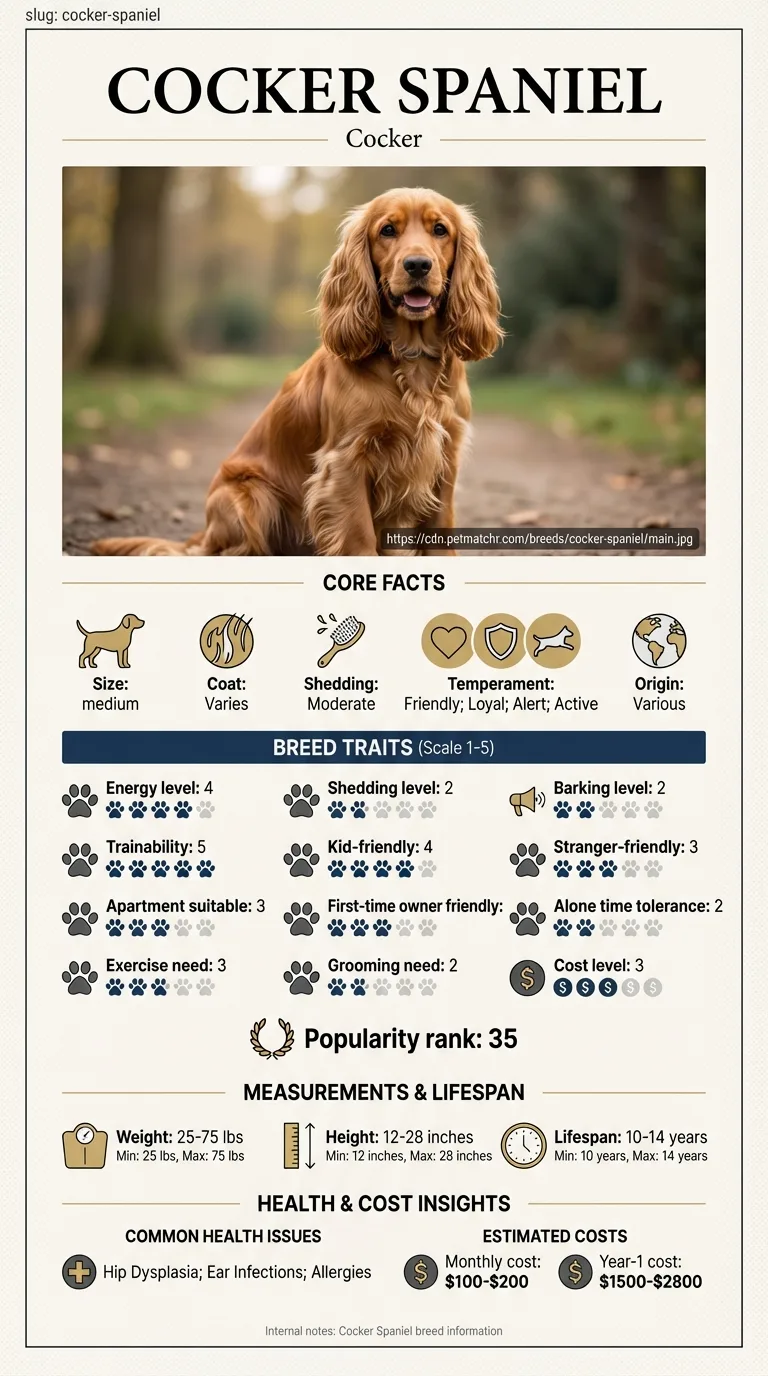
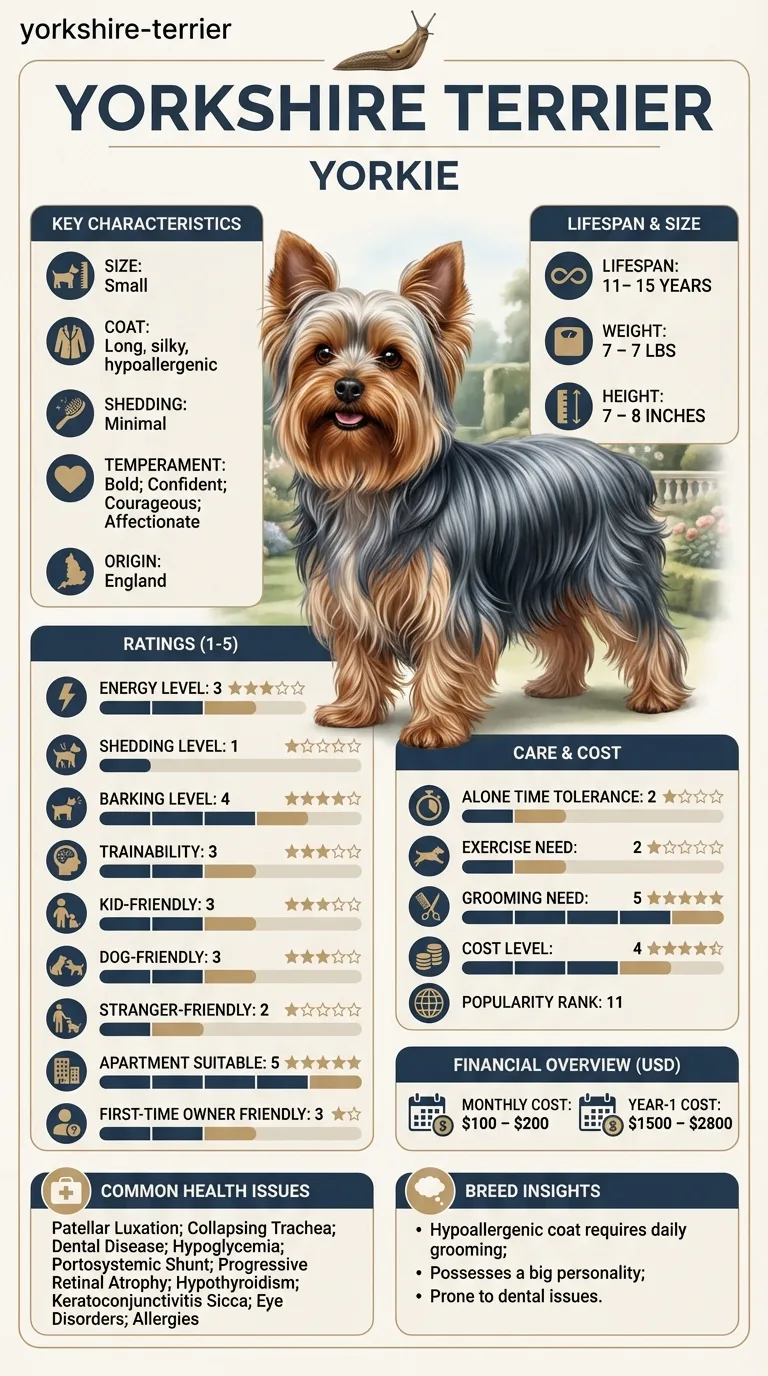
Cocker Spaniel or Yorkshire Terrier? On paper they differ most on shedding, and on the scales Cocker Spaniel is the heavier at 20–30 lbs. Here is how the two compare on everything that shapes an ordinary week.
This is for someone already down to Cocker Spaniel and Yorkshire Terrier and deciding between them. For this pair the decision usually turns on shedding and good with kids, so those are covered first and in most detail. Anyone choosing from a flat has a clear answer here: Yorkshire Terrier rates 5/5 against 4/5. There is no origin story here — only what changes about your week.
Quick verdict
Between Cocker Spaniel and Yorkshire Terrier, shedding is what separates them, and Yorkshire Terrier is the lower-effort dog of the two to keep.
Choose cocker spaniel if...
Choose Cocker Spaniel if this is your first dog, there are young children at home and you already have another dog.
Choose yorkshire terrier if...
Choose Yorkshire Terrier if you are in a flat or a smaller home, shedding is a problem in your house and your walking routine is modest.
Head-to-head comparison
Feature
cocker spaniel
yorkshire terrier
Winner
Size class
small
small
Equal
Weight
20–30 lbs
4–7 lbs
Equal
Height
13–16 in
7–8 in
Equal
Lifespan
10–14 years
11–15 years
yorkshire terrier
Exercise need
Moderate (3/5)
Low (2/5)
yorkshire terrier
Grooming need
Very high (5/5)
Very high (5/5)
Equal
Shedding
Moderate (3/5)
Very low (1/5)
yorkshire terrier
Energy level
Moderate (3/5)
Moderate (3/5)
Equal
Barking
Moderate (3/5)
High (4/5)
cocker spaniel
Apartment suitability
High (4/5)
Very high (5/5)
yorkshire terrier
Good for first-time owners
High (4/5)
Moderate (3/5)
cocker spaniel
Tolerates being alone
Low (2/5)
Low (2/5)
Equal
Trainability
High (4/5)
Moderate (3/5)
cocker spaniel
Good with kids
Very high (5/5)
Moderate (3/5)
cocker spaniel
Good with other dogs
High (4/5)
Moderate (3/5)
cocker spaniel
Friendly to strangers
High (4/5)
Low (2/5)
cocker spaniel
Cost level
Moderate (3/5)
High (4/5)
cocker spaniel
Coat
Silky and feathered
Long, silky, hypoallergenic
Equal
Origin
Various
England
Equal
Typical monthly cost
$80–$150
$100–$190
Equal
Typical first-year cost
$1,100–$2,300
$1,400–$2,900
Equal
Deep dive
Size and build
Both breeds get filed under "small," but the numbers tell two different stories. A Cocker Spaniel runs 20-30 lbs and stands 13-16 inches, closer to a compact sporting dog than a lapdog. A Yorkshire Terrier tops out around 7 lbs and 8 inches -- you could carry two Yorkies in the space one Cocker takes up. If you want a dog you can tuck into a bag for the vet, the Yorkie wins outright; if you want something sturdier for rougher play, the Cocker's build handles it better.
Energy and exercise
The Cocker Spaniel carries a moderate 3/5 exercise need, while the Yorkshire Terrier sits lower at 2/5. Both register the same 3/5 energy level day to day, so the gap shows up in how much structured walking or play each dog actually requires rather than how peppy they act indoors. A Cocker still wants a real daily walk; a Yorkie is satisfied with shorter outings and some living-room zoomies.
Grooming and shedding
Grooming is a wash here -- both breeds rate 5/5, the highest tier, and neither coat looks after itself. Where they split is shedding: the Cocker sheds at a moderate 3/5, while the Yorkshire Terrier's coat is a very low 1/5 and often marketed as hypoallergenic. So you're committing to regular brushing and professional trims either way, but only the Yorkie spares you the vacuum runs.
Apartment living, noise and time alone
The Yorkshire Terrier scores a full 5/5 for apartment suitability against the Cocker's still-respectable 4/5, and its lower exercise needs back that up. The catch is noise: Yorkies bark at a 4/5 clip, a notch above the Cocker's 3/5, which matters more in a building with shared walls. Neither breed handles solitude well -- both land at a low 2/5 for tolerating time alone, so an apartment plan for either needs a real answer for the workday, not just the square footage.
Training and owner experience
The Cocker Spaniel is the easier study, rated 4/5 for trainability and 4/5 for first-time owners. The Yorkshire Terrier trails at 3/5 on both counts -- not difficult, exactly, but more independent-minded and slower to take direction than its size suggests. A first-time owner set on consistent training sessions will likely get there faster with the Cocker.
Kids, other dogs and visitors
This is where the two breeds separate the most. The Cocker Spaniel rates 5/5 with kids, 4/5 with other dogs, and 4/5 with strangers -- a genuinely social, easygoing profile. The Yorkshire Terrier sits at 3/5 across kids, other dogs, and strangers, and its confident, bold temperament, versus the Cocker's gentle, merry streak, can read as feisty around toddlers or unfamiliar dogs. A house with young kids and regular visitors leans Cocker.
Health and lifespan
The Yorkshire Terrier lives longer on average -- 11 to 15 years against the Cocker's 10 to 14 -- but carries a longer list of documented conditions, including collapsing trachea, hypoglycemia, and portosystemic shunt on top of shared risk like Progressive Retinal Atrophy. The Cocker's five flagged conditions include ear infections, cataracts, and hip dysplasia. More years doesn't necessarily mean an easier medical history for the Yorkie.
Cost to keep
Monthly costs run close -- $80-150 for the Cocker versus $100-190 for the Yorkie -- but the Cocker earns the better overall cost rating, 3/5 versus 4/5, and a lower first-year range: $1,100-2,300 against $1,400-2,900. Part of that gap traces back to the Yorkie's longer health list, which tends to mean more diagnostic visits over a lifetime, plus the premium many groomers charge for fine, silky small-breed coats. Budget the difference toward the Yorkie's vet visits and professional trims; the Cocker's larger food bill closes some of the distance but not all of it.
Cocker Spaniel vs Yorkshire Terrier at a glance
Cocker Spaniel weighs 20–30 lbs and lives 10–14 years; Yorkshire Terrier weighs 4–7 lbs and lives 11–15 years. The two diverge most on shedding, good with kids and friendly to strangers. They are level on tolerates being alone, energy level and grooming need, so those cannot decide it. Where the table declares a winner it means less work for the owner, nothing more; descriptive rows are left as ties on purpose. The value here is in the differences between the two columns; treat any single score as approximate.
Cocker Spaniel vs Yorkshire Terrier: Which Suits Your Home? - Cocker Spaniel vs Yorkshire Terrier at a glance
Frequently asked questions
Which is bigger, the Cocker Spaniel or the Yorkshire Terrier?
The Cocker Spaniel, by a wide margin. It weighs 20-30 lbs versus the Yorkie's 4-7 lbs, even though both are officially classed as small dogs.
Does the Yorkshire Terrier shed less than the Cocker Spaniel?
Yes. The Yorkie rates a very low 1/5 for shedding compared to the Cocker's moderate 3/5, though both need the same 5/5 level of grooming commitment to keep their coats in shape.
Is either breed a good fit for a first-time owner?
The Cocker Spaniel edges it out at 4/5 versus the Yorkie's 3/5, largely because it's rated higher for trainability too. Neither is a hard breed to raise, but the Cocker responds more predictably to consistent training.
Which is better for an apartment?
The Yorkshire Terrier, at 5/5 apartment suitability against the Cocker's 4/5, mainly on lower exercise needs. Its higher barking score, 4/5 versus 3/5, is worth weighing if you share walls.
How much should I budget monthly?
Plan on $80-150 for a Cocker Spaniel and $100-190 for a Yorkshire Terrier, with the Cocker also cheaper over the first year: $1,100-2,300 versus $1,400-2,900.
Do the two breeds share any health risks?
Both lists include Progressive Retinal Atrophy. Beyond that they diverge -- the Cocker's risks lean toward ears, eyes and hips, while the Yorkshire Terrier's longer list adds tracheal, liver and dental concerns.
Which is friendlier with kids and strangers?
The Cocker Spaniel, clearly. It scores 5/5 with kids and 4/5 with strangers, against the Yorkie's 3/5 and 2/5. That gap tracks with the breeds' temperaments -- merry and eager to please versus bold and confident.
Cocker Spaniel or Yorkshire Terrier -- which is the better all-around choice?
If you have kids or frequent guests, the Cocker Spaniel's higher marks for friendliness and trainability make it the safer pick. For the smallest footprint and lowest shedding, go Yorkshire Terrier.
Costs
How much more does one cost per month?
Budget $80-150 for a Cocker Spaniel and $100-190 for a Yorkshire Terrier -- a modest gap that widens slightly over the first year.
Behavior
Which needs more exercise?
The Cocker Spaniel, rated moderate (3/5) versus the Yorkie's low (2/5). Both share the same 3/5 energy level indoors.
Health
Which breed lives longer?
The Yorkshire Terrier, at 11-15 years versus the Cocker Spaniel's 10-14 years, though it carries more documented health conditions.
Related DogBreedCompass guides
Cocker Spaniel breed guide – Readers comparing the two usually want the full profile of Cocker Spaniel before deciding.
Yorkshire Terrier breed guide – The same for Yorkshire Terrier, so the comparison can be checked against the detail.
Cocker Spaniel vs English Cocker Spaniel – English Cocker Spaniel is the closest breed to Cocker Spaniel on the measured axes, so it is the natural next comparison.
Health information here is general and is not veterinary advice. If your dog shows pain, sudden behaviour change, or worsening symptoms, consult a licensed veterinarian.
Some links on this site are affiliate links. We may earn a commission at no extra cost to you, and we only suggest products we believe are helpful for dog owners.
We research and check what we publish, but we do not warrant that any figure, date, price, or statement is accurate, complete, or current, and we accept no liability for any loss, cost, injury, or other harm arising from the use of this site. Use it as one reference among several. You remain responsible for your own decisions and for your dog's care - confirm anything that matters with a licensed veterinarian or another qualified professional before you act on it. Full disclaimer.