Great Dane vs Yorkshire Terrier: Which Suits Your Home?
Quick answer
Great Dane or Yorkshire Terrier?
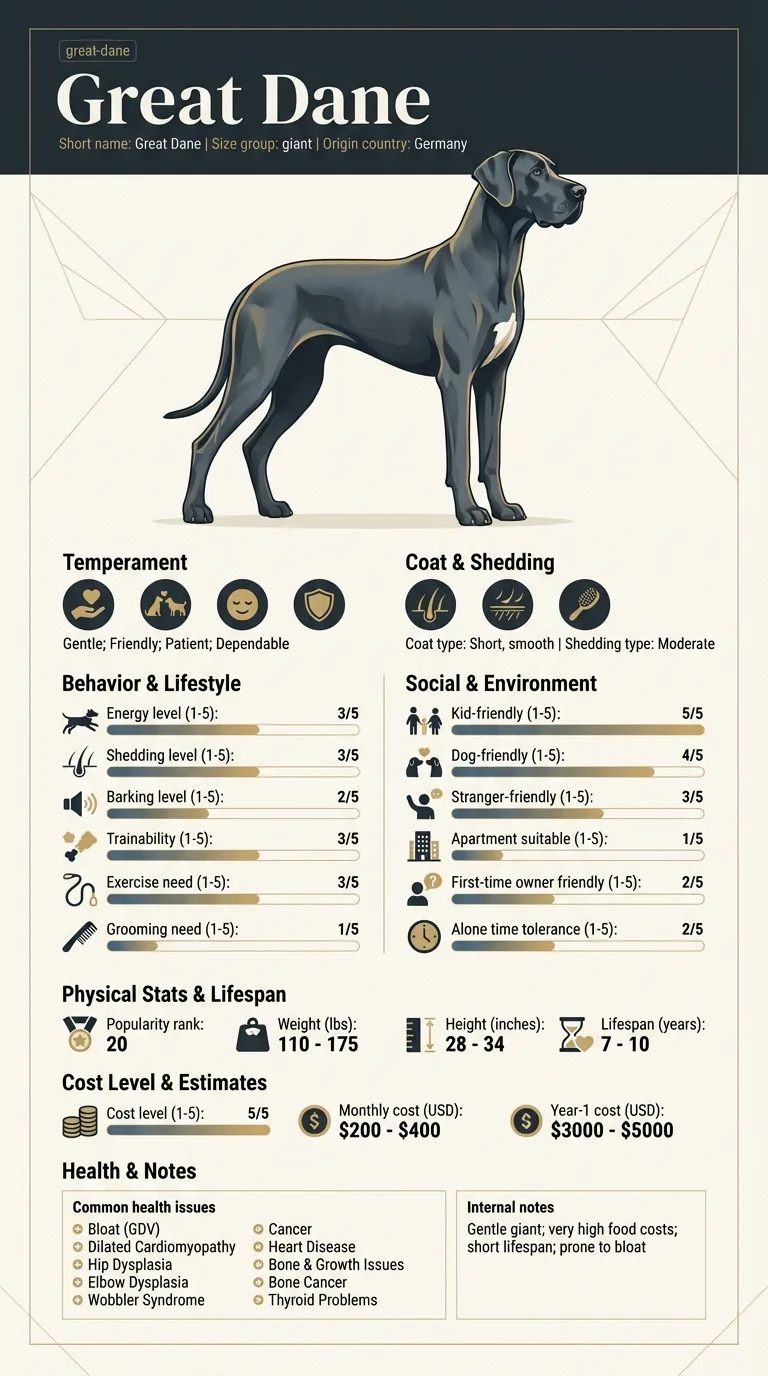
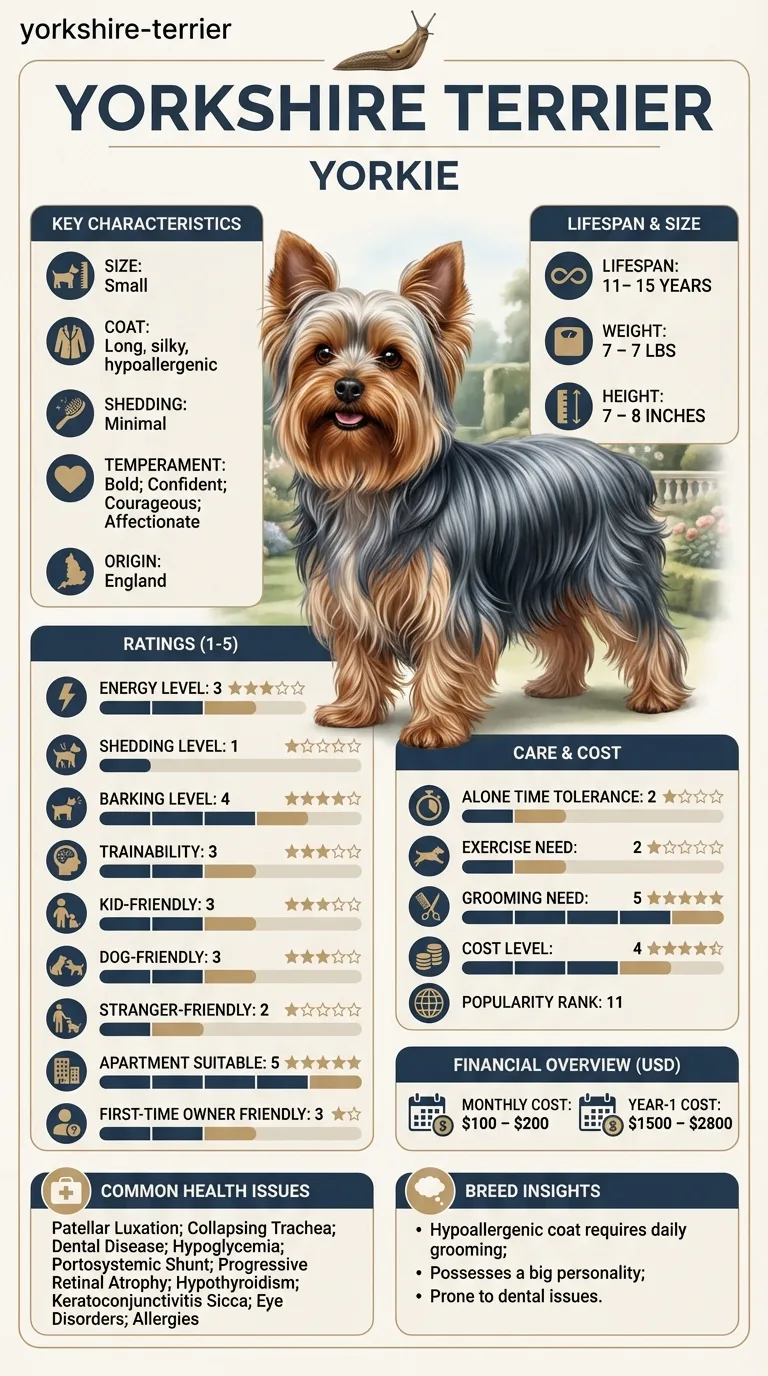
This is really a choice between two different kinds of dog ownership -- the Dane for space and presence, the Yorkie for portability and apartment life -- the size gap (110-175 lbs vs 4-7 lbs) is the whole decision.
Great Dane or Yorkshire Terrier? On paper they differ most on grooming need, and on the scales Great Dane is the heavier at 110–175 lbs. Here is how the two compare on everything that shapes an ordinary week.
This is for someone already down to Great Dane and Yorkshire Terrier and deciding between them. For this pair the decision usually turns on grooming need and apartment suitability, so those are covered first and in most detail. Anyone choosing from a flat has a clear answer here: Yorkshire Terrier rates 5/5 against 1/5. The focus throughout is on daily consequences rather than breed background.
Quick verdict
Between Great Dane and Yorkshire Terrier, grooming need is what separates them, and Yorkshire Terrier is the lower-effort dog of the two to keep.
Choose great dane if...
Choose Great Dane if you do not want a standing grooming appointment, there are young children at home and you already have another dog.
Choose yorkshire terrier if...
Choose Yorkshire Terrier if you are in a flat or a smaller home, this is your first dog and shedding is a problem in your house.
Head-to-head comparison
Feature
great dane
yorkshire terrier
Winner
Size class
giant
small
Equal
Weight
110–175 lbs
4–7 lbs
Equal
Height
28–34 in
7–8 in
Equal
Lifespan
7–10 years
11–15 years
yorkshire terrier
Exercise need
Moderate (3/5)
Low (2/5)
yorkshire terrier
Grooming need
Very low (1/5)
Very high (5/5)
great dane
Shedding
Moderate (3/5)
Very low (1/5)
yorkshire terrier
Energy level
Moderate (3/5)
Moderate (3/5)
Equal
Barking
Low (2/5)
High (4/5)
great dane
Apartment suitability
Very low (1/5)
Very high (5/5)
yorkshire terrier
Good for first-time owners
Low (2/5)
Moderate (3/5)
yorkshire terrier
Tolerates being alone
Low (2/5)
Low (2/5)
Equal
Trainability
Moderate (3/5)
Moderate (3/5)
Equal
Good with kids
Very high (5/5)
Moderate (3/5)
great dane
Good with other dogs
High (4/5)
Moderate (3/5)
great dane
Friendly to strangers
Moderate (3/5)
Low (2/5)
great dane
Cost level
Very high (5/5)
High (4/5)
yorkshire terrier
Coat
Short, smooth
Long, silky, hypoallergenic
Equal
Origin
Germany
England
Equal
Typical monthly cost
$200–$400
$100–$190
Equal
Typical first-year cost
$3,000–$5,000
$1,400–$2,900
Equal
Deep dive
Size and build
The numbers here are almost absurd next to each other: a Great Dane can weigh up to 175 lbs, a Yorkshire Terrier as little as 4. That's roughly 25 times the weight at the extremes, and a height difference of over two feet (28-34 inches versus 7-8 inches). Few breed comparisons on this site involve two dogs this far apart on the scale.
Energy and exercise
Energy level is actually tied at moderate (3/5) for both breeds, which surprises people expecting a tiny dog to be a bundle of nerves. Exercise need tips slightly toward the Dane, moderate (3/5) against the Yorkie's low (2/5) -- the Yorkie is content with shorter, lower-effort activity despite carrying comparable energy.
Grooming and shedding
This is close to the widest grooming gap on the site: very low (1/5) for the Dane's wash-and-go coat against very high (5/5) for the Yorkie's long, silky one, which needs regular brushing or a shorter maintenance clip to stay manageable. Shedding runs the opposite way in volume -- moderate (3/5) for the Dane, very low (1/5) for the Yorkie, whose coat is often marketed as hypoallergenic.
Apartment living, noise and time alone
The Yorkie rates very high (5/5) for apartment suitability against the Dane's very low (1/5) -- an easy call given the size difference alone. Barking runs higher for the Yorkie though, high (4/5) against the Dane's low (2/5), which matters more than size in buildings with thin walls. Alone tolerance ties at low (2/5) for both, so a small footprint doesn't buy you a dog that's fine home alone all day.
Training and owner experience
Trainability ties at moderate (3/5) for both breeds, but first-time-owner suitability favors the Yorkie, moderate (3/5) against the Dane's low (2/5) -- mostly because the physical consequences of an untrained Yorkie are far smaller than those of an untrained 150-lb dog. Neither breed trains itself; both need consistent early work.
Kids, other dogs and visitors
The Dane pulls ahead here across the board: very high (5/5) with kids against the Yorkie's moderate (3/5), high (4/5) with other dogs against moderate (3/5), and moderate (3/5) with strangers against the Yorkie's low (2/5). Small-dog fragility plays into the kids number specifically -- a Yorkie can be injured by rough handling in a way a Dane simply can't.
Health and lifespan
The Yorkie's 11 to 15 year lifespan runs well past the Dane's 7 to 10. Thyroid problems are the clearest overlap between the two lists; otherwise they diverge completely, with the Dane's risks (bloat, wobbler syndrome, bone cancer) tied to giant-breed structure and the Yorkie's (collapsing trachea, patellar luxation, portosystemic shunt) tied to its small, delicate frame.
Cost to keep
The Dane costs far more to feed and treat: $200-400 monthly and $3,000-5,000 in year one, cost level very high (5/5). The Yorkie runs $100-190 monthly and $1,400-2,900 for its first year, cost level high (4/5) -- lower than the Dane's but still not a cheap small dog, largely due to grooming and dental care.
Great Dane vs Yorkshire Terrier at a glance
Great Dane weighs 110–175 lbs and lives 7–10 years; Yorkshire Terrier weighs 4–7 lbs and lives 11–15 years. The two diverge most on grooming need, apartment suitability and shedding and 2 other rated axes. They are level on tolerates being alone, energy level and trainability, so those cannot decide it. The table below marks a winner only where one breed is genuinely easier for a typical owner; size and origin are facts rather than merits and stay level. Ratings come from one source applied to both breeds, so they are meaningful against each other rather than as absolute scores.
Great Dane vs Yorkshire Terrier: Which Suits Your Home? - Great Dane vs Yorkshire Terrier at a glance
Frequently asked questions
How much bigger is a Great Dane than a Yorkshire Terrier?
Enormously -- the Dane weighs 110 to 175 lbs, the Yorkie just 4 to 7 lbs. That's roughly a 25-to-1 ratio at the extremes, one of the largest size gaps between any two breeds compared on this site.
Which breed sheds more?
Neither much, but the Dane sheds more in volume, moderate (3/5) against the Yorkie's very low (1/5). The Yorkie's coat, however, needs far more active grooming -- very high (5/5) versus the Dane's very low (1/5) -- to prevent matting.
Which is the better apartment dog?
The Yorkie, easily -- very high (5/5) apartment suitability against the Dane's very low (1/5). Just be aware it also barks more, rated high (4/5) against the Dane's low (2/5), which matters in close quarters.
Is either breed better for a first-time owner?
The Yorkie edges it, moderate (3/5) against the Dane's low (2/5), mainly because mistakes are lower-stakes with a 5-lb dog than a 150-lb one. Trainability itself is tied at moderate (3/5) for both.
What's the cost difference?
The Dane runs $200-400 monthly and $3,000-5,000 in year one. The Yorkie runs $100-190 monthly and $1,400-2,900 in year one -- notably less, though the Yorkie's grooming and dental costs add up more than its size suggests.
Do the Great Dane and Yorkie share health risks?
Barely -- thyroid problems is the main overlap. Otherwise their risks split along size lines: the Dane faces bloat, wobbler syndrome and bone cancer, while the Yorkie faces collapsing trachea, patellar luxation and portosystemic shunt, all more common in small, delicate breeds.
Which lives longer?
The Yorkie, at 11 to 15 years against the Dane's 7 to 10.
This is really a choice between two different kinds of dog ownership -- the Dane for space and presence, the Yorkie for portability and apartment life -- the size gap (110-175 lbs vs 4-7 lbs) is the whole decision.
Costs
Monthly cost comparison?
Dane: $200-400. Yorkie: $100-190 -- less, but the Yorkie's grooming and dental upkeep narrow the gap.
Training
Which needs more exercise?
The Dane, moderate (3/5) against the Yorkie's low (2/5), though both are tied on actual energy level (3/5).
Health
Which lives longer?
The Yorkie, 11-15 years versus the Dane's 7-10.
Related DogBreedCompass guides
Great Dane breed guide – Readers comparing the two usually want the full profile of Great Dane before deciding.
Yorkshire Terrier breed guide – The same for Yorkshire Terrier, so the comparison can be checked against the detail.
Great Dane vs Saint Bernard – Saint Bernard is the closest breed to Great Dane on the measured axes, so it is the natural next comparison.
Health information here is general and is not veterinary advice. If your dog shows pain, sudden behaviour change, or worsening symptoms, consult a licensed veterinarian.
Some links on this site are affiliate links. We may earn a commission at no extra cost to you, and we only suggest products we believe are helpful for dog owners.
We research and check what we publish, but we do not warrant that any figure, date, price, or statement is accurate, complete, or current, and we accept no liability for any loss, cost, injury, or other harm arising from the use of this site. Use it as one reference among several. You remain responsible for your own decisions and for your dog's care - confirm anything that matters with a licensed veterinarian or another qualified professional before you act on it. Full disclaimer.