Living
Which one should I get?
With a yard and time for real exercise, the Jack Russell's energy and 13-16 year lifespan reward the effort. In an apartment, the Yorkie's 5/5 apartment score fits better, as long as you budget for grooming.

Quick answer
Which one should I get?
With a yard and time for real exercise, the Jack Russell's energy and 13-16 year lifespan reward the effort. In an apartment, the Yorkie's 5/5 apartment score fits better, as long as you budget for grooming.
Jack Russell Terrier or Yorkshire Terrier? On paper they differ most on exercise need, and on the scales Jack Russell Terrier is the heavier at 13–17 lbs. Here is how the two compare on everything that shapes an ordinary week.
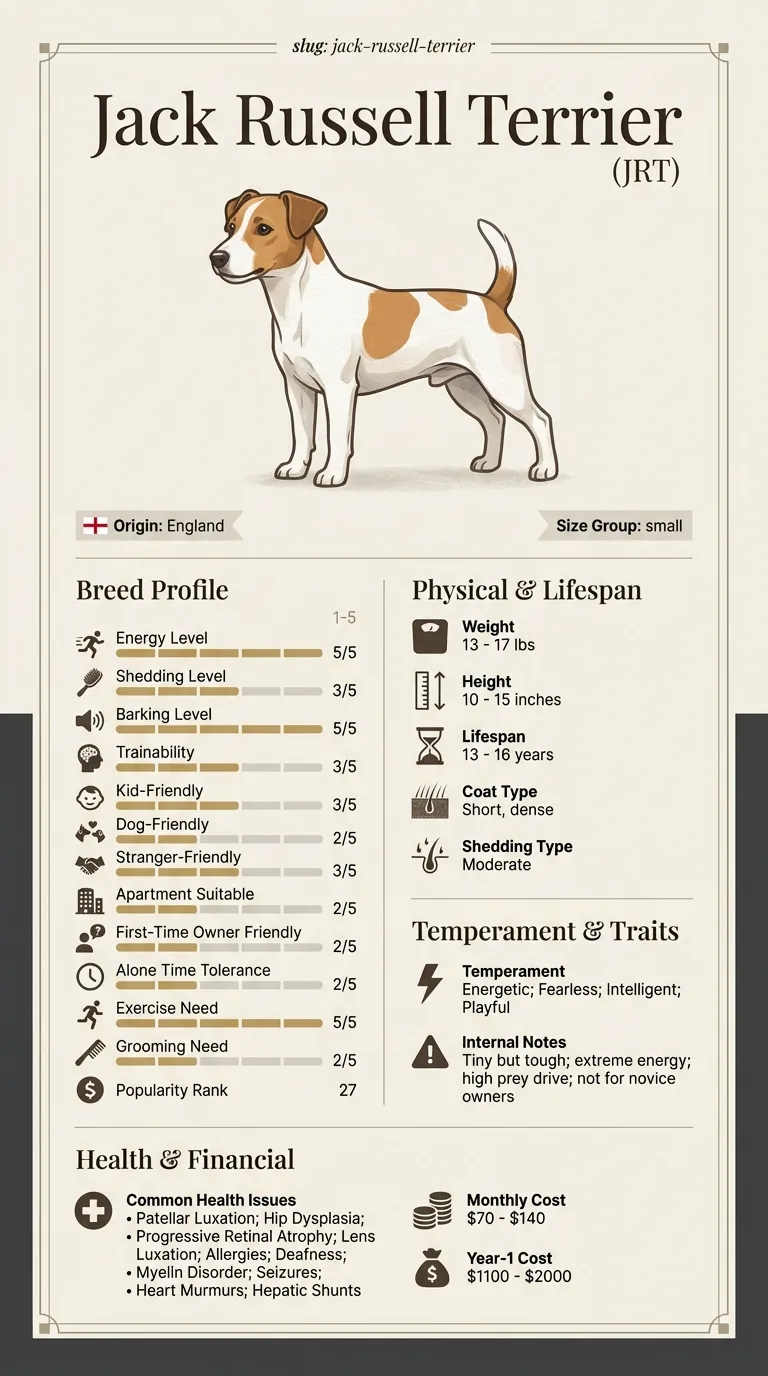
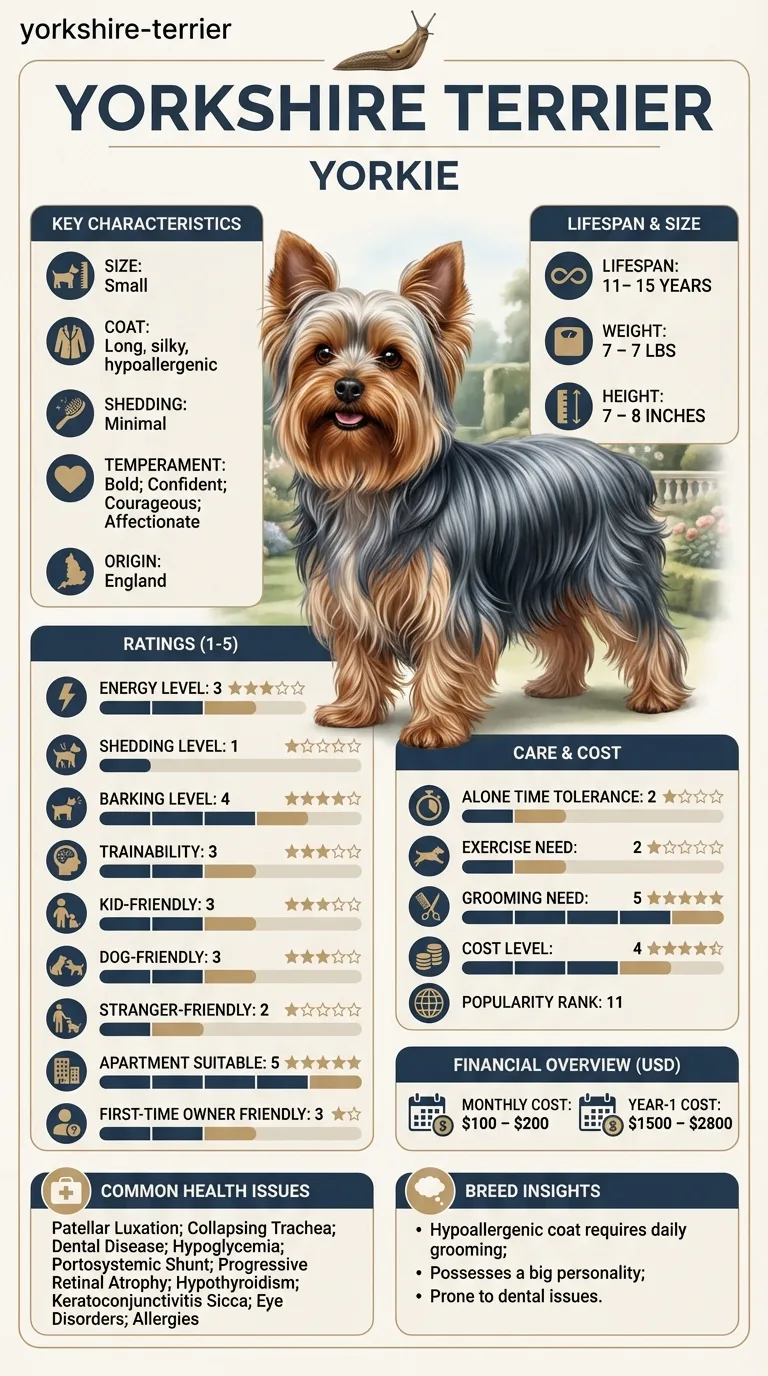
This is for someone already down to Jack Russell Terrier and Yorkshire Terrier and deciding between them. For this pair the decision usually turns on exercise need and grooming need, so those are covered first and in most detail. Anyone choosing from a flat has a clear answer here: Yorkshire Terrier rates 5/5 against 2/5. There is no origin story here — only what changes about your week.
Between Jack Russell Terrier and Yorkshire Terrier, exercise need is what separates them, and Yorkshire Terrier is the lower-effort dog of the two to keep.
Choose Jack Russell Terrier if you do not want a standing grooming appointment and you want a dog that can keep up with an active routine.
Choose Yorkshire Terrier if you are in a flat or a smaller home, this is your first dog and shedding is a problem in your house.
| Feature | jack russell terrier | yorkshire terrier | Winner |
|---|---|---|---|
| Size class | small | small | Equal |
| Weight | 13–17 lbs | 4–7 lbs | Equal |
| Height | 10–15 in | 7–8 in | Equal |
| Lifespan | 13–16 years | 11–15 years | jack russell terrier |
| Exercise need | Very high (5/5) | Low (2/5) | yorkshire terrier |
| Grooming need | Low (2/5) | Very high (5/5) | jack russell terrier |
| Shedding | Moderate (3/5) | Very low (1/5) | yorkshire terrier |
| Energy level | Very high (5/5) | Moderate (3/5) | Equal |
| Barking | Very high (5/5) | High (4/5) | yorkshire terrier |
| Apartment suitability | Low (2/5) | Very high (5/5) | yorkshire terrier |
| Good for first-time owners | Low (2/5) | Moderate (3/5) | yorkshire terrier |
| Tolerates being alone | Low (2/5) | Low (2/5) | Equal |
| Trainability | Moderate (3/5) | Moderate (3/5) | Equal |
| Good with kids | Moderate (3/5) | Moderate (3/5) | Equal |
| Good with other dogs | Low (2/5) | Moderate (3/5) | yorkshire terrier |
| Friendly to strangers | Moderate (3/5) | Low (2/5) | jack russell terrier |
| Cost level | Low (2/5) | High (4/5) | jack russell terrier |
| Coat | Short, dense | Long, silky, hypoallergenic | Equal |
| Origin | England | England | Equal |
| Typical monthly cost | $70–$140 | $100–$190 | Equal |
| Typical first-year cost | $1,100–$2,000 | $1,400–$2,900 | Equal |
"Small" hides a lot of variation here. A Jack Russell runs 13-17 lbs and stands 10-15 inches at the shoulder, built like a compact little athlete. A Yorkie tops out around 7 lbs and 7-8 inches, closer to a housecat in scale. That's nearly triple the mass on the Jack Russell's side of the table. Pick a Yorkie up wrong and you risk an injury; the JRT can take a lot more physical handling.
This is the real fork in the road for this pairing. The Jack Russell rates 5/5 on exercise need, a working terrier bred to chase vermin and still wired that way. The Yorkie sits at 2/5, happy with a short walk and some living-room zoomies. Give a Jack Russell a Yorkie's routine and you'll get a dog that takes its boredom out on your furniture.
The coats flip the script on what the sizes suggest. Yorkie grooming rates 5/5, very high, because that long silky coat mats fast and needs regular trims or tying up; shedding itself is minimal at 1/5. The Jack Russell is nearly the opposite: 2/5 grooming, wash-and-go short fur, but 3/5 shedding, moderate hair on the furniture instead of a coat that needs daily attention.
Barking runs high on both dogs, 5/5 for the Jack Russell and 4/5 for the Yorkie, so don't expect a quiet neighbor from either. Apartment suitability is where they split: JRT at 2/5, Yorkie at 5/5. A Jack Russell without room to burn energy tends to dig, bark, and look for a way out. Both breeds score just 2/5 on tolerating time alone, so long solo days are a problem regardless of square footage.
Trainability comes out tied at 3/5 for both breeds, but "good for first-time owners" splits them: JRT at 2/5, Yorkie at 3/5. The Jack Russell is plenty smart, but its terrier instincts for digging and chasing take a more experienced hand to redirect, even once the dog has learned the basics. A new owner set on the JRT should plan on structured exercise and consistent early socialization rather than assuming intelligence alone will keep those instincts in check.
Kids scores are identical, 3/5 moderate for both, so supervise either breed around small children. The split shows up elsewhere: the JRT scores lower with other dogs, 2/5 against the Yorkie's 3/5, reflecting its prey-driven streak, while it actually edges the Yorkie on friendliness to strangers, 3/5 versus 2/5. Neither is the instant-friend-to-everyone type, but if your household regularly hosts other dogs, that gap in comfort around them is worth weighing more heavily than the stranger score.
The Jack Russell's 13-16 year lifespan beats the Yorkie's 11-15. Both breeds share patellar luxation, progressive retinal atrophy, and allergies on their health lists. Past that they diverge: the JRT's risks lean toward hip dysplasia, deafness, and seizures, while the Yorkie's lean toward collapsing trachea and portosystemic shunt, conditions tied to its very small frame. Either list is worth walking through with a breeder before you put down a deposit.
Cost level rates the Jack Russell at 2/5, low, against the Yorkie's 4/5, high, and the dollar figures back it up: $70-140 a month for the JRT versus $100-190 for the Yorkie, and roughly $1,100-2,000 in year one against $1,400-2,900. Grooming bills are the biggest driver of that gap, since the Yorkie's coat needs a groomer's attention the Jack Russell's never will.
Jack Russell Terrier weighs 13–17 lbs and lives 13–16 years; Yorkshire Terrier weighs 4–7 lbs and lives 11–15 years. The two diverge most on exercise need, grooming need and apartment suitability and 3 other rated axes. They are level on tolerates being alone, good with kids and trainability, so those cannot decide it. Where the table declares a winner it means less work for the owner, nothing more; descriptive rows are left as ties on purpose. The value here is in the differences between the two columns; treat any single score as approximate.

The Jack Russell, by a wide margin. It weighs 13-17 lbs and stands 10-15 inches, while the Yorkie weighs just 4-7 lbs and stands 7-8 inches. Both count as small breeds, but the JRT can be two to three times the Yorkie's mass.
The Jack Russell sheds moderately, 3/5, while the Yorkie barely sheds at all, 1/5, thanks to its hair-like coat. The tradeoff is grooming time; the Yorkie needs far more brushing and trimming to keep that coat from matting.
The Yorkie edges it out at 3/5 moderate versus the Jack Russell's 2/5. The JRT's terrier drive for digging, chasing, and escaping asks more of a new owner than the Yorkie's lapdog temperament does.
The Yorkie, clearly, with a 5/5 apartment score against the JRT's 2/5. The Jack Russell's very high exercise need doesn't pair well with small living spaces unless you're committed to multiple long outings a day.
Plan on $70-140 a month for a Jack Russell and $100-190 for a Yorkie, with the difference mostly coming from grooming. First-year costs run $1,100-2,000 for the JRT and $1,400-2,900 for the Yorkie once setup costs are included.
Yes. Both appear on lists for patellar luxation, progressive retinal atrophy, and allergies. Past that, the Jack Russell's risks skew toward hip dysplasia and neurological issues, while the Yorkie's skew toward tracheal and liver conditions tied to its small size.
Both bark a lot, the JRT at 5/5 and the Yorkie at 4/5, so a quiet dog isn't on offer from either. Expect vocal alerting behavior from both, especially the Jack Russell.
With a yard and time for real exercise, the Jack Russell's energy and 13-16 year lifespan reward the effort. In an apartment, the Yorkie's 5/5 apartment score fits better, as long as you budget for grooming.
Roughly $70-140 for a Jack Russell versus $100-190 for a Yorkie, with the Yorkie's coat care accounting for most of the gap.
The Jack Russell rates 5/5, very high, and needs vigorous daily activity. The Yorkie rates 2/5, low, and is satisfied with short walks and indoor play.
The Jack Russell typically, at 13-16 years against the Yorkie's 11-15. Both are long-lived for dogs generally, but the JRT has the edge.
Secure checkout on Stripe. We never see your card.
7-day money-back guarantee. Instant access.
Health information here is general and is not veterinary advice. If your dog shows pain, sudden behaviour change, or worsening symptoms, consult a licensed veterinarian.
Some links on this site are affiliate links. We may earn a commission at no extra cost to you, and we only suggest products we believe are helpful for dog owners.
We research and check what we publish, but we do not warrant that any figure, date, price, or statement is accurate, complete, or current, and we accept no liability for any loss, cost, injury, or other harm arising from the use of this site. Use it as one reference among several. You remain responsible for your own decisions and for your dog's care - confirm anything that matters with a licensed veterinarian or another qualified professional before you act on it. Full disclaimer.
Match your lifestyle to the right dog.
Take quizNot sure which breed is right for you? Take our 2-minute quiz to find out.
Take the quiz