Living
Which is the better overall pick?
The Shiba fits quieter, smaller living situations better, while the Jack Russell is marginally more trainable if you can handle the barking and higher exercise demand.

Quick answer
Which is the better overall pick?
The Shiba fits quieter, smaller living situations better, while the Jack Russell is marginally more trainable if you can handle the barking and higher exercise demand.
Jack Russell Terrier or Shiba Inu? On paper they differ most on exercise need, and on the scales Shiba Inu is the heavier at 17–23 lbs. Here is how the two compare on everything that shapes an ordinary week.
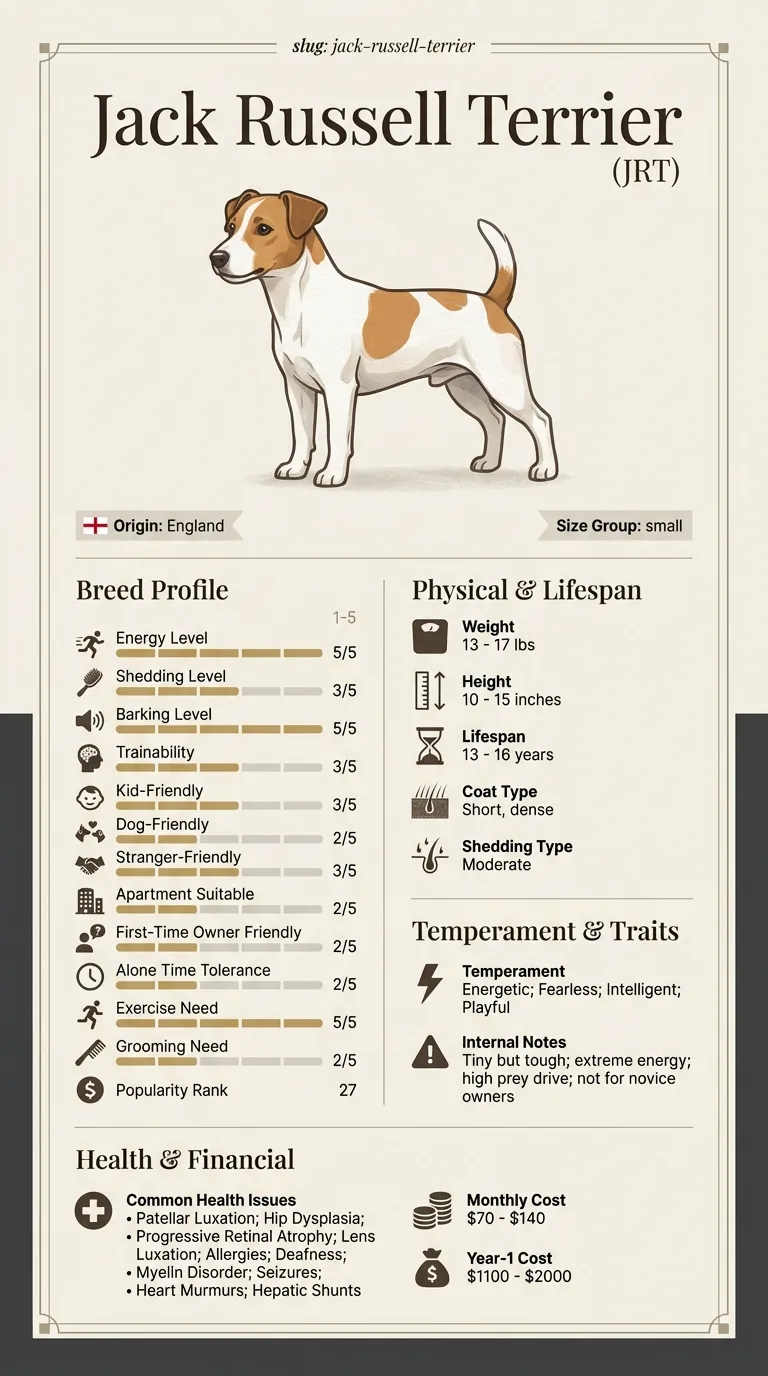
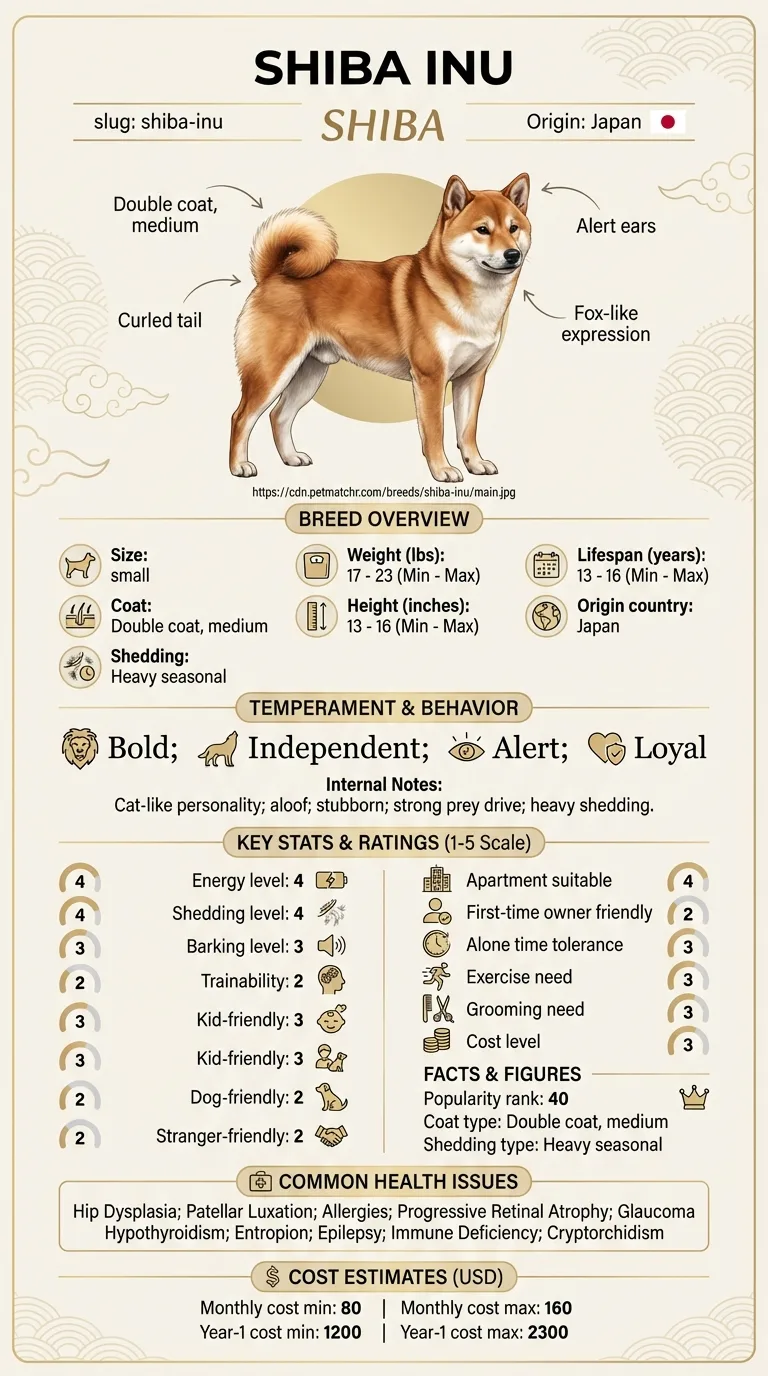
This is for someone already down to Jack Russell Terrier and Shiba Inu and deciding between them. For this pair the decision usually turns on exercise need and apartment suitability, so those are covered first and in most detail. Anyone choosing from a flat has a clear answer here: Shiba Inu rates 4/5 against 2/5. The focus throughout is on daily consequences rather than breed background.
Between Jack Russell Terrier and Shiba Inu, exercise need is what separates them, and Shiba Inu is the lower-effort dog of the two to keep.
Choose Jack Russell Terrier if you do not want a standing grooming appointment, shedding is a problem in your house and you want a dog that picks up training quickly.
Choose Shiba Inu if you are in a flat or a smaller home, your walking routine is modest and the dog will be alone during the working day.
| Feature | jack russell terrier | shiba inu | Winner |
|---|---|---|---|
| Size class | small | small | Equal |
| Weight | 13–17 lbs | 17–23 lbs | Equal |
| Height | 10–15 in | 13–16 in | Equal |
| Lifespan | 13–16 years | 13–16 years | Equal |
| Exercise need | Very high (5/5) | Moderate (3/5) | shiba inu |
| Grooming need | Low (2/5) | Moderate (3/5) | jack russell terrier |
| Shedding | Moderate (3/5) | High (4/5) | jack russell terrier |
| Energy level | Very high (5/5) | High (4/5) | Equal |
| Barking | Very high (5/5) | Moderate (3/5) | shiba inu |
| Apartment suitability | Low (2/5) | High (4/5) | shiba inu |
| Good for first-time owners | Low (2/5) | Low (2/5) | Equal |
| Tolerates being alone | Low (2/5) | Moderate (3/5) | shiba inu |
| Trainability | Moderate (3/5) | Low (2/5) | jack russell terrier |
| Good with kids | Moderate (3/5) | Moderate (3/5) | Equal |
| Good with other dogs | Low (2/5) | Low (2/5) | Equal |
| Friendly to strangers | Moderate (3/5) | Low (2/5) | jack russell terrier |
| Cost level | Low (2/5) | Moderate (3/5) | jack russell terrier |
| Coat | Short, dense | Double coat, medium | Equal |
| Origin | England | Japan | Equal |
| Typical monthly cost | $70–$140 | $80–$160 | Equal |
| Typical first-year cost | $1,100–$2,000 | $1,200–$2,300 | Equal |
These two land close in size — the Jack Russell at 13 to 17 pounds and 10 to 15 inches, the Shiba Inu slightly larger at 17 to 23 pounds and 13 to 16 inches. Neither will dominate a room by sheer bulk; the difference here is more about build and coat than weight class. Either dog will fit comfortably into a modest-sized car crate or carrier.
The Jack Russell is the more demanding of the two, rating a full 5/5 on exercise need against the Shiba's moderate 3/5. Shiba Inus are known for a cat-like independence that includes deciding for themselves when they've had enough exercise, while the terrier tends to keep pushing until you stop it. A couple of brisk walks usually cover a Shiba; a Jack Russell will keep angling for more no matter how much you've already given it.
The Jack Russell is the lower-maintenance coat, at 2/5 grooming need versus the Shiba's 3/5, but the Shiba sheds more — 4/5 against the terrier's 3/5. Shiba Inus are famous for seasonal "blowouts" where the undercoat comes out in clumps, which the moderate shedding rating understates a bit for those weeks. Outside of those blowout weeks, though, both breeds are fairly manageable with a weekly brush.
The Shiba Inu is the better apartment prospect, rating 4/5 on apartment suitability against the terrier's 2/5, and it's quieter too at a moderate 3/5 on barking versus the terrier's maxed-out 5/5. If noise complaints are a real concern where you live, this category alone tilts the decision toward the Shiba. Shibas are also known for an unusual, high-pitched "Shiba scream" on occasion, so quiet isn't quite guaranteed either.
Neither breed is easy for a first-timer — both rate a low 2/5 on first-time-owner suitability. But the Jack Russell actually rates higher on trainability, 3/5 against the Shiba's 2/5, which runs counter to the size difference and comes down to temperament: Shibas are notoriously independent, and food-motivated training doesn't always land the way it does with a terrier. Patience and consistency matter more than raw effort with either breed.
Both breeds rate a modest 2/5 with other dogs, so neither is a natural pick for a multi-dog household. The Jack Russell edges ahead on friendliness to strangers, 3/5 versus the Shiba's 2/5 — Shibas tend to bond tightly with their household and stay aloof with everyone else, a trait the numbers reflect clearly. Early, deliberate socialization matters more than usual with either breed if you expect a lot of visitors or other pets.
Lifespan is identical at 13 to 16 years for both breeds, an unusually clean tie. Their health lists overlap substantially — hip dysplasia, patellar luxation, allergies, and progressive retinal atrophy all appear on both — so joint and eye screening matters no matter which you pick. The Shiba's list adds glaucoma, epilepsy, and immune deficiency conditions not flagged for the terrier.
The Shiba costs a bit more to keep, rating 3/5 against the terrier's 2/5. Monthly costs run $80–$160 for the Shiba versus $70–$140 for the terrier, with first-year costs of $1,200–$2,300 against $1,100–$2,000 — a modest gap rather than a dramatic one. Neither breed carries the kind of specialized-care costs that drive up the price of some larger, more health-troubled dogs.
Jack Russell Terrier weighs 13–17 lbs and lives 13–16 years; Shiba Inu weighs 17–23 lbs and lives 13–16 years. The two diverge most on exercise need, apartment suitability and barking. They are level on good with other dogs, good for first-time owners and good with kids, so those cannot decide it. The table below marks a winner only where one breed is genuinely easier for a typical owner; size and origin are facts rather than merits and stay level. Ratings come from one source applied to both breeds, so they are meaningful against each other rather than as absolute scores.

Close but not identical — the Jack Russell runs 13–17 pounds, the Shiba Inu 17–23. Both are small dogs, with the Shiba slightly the larger of the two.
The Shiba Inu, rated 4/5 against the terrier's 3/5, and it's known for pronounced seasonal shedding when the undercoat releases.
Not really — both rate a low 2/5 for first-time-owner suitability, the terrier for its stubborn drive, the Shiba for its cat-like independence.
The Shiba Inu clearly — 4/5 apartment suitability and moderate barking (3/5) against the terrier's 2/5 suitability and maxed-out 5/5 barking.
$70–$140 for the Jack Russell, $80–$160 for the Shiba Inu — a modest difference either way.
Yes, several — hip dysplasia, patellar luxation, allergies, and progressive retinal atrophy appear on both lists, making joint and eye checks relevant for either breed.
Neither — both typically live 13 to 16 years, one of the cleaner ties in this comparison.
The Shiba fits quieter, smaller living situations better, while the Jack Russell is marginally more trainable if you can handle the barking and higher exercise demand.
$70–$140 for the Jack Russell, $80–$160 for the Shiba Inu.
The Jack Russell needs more — 5/5 versus the Shiba's moderate 3/5.
Both typically live 13 to 16 years.
Secure checkout on Stripe. We never see your card.
7-day money-back guarantee. Instant access.
Health information here is general and is not veterinary advice. If your dog shows pain, sudden behaviour change, or worsening symptoms, consult a licensed veterinarian.
Some links on this site are affiliate links. We may earn a commission at no extra cost to you, and we only suggest products we believe are helpful for dog owners.
We research and check what we publish, but we do not warrant that any figure, date, price, or statement is accurate, complete, or current, and we accept no liability for any loss, cost, injury, or other harm arising from the use of this site. Use it as one reference among several. You remain responsible for your own decisions and for your dog's care - confirm anything that matters with a licensed veterinarian or another qualified professional before you act on it. Full disclaimer.
Match your lifestyle to the right dog.
Take quizNot sure which breed is right for you? Take our 2-minute quiz to find out.
Take the quiz