Living
Which breed should you choose overall?
Choose the Cocker if you're a first-time owner who wants a trainable, social dog; choose the Shiba if you want lower grooming effort and have handling experience.

Quick answer
Which breed should you choose overall?
Choose the Cocker if you're a first-time owner who wants a trainable, social dog; choose the Shiba if you want lower grooming effort and have handling experience.
English Cocker Spaniel or Shiba Inu? On paper they differ most on good for first-time owners, and on the scales English Cocker Spaniel is the heavier at 26–34 lbs. Here is how the two compare on everything that shapes an ordinary week.
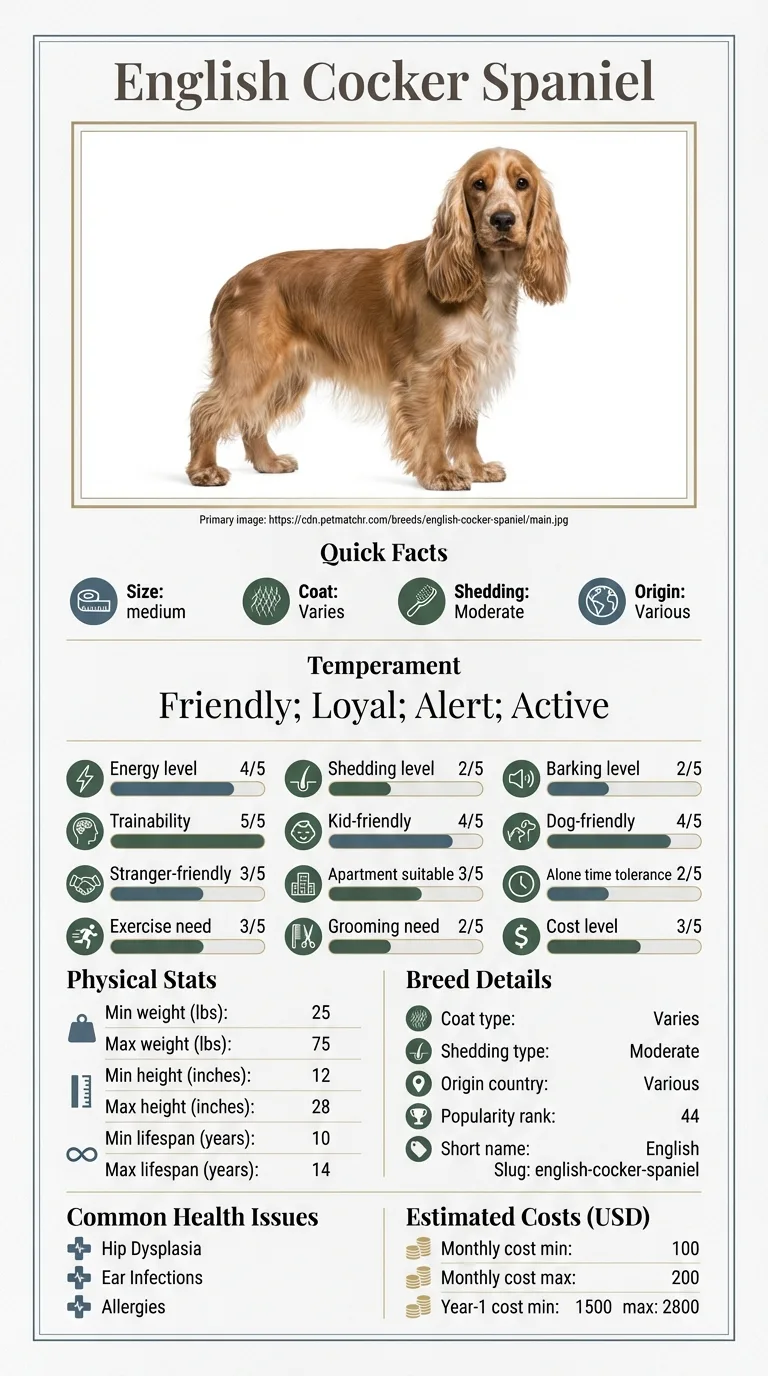
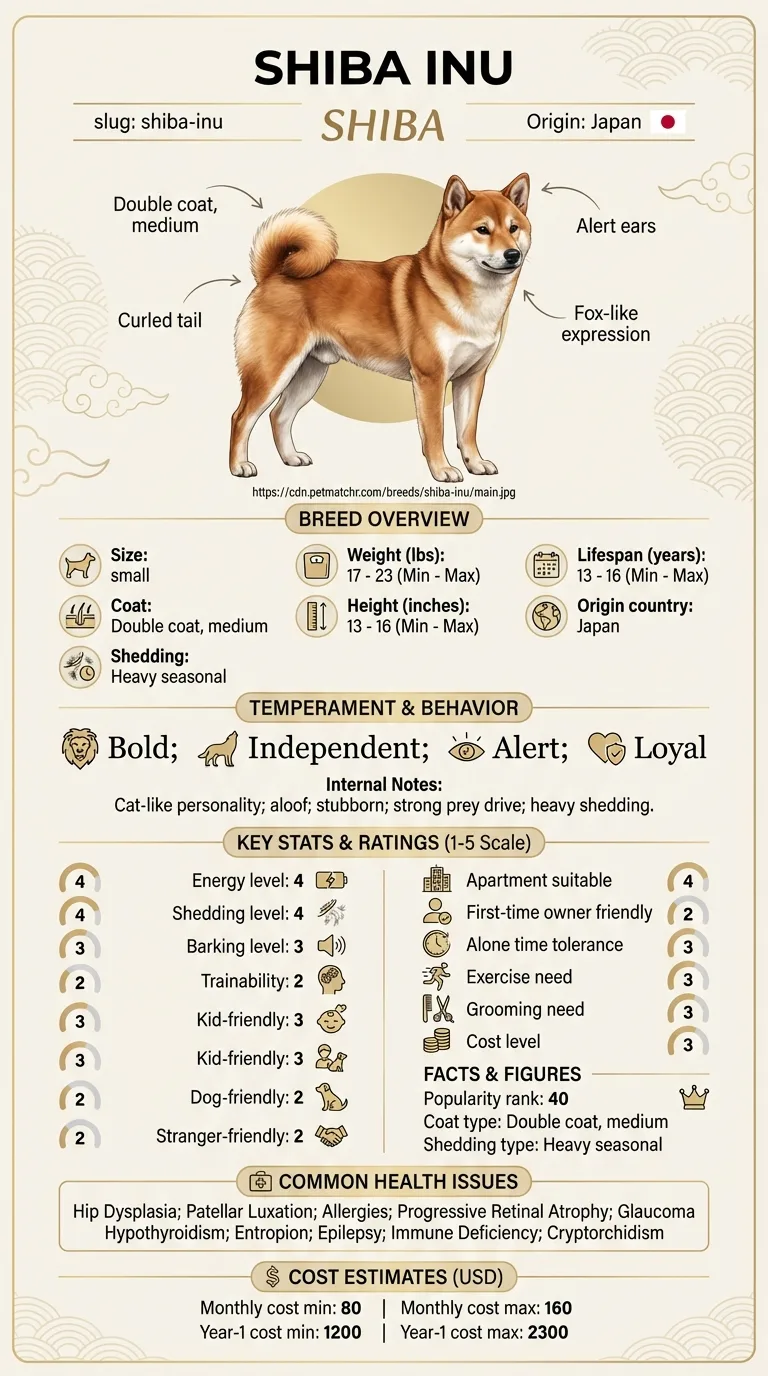
This is for someone already down to English Cocker Spaniel and Shiba Inu and deciding between them. For this pair the decision usually turns on good for first-time owners and good with kids, so those are covered first and in most detail. Both rate 4/5 for flats, so housing does not settle this one. It is written for the decision rather than the breed history.
Between English Cocker Spaniel and Shiba Inu, good for first-time owners is what separates them, and Shiba Inu is the lower-effort dog of the two to keep.
Choose English Cocker Spaniel if this is your first dog, shedding is a problem in your house and there are young children at home.
Choose Shiba Inu if you do not want a standing grooming appointment, your walking routine is modest and the dog will be alone during the working day.
| Feature | english cocker spaniel | shiba inu | Winner |
|---|---|---|---|
| Size class | medium | small | Equal |
| Weight | 26–34 lbs | 17–23 lbs | Equal |
| Height | 15–17 in | 13–16 in | Equal |
| Lifespan | 12–14 years | 13–16 years | shiba inu |
| Exercise need | High (4/5) | Moderate (3/5) | shiba inu |
| Grooming need | High (4/5) | Moderate (3/5) | shiba inu |
| Shedding | Moderate (3/5) | High (4/5) | english cocker spaniel |
| Energy level | High (4/5) | High (4/5) | Equal |
| Barking | Moderate (3/5) | Moderate (3/5) | Equal |
| Apartment suitability | High (4/5) | High (4/5) | Equal |
| Good for first-time owners | High (4/5) | Low (2/5) | english cocker spaniel |
| Tolerates being alone | Low (2/5) | Moderate (3/5) | shiba inu |
| Trainability | High (4/5) | Low (2/5) | english cocker spaniel |
| Good with kids | Very high (5/5) | Moderate (3/5) | english cocker spaniel |
| Good with other dogs | High (4/5) | Low (2/5) | english cocker spaniel |
| Friendly to strangers | High (4/5) | Low (2/5) | english cocker spaniel |
| Cost level | Moderate (3/5) | Moderate (3/5) | Equal |
| Coat | Medium, silky and feathered | Double coat, medium | Equal |
| Origin | Various | Japan | Equal |
| Typical monthly cost | $100–$200 | $80–$160 | Equal |
| Typical first-year cost | $1,400–$2,900 | $1,200–$2,300 | Equal |
The Shiba Inu is noticeably lighter — 17 to 23 lbs against the Cocker's 26 to 34 — and about two inches shorter at the shoulder, landing it in the small size class where the Cocker sits medium. Don't mistake that for fragility, though: the Shiba's compact, muscular frame was built for hunting in mountainous terrain.
Exercise need favors the Shiba if you want lower upkeep: it rates moderate (3/5) against the Cocker's high (4/5), and grooming follows the same pattern, 3/5 versus 4/5. Energy level itself is tied at 4/5, though — the Shiba just tends to spend that energy in shorter, more independent bursts rather than sustained retrieving or field work.
Grooming time actually favors the Shiba (3/5 versus the Cocker's 4/5), but shedding flips the other way — the Shiba sheds more, 4/5 against the Cocker's 3/5. That's the double-coat blowout effect: less daily brushing required, but seasonal shedding that can carpet a room. The Cocker's coat needs more regular attention but sheds more evenly across the year.
Apartment suitability and barking are tied at 4/5 and 3/5 respectively, so square footage and noise complaints aren't what separates these two. What does separate them is temperament under confinement — the Shiba's independence, a defining trait in its profile, means it tolerates having its own space in ways a breed bred to stay close to people doesn't.
This is where the two breeds diverge sharply. The Cocker rates high for both trainability (4/5) and first-time-owner suitability (4/5); the Shiba rates low on both (2/5 each). Shibas are famously independent and food-motivated in ways that don't always translate to eager obedience, and a first-time owner expecting Cocker-level biddability from a Shiba is in for a surprise.
The household-fit numbers tell a consistent story: the Cocker outscores the Shiba with kids (5/5 vs 3/5), other dogs (4/5 vs 2/5), and strangers (4/5 vs 2/5). None of these are disqualifying for the Shiba, but they reflect a breed that's more selectively social than the openly friendly Cocker.
The Shiba edges the Cocker on lifespan, 13 to 16 years against 12 to 14, which tracks with its smaller size. Its health list is longer, though — ten conditions including glaucoma, epilepsy, and immune deficiency, against five for the Cocker. Progressive retinal atrophy is the one condition both breeds share.
Cost level is rated moderate (3/5) for both, and the dollar ranges sit close together — the Shiba runs slightly cheaper at $80 to $160 a month and $1,200 to $2,300 in year one, against the Cocker's $100 to $200 and $1,400 to $2,900. The smaller Shiba's lighter food bill accounts for most of the gap.
English Cocker Spaniel weighs 26–34 lbs and lives 12–14 years; Shiba Inu weighs 17–23 lbs and lives 13–16 years. The two diverge most on good for first-time owners, good with kids and trainability and 2 other rated axes. They are level on apartment suitability, barking and cost level, so those cannot decide it. In the table, a "winner" means easier for an ordinary household — not better. Size, coat and origin are recorded without a verdict. Because both breeds are scored the same way, the gaps are reliable even where the absolute numbers are rough.

The Cocker, clearly — rated 4/5 for trainability against the Shiba's 2/5.
It runs 17–23 lbs against the Cocker's 26–34, and is classed small rather than medium.
Not really by the data — it rates 2/5 for first-time-owner suitability against the Cocker's 4/5.
Yes, both are tied at 4/5 for apartment suitability.
The Shiba, rated 4/5 against the Cocker's 3/5, despite needing less brushing overall.
Progressive retinal atrophy is the one shared condition. The Shiba's overall list runs to ten conditions against five for the Cocker.
The Shiba, slightly — $80–160 a month against the Cocker's $100–200.
Choose the Cocker if you're a first-time owner who wants a trainable, social dog; choose the Shiba if you want lower grooming effort and have handling experience.
$80–160 for the Shiba versus $100–200 for the Cocker.
The Cocker rates higher (4/5 vs 3/5), though the Shiba's energy level ties it at 4/5.
The Shiba lives a bit longer, 13–16 years against the Cocker's 12–14.
Secure checkout on Stripe. We never see your card.
7-day money-back guarantee. Instant access.
Health information here is general and is not veterinary advice. If your dog shows pain, sudden behaviour change, or worsening symptoms, consult a licensed veterinarian.
Some links on this site are affiliate links. We may earn a commission at no extra cost to you, and we only suggest products we believe are helpful for dog owners.
We research and check what we publish, but we do not warrant that any figure, date, price, or statement is accurate, complete, or current, and we accept no liability for any loss, cost, injury, or other harm arising from the use of this site. Use it as one reference among several. You remain responsible for your own decisions and for your dog's care - confirm anything that matters with a licensed veterinarian or another qualified professional before you act on it. Full disclaimer.
Match your lifestyle to the right dog.
Take quizNot sure which breed is right for you? Take our 2-minute quiz to find out.
Take the quiz