Living
Which is the easier overall choice?
The Bichon Frise for almost any household without acreage or a serious activity plan, better apartment fit, easier for beginners, and a longer average lifespan.

Quick answer
Which is the easier overall choice?
The Bichon Frise for almost any household without acreage or a serious activity plan, better apartment fit, easier for beginners, and a longer average lifespan.
Australian Shepherd or Bichon Frise? On paper they differ most on apartment suitability, and on the scales Australian Shepherd is the heavier at 40–65 lbs. Here is how the two compare on everything that shapes an ordinary week.
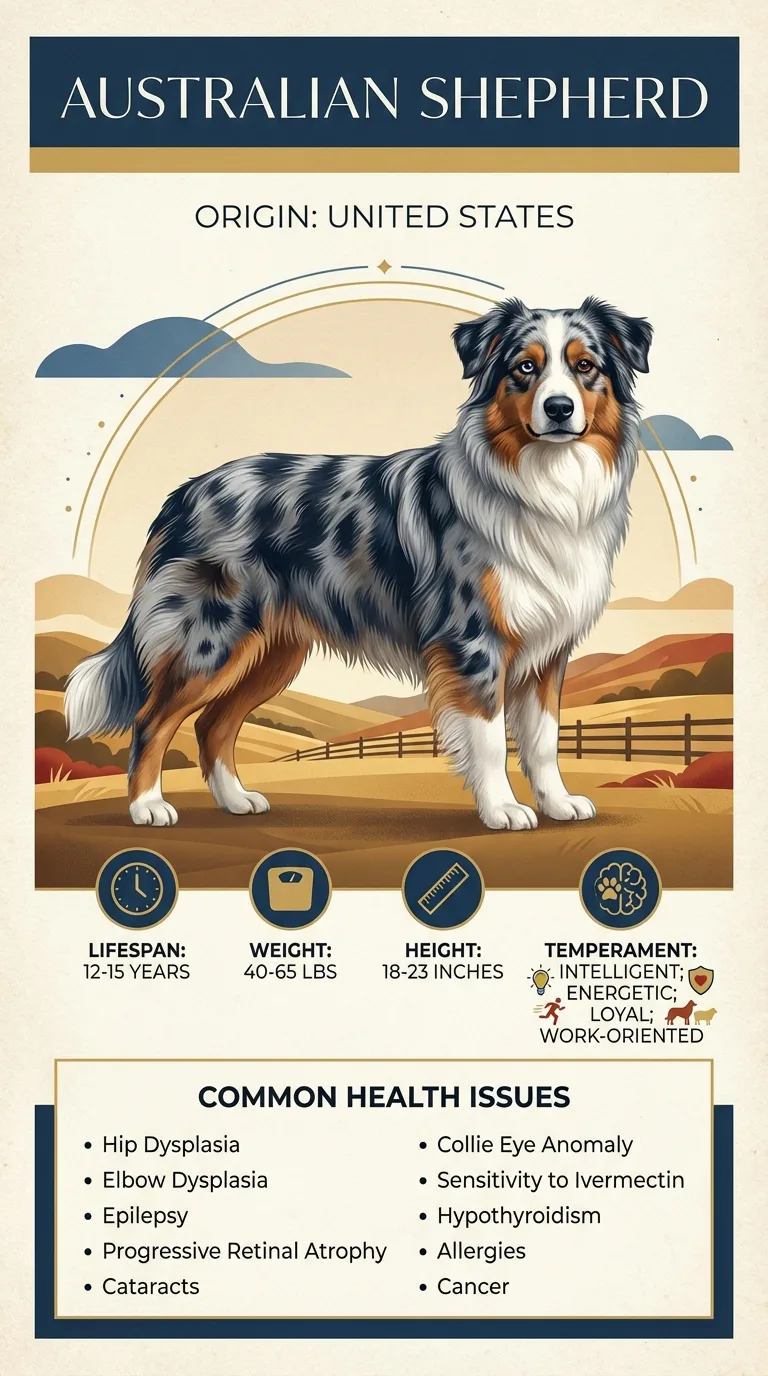
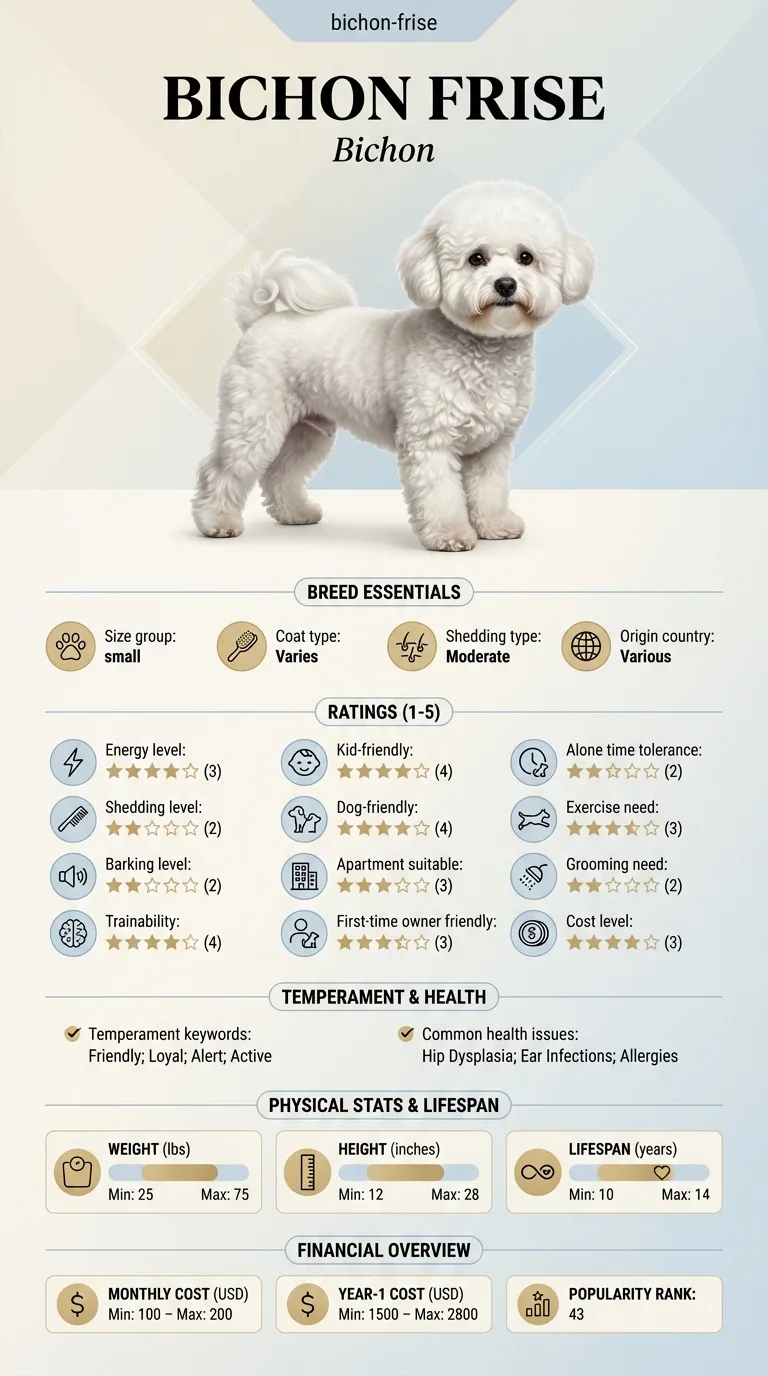
This is for someone already down to Australian Shepherd and Bichon Frise and deciding between them. For this pair the decision usually turns on apartment suitability and exercise need, so those are covered first and in most detail. Anyone choosing from a flat has a clear answer here: Bichon Frise rates 5/5 against 1/5. Breed history is left out; what follows is what you will actually live with.
Between Australian Shepherd and Bichon Frise, apartment suitability is what separates them, and Bichon Frise is the lower-effort dog of the two to keep.
Choose Australian Shepherd if you do not want a standing grooming appointment, you want a dog that picks up training quickly and you want a dog that can keep up with an active routine.
Choose Bichon Frise if you are in a flat or a smaller home, this is your first dog and shedding is a problem in your house.
| Feature | australian shepherd | bichon frise | Winner |
|---|---|---|---|
| Size class | medium | small | Equal |
| Weight | 40–65 lbs | 12–18 lbs | Equal |
| Height | 18–23 in | 9–12 in | Equal |
| Lifespan | 12–15 years | 14–15 years | bichon frise |
| Exercise need | Very high (5/5) | Low (2/5) | bichon frise |
| Grooming need | Moderate (3/5) | Very high (5/5) | australian shepherd |
| Shedding | High (4/5) | Very low (1/5) | bichon frise |
| Energy level | Very high (5/5) | Moderate (3/5) | Equal |
| Barking | Moderate (3/5) | Moderate (3/5) | Equal |
| Apartment suitability | Very low (1/5) | Very high (5/5) | bichon frise |
| Good for first-time owners | Low (2/5) | High (4/5) | bichon frise |
| Tolerates being alone | Low (2/5) | Low (2/5) | Equal |
| Trainability | Very high (5/5) | Moderate (3/5) | australian shepherd |
| Good with kids | High (4/5) | High (4/5) | Equal |
| Good with other dogs | High (4/5) | High (4/5) | Equal |
| Friendly to strangers | Low (2/5) | High (4/5) | bichon frise |
| Cost level | Moderate (3/5) | Moderate (3/5) | Equal |
| Coat | Medium-length double coat | Curly, dense double coat | Equal |
| Origin | United States | Various | Equal |
| Typical monthly cost | $100–$200 | $80–$150 | Equal |
| Typical first-year cost | $1,500–$2,800 | $1,100–$2,300 | Equal |
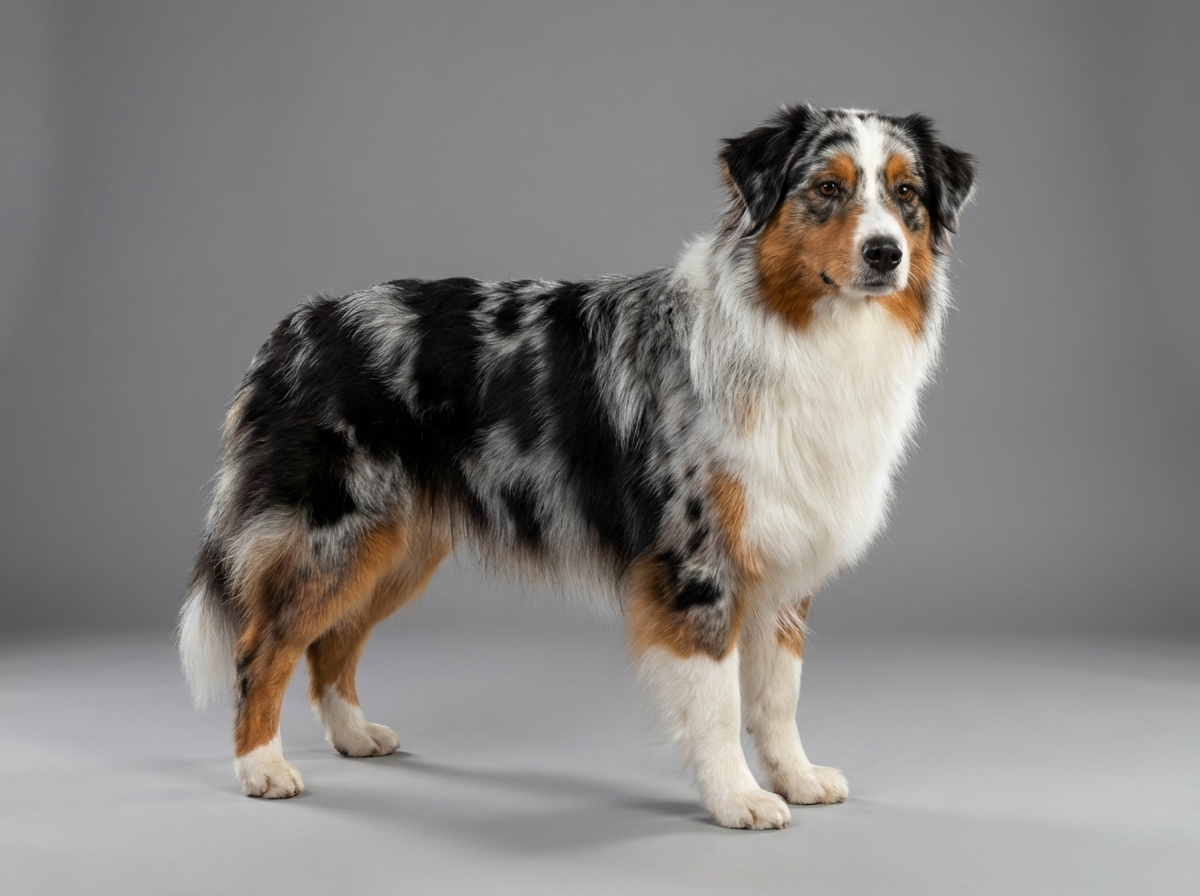
It's hard to find two more different silhouettes: the Aussie at 40-65 lbs and 18-23 inches, the Bichon Frise at a fraction of that, 12-18 lbs and 9-12 inches. The Bichon's round, powder-puff look comes from its curly double coat, not extra bulk underneath, strip the coat and there's not much dog left.
The Aussie's exercise need sits at the maximum, 5/5, while the Bichon's is low, 2/5, a couple of short outings and some indoor play satisfy most Bichons. Energy level tells a similar story, very high (5/5) for the Aussie against moderate (3/5) for the Bichon.
The Bichon flips the usual small-dog pattern: its grooming need rates the maximum 5/5, higher than the Aussie's moderate 3/5, driven by that dense curly coat that needs regular professional clipping to avoid matting. Shedding runs the opposite direction, though, the Bichon sheds almost nothing (1/5) against the Aussie's high 4/5, which is why the breed shows up so often on hypoallergenic-adjacent lists.
The Bichon is built for small spaces, rating the maximum 5/5 for apartment suitability against the Aussie's rock-bottom 1/5. Barking is tied at moderate (3/5) for both, so don't expect the smaller dog to be the quieter one here, Bichons are known talkers in their own right.
The Aussie trains more readily, rating 5/5 against the Bichon's 3/5, but the Bichon is the friendlier breed for a novice overall, rating high (4/5) for first-time owners against the Aussie's low (2/5). A dog that's slightly harder to train but far easier to live with day to day is often the better beginner choice, and the numbers here reflect that trade-off.
Kids and other dogs are a tie, both rated 4/5, so neither breed has an edge in a typical family home. Strangers are where they split, the Bichon is notably more outgoing (4/5 vs. 2/5), which tracks with its history as a companion breed bred for sociability rather than watchfulness.
The Bichon lives longer, 14-15 years against the Aussie's 12-15, and carries a much shorter health list, five conditions (skin allergies, patellar luxation, bladder stones, cataracts, dental disease) against the Aussie's ten, which include epilepsy and cancer risk. Neither list overlaps directly, though skin issues show up in both breeds under slightly different names.
Cost is tied at moderate (3/5) for both, and the dollar figures land close too, $100-200 monthly for the Aussie versus $80-150 for the Bichon, with the Bichon running a bit cheaper across the first year as well ($1,100-2,300 vs. $1,500-2,800).
Australian Shepherd weighs 40–65 lbs and lives 12–15 years; Bichon Frise weighs 12–18 lbs and lives 14–15 years. The two diverge most on apartment suitability, exercise need and shedding and 5 other rated axes. They are level on tolerates being alone, barking and cost level, so those cannot decide it. The comparison marks an easier option only where one exists. Facts like weight and country of origin are not scored. Both dogs are rated from the same dataset, which is what makes the numbers comparable with each other even though any individual dog sits somewhere inside its breed's range.

Yes, 12-18 lbs against the Aussie's 40-65 lbs, roughly a third to a quarter of the weight, on a frame less than half the height.
The Bichon, somewhat surprisingly, its 5/5 grooming need beats even the Aussie's 3/5, thanks to a curly coat that mats without regular clipping.
The Aussie, by a wide margin, 4/5 versus the Bichon's nearly nonexistent 1/5.
The Bichon, clearly, 4/5 versus the Aussie's 2/5. Its lower exercise needs and easygoing temperament make it far more forgiving of a novice's learning curve.
The Bichon can comfortably, it rates the maximum 5/5. The Aussie rates the minimum 1/5 and is a poor match for small-space living regardless of exercise effort.
$100-200 for the Aussie, $80-150 for the Bichon.
Not directly by name, though both have allergy-related conditions listed, general allergies for the Aussie, skin allergies specifically for the Bichon. Otherwise the lists don't overlap.
The Bichon Frise for almost any household without acreage or a serious activity plan, better apartment fit, easier for beginners, and a longer average lifespan.
$100-200 for the Aussie, $80-150 for the Bichon.
The Aussie by a wide margin, 5/5 versus the Bichon's 2/5.
The Bichon, 14-15 years versus the Aussie's 12-15.
Secure checkout on Stripe. We never see your card.
7-day money-back guarantee. Instant access.
Health information here is general and is not veterinary advice. If your dog shows pain, sudden behaviour change, or worsening symptoms, consult a licensed veterinarian.
Some links on this site are affiliate links. We may earn a commission at no extra cost to you, and we only suggest products we believe are helpful for dog owners.
We research and check what we publish, but we do not warrant that any figure, date, price, or statement is accurate, complete, or current, and we accept no liability for any loss, cost, injury, or other harm arising from the use of this site. Use it as one reference among several. You remain responsible for your own decisions and for your dog's care - confirm anything that matters with a licensed veterinarian or another qualified professional before you act on it. Full disclaimer.
Match your lifestyle to the right dog.
Take quizNot sure which breed is right for you? Take our 2-minute quiz to find out.
Take the quiz