DogBreedCompass

Malamute or Yorkie: The Smallest Working Terrier Against a Sled Dog

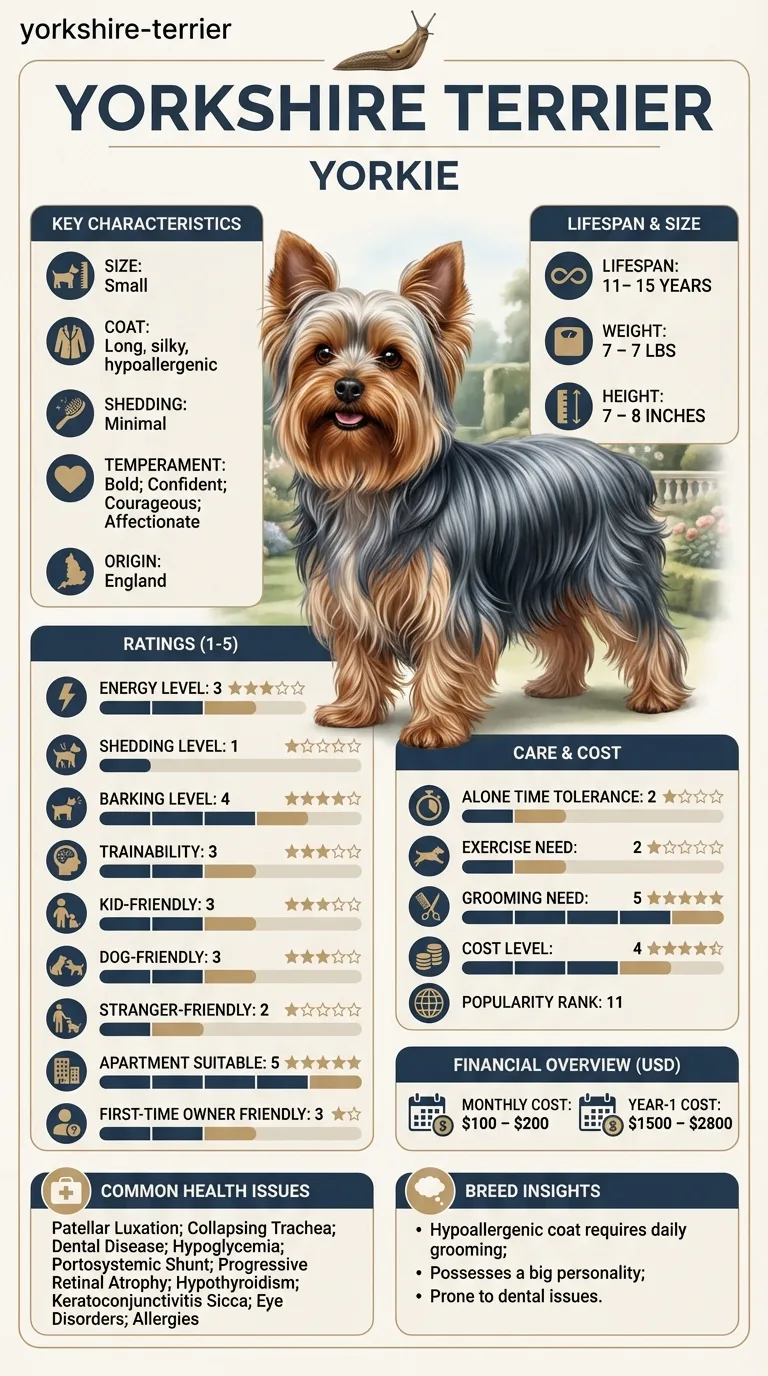
The Yorkshire Terrier weighs 4 to 7 pounds and rates 4/5 for barking, 2/5 with strangers and 3/5 with other dogs. Its temperament keywords are bold, confident and courageous. This is not a lapdog that happens to be small.

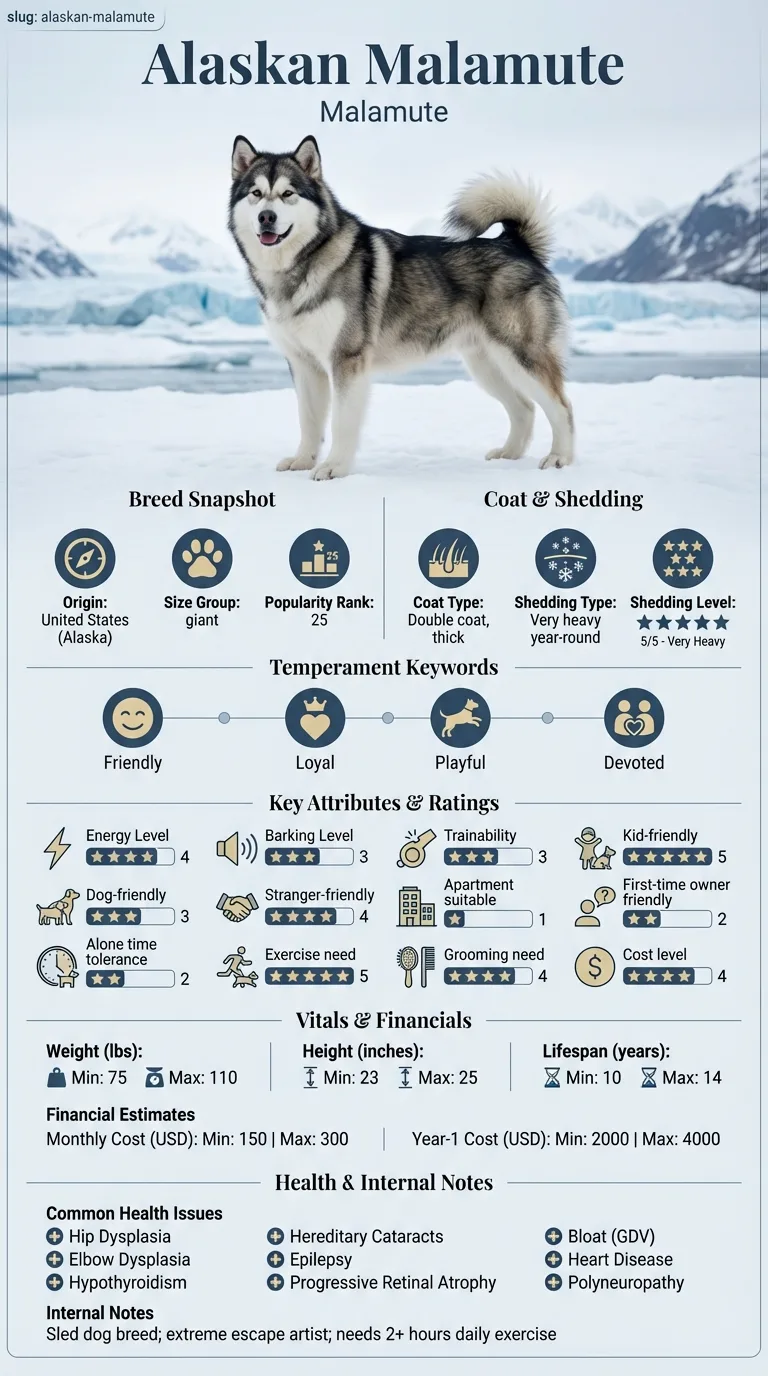
alaskan malamute infographic
yorkshire terrier infographic

This page is for someone looking at the two ends of the size range and wanting to know what a toy-sized terrier actually asks for — and for anyone who assumes the smallest dog on the list will be the least trouble.

Quick verdict

The Yorkie fits any home, costs less to feed and lives longer, but it is a genuine terrier with a 5/5 grooming coat, a serious dental and skeletal fragility, and a bark that carries.

Choose alaskan malamute if...

Choose the Alaskan Malamute if you want a large cold-weather working dog, you have secure fencing and two hours a day for physical work, and you want a breed that is physically robust around children.

Choose yorkshire terrier if...

Choose the Yorkshire Terrier if you want a bold, portable, long-lived companion for a flat, and you will treat daily coat work, daily tooth brushing and a harness rather than a collar as fixed parts of the routine.

Head-to-head comparison

Featurealaskan malamuteyorkshire terrierWinner
Weight75–110 lbs4–7 lbsEqual
Height23–25 in7–8 inEqual
Lifespan10–14 years11–15 yearsyorkshire terrier
CoatThick double coatLong, silky, low-shedEqual
Grooming need4/55/5alaskan malamute
Shedding5/5 — very heavy year-round1/5 — minimalyorkshire terrier
Energy level4/53/5yorkshire terrier
Exercise need5/52/5yorkshire terrier
Trainability3/53/5Equal
Barking3/54/5alaskan malamute
Good with kids5/53/5alaskan malamute
Good with other dogs3/53/5Equal
Friendly to strangers4/52/5alaskan malamute
Apartment suitability1/55/5yorkshire terrier
Good for first-time owners2/53/5yorkshire terrier
Tolerates being alone2/52/5Equal
Typical monthly cost$150–300$100–190yorkshire terrier
Typical first-year cost$2,000–4,000$1,400–2,900yorkshire terrier

Deep dive

A terrier first and a toy breed second

Almost every complaint about Yorkshire Terriers comes from expecting a companion breed and getting a working one.

The breed was built in nineteenth-century Yorkshire from small terriers brought south by Scottish weavers, and its job was killing rats in textile mills, mines and stables — confined spaces where a small, fearless, determined dog was the right tool. Selection rewarded boldness, persistence, noise and a complete absence of caution. Only afterwards did the breed become fashionable and shrink further.

The ratings are that history written down. Barking 4/5, because a terrier working underground or behind machinery announces what it has found. Strangers 2/5, because a ratter was not selected to be sociable. Other dogs 3/5, with the classic terrier willingness to challenge something ten times its size. Bold, confident, courageous — those are the breed's own words.

What that means for an owner is that a Yorkie needs training, structure and socialisation like any working breed, not indulgence. The single most common mistake is treating it as an accessory: carrying it everywhere, never asking it to walk, allowing behaviour that would be unacceptable in a larger dog, and skipping socialisation because it is small enough to pick up. The result is a stressed, reactive, over-vocal animal, and the label small dog syndrome describes an owner's choices rather than a breed trait.

A Yorkie that walks on its own feet, is asked for manners, meets other dogs regularly and has been socialised properly is a confident and genuinely charming dog. That is achievable and it is the whole difference.

The Malamute's 3/5 trainability comes from independence rather than intensity, and its 4/5 with strangers means it needs no equivalent socialisation work.

Hair rather than fur, and a 5/5 grooming rating

The Yorkie's coat is unusual enough to explain properly. It is a single coat with no undercoat, and it grows continuously rather than reaching a length and stopping — behaving more like human hair than like a typical dog coat. That is why it sheds at 1/5 and why it carries a 5/5 grooming rating.

Dead hair stays in the coat instead of falling out, and a fine silky coat with no undercoat tangles quickly. On a 5 pound dog the mats form close to the skin and tighten fast, and the usual places are behind the ears, under the collar or harness, in the armpits, on the chest where the dog lies, and around the rear.

Kept long — the traditional floor-length show coat — the routine is a full comb-through to the skin daily, regular bathing and drying, and the hair over the eyes tied up or trimmed. That is fifteen to twenty minutes every day, and realistically most pet owners do not sustain it.

The sensible alternative is a short puppy or teddy clip every six to eight weeks, which reduces the daily work to a few minutes and does no harm at all, since a single coat can be clipped freely. This is what the majority of Yorkies wear and there is no reason to feel it is a compromise.

Alongside the coat sit two small daily jobs: wiping the face, since tear staining shows on a pale muzzle, and keeping the hair out of the eyes.

The Malamute's 4/5 is a very different bargain — an undercoat rake to the skin two or three times a week, two annual coat blows filling the house with wool, 5/5 shedding all year, no appointments, no fees, and an absolute prohibition on clipping because a double coat insulates in both directions.

Six pounds: the trachea, the knees and the teeth

Three entries on the Yorkie's health list shape daily routine, and all three have practical answers.

Collapsing trachea comes first because the fix is free. The windpipe's cartilage rings can weaken and flatten, producing a dry honking cough that worsens with excitement, heat or pressure on the throat. Lead pressure on a 5 pound neck is a genuine contributor. Use a harness, never a collar, from the first day — it costs nothing and removes one of the few controllable risk factors.

Dental disease is second and is likely to be the largest recurring veterinary cost across an 11 to 15 year life. Forty-two adult teeth in a tiny jaw crowd and overlap, plaque collects where the tongue cannot reach, and gum recession and tooth loss arrive early. Daily brushing from puppyhood is what determines whether the dog reaches twelve with a functional mouth, alongside professional scaling under anaesthetic every one to three years.

Patellar luxation is third — a kneecap slipping out of its groove, showing as a skipping stride where the dog hops for a step and carries on. Mild cases are managed with weight control and muscle condition; severe ones are surgical. Ask a breeder whether the parents have been evaluated.

Hypoglycaemia belongs alongside them, especially in puppies and the smallest adults. A very small dog has almost no glycogen reserve, so a missed meal or a stressful day can cause wobbling, weakness and collapse. Frequent small meals are standard advice for Yorkie puppies.

The Malamute's risks are the opposite shape entirely — hip and elbow dysplasia, bloat, hypothyroidism, epilepsy, progressive retinal atrophy, hereditary cataracts, zinc-responsive dermatosis and inherited polyneuropathy. Larger, rarer, more expensive events across a slightly shorter life.

Portosystemic shunt and dry eye: two conditions to recognise early

Two further entries on the Yorkie's list are worth knowing by name because both are frequently missed.

A portosystemic shunt is an abnormal blood vessel that bypasses the liver, so blood carrying waste from the gut goes straight into general circulation without being filtered. The Yorkshire Terrier is one of the breeds most associated with the congenital form. The signs are subtle and easy to attribute to something else: a puppy that grows poorly, seems dull or disoriented particularly after meals, drinks and urinates more than expected, vomits intermittently, or reacts badly to sedation. Diagnosis is usually by bile acid testing followed by imaging, and treatment may be surgical or medical depending on the vessel. Caught early the outlook is far better, which is why a Yorkie puppy that is not thriving deserves a liver workup rather than a wait.

Keratoconjunctivitis sicca — dry eye — is the second. Tear production falls, the cornea dries, and the presentation is a thick sticky discharge, redness and a dull-looking eye that owners often treat as a mild infection for weeks. It is diagnosed with a simple tear-production test and managed with lifelong medication, and untreated it damages the cornea permanently. Persistent gooey discharge in one or both eyes deserves that test.

Progressive retinal atrophy, other eye disorders, hypothyroidism and allergies complete the list.

On cost the Yorkie runs $100–190 a month against the Malamute's $150–300, but both sit at cost level 4/5 — the Yorkie's money going on grooming appointments, dentals and a long life rather than on food. Its first year is $1,400–2,900 against $2,000–4,000.

Space, noise and what each dog does with a day

The Yorkie rates 5/5 for apartments and the Malamute 1/5, and the exercise ratings account for it: 2/5 against 5/5.

A Yorkie needs twenty to thirty minutes of walking a day plus indoor play and a little training. Its 3/5 energy is real — it is a busy, inquisitive dog rather than a cushion — but the requirement is small and can be met without leaving the building on a bad day. It also travels easily, fits under a seat, and can be lifted out of a situation.

The Malamute needs two hours minimum with physical resistance, in all weathers, with no indoor version and a summer routine pushed to first and last light by its Arctic coat.

The qualification on that 5/5 apartment rating is the 4/5 barking. Yorkies alert to the lift, the corridor, footsteps and the post, and the bark is sharp and carrying. It is trainable — a quiet cue, blocked sight lines to the front door, and enough activity that the dog is not patrolling out of boredom — but it starts loud and it is the trait most likely to cause friction with neighbours.

With children the Malamute leads 5/5 to 3/5, and the reason is fragility. A 5 pound dog with fine bones can be seriously hurt by a fall or a firm grip, and a terrier that is hurt will defend itself. Yorkies suit households with older children who understand how to handle a small dog.

Both rate 2/5 for time alone. Neither belongs in an empty house all day, and the Yorkie's version is vocal, which in a flat compounds the barking problem rather than sitting beside it.

Lifespan favours the Yorkie at 11 to 15 years, and where an individual dog lands in that range is decided largely by its teeth and its weight.

Alaskan Malamute vs Yorkshire Terrier at a glance

The Yorkshire Terrier weighs just 4 to 7 pounds and rates 4/5 for barking, 2/5 with strangers, and 3/5 with other dogs. Its own temperament keywords are bold, confident, and courageous — this is not a lapdog that happens to be small.

The Yorkie fits any home, costs less to feed than the Malamute, and lives longer. But it is a genuine terrier underneath the coat, carrying a 5/5 grooming requirement, serious dental and skeletal fragility, and a bark that carries well beyond its size.

Choose the Malamute if you want a large cold-weather working dog, you have secure fencing and two hours a day for physical work, and you want a breed that is physically robust around children. Choose the Yorkshire Terrier if you want a bold, portable, long-lived companion for a flat, and you will treat daily coat work, daily tooth brushing, and a harness as fixed parts of the routine.

Frequently asked questions

Is a Yorkshire Terrier really a working breed?

By origin, yes. Yorkies were developed to kill rats in Yorkshire mills and mines, and the temperament survived the shrinking. Bold, courageous, vocal at 4/5 and reserved with strangers at 2/5 are all terrier traits, not toy-breed ones.

Why does a non-shedding dog rate 5/5 for grooming?

Because the coat is a single layer of continuously growing hair that keeps its dead strands instead of dropping them. It tangles into mats against the skin quickly, so a long coat needs a full comb-through every day.

Should I keep the coat long or short?

Short is the practical choice for most homes. A puppy or teddy clip every six to eight weeks reduces daily brushing to a few minutes and does the coat no harm, since a single coat can be clipped freely.

Why should a Yorkie wear a harness rather than a collar?

Collapsing trachea is on the breed's health list, and lead pressure on a five pound neck contributes to it. A harness removes that pressure entirely and costs nothing. The cough it causes is dry and honking, worse with excitement or heat.

What is a portosystemic shunt?

An abnormal vessel routing blood past the liver so waste is not filtered. Yorkies are among the most affected breeds. Signs are subtle — poor growth, dullness after meals, excess drinking, odd reactions to sedation — and bile acid testing is the route to diagnosis.

Which is better with children?

The Malamute at 5/5 against 3/5, on grounds of fragility rather than temperament. A four to seven pound dog is easily injured by a fall or a grab, and a hurt terrier will defend itself. Older children suit the breed far better.

Which is cheaper to own?

The Yorkie month to month at $100–190 against $150–300, though both rate 4/5 for cost. Grooming appointments, repeated dentals and a long life close most of the gap.

Quick answers

View more answers
Living

Malamute or Yorkshire Terrier: which should I choose?

The Yorkie if you want a bold, portable, long-lived dog for a flat and will keep up the coat, the teeth and the socialisation. The Malamute if you want a large cold-weather working dog and can supply two hours of daily physical work.

Costs

Which is cheaper month to month?

The Yorkshire Terrier at $100–190 against $150–300, but both sit at cost level 4/5 because grooming and dental care run for the whole of an 11 to 15 year life.

Health

What is the biggest health cost for a Yorkie?

Dental disease. Crowded teeth in a tiny jaw mean daily brushing from puppyhood and professional scaling under anaesthetic every one to three years across a long life.

Training

How do I avoid small dog syndrome?

Let the dog walk rather than carrying it, ask for the same manners you would from a large dog, socialise it properly through the first year, and train a quiet cue before the barking becomes a habit.

Related DogBreedCompass guides

  • Alaskan Malamute breed guideThe Malamute profile covers exercise load, coat raking and the containment the breed requires.
  • Yorkshire Terrier breed guideThe Yorkie profile covers coat options, terrier temperament and small-breed handling.
  • dental disease in Yorkshire TerriersDental disease is the dominant lifetime cost in the breed and the reason daily brushing matters.
  • patellar luxation in Yorkshire TerriersPatellar luxation is the common orthopaedic complaint and shows as a skipping stride.
  • Alaskan Malamute vs Jack Russell TerrierReaders weighing terrier temperament usually want the larger working terrier alongside it.
  • apartment dogs that do not shedAnyone choosing on hair alone wants the wider list of low-shedding options for small homes.

Related guides

Important reminder

Health information here is general and is not veterinary advice. Toy-breed concerns such as tracheal collapse, hypoglycaemia and liver shunt should be discussed with your own veterinarian.

Some links on this site are affiliate links. We may earn a commission if you buy through them, at no additional cost to you.

Find Your Perfect Breed

Match your lifestyle to the right dog.

Take quiz

Find your match

Not sure which breed is right for you? Take our 2-minute quiz to find out.

Take the quiz