DogBreedCompass

Malamute or Vizsla: Two Hours a Day, and One Wants Company Too

Five ratings match: exercise 5/5, children 5/5, apartments 1/5, first-time owners 2/5, and a lifespan of 10 to 14 years. The Vizsla then rates 1/5 for grooming and 1/5 for tolerating time alone — the extremes of both scales.

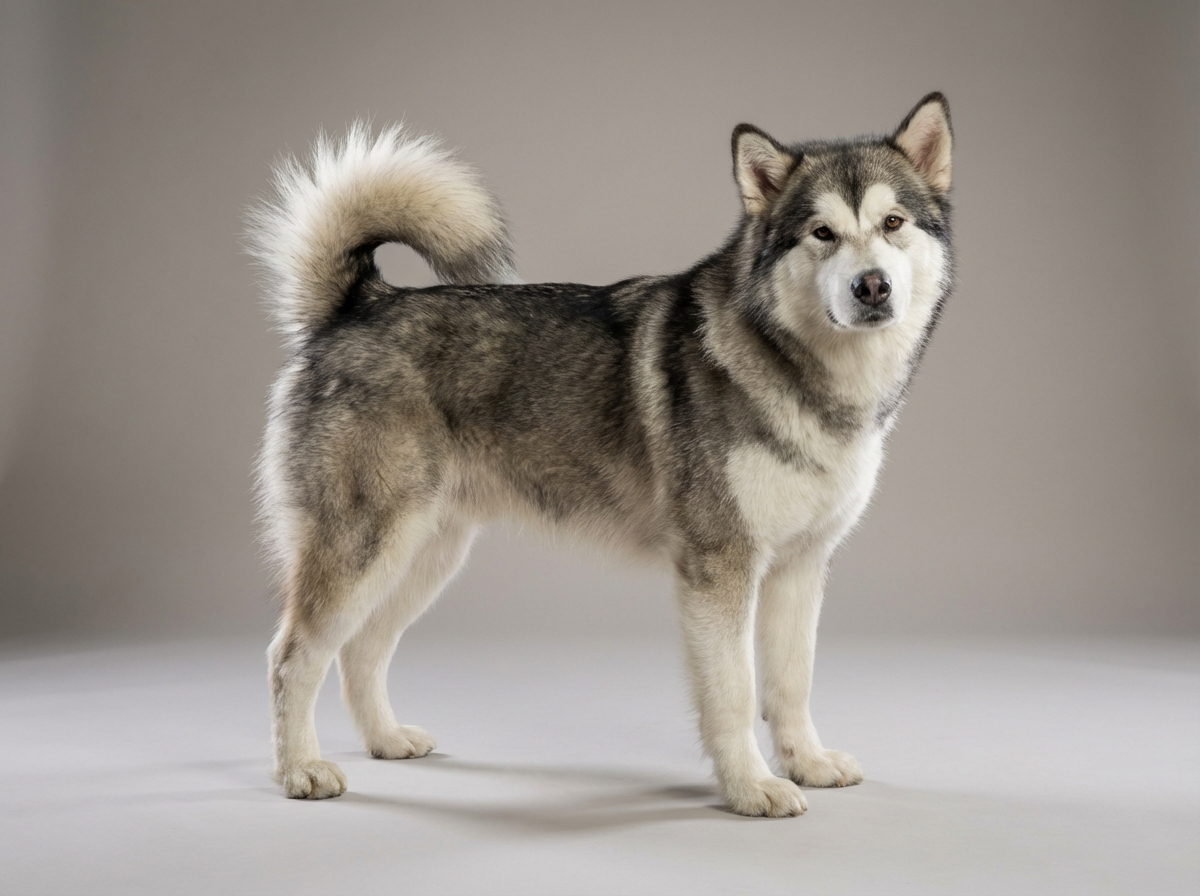
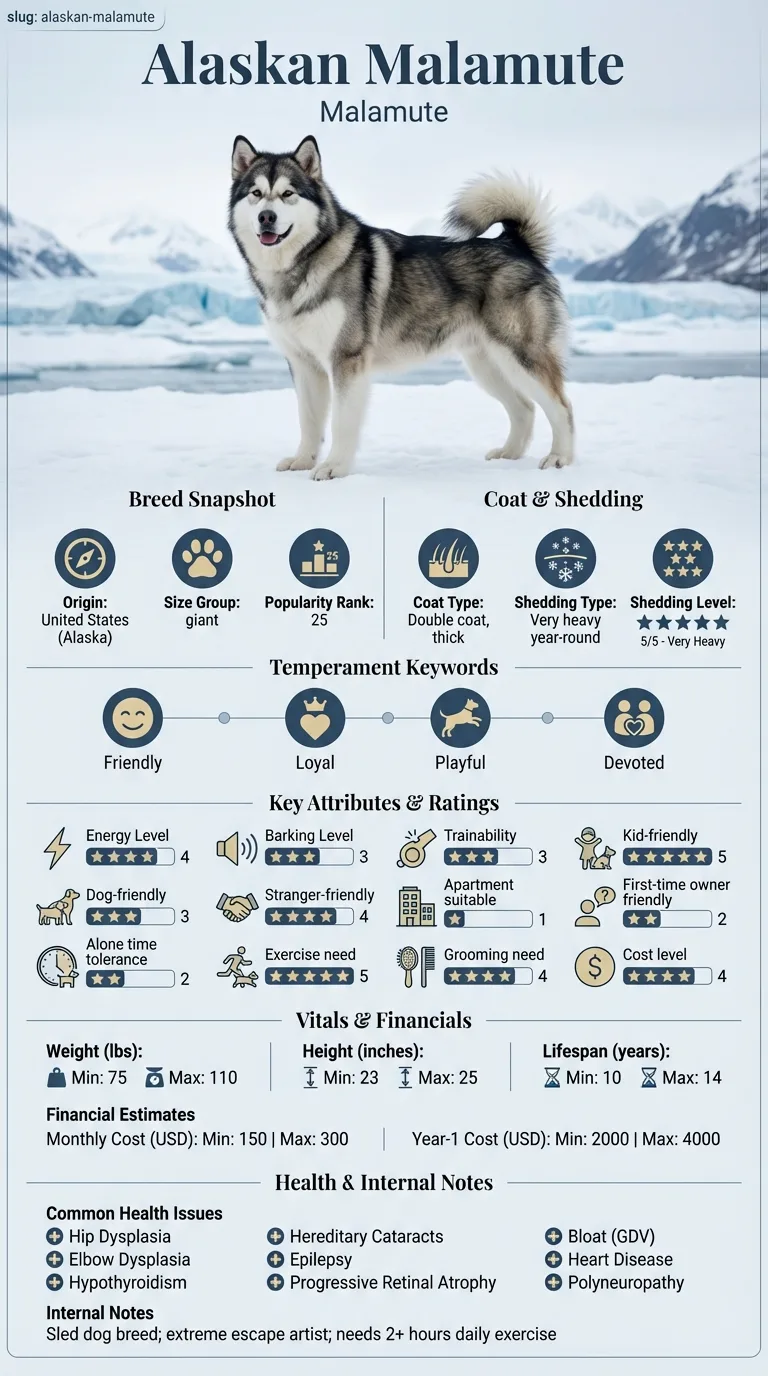
alaskan malamute infographic
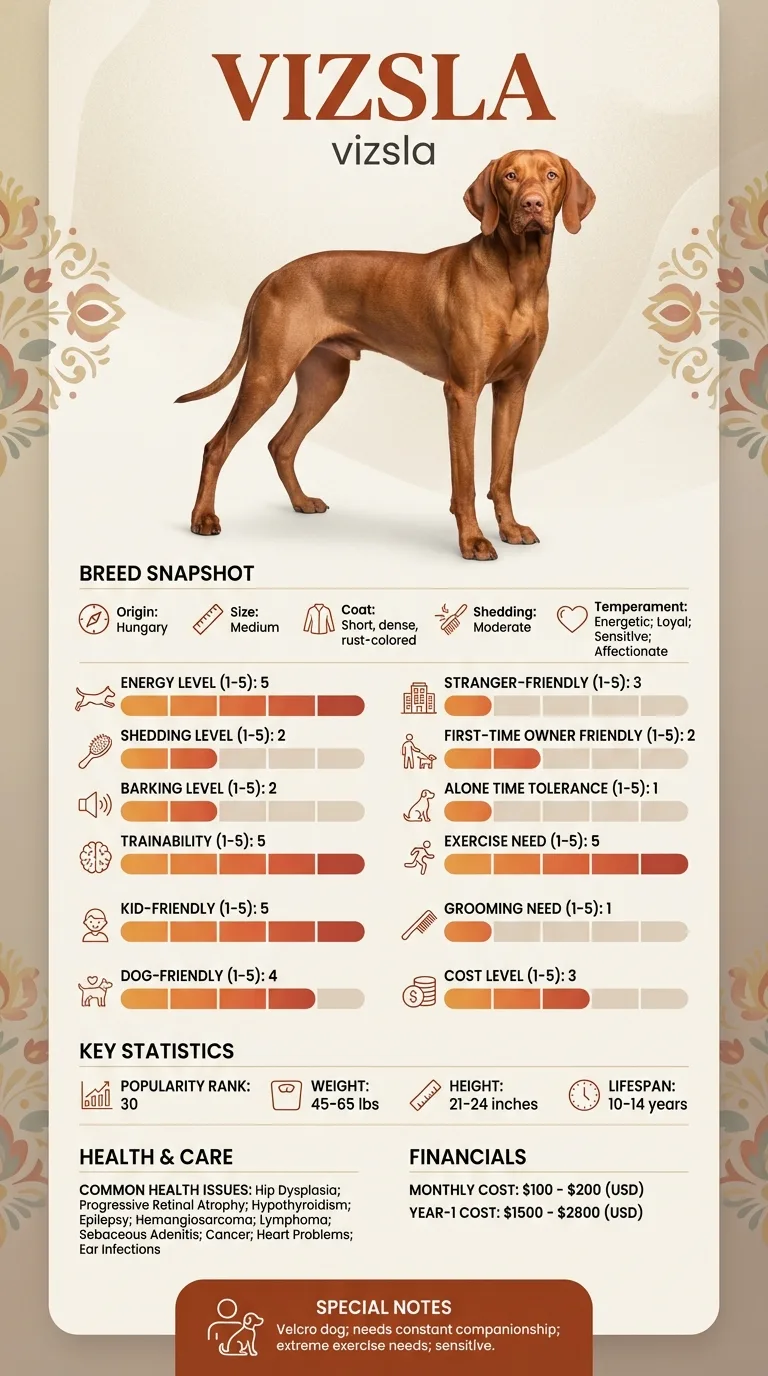
vizsla infographic

This page is for an active person choosing between two genuinely demanding breeds, and needing to know whether the demand they can meet is physical distance or constant company.

Quick verdict

The Vizsla is easier to groom than almost any breed alive, trains at 5/5 and matches the Malamute's exercise demand — but it needs a person present in a way the Malamute never does, and it carries a heavier cancer burden.

Choose alaskan malamute if...

Choose the Alaskan Malamute if your household is out during the day, you want a dog that is affectionate without being attached to you, you have cold weather and secure fencing, and hair in the house is acceptable.

Choose vizsla if...

Choose the Vizsla if someone is home nearly all the time, you run or hike daily in a temperate climate, and you want a fast-learning, almost maintenance-free coat on a dog that will follow you between rooms for its whole life.

Head-to-head comparison

Featurealaskan malamutevizslaWinner
Weight75–110 lbs45–65 lbsEqual
Height23–25 in21–24 inEqual
Lifespan10–14 years10–14 yearsEqual
CoatThick double coatShort, dense, rust-colouredvizsla
Grooming need4/51/5vizsla
Shedding5/5 — very heavy year-round2/5 — moderatevizsla
Energy level4/55/5alaskan malamute
Exercise need5/55/5Equal
Trainability3/55/5vizsla
Barking3/52/5vizsla
Good with kids5/55/5Equal
Good with other dogs3/54/5vizsla
Friendly to strangers4/53/5alaskan malamute
Apartment suitability1/51/5Equal
Good for first-time owners2/52/5Equal
Tolerates being alone2/51/5alaskan malamute
Typical monthly cost$150–300$100–200vizsla
Typical first-year cost$2,000–4,000$1,500–2,800vizsla

Deep dive

1/5 for time alone: the lowest rating on the scale

The Vizsla's own breed notes use the phrase constant companionship, and the 1/5 rating is not softened for effect. This is the defining characteristic of the breed and the reason most Vizslas end up in rescue.

The history explains it. Hungarian hunters kept these dogs in the house rather than in kennels, working them close, and the breed was selected for a dog that stays with its person rather than ranging. That produced an animal that follows you from room to room, leans against your legs, gets into your bed and watches the door when you leave.

Left regularly for a full working day, a meaningful proportion of Vizslas develop genuine separation distress — not boredom, but panic. The signs are destruction focused on exit points, self-injury from attempts to escape a crate or a door, vocalising throughout the absence, refusal to eat while alone, and drooling or house-soiling in an otherwise clean adult. It is far harder to resolve than boredom, and it usually requires structured desensitisation work with professional help rather than more exercise.

The honest planning question is not whether you can be home for the first six months but what a normal Tuesday looks like in year four. Vizslas suit households where someone works from home, where the dog can come to work, or where a genuine mid-day routine exists.

The Malamute's 2/5 is bad in a different way and easier to manage. It is bored rather than frightened, and boredom responds to exercise, enrichment, a garden it cannot escape and something to chew. A Malamute is also comfortable being in a different room from you, which sounds trivial until you have lived with a dog that is not.

Two 5/5 ratings, and neither is negotiable

It is unusual to find two breeds this different that agree exactly on exercise, and the agreement is real — both need substantially more than most owners expect.

The Vizsla is rated 5/5 for both exercise and energy, a point above the Malamute on energy, and its notes describe extreme exercise needs. What satisfies it is running: a fast, sustained hour or more, ideally off-lead in open country, with scent work and retrieving mixed in. It is a genuine running companion — one of the few breeds that will comfortably keep a daily pace with a distance runner — and it also excels at agility, tracking and gundog work. At 5/5 trainability, mental work counts for a real share of the requirement, which gives an owner options on a bad day.

The Malamute's 5/5 is about load and duration rather than speed. Two hours minimum with resistance — a weighted pack, a pulling harness, a rig, snow, steep ground. It will not run fast for long, it is not built for it, and mental work counts for nothing. Its limiting factor is heat: the Arctic coat pushes summer exercise to first and last light for months.

The Vizsla's limiting factor is the opposite. A short coat with almost no undercoat and very little body fat means it feels cold quickly, needs a coat for standing around in winter, and picks up scrapes and thorn scratches in cover that a thicker-coated dog shrugs off.

Both rate 1/5 for apartments and 2/5 for first-time owners, and both fail badly when under-exercised — the Malamute by digging and escaping, the Vizsla by becoming frantic, mouthy and unable to settle at all.

Grooming 1/5 against 4/5: the widest maintenance gap here

The Vizsla holds the lowest grooming rating on this site, and it is genuinely as easy as the number suggests.

The coat is short, dense and rust-coloured, with no undercoat at all. Shedding is 2/5 — noticeable but light, and the hairs are short and fine. The entire routine is a rubber curry mitt once a week and a bath when the dog rolls in something. There is no matting risk, no seasonal blow, no professional appointment, no equipment beyond a mitt, and no skill required. Owners of thick-coated breeds find it slightly unbelievable.

The practical consequences are worth spelling out. No grooming budget across a ten to fourteen year life. No vacuum replaced every two years. No two-week period twice a year when the house fills with wool. A dog that dries in minutes after rain rather than hours.

What the thin coat costs instead is protection. A Vizsla in brambles comes back with scratches, its ears are prone to infection because they are drop ears on a dog that works cover and swims, and it needs a coat in genuinely cold weather rather than as a fashion choice. Sebaceous adenitis also appears on its health list — an immune-mediated condition that destroys the glands lubricating the coat, showing as scaling, dullness and patchy hair loss, diagnosed by skin biopsy.

The Malamute's 4/5 is the opposite bargain entirely: an undercoat rake taken to the skin two or three times a week, two annual blows when the wool leaves in sheets, 5/5 shedding year-round, and an absolute rule against clipping since the double coat insulates in both directions.

If hair in the house is a deciding factor, this is the widest gap on the whole site.

A heavy cancer burden on a medium-sized dog

The Vizsla's health list names cancer three times — hemangiosarcoma, lymphoma and cancer generally — and for a 45 to 65 pound breed that is a significant weight of risk.

Hemangiosarcoma is a cancer of blood vessel lining, usually arising in the spleen or the heart. Its defining feature is silence: it grows without symptoms and then announces itself by bleeding. The typical presentation is a middle-aged or older dog that becomes suddenly weak, has pale gums, a distended abdomen, or simply collapses. There is no routine screening test, so the practical advice is behavioural — sudden unexplained weakness or pale gums in an older Vizsla is an emergency.

Lymphoma is a cancer of the lymphatic system and it does give a warning sign that owners can check for: enlarged lymph nodes, most easily felt under the jaw, in front of the shoulders and behind the knees. Firm, painless, symmetrical swellings in those places warrant an appointment. Lymphoma responds to treatment better than most canine cancers, and early detection matters.

The rest of the list runs hip dysplasia, progressive retinal atrophy, hypothyroidism, epilepsy, heart problems, ear infections and sebaceous adenitis. Epilepsy is worth asking a breeder about specifically, as is any cancer history in the line — a breeder who tracks longevity and cause of death across three generations is telling you something valuable.

The Malamute's list is more orthopaedic and less oncological: hip and elbow dysplasia, bloat, hypothyroidism, epilepsy, progressive retinal atrophy, hereditary cataracts, zinc-responsive dermatosis and inherited polyneuropathy.

The lifespans are identical at 10 to 14 years, which is a poor result for a medium breed and a good one for a large one — and the cancer list is most of the reason why.

Sensitive and biddable against warm and independent

Both breeds rate 5/5 with children, and both are genuinely good family dogs for households that can meet their needs.

The Vizsla's temperament keywords are energetic, loyal, sensitive and affectionate, and sensitive is the one that shapes training. This is a soft dog. Harsh correction produces shutdown and avoidance rather than resistance, a raised voice registers, and an unfair session sets progress back further than it would in a robust breed. Combined with 5/5 trainability, that makes it superb material for reward-based training and poor material for anyone who wants to be firm with a dog.

It is also mouthy and physical as an adolescent — leaning, nudging, carrying things, jumping up — which reads as affection and needs shaping early, because a 60 pound dog doing it at four is less charming.

The Malamute's 3/5 trainability is independence rather than sensitivity. It is comparatively unbothered by tone, does not take correction personally, and simply declines instructions that do not suit it. Its affection is warm but self-directed: it will greet you enthusiastically and then go and lie somewhere cool by itself.

With other dogs the Vizsla leads 4/5 to 3/5. With strangers the Malamute leads 4/5 to 3/5, though neither is a guard dog and the Vizsla is the quieter of the two at 2/5 barking against 3/5.

On cost the Vizsla is cheaper at $100–200 a month against $150–300, with cost level 3/5 against 4/5 and a first year of $1,500–2,800 against $2,000–4,000. No grooming costs, less food, and lower weight-based veterinary pricing all contribute — though the cancer profile makes insurance worth arranging early.

Alaskan Malamute vs Vizsla at a glance

Five ratings match: exercise 5/5, children 5/5, apartments 1/5, first-time owners 2/5, and a lifespan of 10 to 14 years. The Vizsla then rates 1/5 for grooming and 1/5 for tolerating time alone — the extremes of both scales.

The Vizsla is easier to groom than almost any breed on this site, trains at 5/5, and matches the Malamute's exercise demand pound for pound. What it needs that the Malamute does not is a person actually present — it does not tolerate an empty house, and it carries a heavier cancer burden.

Choose the Malamute if your household is out during the day, you want a dog that is affectionate without being attached to you, and you have cold weather and secure fencing. Choose the Vizsla if someone is home nearly all the time, you run or hike daily in a temperate climate, and you want an almost maintenance-free coat on a dog that follows you between rooms.

Frequently asked questions

Can a Vizsla be left alone during a workday?

It rates 1/5, the lowest on the scale, and its own breed notes call it a velcro dog needing constant companionship. Many develop genuine separation panic rather than boredom, which is far harder to resolve. The breed suits households where someone is usually home.

Which needs more exercise?

Both rate 5/5 and the Vizsla is higher on energy at 5/5 against 4/5. The content differs: the Vizsla wants a fast sustained run with scent work, the Malamute wants two hours of load-bearing work at a slower pace.

Is a Vizsla really that easy to groom?

Yes — 1/5, the lowest rating here. A rubber curry mitt once a week and a bath when needed. No undercoat, no matting, no seasonal blow and no professional appointments across the dog's whole life.

How serious is the cancer risk?

Notable for a medium breed — hemangiosarcoma, lymphoma and cancer generally all appear on the list. Hemangiosarcoma gives no warning and presents as sudden weakness or pale gums; lymphoma shows as firm painless lymph node swellings you can check for.

Which is easier to train?

The Vizsla at 5/5 against 3/5, but it is a sensitive dog. Reward-based training works extremely well and heavy correction backfires badly. The Malamute is largely unbothered by tone and simply declines what does not suit it.

Which copes better with cold?

The Malamute, decisively. A Vizsla has a thin coat, no undercoat and little body fat, so it feels cold quickly and needs a coat in winter. The Malamute's limiting factor is heat rather than cold.

Which is cheaper to keep?

The Vizsla at $100–200 a month against $150–300, at cost level 3/5 against 4/5. It eats less, costs nothing to groom and prices lower on weight-based veterinary items.

Quick answers

View more answers
Living

Malamute or Vizsla: which should I choose?

The Vizsla if someone is home most of the day, you run or hike daily and you want a fast-learning dog with almost no grooming. The Malamute if the house is empty during the day and you want an affectionate dog that is comfortable being separate.

Costs

Which is cheaper to own?

The Vizsla at $100–200 a month against $150–300, and $1,500–2,800 in the first year against $2,000–4,000. Cost level 3/5 against 4/5.

Health

What health signs should a Vizsla owner watch for?

Sudden weakness or pale gums in an older dog, which is a hemangiosarcoma emergency, and firm painless lymph node swellings under the jaw, at the shoulders or behind the knees, which warrant an appointment.

Living

Which sheds less?

The Vizsla, by the widest margin on this site — 2/5 shedding and 1/5 grooming against the Malamute's 5/5 and 4/5. There is no undercoat, no matting and no seasonal blow at all.

Related DogBreedCompass guides

  • Alaskan Malamute breed guideThe Malamute profile covers exercise load, coat raking and the containment the breed requires.
  • Vizsla breed guideThe Vizsla profile covers the breed's companionship needs, running requirement and sensitivity.
  • separation anxiety in VizslasA 1/5 tolerance for solitude is the breed's defining behavioural risk and the main reason it reaches rescue.
  • cancer in VizslasCancer appears three times on the breed's list and is the main limit on its lifespan.
  • hip dysplasia in Alaskan MalamutesHip dysplasia sits on both lists and is the first screening question for either breeder.
  • Alaskan Malamute vs German Shorthaired PointerBuyers considering a high-energy pointer usually weigh the German gundogs alongside the Hungarian one.

Related guides

Important reminder

Health information here is general and is not veterinary advice. Cancer signs, screening and individual risk should be discussed with your own veterinarian.

Some links on this site are affiliate links. We may earn a commission if you buy through them, at no additional cost to you.

Find Your Perfect Breed

Match your lifestyle to the right dog.

Take quiz

Find your match

Not sure which breed is right for you? Take our 2-minute quiz to find out.

Take the quiz