Living
Which is the better overall choice?
The Vizsla suits an active owner who wants a highly trainable, kid-friendly companion and has the space; the Jack Russell fits a smaller footprint and lower grooming budget.

Quick answer
Which is the better overall choice?
The Vizsla suits an active owner who wants a highly trainable, kid-friendly companion and has the space; the Jack Russell fits a smaller footprint and lower grooming budget.
Jack Russell Terrier or Vizsla? On paper they differ most on barking, and on the scales Vizsla is the heavier at 45–65 lbs. Here is how the two compare on everything that shapes an ordinary week.
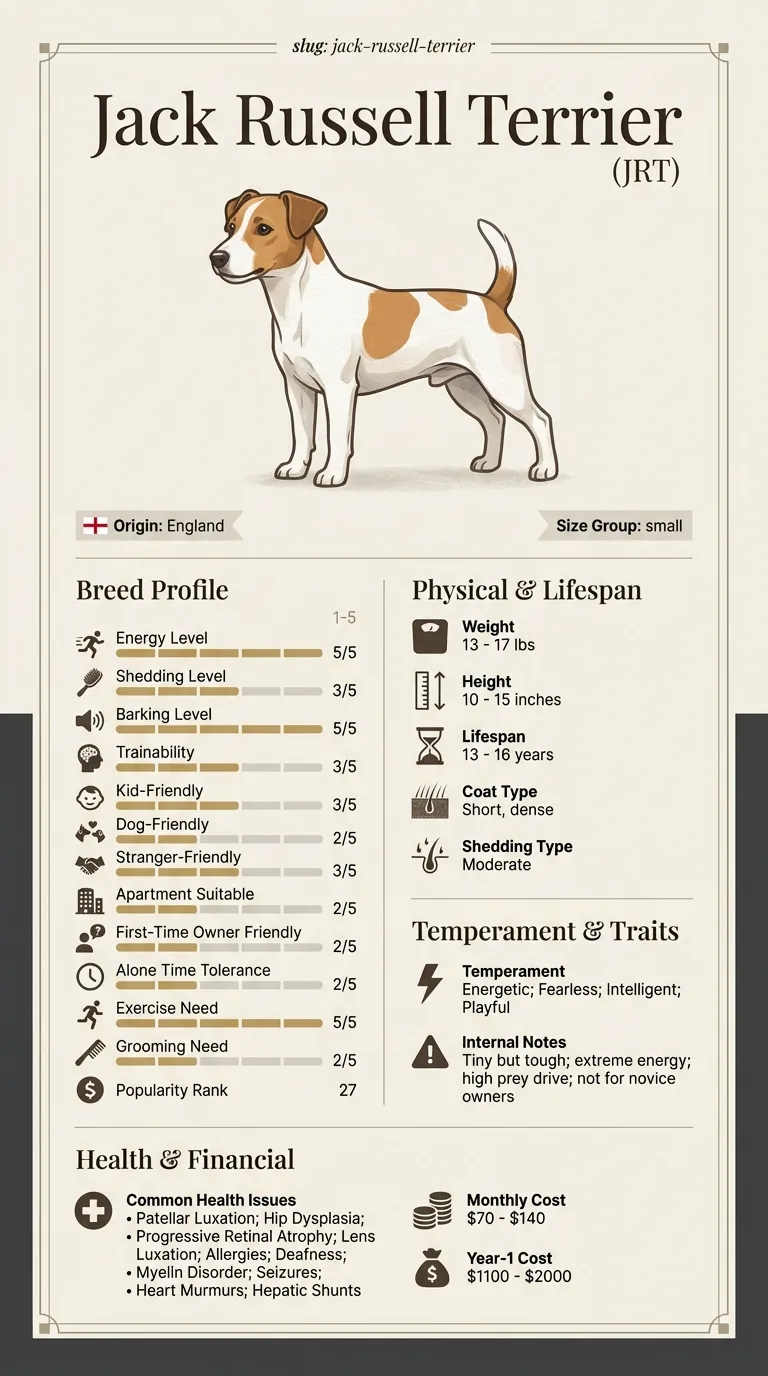
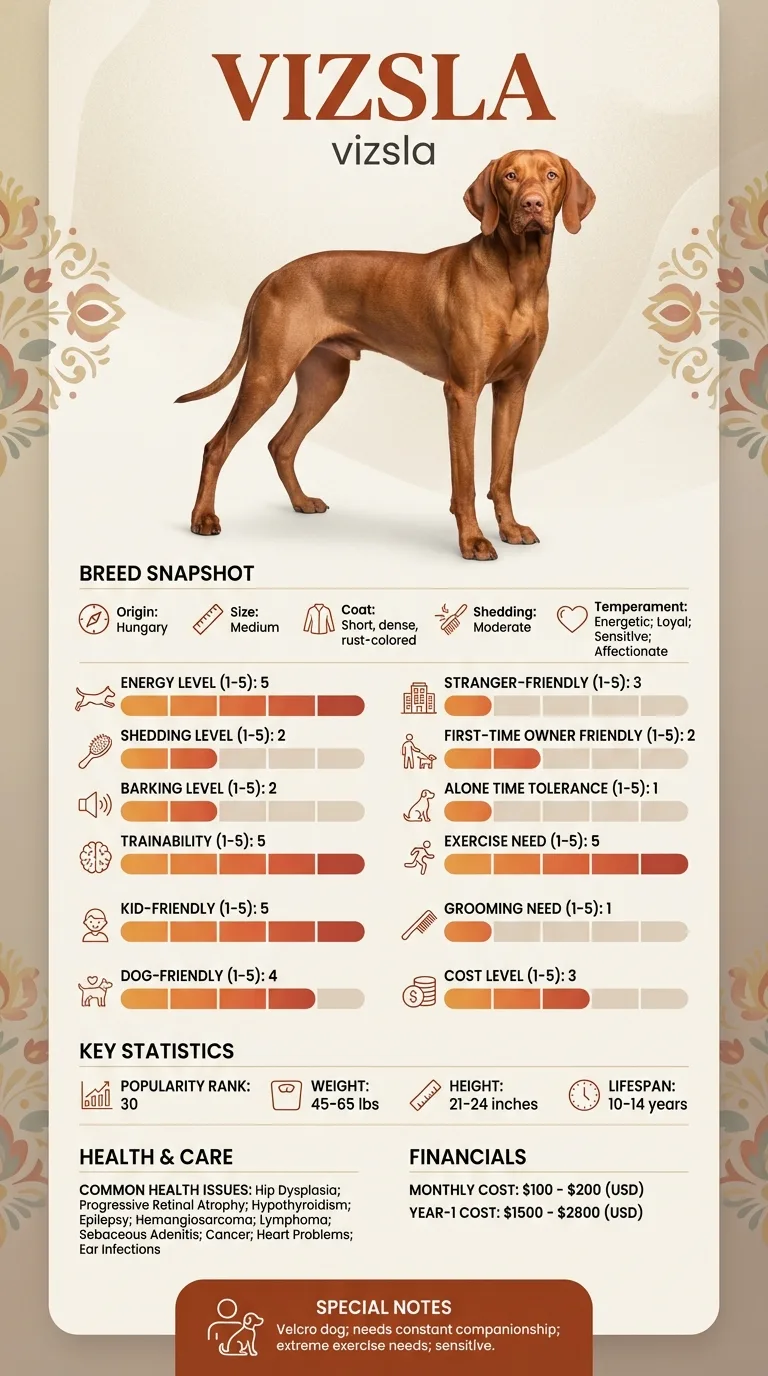
This is for someone already down to Jack Russell Terrier and Vizsla and deciding between them. For this pair the decision usually turns on barking and good with kids, so those are covered first and in most detail. Anyone choosing from a flat has a clear answer here: Jack Russell Terrier rates 2/5 against 1/5. It is written for the decision rather than the breed history.
Between Jack Russell Terrier and Vizsla, barking is what separates them, and Jack Russell Terrier is the lower-effort dog of the two to keep.
Choose Jack Russell Terrier if a smaller dog suits your car, your home or your back.
Choose Vizsla if you do not want a standing grooming appointment, shedding is a problem in your house and there are young children at home.
| Feature | jack russell terrier | vizsla | Winner |
|---|---|---|---|
| Size class | small | medium | Equal |
| Weight | 13–17 lbs | 45–65 lbs | Equal |
| Height | 10–15 in | 21–24 in | Equal |
| Lifespan | 13–16 years | 10–14 years | jack russell terrier |
| Exercise need | Very high (5/5) | Very high (5/5) | Equal |
| Grooming need | Low (2/5) | Very low (1/5) | vizsla |
| Shedding | Moderate (3/5) | Low (2/5) | vizsla |
| Energy level | Very high (5/5) | Very high (5/5) | Equal |
| Barking | Very high (5/5) | Low (2/5) | vizsla |
| Apartment suitability | Low (2/5) | Very low (1/5) | jack russell terrier |
| Good for first-time owners | Low (2/5) | Low (2/5) | Equal |
| Tolerates being alone | Low (2/5) | Very low (1/5) | jack russell terrier |
| Trainability | Moderate (3/5) | Very high (5/5) | vizsla |
| Good with kids | Moderate (3/5) | Very high (5/5) | vizsla |
| Good with other dogs | Low (2/5) | High (4/5) | vizsla |
| Friendly to strangers | Moderate (3/5) | Moderate (3/5) | Equal |
| Cost level | Low (2/5) | Moderate (3/5) | jack russell terrier |
| Coat | Short, dense | Short, dense, rust-colored | Equal |
| Origin | England | Hungary | Equal |
| Typical monthly cost | $70–$140 | $100–$200 | Equal |
| Typical first-year cost | $1,100–$2,000 | $1,500–$2,800 | Equal |
The Vizsla is a substantially bigger dog — 45 to 65 pounds and 21 to 24 inches, against the Jack Russell's 13 to 17 pounds and 10 to 15 inches. Vizslas were bred as versatile hunting dogs, and their sleek, athletic medium-large frame is built for stamina over distance rather than the terrier's low-to-the-ground digging build. That difference in build also shows up in how each dog moves through a house.
Both breeds tie at the top of the exercise scale, 5/5 apiece. Vizslas are sometimes called "velcro dogs" for how closely they shadow their owner, and that intensity carries into their exercise needs — this is not a pairing where either dog will let you skip a day. An hour or more of real activity daily is closer to the baseline than the exception for both breeds.
The Vizsla is the easier coat by a clear margin: 1/5 grooming need against the terrier's 2/5, and 2/5 shedding against the terrier's moderate 3/5. Its short, dense coat needs little beyond an occasional wipe-down, less upkeep even than the already-low-maintenance Jack Russell. Coat care simply isn't where either breed's real demands lie — that budget goes toward exercise and training instead.
Neither breed suits apartment living, but the Vizsla is worse off at 1/5 against the terrier's 2/5 — its size and clinginess make small spaces harder to manage. The terrier is by far the louder of the two, though, rating 5/5 on barking against the Vizsla's low 2/5. A Vizsla left alone in a small space for long stretches is more likely to show distress than to bark it out.
Both rate a low 2/5 for first-time owners, but the Vizsla is considerably more trainable — 5/5 against the terrier's 3/5. Vizslas were bred to work in close partnership with a handler in the field, and that responsiveness shows up clearly here, even though its intensity still makes it a demanding first dog. Both benefit from early, consistent training, but the Vizsla is more likely to reward that effort quickly.
The Vizsla rates higher with kids (5/5 versus 3/5) and other dogs (4/5 versus 2/5), while the two tie on friendliness to strangers at 3/5. Its sensitivity and attachment to its family, listed directly in its temperament profile, tends to translate into a gentler presence around children specifically. The terrier can still do well with kids, but it needs more active supervision than the more even-tempered Vizsla.
The Jack Russell lives noticeably longer — 13 to 16 years against 10 to 14 for the Vizsla. Hip dysplasia and progressive retinal atrophy appear on both health lists. The Vizsla's list carries a heavier cancer burden, with hemangiosarcoma and lymphoma both flagged alongside sebaceous adenitis, a skin condition fairly specific to the breed. Regular skin and coat checks are worth building into a Vizsla's routine given that history.
The Vizsla costs more, rating 3/5 against the terrier's 2/5. Monthly costs run $100–$200 for the Vizsla versus $70–$140 for the terrier, and first-year costs of $1,500–$2,800 against $1,100–$2,000 — a moderate gap that reflects the Vizsla's larger size rather than any specialized care needs. Food volume, not medical care, is the main line item pushing the Vizsla's budget higher.
Jack Russell Terrier weighs 13–17 lbs and lives 13–16 years; Vizsla weighs 45–65 lbs and lives 10–14 years. The two diverge most on barking, good with kids and trainability and 1 other rated axes. They are level on energy level, exercise need and good for first-time owners, so those cannot decide it. In the table, a "winner" means easier for an ordinary household — not better. Size, coat and origin are recorded without a verdict. Because both breeds are scored the same way, the gaps are reliable even where the absolute numbers are rough.

Considerably — 45–65 pounds against 13–17, roughly three to four times the terrier's weight, with a taller, leaner frame.
Neither needs much, but the Vizsla needs even less — 1/5 against the terrier's already-low 2/5, and it sheds less too (2/5 versus 3/5).
The Vizsla, clearly — 5/5 against the terrier's 3/5, though both rate low for first-time-owner suitability given their intensity.
Not well — the Vizsla is actually worse suited at 1/5 against the terrier's 2/5, mostly due to its size and tendency to shadow its owner constantly.
$70–$140 for the Jack Russell, $100–$200 for the Vizsla.
Hip dysplasia and progressive retinal atrophy appear on both lists. The Vizsla's list also carries more cancer risk, including hemangiosarcoma and lymphoma.
The Jack Russell, typically 13–16 years against 10–14 for the Vizsla.
The Vizsla suits an active owner who wants a highly trainable, kid-friendly companion and has the space; the Jack Russell fits a smaller footprint and lower grooming budget.
$70–$140 for the Jack Russell, $100–$200 for the Vizsla.
Both need maximum daily exercise — a tie at 5/5 each.
The Jack Russell, typically 13–16 years against 10–14 for the Vizsla.
Secure checkout on Stripe. We never see your card.
7-day money-back guarantee. Instant access.
Health information here is general and is not veterinary advice. If your dog shows pain, sudden behaviour change, or worsening symptoms, consult a licensed veterinarian.
Some links on this site are affiliate links. We may earn a commission at no extra cost to you, and we only suggest products we believe are helpful for dog owners.
We research and check what we publish, but we do not warrant that any figure, date, price, or statement is accurate, complete, or current, and we accept no liability for any loss, cost, injury, or other harm arising from the use of this site. Use it as one reference among several. You remain responsible for your own decisions and for your dog's care - confirm anything that matters with a licensed veterinarian or another qualified professional before you act on it. Full disclaimer.
Match your lifestyle to the right dog.
Take quizNot sure which breed is right for you? Take our 2-minute quiz to find out.
Take the quiz