Behavior
Labradoodle or Vizsla — which fits a busy household better?
Both need serious daily exercise, but the Labradoodle is the easier choice for a first-time or less experienced owner given its higher first-time-owner rating (4/5 vs. 2/5).

Quick answer
Labradoodle or Vizsla — which fits a busy household better?
Both need serious daily exercise, but the Labradoodle is the easier choice for a first-time or less experienced owner given its higher first-time-owner rating (4/5 vs. 2/5).
Labradoodle or Vizsla? On paper they differ most on grooming need, and on the scales Vizsla is the heavier at 45–65 lbs. Here is how the two compare on everything that shapes an ordinary week.
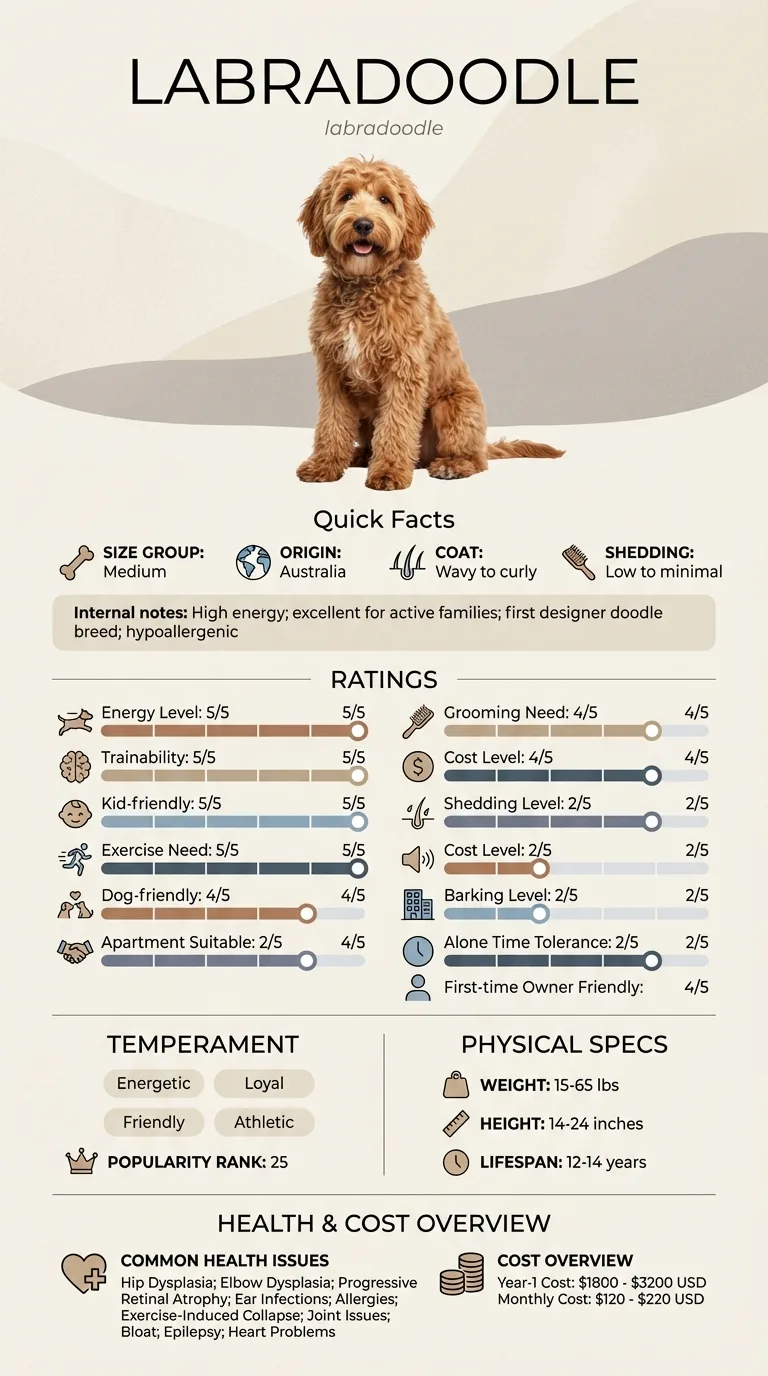
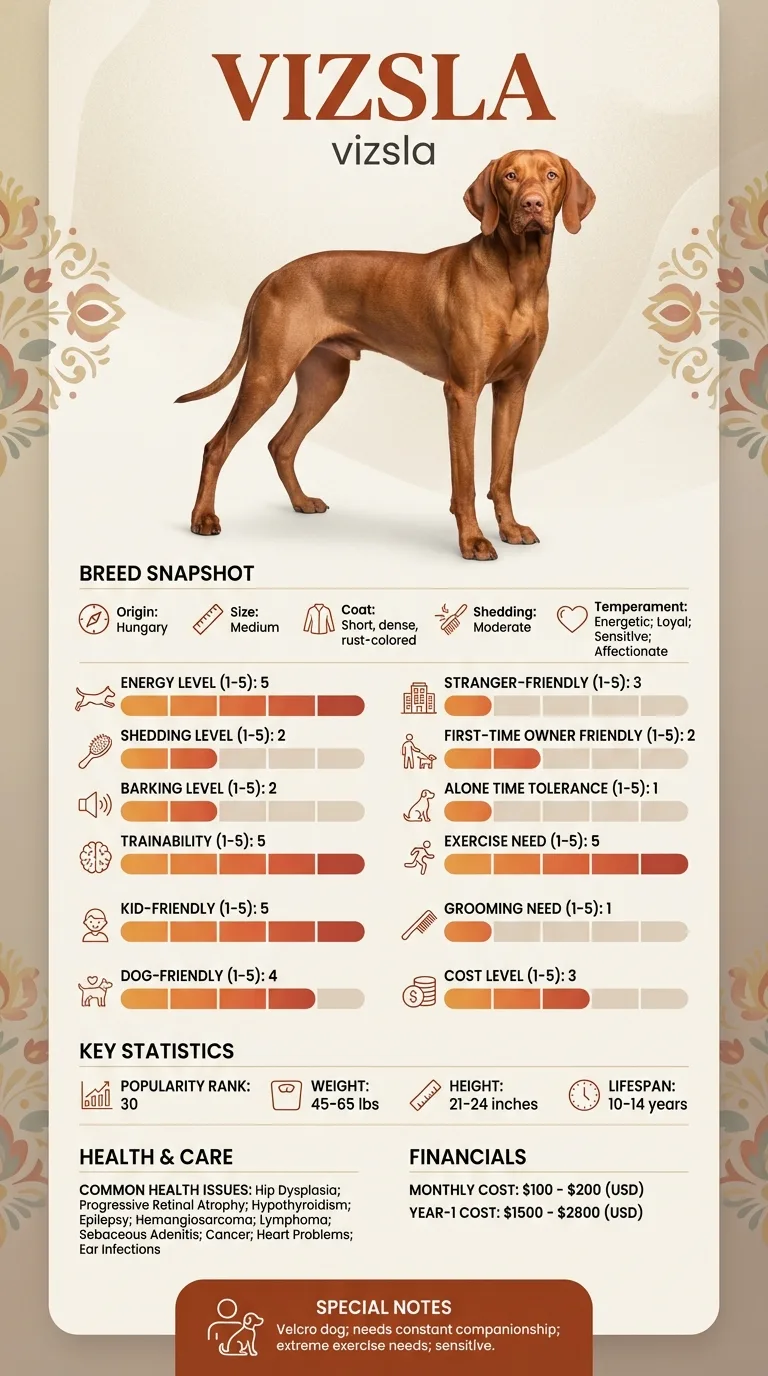
This is for someone already down to Labradoodle and Vizsla and deciding between them. For this pair the decision usually turns on grooming need and good for first-time owners, so those are covered first and in most detail. Anyone choosing from a flat has a clear answer here: Labradoodle rates 2/5 against 1/5. The focus throughout is on daily consequences rather than breed background.
Between Labradoodle and Vizsla, grooming need is what separates them, and Labradoodle is the lower-effort dog of the two to keep.
Choose Labradoodle if this is your first dog and a smaller dog suits your car, your home or your back.
Choose Vizsla if you do not want a standing grooming appointment and you want a dog that is more watchful with visitors.
| Feature | labradoodle | vizsla | Winner |
|---|---|---|---|
| Size class | medium | medium | Equal |
| Weight | 15–65 lbs | 45–65 lbs | Equal |
| Height | 14–24 in | 21–24 in | Equal |
| Lifespan | 12–14 years | 10–14 years | labradoodle |
| Exercise need | Very high (5/5) | Very high (5/5) | Equal |
| Grooming need | High (4/5) | Very low (1/5) | vizsla |
| Shedding | Low (2/5) | Low (2/5) | Equal |
| Energy level | Very high (5/5) | Very high (5/5) | Equal |
| Barking | Low (2/5) | Low (2/5) | Equal |
| Apartment suitability | Low (2/5) | Very low (1/5) | labradoodle |
| Good for first-time owners | High (4/5) | Low (2/5) | labradoodle |
| Tolerates being alone | Low (2/5) | Very low (1/5) | labradoodle |
| Trainability | Very high (5/5) | Very high (5/5) | Equal |
| Good with kids | Very high (5/5) | Very high (5/5) | Equal |
| Good with other dogs | High (4/5) | High (4/5) | Equal |
| Friendly to strangers | High (4/5) | Moderate (3/5) | labradoodle |
| Cost level | High (4/5) | Moderate (3/5) | vizsla |
| Coat | Wavy to curly | Short, dense, rust-colored | Equal |
| Origin | Australia | Hungary | Equal |
| Typical monthly cost | $120–$220 | $100–$200 | Equal |
| Typical first-year cost | $1,800–$3,200 | $1,500–$2,800 | Equal |
Weight ranges nearly overlap — 15-65 lbs for the Labradoodle against 45-65 lbs for the Vizsla — but a standard Labradoodle and a Vizsla end up close in stature, 14-24 inches versus 21-24 inches. The Vizsla is the more athletically built of the two, a lean hunting dog shape rather than the Labradoodle's shaggier profile.
Exercise need and energy level tie at 5/5 for both breeds — this is a matchup between two dogs that both need serious daily output. The Vizsla in particular is known as a 'velcro dog' that wants to be moving with you specifically, not just moving. Neither breed suits an owner who can't commit real hours to activity most days.
Grooming is the clearest split in this comparison. The Vizsla's short, dense coat needs almost nothing — a 1/5 grooming rating — while the Labradoodle's wavy-to-curly coat sits at a demanding 4/5. Shedding ties close, both low (2/5), so the Labradoodle's extra upkeep is about coat texture and mats, not fur on the floor. If brushing and trims aren't chores you enjoy, the Vizsla removes them almost entirely.
Neither breed is built for small spaces. Apartment suitability rates a low 2/5 for the Labradoodle and an even lower 1/5 for the Vizsla, and both tolerate being alone badly — 2/5 and 1/5. The Vizsla's separation-related stress is particularly well documented; this is not a dog to leave for a full workday without a plan. Barking stays low for both.
Trainability ties at 5/5 — both breeds are quick, willing learners. Where they split is first-time-owner suitability: 4/5 for the Labradoodle against 2/5 for the Vizsla, whose intensity and sensitivity can overwhelm someone without prior experience managing a high-drive dog. A trainable dog isn't automatically an easy dog, and the Vizsla is the clearer example of that gap.
Good with kids ties at a strong 5/5 for both. Other dogs also tie at 4/5. Strangers is where the Vizsla pulls back slightly, at 3/5 moderate against the Labradoodle's 4/5 — consistent with its more sensitive, attached-to-its-people temperament. Visitors should expect a warm-up period rather than instant friendliness.
The Labradoodle edges ahead on lifespan, 12-14 years against the Vizsla's 10-14. Both share hip dysplasia, progressive retinal atrophy, epilepsy, heart problems, and ear infections. The Vizsla's list carries more cancer risk specifically — hemangiosarcoma and lymphoma both appear — which is worth discussing with a vet given the breed's documented higher cancer rates.
Cost level favors the Vizsla slightly, 3/5 against the Labradoodle's 4/5, with monthly costs of $100-200 versus $120-220 and first-year totals of $1,500-2,800 versus $1,800-3,200. The Vizsla's near-zero grooming need is the main reason it comes in cheaper despite being the larger dog on average. Food costs land close given their overlapping weight ranges.
Labradoodle weighs 15–65 lbs and lives 12–14 years; Vizsla weighs 45–65 lbs and lives 10–14 years. The two diverge most on grooming need and good for first-time owners. They are level on barking, good with other dogs and energy level, so those cannot decide it. The table below marks a winner only where one breed is genuinely easier for a typical owner; size and origin are facts rather than merits and stay level. Ratings come from one source applied to both breeds, so they are meaningful against each other rather than as absolute scores.

The Labradoodle by far — 4/5 against the Vizsla's minimal 1/5. The Vizsla's short coat needs little beyond occasional brushing, while the Labradoodle's curls require regular attention to avoid matting.
Not especially — it rates 2/5 for first-time owners due to its intensity and sensitivity, even though it's highly trainable (5/5). The Labradoodle, at 4/5 for first-timers, is the more forgiving pick.
Both struggle with it. The Labradoodle rates 2/5 and the Vizsla just 1/5 for tolerating alone time — the Vizsla in particular is prone to real separation anxiety and isn't suited to long solo days.
The Vizsla, at $100-200 a month against the Labradoodle's $120-220. Its near-zero grooming costs offset its larger average size.
Hip dysplasia, progressive retinal atrophy, epilepsy, heart problems, and ear infections appear on both lists. The Vizsla carries additional cancer risk, including hemangiosarcoma and lymphoma.
The Labradoodle has a slight edge, 12-14 years against the Vizsla's 10-14 year range.
Both need a full 5/5 worth of daily exercise. The Vizsla in particular wants to exercise alongside you specifically, not just get time in the yard.
Both need serious daily exercise, but the Labradoodle is the easier choice for a first-time or less experienced owner given its higher first-time-owner rating (4/5 vs. 2/5).
$120-220 for a Labradoodle versus $100-200 for a Vizsla — the Vizsla's near-zero grooming need keeps its costs lower.
Both max out at 5/5 — this is a high-energy matchup either way.
The Labradoodle has a slight edge, 12-14 years versus the Vizsla's 10-14.
Secure checkout on Stripe. We never see your card.
7-day money-back guarantee. Instant access.
Health information here is general and is not veterinary advice. If your dog shows pain, sudden behaviour change, or worsening symptoms, consult a licensed veterinarian.
Some links on this site are affiliate links. We may earn a commission at no extra cost to you, and we only suggest products we believe are helpful for dog owners.
We research and check what we publish, but we do not warrant that any figure, date, price, or statement is accurate, complete, or current, and we accept no liability for any loss, cost, injury, or other harm arising from the use of this site. Use it as one reference among several. You remain responsible for your own decisions and for your dog's care - confirm anything that matters with a licensed veterinarian or another qualified professional before you act on it. Full disclaimer.
Match your lifestyle to the right dog.
Take quizNot sure which breed is right for you? Take our 2-minute quiz to find out.
Take the quiz