DogBreedCompass

Malamute or Standard Poodle: Same Bill, Very Different Dog

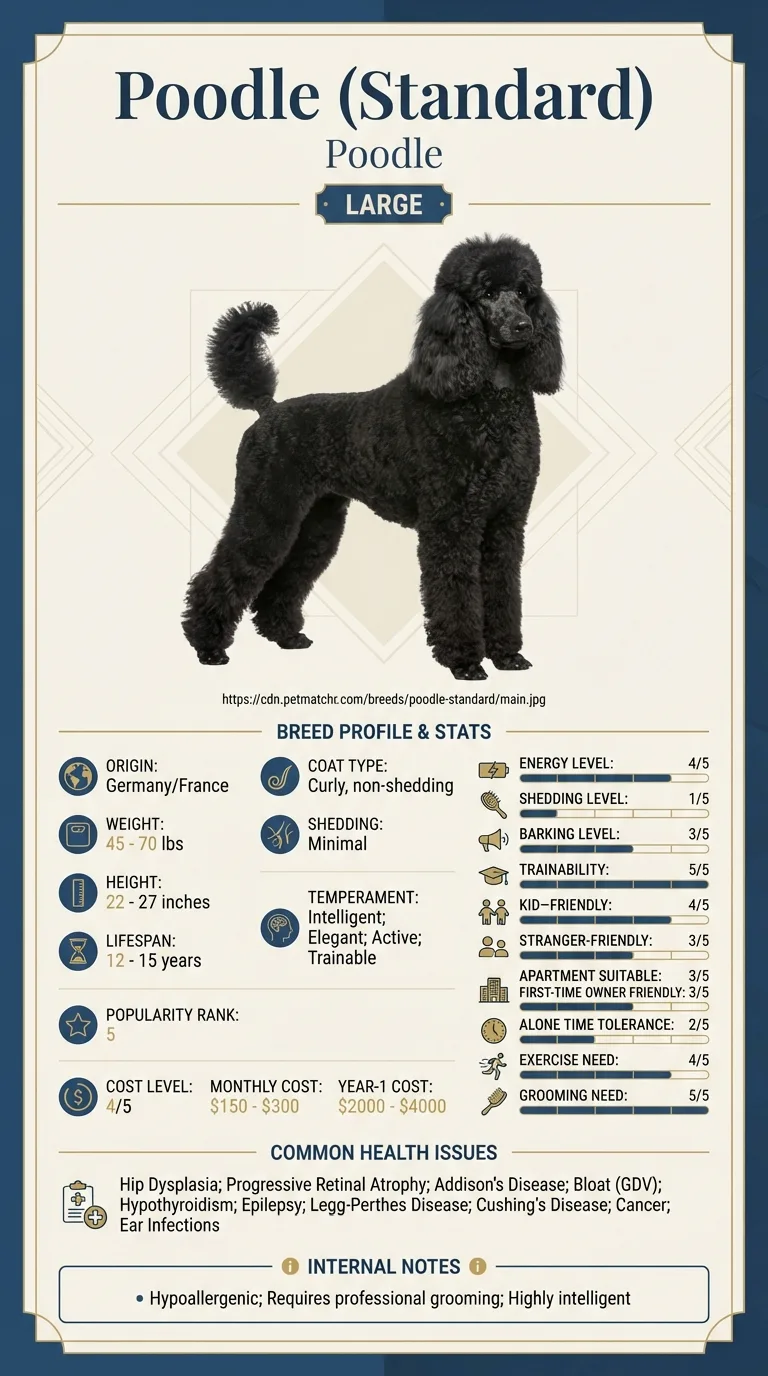
These two breeds carry exactly the same cost figures — $150 to $300 a month and $2,000 to $4,000 in the first year — and arrive at them through completely different spending. One is food. The other is the groomer.

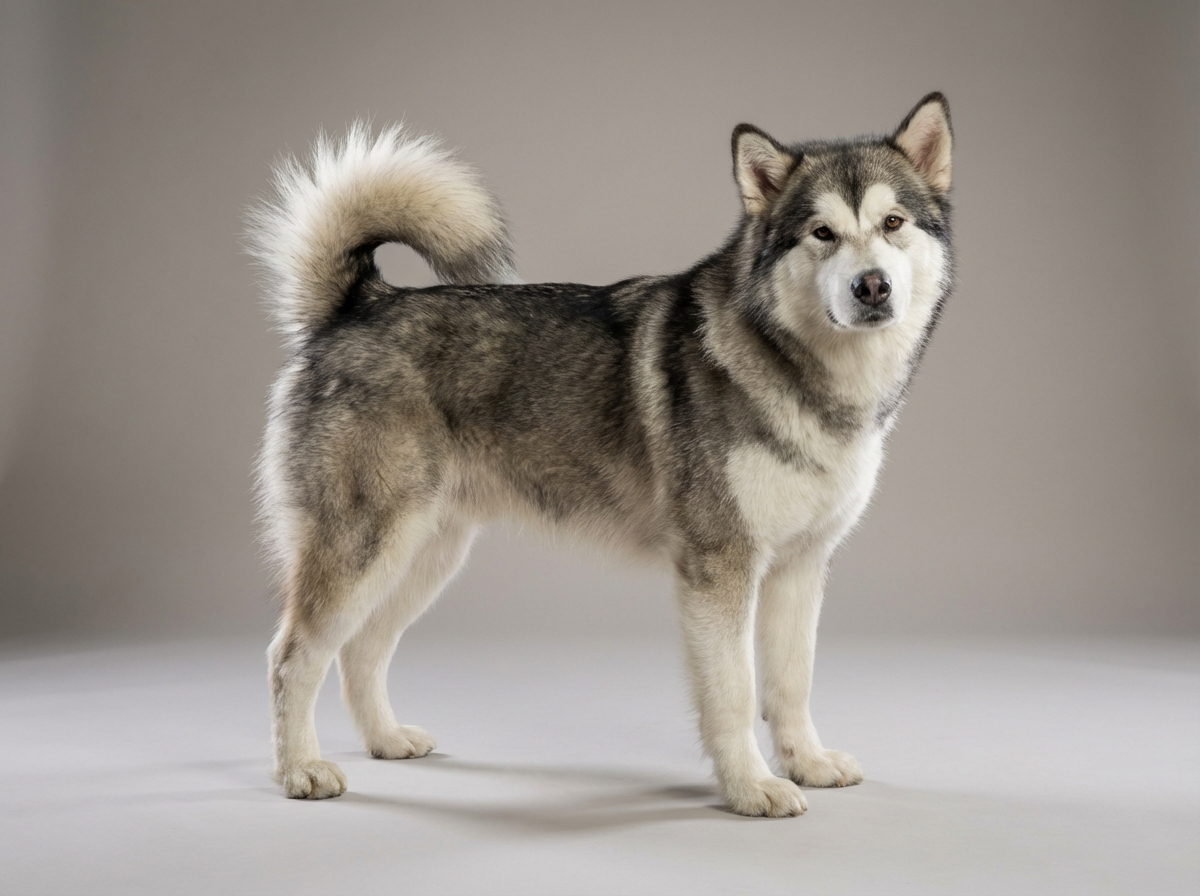
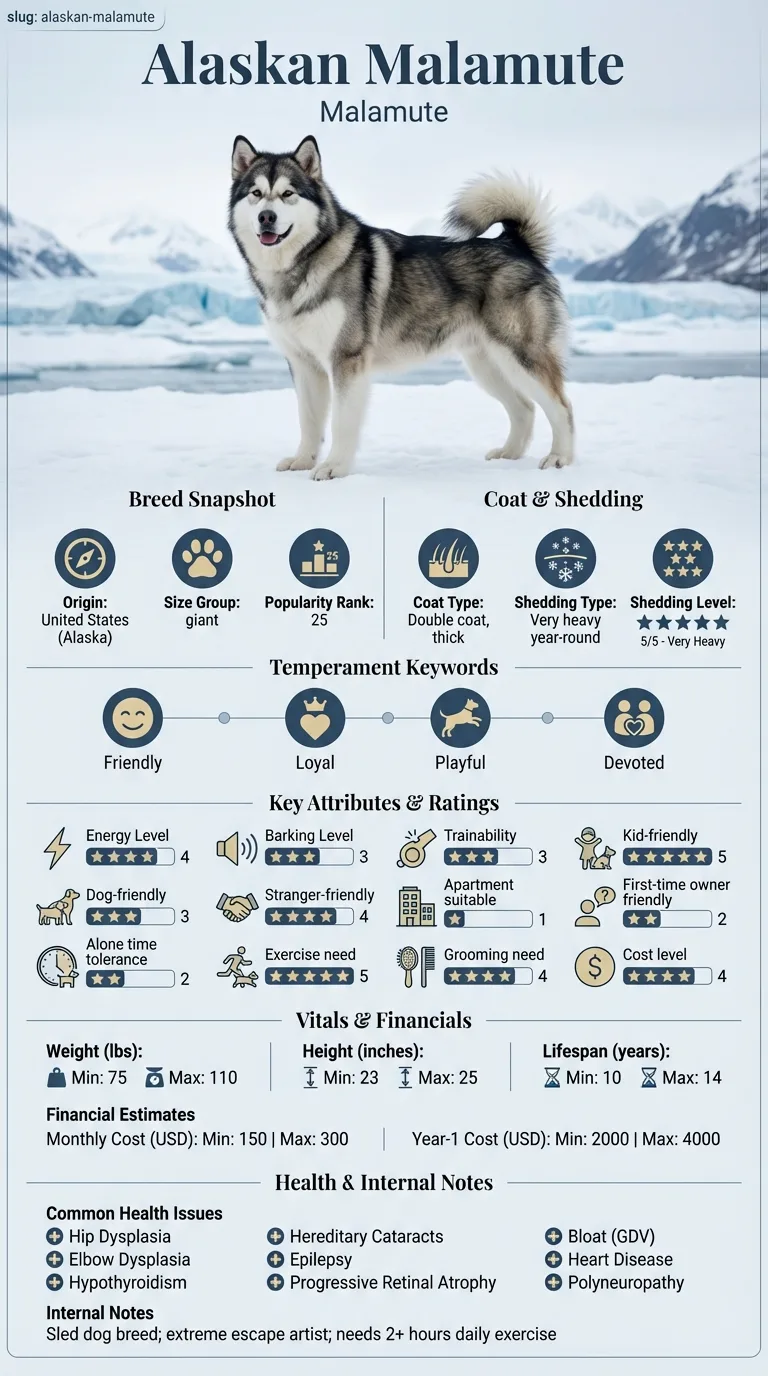
alaskan malamute infographic
poodle standard infographic

This page is for someone who wants a large, capable, intelligent dog and has narrowed it to a working breed that sheds enormously and a working breed that sheds nothing — and needs to know which set of demands they can carry.

Quick verdict

The Standard Poodle is more trainable, cleaner, longer-lived and more adaptable, and it costs the same to run; the Malamute wins only on grooming simplicity, warmth with children and a lower bloat risk.

Choose alaskan malamute if...

Choose the Alaskan Malamute if you want a cold-weather working dog with a fixed size and a coat you maintain yourself for free, and you can supply two hours of daily physical work and a fence it cannot get through.

Choose poodle standard if...

Choose the Standard Poodle if you want a large dog that trains at 5/5, drops no hair and lives 12 to 15 years, and you will book a professional clip every four to six weeks and take its bloat risk seriously.

Head-to-head comparison

Featurealaskan malamutepoodle standardWinner
Weight75–110 lbs45–70 lbsEqual
Height23–25 in22–27 inEqual
Lifespan10–14 years12–15 yearspoodle standard
CoatThick double coatCurly, non-sheddingEqual
Grooming need4/55/5alaskan malamute
Shedding5/5 — very heavy year-round1/5 — minimalpoodle standard
Energy level4/54/5Equal
Exercise need5/54/5poodle standard
Trainability3/55/5poodle standard
Barking3/53/5Equal
Good with kids5/54/5alaskan malamute
Good with other dogs3/54/5poodle standard
Friendly to strangers4/53/5alaskan malamute
Apartment suitability1/53/5poodle standard
Good for first-time owners2/53/5poodle standard
Tolerates being alone2/52/5Equal
Typical monthly cost$150–300$150–300Equal
Typical first-year cost$2,000–4,000$2,000–4,000Equal

Deep dive

The same numbers, spent on completely different things

It is worth pausing on the fact that these two breeds land on identical figures, because the identity is coincidental and the composition is instructive.

The Malamute's $150 to $300 a month is dominated by food volume and by weight-scaled veterinary pricing. A dog approaching a hundred pounds is charged more for parasite prevention, anaesthesia, sedation, pain relief and antibiotics than a seventy pound one, at every appointment for its whole life. Grooming costs nothing but hours — an undercoat rake and two or three sessions a week.

The Standard Poodle's identical figure is dominated by grooming. A large-breed full clip every four to six weeks, for twelve to fifteen years, is somewhere around a hundred and thirty appointments and is the single biggest recurring line in the breed's budget. Food for a 55 pound dog is meaningfully cheaper than for a 95 pound one, and weight-based veterinary items cost less — but the groomer closes the gap and then some.

There is a third component that does not appear in either monthly figure: insurance. The Standard Poodle's list carries several chronic conditions requiring lifelong medication — Addison's disease, Cushing's disease, hypothyroidism — plus cancer and bloat. The Malamute's carries orthopaedic risk. Quotes vary enormously by region and by age at enrolment, and in both breeds insuring before anything is diagnosed is the difference between a policy that covers a chronic condition and one that excludes it.

The practical conclusion is that cost should not be the deciding variable here. It is the same. The decision is about hair, training and time.

Bloat: the Standard Poodle's risk is higher than most owners expect

Bloat appears on both breeds' health lists, but it belongs in a section of its own for the Standard Poodle because the breed's build makes it one of the higher-risk large dogs.

Gastric dilatation and volvulus is a stomach that fills with gas and then rotates on its own axis, cutting off the blood supply. The risk correlates strongly with a deep, narrow chest — and a Standard Poodle's chest is exactly that shape, deeper relative to its width than a Malamute's. The signs are a dog that becomes restless and uncomfortable, tries repeatedly to vomit and produces nothing, has a swelling or drum-tight abdomen, and drools. It kills in hours, not days.

What that means practically: split the daily food into two or three meals rather than one, keep the hour either side of eating quiet, use a slow-feeder bowl for a fast eater, and know before you need to know where your nearest out-of-hours surgery is and roughly what it charges. Because the risk is elevated in the breed, prophylactic gastropexy — tacking the stomach so it cannot rotate, often done alongside spay or neuter — is a reasonable conversation to have with a vet rather than an exotic one.

The same measures apply to the Malamute, whose risk is real but lower.

The rest of the Standard's list runs long: hip dysplasia, progressive retinal atrophy with DNA testing available, Addison's disease, Cushing's disease, hypothyroidism, epilepsy, Legg-Calve-Perthes, cancer and ear infections. Cancer incidence in the breed is meaningful, and ear care is a routine maintenance job because hair grows inside the canal and traps moisture.

The Malamute's list is shorter: hip and elbow dysplasia, bloat, hypothyroidism, epilepsy, progressive retinal atrophy, hereditary cataracts, zinc-responsive dermatosis and inherited polyneuropathy.

Two working coats: one you rake, one you book

Both coats were built for water and weather. Neither is low maintenance. They fail in opposite directions.

The Standard Poodle's coat is a dense single-layer curl that grows continuously and traps its dead hair instead of dropping it. That is the whole reason for the 1/5 shedding rating and the whole reason for the 5/5 grooming rating — the same fact stated twice. Trapped hair felts into the live coat against the skin, fastest behind the ears, under the collar and harness, in the armpits, between the back legs and around the tail. The prevention is line-brushing at home most days, parting the coat and working from the skin outwards, plus a professional clip every four to six weeks. Skip the daily work and the appointment becomes a shave-down.

The traditional Poodle trims are functional in origin: coat left over the chest and joints for insulation in cold water, hindquarters stripped for swimming. For a pet, a short even trim all over is entirely acceptable and reduces the daily job to a few minutes.

The Malamute's coat is a double coat — coarse outer, dense wool undercoat — rated 5/5 for shedding, very heavy year-round, with two annual blows when the wool leaves in sheets over two to three weeks. The tool is an undercoat rake worked to the skin, two or three sessions a week, and the risk points are behind the ears, the armpits and the trousers. No appointments, no fees, and one absolute rule: never clip it. A double coat insulates in both directions and regrowth after a shave is frequently permanently altered.

The household difference is stark. A Poodle house has no dog hair in it. A Malamute house has dog hair in every room, on every surface, permanently, and drifts of it twice a year.

5/5 against 3/5 in two dogs of similar size

This is the most useful comparison on the page for anyone who actually intends to train their dog, because size is held roughly constant and the difference is pure temperament.

The Standard Poodle is a water retriever with one of the highest trainability ratings of any breed. It watches its handler, offers behaviour, discriminates between cues and retains sequences. It competes seriously in obedience, agility, rally, scent work and gundog disciplines, and it takes to assistance work. For an owner who wants a partner rather than a companion, this is close to ideal material.

It is also sensitive. Harsh correction produces shutdown and avoidance rather than defiance, and a Poodle that has learned a handler is unpredictable becomes hesitant to offer anything. The training approach that works is clear, consistent and reward-based.

The Malamute at 3/5 was selected for the opposite quality. A freighting dog on ice had to keep working without consulting anyone and had to override a driver's decision when the ice said so. That produces a dog that understands the instruction, weighs it, and complies if the terms are good. Off-lead recall is the clearest expression, and most Malamute owners never fully trust it.

The exercise ratings differ by one point, 5/5 against 4/5, and the practical gap is larger. A Standard Poodle can be satisfied with an hour that mixes movement and mental work, and it swims willingly, which is a genuine outlet. The Malamute needs two hours with physical resistance in it and mental work does not substitute. On a wet Tuesday the Poodle owner has options and the Malamute owner has a coat and a head torch.

Both rate 2/5 for solitude. Neither belongs in an empty house all day, and both develop problems when under-employed — the Poodle anxious and inventive, the Malamute destructive and escape-oriented.

Family fit, space and the last considerations

With children the Malamute leads 5/5 to 4/5. Both are safe, warm dogs; the Malamute is simply more tolerant of clumsy handling, while a Poodle is finer-boned and more sensitive to being grabbed. Neither should be left unsupervised with a toddler, for opposite reasons — one might knock a child over, the other might be hurt.

With other dogs the Poodle leads 4/5 to 3/5 and is generally straightforward in group settings. The Malamute's tolerance narrows with same-sex adults. Around cats the Poodle is usually safe and the Malamute keeps a hunting drive that is managed rather than resolved.

With strangers the Malamute is warmer at 4/5 against 3/5 — Poodles are often reserved with new people, which reads as aloofness rather than suspicion. Neither is a guard dog; both rate 3/5 for barking.

On space, the Poodle's 3/5 apartment rating against 1/5 reflects the fact that its needs can be partly met indoors and that it does not shed. It is still a 27 inch dog and a large flat is the minimum. The Malamute's 1/5 is about the exercise requirement and the summer heat problem more than the footprint.

Lifespan favours the Poodle at 12 to 15 years against 10 to 14 — a modest edge, but a real one given the two dogs are similar in size.

The honest summary: if you can meet the Malamute's exercise requirement and you genuinely do not mind hair, it is a magnificent dog and the cheaper one in effort terms. If either of those is in doubt, the Standard Poodle does almost everything the Malamute does not, for the same money.

Alaskan Malamute vs Poodle (Standard) at a glance

These two breeds carry exactly the same cost figures — $150 to $300 a month and $2,000 to $4,000 in the first year — and arrive at them through completely different spending. For the Malamute it is food for a large, active dog. For the Standard Poodle it is the groomer.

The Standard Poodle is more trainable, cleaner, longer-lived, and more adaptable to different homes, and it costs the same to run as the Malamute despite the very different reason. The Malamute's advantages are narrower but real: simpler grooming that needs no professional input, more natural warmth with children, and a lower bloat risk.

Choose the Malamute if you want a cold-weather working dog with a fixed size and a coat you maintain yourself for free, and you can supply two hours of daily physical work and secure fencing. Choose the Standard Poodle if you want a large, highly trainable dog that drops no hair, and you will book a professional clip every four to six weeks and take its bloat risk seriously.

Frequently asked questions

Do these two breeds really cost the same?

Yes — both are listed at $150 to $300 a month and $2,000 to $4,000 in the first year. The Malamute's spend is food and weight-based veterinary pricing; the Poodle's is a professional clip every four to six weeks for twelve to fifteen years.

Which is bigger?

The Malamute is heavier at 75 to 110 pounds against 45 to 70, but the Standard Poodle is often taller — 22 to 27 inches against 23 to 25. The Poodle is a tall, lean dog rather than a small one.

Is bloat a serious risk for Standard Poodles?

Yes. The breed's deep narrow chest puts it among the higher-risk large dogs, and bloat kills in hours. Split meals, quiet time around eating and a known emergency route all help, and prophylactic gastropexy is worth discussing with a vet.

Which sheds less?

The Poodle at 1/5 against the Malamute's 5/5, and the difference in a house is absolute rather than marginal. The trade is that the Poodle's coat needs daily brushing and a clip every four to six weeks.

Which is easier to train?

The Standard Poodle at 5/5 against 3/5. It is a working retriever that watches its handler and offers behaviour. The Malamute considers each instruction on its merits, which is why off-lead recall rarely becomes reliable.

Which needs more exercise?

The Malamute at 5/5 against 4/5. The Poodle can be satisfied by an hour mixing movement and mental work, and it swims willingly. The Malamute needs two hours with physical resistance and nothing indoors substitutes.

Which lives longer?

The Standard Poodle at 12 to 15 years against 10 to 14. Cancer is the entry on its list that most often decides the end, while the Malamute's limiting factors are usually orthopaedic.

Quick answers

View more answers
Living

Malamute or Standard Poodle: which should I choose?

The Poodle if you want a large, highly trainable dog with no hair in the house and you will keep a four to six week grooming schedule. The Malamute if you want a cold-weather working dog and would rather rake a coat than book one in.

Costs

Which is cheaper to run?

Neither — both are listed at $150 to $300 a month and $2,000 to $4,000 in the first year, with cost level 4/5. Cost should not be the deciding factor between these two.

Health

What health testing should a Standard Poodle breeder have done?

Hip scores, eye certification and DNA testing for progressive retinal atrophy, plus honesty about any Addison's disease, epilepsy or cancer in the line.

Behavior

Which is better with other dogs?

The Standard Poodle at 4/5 against 3/5. It is generally easy in group settings, while Malamute tolerance narrows sharply with same-sex adults.

Related DogBreedCompass guides

  • Alaskan Malamute breed guideThe Malamute profile covers exercise load, coat raking and the containment work the breed requires.
  • Standard Poodle breed guideThe Standard Poodle profile covers coat maintenance, training potential and the breed's working origins.
  • bloat in Standard PoodlesA deep narrow chest puts the breed among the higher-risk large dogs for this emergency.
  • hip dysplasia in Standard PoodlesHip dysplasia sits on both lists and is the first screening question for either breeder.
  • cancer in Standard PoodlesCancer incidence is meaningful in the breed and is usually what limits the upper end of its lifespan.
  • Alaskan Malamute vs Miniature PoodleReaders choosing between Poodle sizes usually want the smaller variety weighed up alongside.

Related guides

Important reminder

Health information here is general and is not veterinary advice. Bloat risk, preventive surgery and screening should be discussed with your own veterinarian.

Some links on this site are affiliate links. We may earn a commission if you buy through them, at no additional cost to you.

Find Your Perfect Breed

Match your lifestyle to the right dog.

Take quiz

Find your match

Not sure which breed is right for you? Take our 2-minute quiz to find out.

Take the quiz