Malamute or Doberman: Same Workload, Opposite Instincts
Quick answer
Malamute vs Doberman: which should I choose?
The Doberman if you want a working partner and a genuine deterrent, and will train it daily and screen its heart. The Malamute if you want a sociable dog with no guarding liability and can meet its physical demands.
Five ratings match exactly: exercise, energy, barking, dog tolerance and time alone. Both are 5/5 exercise dogs that should not be left all day. Then the stranger row splits them — 4/5 against 2/5 — and everything about what each dog is for follows from that single number.
This page is for someone weighing two athletic large breeds with the same workload and opposite purposes. It covers the guarding difference, trainability, cardiac screening in the Doberman, coat and climate, and cost.
Quick verdict
The Doberman is far more trainable and is a genuine deterrent; the Malamute is friendlier, hairier, harder to contain and carries nothing like the Doberman's cardiac risk.
Choose alaskan malamute if...
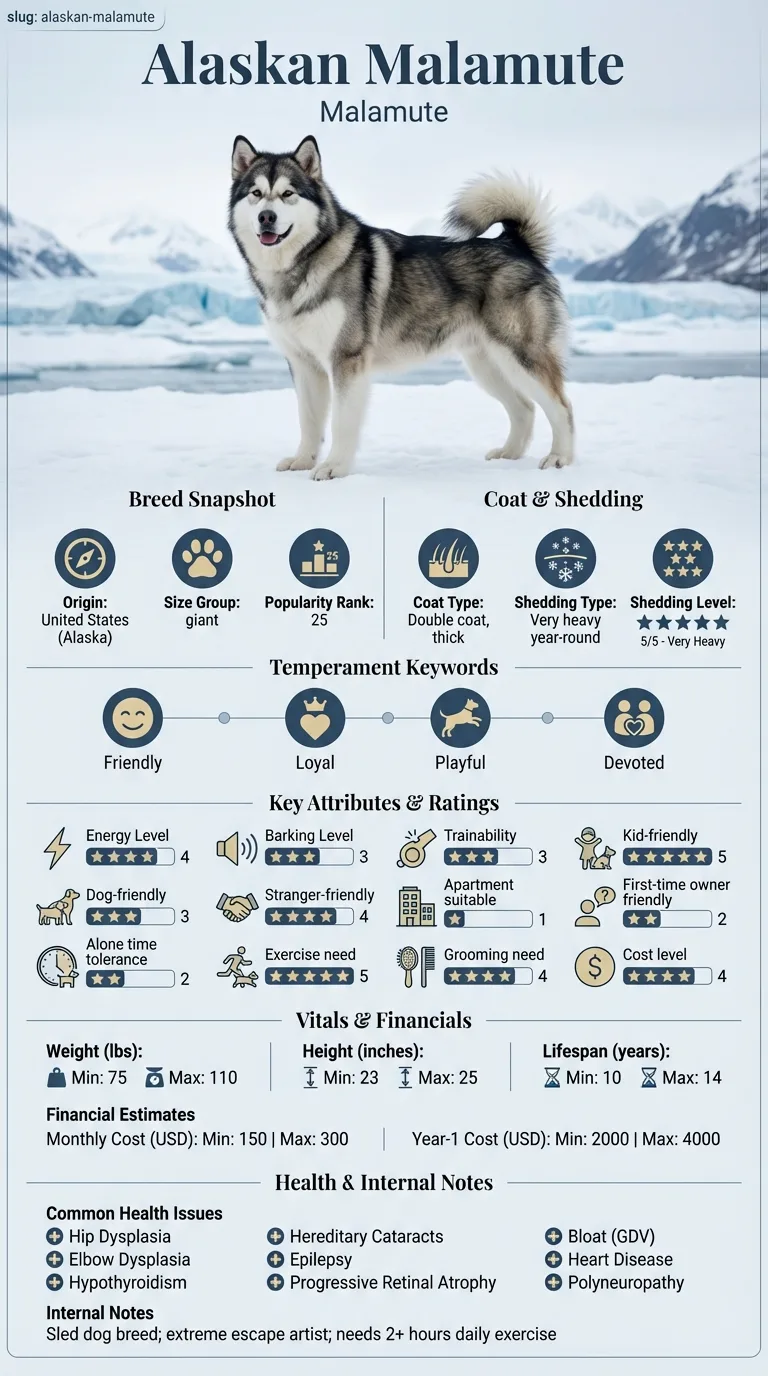
Choose the Alaskan Malamute if you want a sociable dog and no guarding. It rates 4/5 with strangers against the Doberman's 2/5 and 5/5 with children against 4/5, and it has no comparable cardiac burden. You are accepting $150–$300 a month against $120–$250, 5/5 shedding against 3/5 and 4/5 grooming against 1/5.
Choose doberman pinscher if...
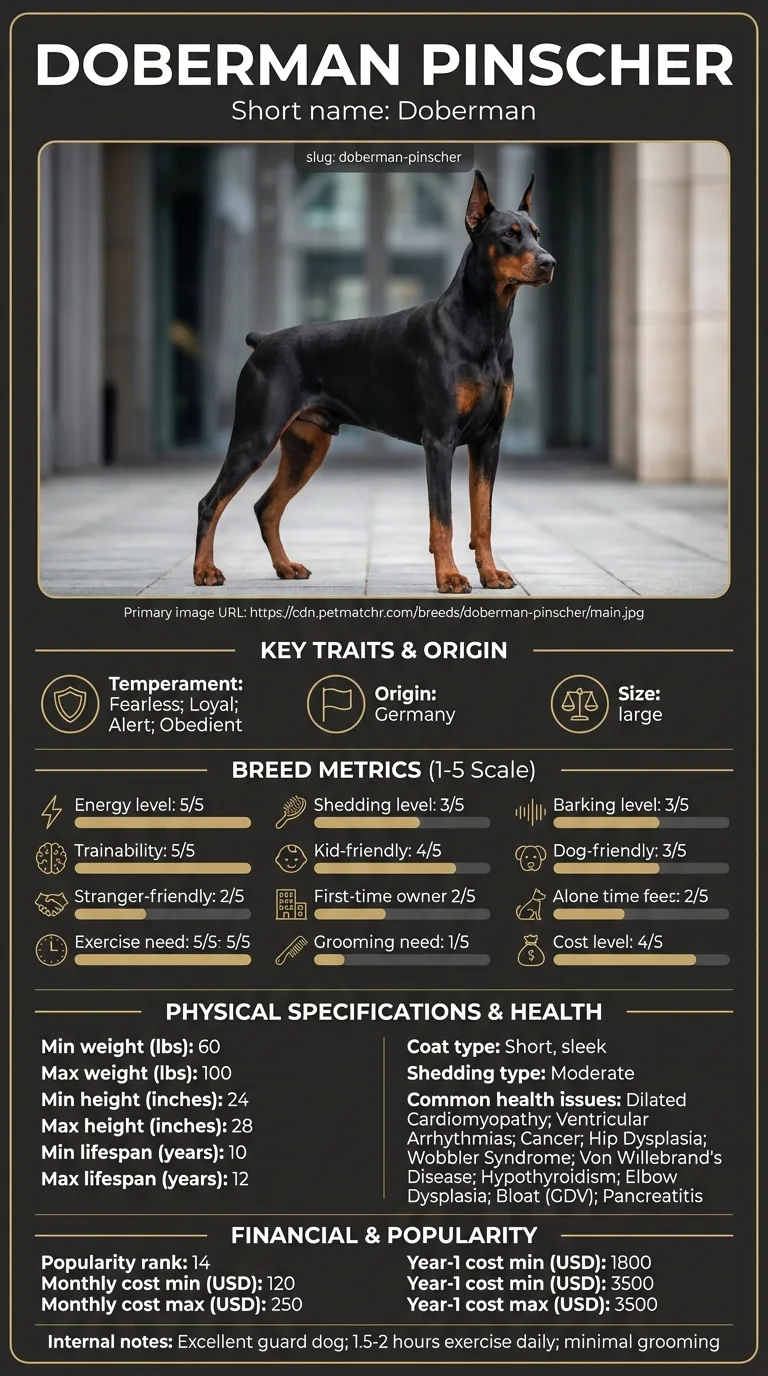
Choose the Doberman if you want a working partner that looks to you for direction. It rates 5/5 for trainability against 3/5, grooms at 1/5 — the lowest here — and sheds at 3/5. You are accepting 2/5 with strangers, a serious cardiac screening commitment, and a coat that gives no protection from cold.
Head-to-head comparison
Feature
alaskan malamute
doberman pinscher
Winner
Weight
75–110 lbs
60–100 lbs
Equal
Height
23–25 in
24–28 in
Equal
Lifespan
10–14 years
10–12 years
alaskan malamute
Coat
Thick double coat
Short and sleek
Equal
Grooming need
High (4/5)
Very low (1/5)
doberman pinscher
Shedding
Very high (5/5)
Moderate (3/5)
doberman pinscher
Energy level
High (4/5)
Very high (5/5)
Equal
Exercise need
Very high (5/5)
Very high (5/5)
Equal
Trainability
Moderate (3/5)
Very high (5/5)
doberman pinscher
Barking
Moderate (3/5)
Moderate (3/5)
Equal
Good with kids
Very high (5/5)
High (4/5)
alaskan malamute
Good with other dogs
Moderate (3/5)
Moderate (3/5)
Equal
Friendly to strangers
High (4/5)
Low (2/5)
alaskan malamute
Apartment suitability
Very low (1/5)
Low (2/5)
doberman pinscher
Good for first-time owners
Low (2/5)
Low (2/5)
Equal
Tolerates being alone
Low (2/5)
Low (2/5)
Equal
Typical monthly cost
$150–$300
$120–$250
doberman pinscher
Typical first-year cost
$2,000–$4,000
$1,800–$3,500
doberman pinscher
Deep dive
5/5 against 3/5, and what each requires
The Doberman learns quickly, retains reliably and works at distance. It does detection, protection, obedience and assistance work at a professional level, and a well-handled one is superb.
The corollary is that the training is not optional. A dog that learns quickly learns unwanted things quickly, and a Doberman that has taught itself to charge the fence or guard the sofa has learned that as thoroughly as anything you meant to teach it. Ninety minutes to two hours of activity a day with a real portion of it mental — obedience, tracking, scent work — is the realistic commitment.
It is also a sensitive breed. Dobermans attach closely, dislike heavy-handedness, and are frequently described as velcro dogs at home despite the reputation.
The Malamute's 3/5 is disinterest rather than difficulty. It was bred to work without instruction and does not look to a handler, so training gives you influence rather than control. Its recall should be treated as a bonus rather than a safety measure.
Which brings up the difference that matters most outdoors: containment.
One dog leaves, the other patrols
The Malamute is one of the harder dogs in this batch to keep in a garden. Its own breed notes describe an extreme escape artist: it digs, climbs, works at latches and travels once loose, and the instinct to cover distance is the whole point of the breed.
A fence dug in at the base, secured gates and a microchip with current details are the baseline. Long lines rather than off-lead in open ground, and no assumption that recall will save the dog.
A Doberman generally stays. Its boundary problem is the opposite — it patrols, and a fence it can see through into a street gives it something to guard against all day, which builds reactivity rather than escape attempts.
So the fencing brief differs: solid and dug in for the Malamute, and solid and visually screened for the Doberman.
Both need broad socialisation continued past the first year, the Malamute because same-sex intolerance appears at social maturity and the Doberman because a discriminating guardian temperament needs a wide reference library of normal people and situations.
The Doberman's cardiac screening is a real commitment
Dilated cardiomyopathy heads the Doberman's condition list and no other breed on this site carries a cardiac risk of comparable scale.
The heart muscle weakens and the chambers enlarge. In Dobermans there is usually a long occult phase in which the dog looks entirely healthy while the disease is already established, and the first outward sign can be collapse or sudden death from an arrhythmia.
That is why screening here means annual Holter monitoring and echocardiography from around three years old rather than a stethoscope check. Catching the occult phase allows medication that meaningfully delays heart failure, and the cost of that screening — several hundred a year — is a genuine part of the budget for the breed rather than an optional extra.
Ask a breeder for Holter and echo results on both parents, and the ages and causes of death of the grandparents.
Von Willebrand's disease is the second item: an inherited clotting disorder with a DNA test, usually discovered during surgery when it is not tested for. Wobbler syndrome, hypothyroidism, hip and elbow dysplasia, pancreatitis and bloat complete the list.
The Malamute's list is orthopaedic, endocrine and neurological, and it lives two years longer.
Coat, climate and money
The Doberman's coat is the lowest maintenance in this batch at 1/5 — a weekly wipe over — and it sheds moderately at 3/5 in fine hairs that stick to everything.
It also provides almost no insulation. Dobermans need a coat in cold weather and should not be left outside in it, which is a real constraint in a northern climate.
The Malamute is the exact opposite: entirely comfortable in cold that keeps other breeds indoors, limited by heat instead, and carrying a 4/5 grooming load with 5/5 shedding. Its coat needs an undercoat rake and several long sessions during two heavy blows a year and should never be clipped.
On money the Doberman runs $120–$250 a month against $150–$300, and $1,800–$3,500 against $2,000–$4,000 in the first year — before cardiac screening, which closes most of that gap.
Both are deep-chested and both carry a real bloat risk, so both households should know the signs and know where the nearest out-of-hours surgery is.
Alaskan Malamute vs Doberman Pinscher: the row that decides it
Exercise, energy, barking, dog tolerance, first-time owners and time alone all tie. Two athletic large dogs with the same demands on your week.
The stranger rating is where they part: 4/5 against 2/5.
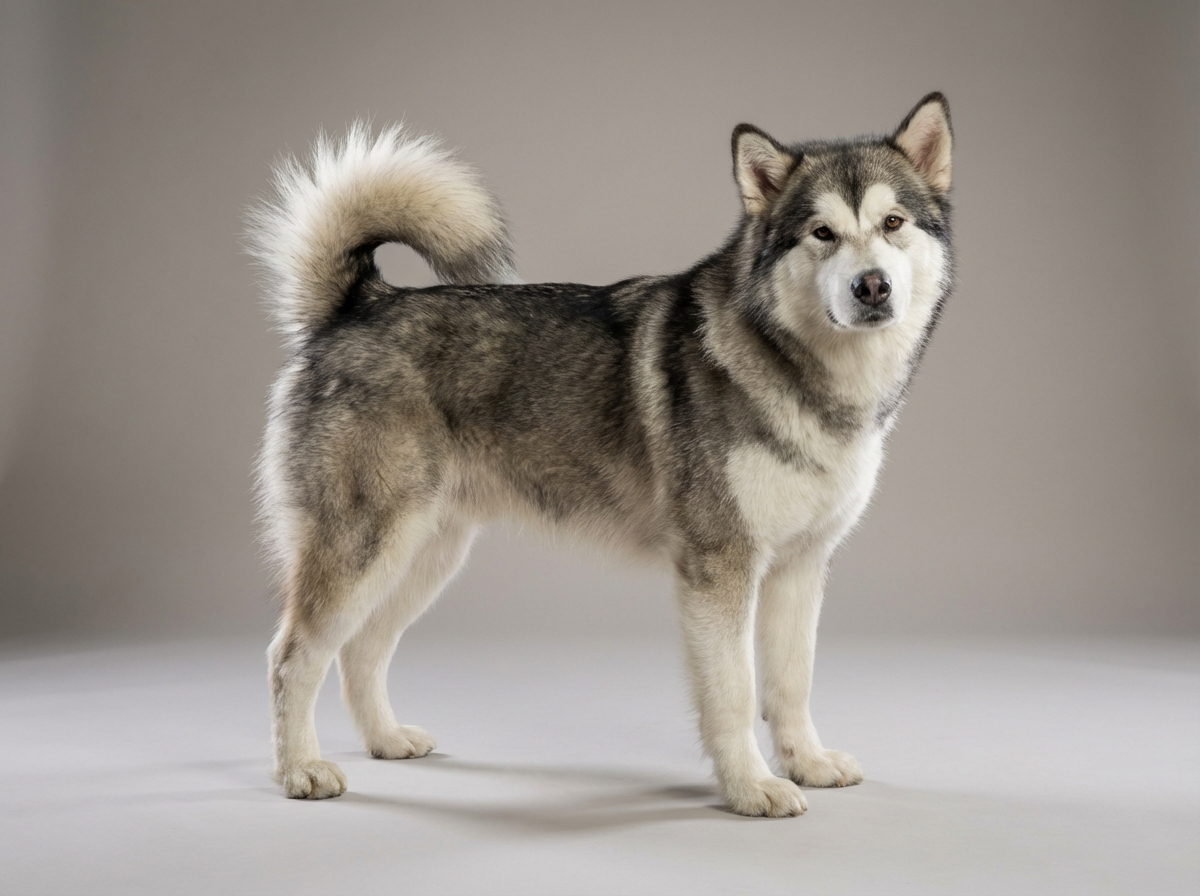
A Malamute greets everybody. It will meet an intruder at the gate with enthusiasm and show him the garden, and for a great many buyers that is exactly what they want — a big dog with no liability attached.
A Doberman assesses. It is not sharp or nervous when correctly bred; it notices, defers to its handler, and does not escalate without cause. At 5/5 trainability it is arguably the most controllable protection breed available, and that control is what you are buying.
The practical rows favour the Doberman: 1/5 grooming against 4/5, 3/5 shedding against 5/5, and a lower monthly cost.
The Malamute's advantages are children at 5/5, cold-weather capability, and a much lighter health list.
Malamute or Doberman: Same Workload, Opposite Instincts - Alaskan Malamute vs Doberman Pinscher: the row that decides it
Frequently asked questions
Which is the guard dog?
The Doberman, unambiguously — 2/5 with strangers against the Malamute's 4/5, and 5/5 trainability makes it arguably the most controllable protection breed available. The Malamute is a hopeless guard: it will greet an intruder happily and show him the garden.
Do both breeds need the same exercise?
Both rate 5/5 and the content differs. The Malamute is tired by resistance — carting, scootering, loaded hikes. The Doberman needs ninety minutes to two hours with a real portion of it mental: obedience, tracking or scent work. Physical exercise alone leaves a Doberman fit and unsatisfied.
How is a Doberman's heart screened?
With annual Holter monitoring and echocardiography from around three years old, not a stethoscope check. Dilated cardiomyopathy has a long occult phase in which the dog looks healthy, and catching it there allows medication that meaningfully delays heart failure. Budget several hundred a year for it.
Which is harder to contain?
The Malamute. Its own breed notes call it an extreme escape artist — it digs, climbs, works at latches and travels once loose. A Doberman generally stays; its boundary problem is patrolling, so a fence it can see through into a street builds reactivity rather than escape attempts.
Which handles cold better?
The Malamute, overwhelmingly. It is comfortable in temperatures that keep most breeds indoors. The Doberman's sleek coat gives almost no insulation — it needs a coat in winter and should not be left outside in cold weather, which is a real constraint in a northern climate.
Which is easier to groom?
The Doberman at 1/5 — the lowest rating in this batch — against the Malamute's 4/5, with 3/5 shedding against 5/5. A weekly wipe over covers a Doberman. The Malamute needs an undercoat rake and several long sessions during two heavy blows a year.
Which lives longer?
The Malamute, at 10 to 14 years against the Doberman's 10 to 12. Cardiac disease is the main driver on the Doberman side. Both carry a real bloat risk, and both households should know the signs and where their nearest out-of-hours surgery is.
The Doberman if you want a working partner and a genuine deterrent, and will train it daily and screen its heart. The Malamute if you want a sociable dog with no guarding liability and can meet its physical demands.
Costs
How much does each cost per month?
The Malamute runs $150–$300 a month and the Doberman $120–$250, with first-year totals of $2,000–$4,000 and $1,800–$3,500. Annual cardiac screening closes most of that gap for the Doberman.
Health
What should I test before Doberman surgery?
Von Willebrand's disease, an inherited clotting disorder with a DNA test. Most owners find out during an operation, so test before any elective procedure including neutering.
Behavior
Which is better with children?
The Malamute at 5/5 against the Doberman's 4/5, though both are good. The Malamute is demonstrative and tolerant; the Doberman is closely attached and more intense, and its caveat is momentum rather than temperament.
Health information here is general and is not veterinary advice. If your dog shows pain, sudden behaviour change, or worsening symptoms, consult a licensed veterinarian.
Some links on this site are affiliate links. We may earn a commission at no extra cost to you, and we only suggest products we believe are helpful for dog owners.
We research and check what we publish, but we do not warrant that any figure, date, price, or statement is accurate, complete, or current, and we accept no liability for any loss, cost, injury, or other harm arising from the use of this site. Use it as one reference among several. You remain responsible for your own decisions and for your dog's care - confirm anything that matters with a licensed veterinarian or another qualified professional before you act on it. Full disclaimer.