DogBreedCompass

Malamute or Brittany: A Sled Dog and a Pointing Dog Compared

The Brittany is a third of the weight, half the running cost, twice as trainable and better with other dogs. On the numbers it is the easier dog by a wide margin, and it shares the Malamute's one real weakness: neither of them copes with being left alone, and in the Brittany that is a listed condition.

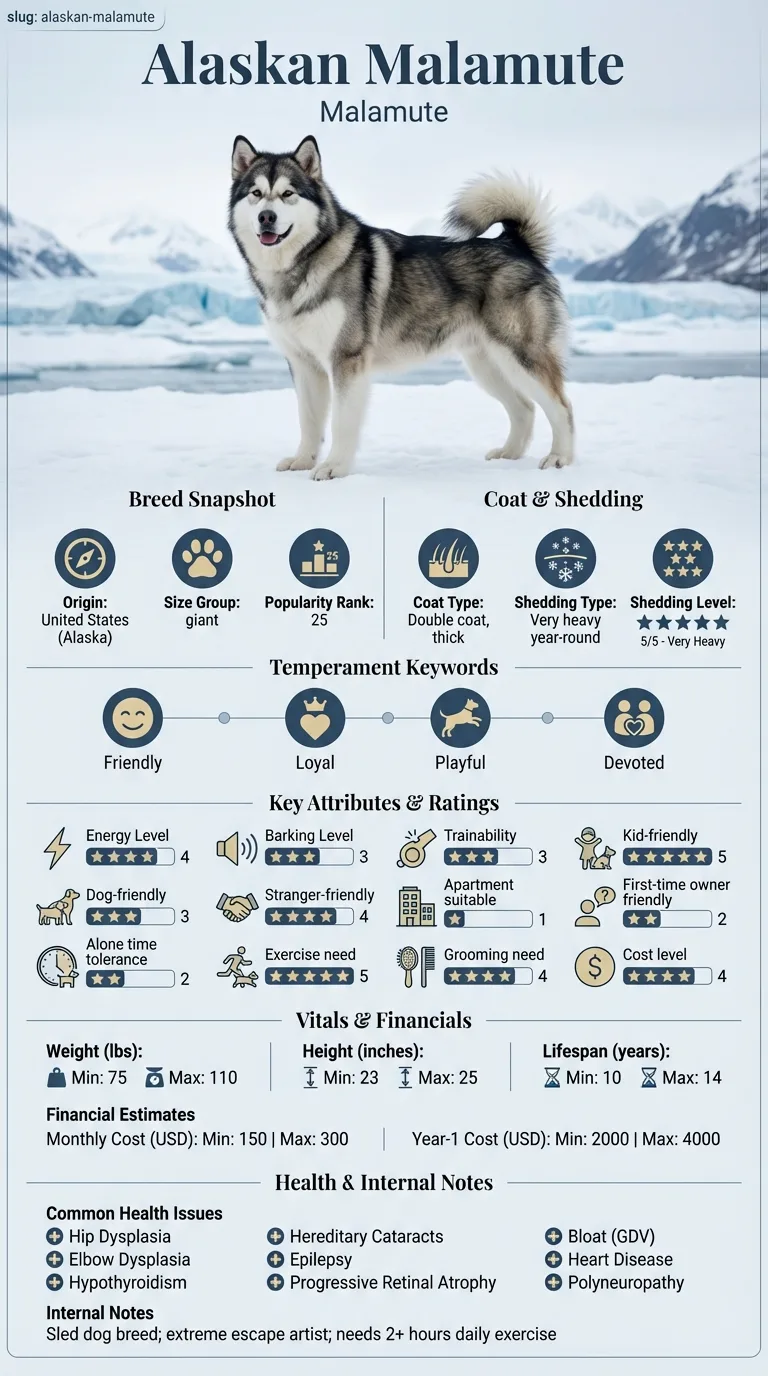
alaskan malamute infographic
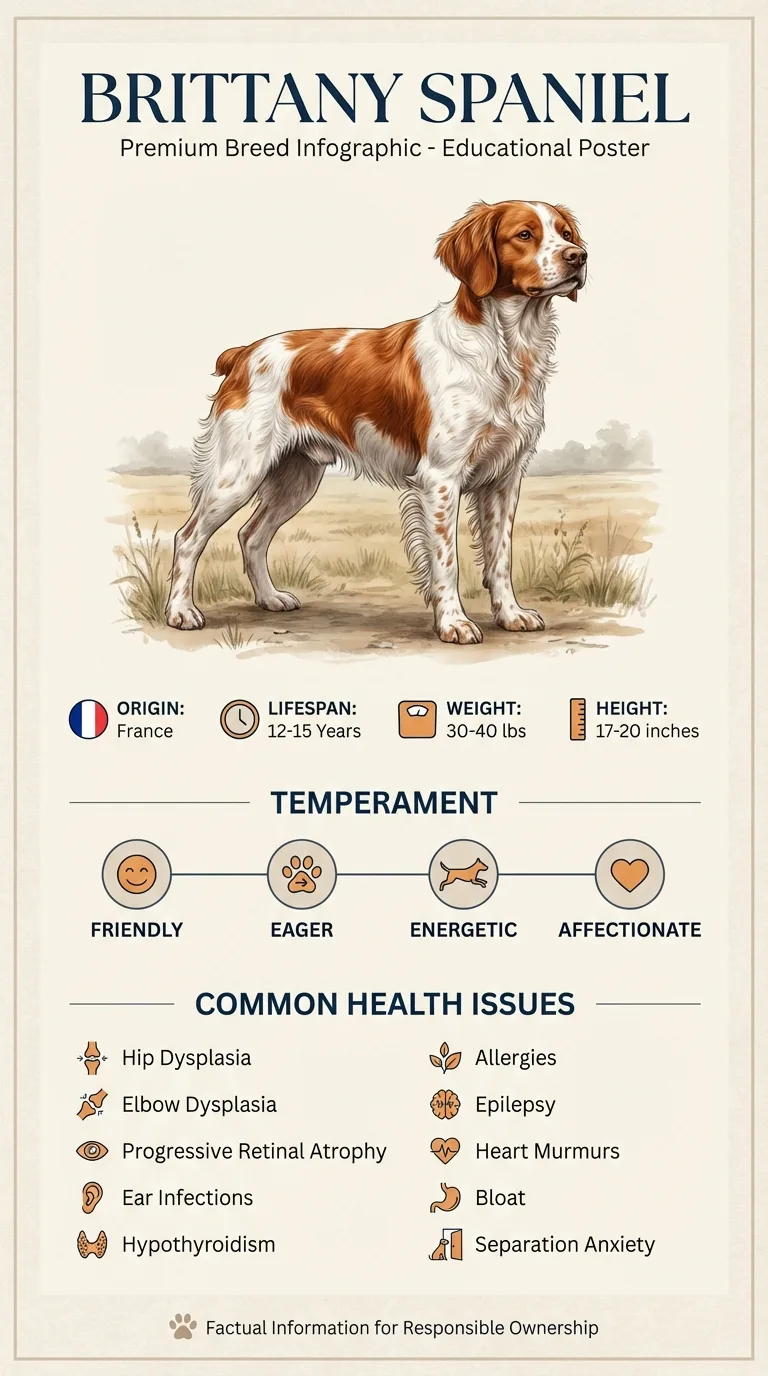
brittany infographic

This page is for someone weighing a mid-sized sporting breed against a large northern one. It covers the trainability and cost gap, what a 4/5 exercise pointing dog actually needs, separation anxiety, coat work and containment.

Quick verdict

The Brittany wins nearly every practical row and needs someone at home; the Malamute is for a household that specifically wants a northern breed and can meet its physical and financial terms.

Choose alaskan malamute if...

Choose the Alaskan Malamute if you want a large cold-weather working dog and have the space and budget. It rates 5/5 with children against the Brittany's 5/5 and is more physically imposing. You are accepting $150–$300 a month against $90–$180, 5/5 exercise, 5/5 shedding, 4/5 grooming and a 1/5 apartment rating.

Choose brittany if...

Choose the Brittany if someone is usually home and you want a sociable, highly trainable dog of manageable size. It rates 5/5 for trainability, children and other dogs, 4/5 with strangers and for first-time owners, grooms at 2/5 and lives 12 to 15 years at $90–$180 a month. You are accepting real separation anxiety.

Head-to-head comparison

Featurealaskan malamutebrittanyWinner
Weight75–110 lbs30–40 lbsEqual
Height23–25 in17–20 inEqual
Lifespan10–14 years12–15 yearsbrittany
CoatThick double coatMedium, wavyEqual
Grooming needHigh (4/5)Low (2/5)brittany
SheddingVery high (5/5)Moderate (3/5)brittany
Energy levelHigh (4/5)High (4/5)Equal
Exercise needVery high (5/5)High (4/5)brittany
TrainabilityModerate (3/5)Very high (5/5)brittany
BarkingModerate (3/5)Low (2/5)brittany
Good with kidsVery high (5/5)Very high (5/5)Equal
Good with other dogsModerate (3/5)Very high (5/5)brittany
Friendly to strangersHigh (4/5)High (4/5)Equal
Apartment suitabilityVery low (1/5)Moderate (3/5)brittany
Good for first-time ownersLow (2/5)High (4/5)brittany
Tolerates being aloneLow (2/5)Low (2/5)Equal
Typical monthly cost$150–$300$90–$180brittany
Typical first-year cost$2,000–$4,000$1,300–$2,500brittany

Deep dive

Ninety minutes of searching against two hours of pulling

The Brittany rates 4/5 and wants around ninety minutes, and as with every pointing breed the satisfaction comes from searching rather than distance. Quartering ground, freezing on scent, retrieves and directional work do far more for it than a long walk.

That is convenient for owners without land: forty minutes of proper scent work in a wood beats an hour of pavement.

The Malamute rates 5/5 and is tired by resistance. Carting, scootering, canicross or loaded hikes are what the breed exists for, and walking beside you does very little. Heat is the limit, so summer sessions move to the cool ends of the day.

Recall differs too. A Brittany can be trained to an excellent recall because 5/5 trainability makes it achievable, though it has to be proofed against live game before you trust it in open country. A Malamute's recall should be treated as a bonus rather than a safety measure at any stage.

And containment differs sharply. The Malamute's own breed notes call it an extreme escape artist — it digs, climbs and travels — where a Brittany generally stays with its people.

The shared 2/5, and why it is worse in the Brittany

Separation anxiety appears explicitly on the Brittany's condition list, which is unusual — most breed health lists are structural or systemic rather than behavioural.

It is there because the breed genuinely struggles. A dog bred to spend whole days working beside a person does not find eight hours in an empty house neutral, and the signs are the familiar ones: vocalising, destruction focused on doors and windows, house-soiling in a clean dog, and refusing food while alone.

The management has to start in week one rather than when the problem appears. Graduated absences beginning at seconds, never pushed past the point where the dog worries. A genuinely tired dog before you leave. A walker or day care for a full-time household.

The Malamute at 2/5 has the same rating and a different flavour. It does not usually panic; it gets bored, and a bored Malamute digs up a garden and works on the fence line.

So both breeds need cover, and the consequences of not providing it are distress in one case and demolition in the other.

Coat, ears and the weather

The Brittany's medium wavy coat rates 2/5 for grooming — brushing through a couple of times a week, with attention to the feathering on the legs and ears, which picks up burrs and grass seeds from cover.

Grass seeds are the seasonal hazard worth naming. They are barbed, they cannot back out, and they migrate inward from between the toes, an armpit or an ear canal. A two-minute check of feet, ears and armpits after summer walks prevents most of the minor surgery they cause.

Ear infections are on the list, as in every drop-eared sporting breed. Dry the ears after every swim and wet walk.

The Malamute's coat is a different order of work at 4/5. It sheds constantly at 5/5 and blows its undercoat in sheets twice a year, needing an undercoat rake and several long sessions. It never mats and never needs a groomer, and it should never be clipped.

On climate the Malamute is superb in cold and limited in heat; the Brittany is comfortable across a much wider range and needs no special management either way.

Health lists and running costs

The Brittany's list runs to hip and elbow dysplasia, progressive retinal atrophy, ear infections, hypothyroidism, allergies, epilepsy, heart murmurs, bloat and separation anxiety. Hip and elbow scores as numbers, eye certification and thyroid results are the standard asks, plus a direct question about epilepsy in the line.

The Malamute's runs to hip and elbow dysplasia, hypothyroidism, hereditary cataracts, progressive retinal atrophy, epilepsy, heart disease, bloat, inherited polyneuropathy and zinc-responsive skin disease. Polyneuropathy has a DNA test and shows in young dogs as exercise intolerance and a wobbly gait — ask for the result by name.

Both carry a real bloat risk and both households should know the signs: unproductive retching, a distending abdomen, restlessness.

On money the Brittany runs $90–$180 a month against $150–$300, and $1,300–$2,500 against $2,000–$4,000 in the first year — mostly weight, with grooming and lower veterinary exposure widening it further.

And it lives 12 to 15 years against 10 to 14.

Alaskan Malamute vs Brittany: the numbers favour the smaller dog

Energy ties at 4/5, children tie at 5/5, strangers tie at 4/5 and time alone ties at 2/5. Both are cheerful, sociable, people-oriented breeds and neither guards anything.

On everything else the Brittany is easier. 5/5 trainability against 3/5. 5/5 with other dogs against 3/5. 4/5 for first-time owners against 2/5. 2/5 grooming against 4/5. 3/5 shedding against 5/5. Half the monthly cost. And it lives two to four years longer.

The Malamute's advantages are not on the table because they are not the sort of thing a rating captures: presence, cold-weather capability, and the specific pleasure of a breed that will pull a load all day.

What the two genuinely share is the solitude problem. Both were bred to work alongside others all day and neither inherited a tolerance for an empty house.

Frequently asked questions

Which is easier to own overall?

The Brittany, on almost every practical row: 5/5 trainability against 3/5, 5/5 with other dogs against 3/5, 4/5 for first-time owners against 2/5, half the monthly cost, a quarter of the grooming, and two to four more years of life. The Malamute's advantages are presence and cold-weather capability.

Does the Brittany really get separation anxiety?

Yes, and it is listed as a breed condition rather than an individual quirk. A dog bred to work beside a person all day does not find an empty house neutral. Expect vocalising, destruction at doors and refusal to eat. Graduated absence training from week one and a midday walker are the standard answers.

How much exercise does each need?

The Brittany needs around ninety minutes at 4/5 and wants to search rather than travel — scent work and quartering ground tire it far more than distance. The Malamute needs two hours at 5/5 and is tired by resistance: carting, scootering or loaded hikes rather than walking.

Which is better with other dogs?

The Brittany at 5/5 against the Malamute's 3/5. Malamute same-sex intolerance is common and usually appears at social maturity around two years old, in a dog that was fine as a puppy. Both are excellent with people and neither is any use as a guard dog.

Can either be trusted off the lead?

A Brittany can, once its recall has been proofed against live game — 5/5 trainability makes that achievable. A Malamute cannot; its recall should be treated as a bonus rather than a safety measure, and its own breed notes describe an extreme escape artist that digs, climbs and travels.

What are grass seeds and why do they matter?

Barbed seed heads that work into feathering and then into skin, between toes or into an ear canal, and migrate inward because the barbs stop them backing out. In a feathered sporting coat they are easy to miss. Check feet, ears and armpits after summer walks — it takes two minutes.

Which is cheaper to keep?

The Brittany, at $90–$180 a month against the Malamute's $150–$300, and $1,300–$2,500 against $2,000–$4,000 in the first year. Grooming widens it further at 2/5 against 4/5, and the Brittany lives longer, at 12 to 15 years against 10 to 14.

Quick answers

View more answers
Living

Malamute vs Brittany: which should I choose?

The Brittany for most households — cheaper, smaller, far more trainable and better with other dogs, provided someone is usually home. The Malamute if you specifically want a large cold-weather working breed and can meet its terms.

Costs

How much does each cost per month?

The Malamute runs $150–$300 a month and the Brittany $90–$180, with first-year totals of $2,000–$4,000 and $1,300–$2,500. Grooming is 4/5 against 2/5.

Behavior

Do both breeds struggle alone?

Yes — both rate 2/5. The Brittany tends toward genuine distress and the Malamute toward boredom and demolition. Either way, absence training from week one and cover for a full working day are needed.

Living

Which sheds more?

The Malamute at 5/5 against the Brittany's 3/5, with grooming at 4/5 against 2/5. It sheds year-round and blows its undercoat in sheets twice a year, and the coat should never be clipped.

Related DogBreedCompass guides

  • Alaskan Malamute breed guideThe Malamute profile covers exercise, containment and the breed's coat.
  • Brittany breed guideThe Brittany profile covers field drive, coat care and the breed's need for company.
  • Malamute vs German Shorthaired PointerThe German Shorthaired Pointer is the larger pointing breed most often weighed against a Brittany.
  • Akita vs Alaskan MalamuteThe Akita comparison sets out how the Malamute differs from a Japanese guardian breed.
  • Brittany genetic disordersThe inherited conditions worth screening for before buying a Brittany puppy.
  • Malamute bloat and GDVBloat is a genuine emergency in both breeds and every owner should know the signs.

Related guides

Important reminder

Health information here is general and is not veterinary advice. If your dog shows pain, sudden behaviour change, or worsening symptoms, consult a licensed veterinarian.

Some links on this site are affiliate links. We may earn a commission at no extra cost to you, and we only suggest products we believe are helpful for dog owners.

Find Your Perfect Breed

Match your lifestyle to the right dog.

Take quiz

Find your match

Not sure which breed is right for you? Take our 2-minute quiz to find out.

Take the quiz