Akita or Vizsla: A Dog That Cannot Be Left, or One That Prefers It
Quick answer
Akita vs Vizsla: which should I choose?
The Vizsla if you are athletic, mostly at home, and want an affectionate working dog. The Akita if the house is empty during the day or you cannot commit two hours of exercise — it tolerates solitude at 3/5 against the Vizsla's 1/5.
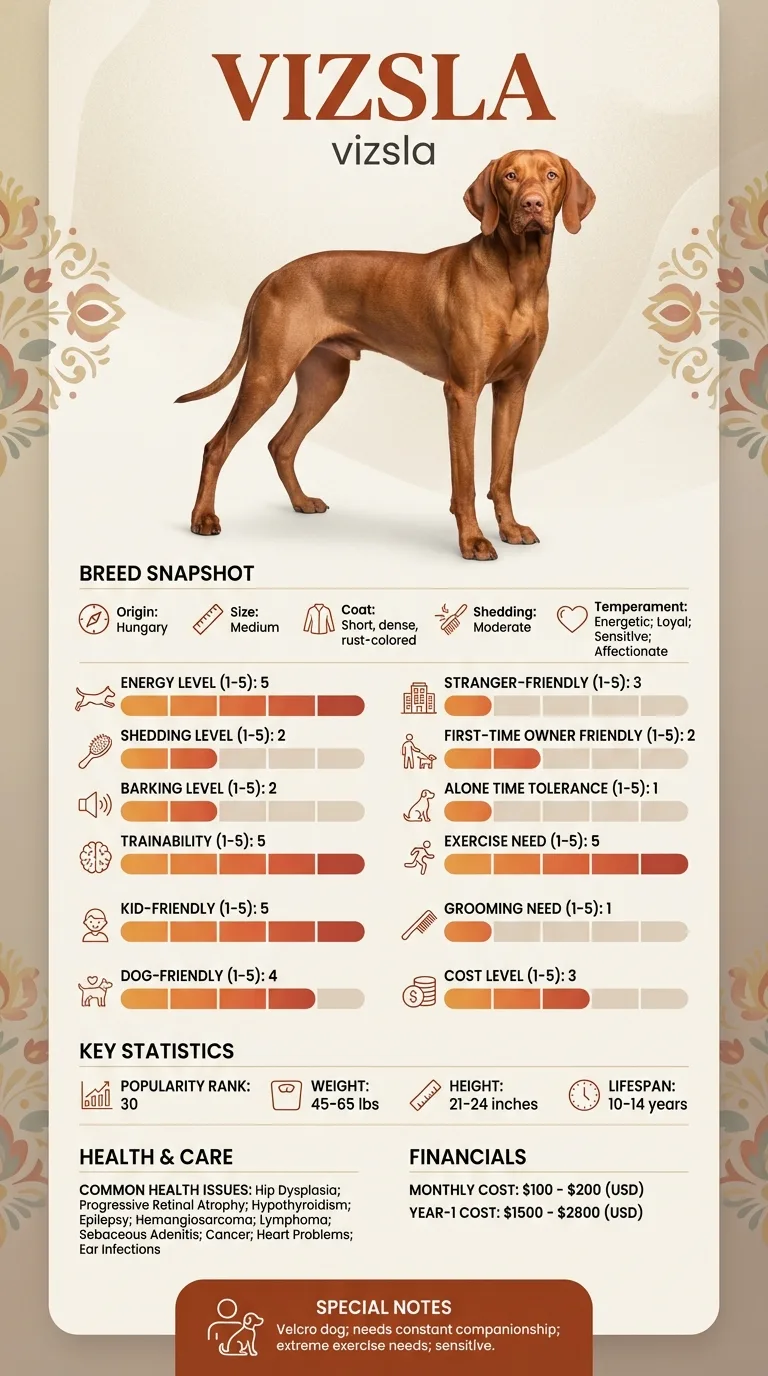
The Vizsla rates 1/5 for tolerating time alone, 1/5 for apartments and 5/5 for exercise. That is the most demanding combination in this batch, and it is not softened by the fact that the dog is friendly, biddable and easy to groom. It needs a person, a landscape, and both of them most of the day.
This page is for someone weighing a high-drive, highly attached sporting breed against a self-contained guardian. It covers the exercise and companionship requirements honestly, the breed's sensitivity, a significant cancer burden, and cost.
Quick verdict
The Vizsla is the more affectionate, more trainable and far more demanding dog, and it needs company almost all the time; the Akita needs a walk and would rather you did not fuss.
Choose akita if...
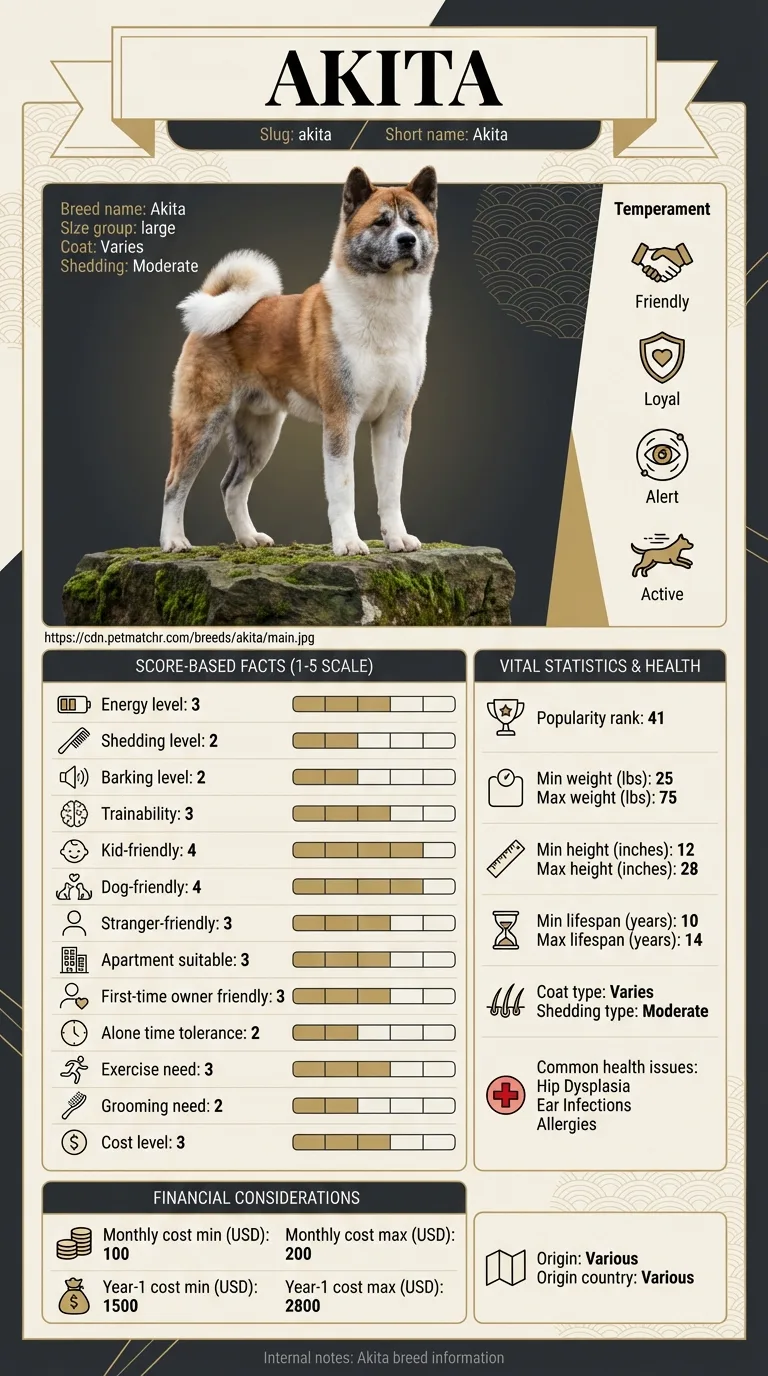
Choose the Akita if the house is empty during the day or you cannot commit two hours of exercise. It tolerates being alone at 3/5 against the Vizsla's 1/5, needs 3/5 exercise against 5/5, and rates 2/5 for apartments against 1/5. You are accepting 5/5 shedding against 2/5 and 3/5 grooming against 1/5.
Choose vizsla if...
Choose the Vizsla if you are athletic, mostly at home, and want a genuinely affectionate working dog. It rates 5/5 for trainability and with children, 4/5 with other dogs, grooms at 1/5, sheds at 2/5 and barks at 2/5. You are accepting 5/5 exercise, a 1/5 solitude rating, real sensitivity and a notable cancer burden.
Head-to-head comparison
Feature
akita
vizsla
Winner
Weight
70–130 lbs
45–65 lbs
Equal
Height
24–28 in
21–24 in
Equal
Lifespan
10–13 years
10–14 years
vizsla
Coat
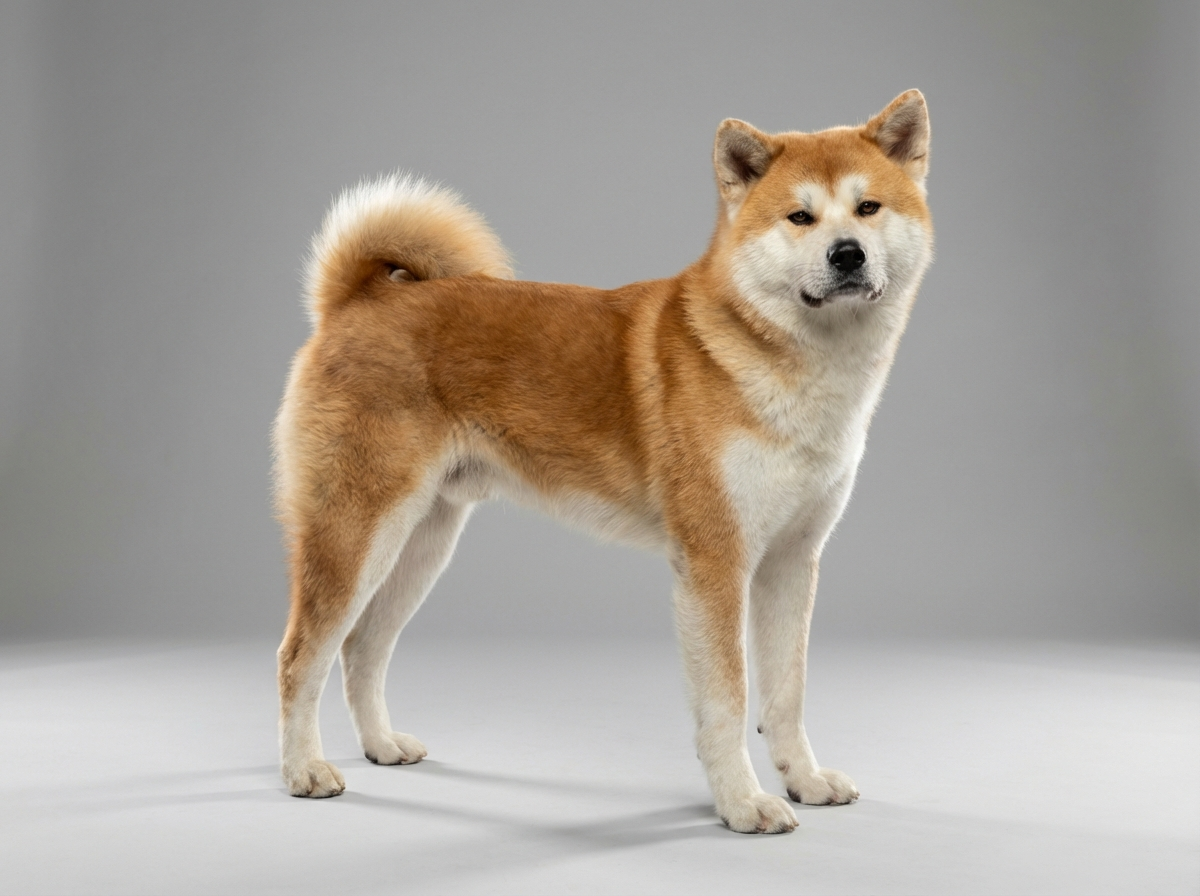
Dense double coat
Short and dense
Equal
Grooming need
Moderate (3/5)
Very low (1/5)
vizsla
Shedding
Very high (5/5)
Low (2/5)
vizsla
Energy level
Moderate (3/5)
Very high (5/5)
Equal
Exercise need
Moderate (3/5)
Very high (5/5)
akita
Trainability
Moderate (3/5)
Very high (5/5)
vizsla
Barking
Low (2/5)
Low (2/5)
Equal
Good with kids
Moderate (3/5)
Very high (5/5)
vizsla
Good with other dogs
Low (2/5)
High (4/5)
vizsla
Friendly to strangers
Low (2/5)
Moderate (3/5)
vizsla
Apartment suitability
Low (2/5)
Very low (1/5)
akita
Good for first-time owners
Very low (1/5)
Low (2/5)
vizsla
Tolerates being alone
Moderate (3/5)
Very low (1/5)
akita
Typical monthly cost
$110–$240
$100–$200
vizsla
Typical first-year cost
$1,700–$3,200
$1,500–$2,800
vizsla
Deep dive
Two hours a day, and what kind
A Vizsla is a pointing dog built for endurance over open ground. Two hours of genuine activity a day is realistic for a fit adult, and it should include running, searching and thinking rather than only walking.
Scent work and directional training satisfy this breed in a way distance alone does not. Forty minutes hunting a wood does more than ninety minutes on a lead, which is convenient for owners without a farm.
The 1/5 apartment rating follows directly. It is not about the dog's footprint — at 45 to 65 pounds it is smaller than an Akita — but about output. A Vizsla with unmet needs in a flat is a genuinely destructive animal.
Heat and cold both need managing. The coat is short and there is very little body fat, so a Vizsla feels the cold and needs a coat in winter; in summer it will run itself into trouble if allowed.
The Akita at 3/5 wants a walk and then lies down heavily somewhere inconvenient, and it does not deteriorate if the walk is short.
A 1/5 solitude rating in a 60-pound dog
Most breeds rated 1/5 for time alone are small companion dogs. The Vizsla is a large working breed with the same rating, and that combination is unusual and difficult.
A Vizsla left alone for a full working day, without preparation and without cover, will vocalise, chew and become genuinely distressed rather than merely bored. Separation-related behaviour is one of the two most common reasons Vizslas end up in rescue; the other is exercise.
It is manageable, but the management has to start on day one: graduated absences from the first week, beginning at seconds rather than minutes, a genuinely tired dog before you leave, and for most working households a walker or day care.
The breed is also sensitive. Vizslas read household mood, and they shut down under sharp correction more visibly than most gundogs — training one with firmness produces a worse dog, not a better one.
The Akita at 3/5 is genuinely self-contained. It does not experience an empty afternoon as a loss, does not need occupying, and does not read the room.
Cancer, skin and the questions for a breeder
The Vizsla's condition list carries a heavier cancer burden than most sporting breeds: haemangiosarcoma, lymphoma and cancer generally all appear.
Haemangiosarcoma is the one to understand, because it is often silent until it is not. It is a cancer of blood vessel walls, most often in the spleen or heart, and a tumour can bleed suddenly — the first sign is frequently collapse, pale gums and weakness in a dog that seemed well that morning. That presentation is an emergency, not something to reassess in the morning.
Sebaceous adenitis is the distinctive skin entry: inflammation destroys the glands that oil the skin, producing scaling, a dull coat, patchy hair loss and a musty smell. It is diagnosed by skin biopsy and managed rather than cured.
Hip dysplasia, progressive retinal atrophy, hypothyroidism, epilepsy, heart problems and ear infections complete the list. Ask a breeder for hip scores as numbers, eye certification, thyroid results, and about the ages and causes of death in the line.
The Akita's burden is autoimmune and endocrine, with hip dysplasia and bloat, and it lives a similar span at 10 to 13 years against 10 to 14.
Cheap to groom, expensive in time
The Vizsla runs $100–$200 a month against the Akita's $110–$240, and $1,500–$2,800 against $1,700–$3,200 in the first year.
Grooming is as close to free as a dog gets — 1/5, a rubber curry once a week, and 2/5 shedding in short rust-coloured hairs that are much easier to live with than an Akita's undercoat. There is no groomer, no undercoat rake and no seasonal clearing operation.
What the Vizsla costs instead is time and cover. Two hours a day for ten to fourteen years, plus a walker or day care for a dog that cannot be left, is a larger commitment than any grooming bill in this batch.
Insurance is worth carrying from puppyhood and keeping unbroken, given the cancer burden — a diagnosis at five years old will be excluded by any policy started afterwards.
The Akita's costs are food-dominated and flat, with autoimmune disease and bloat as the large uncertain risks, and its real advantage here is that it asks for almost none of your day.
Akita vs Vizsla: attachment at opposite ends
Barking ties at 2/5 and that is nearly the whole list of agreements. Everything else on this table separates.
The row that decides most households is solitude: 1/5 against 3/5. A Vizsla is called a velcro dog by everyone who owns one, and the description is literal — it follows its person from room to room, leans on legs, and gets under blankets. That closeness is what made it a good pointer working with a single handler, and it does not switch off when the handler goes to work.
Exercise is the other decisive row, 5/5 against 3/5, roughly two hours a day against forty-five to sixty minutes.
Where the Vizsla is easy, it is very easy: 1/5 grooming — the lowest here — 2/5 shedding, 5/5 trainability, 5/5 with children and 4/5 with other dogs.
The Akita's offer is the reverse. Hair everywhere, a temperament that must be managed, and a dog that does not need you.
Akita or Vizsla: A Dog That Cannot Be Left, or One That Prefers It - Akita vs Vizsla: attachment at opposite ends
Frequently asked questions
Why is the Vizsla called a velcro dog?
Because it follows its person from room to room, leans on legs and gets under blankets. That closeness was selected for — it worked as a pointer alongside a single handler — and it rates 1/5 for tolerating time alone, which is unusual for a large working breed and the main reason Vizslas end up in rescue.
How much exercise does a Vizsla need?
Around two hours a day of genuine activity, including running, searching and thinking rather than only walking. Scent work and directional training satisfy it far better than distance alone. The Akita at 3/5 wants forty-five to sixty minutes of walking and no structured work at all.
Why does a 60-pound dog rate 1/5 for apartments?
Because the rating measures output rather than footprint. The Vizsla is smaller than an Akita, which rates 2/5, but at 5/5 energy and 5/5 exercise with a 1/5 tolerance for being left, a flat is a genuinely poor fit unless someone is home and the exercise is comprehensive.
Can a Vizsla be left during a working day?
Not without preparation and cover. Expect vocalising, chewing and real distress rather than boredom. Graduated absences from the first week, a properly tired dog before you leave, and a walker or day care are what make it workable. The Akita at 3/5 is self-contained and will sleep.
What is haemangiosarcoma and why does it matter here?
A cancer of blood vessel walls, most often in the spleen or heart, that is frequently silent until a tumour bleeds. The first sign is often sudden collapse with pale gums in a dog that seemed well hours earlier. That presentation is an emergency, and the Vizsla carries a heavier cancer burden than most sporting breeds.
Which is easier to groom?
The Vizsla, by a wide margin — 1/5 against the Akita's 3/5, and 2/5 shedding against 5/5. A rubber curry once a week covers it, with no groomer, no rake and no seasonal clearing operation. It is one of the lowest-maintenance coats of any breed.
Is the Vizsla a sensitive breed?
Very. It reads household mood and shuts down under sharp correction more visibly than most gundogs. Training one firmly produces a worse dog rather than a better one. Cheerful consistency, food and short varied sessions get the best out of a 5/5 trainable breed.
The Vizsla if you are athletic, mostly at home, and want an affectionate working dog. The Akita if the house is empty during the day or you cannot commit two hours of exercise — it tolerates solitude at 3/5 against the Vizsla's 1/5.
Costs
How much does each cost per month?
The Vizsla runs $100–$200 a month and the Akita $110–$240, with first-year totals of $1,500–$2,800 and $1,700–$3,200. The Vizsla's real cost is time and day cover rather than money.
Living
Which sheds less?
The Vizsla at 2/5 against the Akita's 5/5, with grooming at 1/5 against 3/5. Its short rust-coloured hairs are far easier to live with than a blown undercoat, and it never needs a groomer.
Behavior
Which is quieter?
They tie at 2/5. Neither is a nuisance barker, which is unusual for a high-drive sporting breed — though an under-exercised, under-companioned Vizsla becomes vocal in a way a satisfied one is not.
Related DogBreedCompass guides
Akita breed guide – The Akita profile covers guardian temperament and the long socialisation window the breed needs.
Vizsla breed guide – The Vizsla profile covers exercise, companionship needs and the breed's sensitivity.
Akita vs German Shorthaired Pointer – The German Shorthaired Pointer is the closest working alternative with a similar drive.
Akita vs Weimaraner – The Weimaraner is the other lean continental gundog with comparable attachment needs.
Vizsla cancer risk – Cancer risk is the health question most worth raising with a Vizsla breeder.
Akita autoimmune diseases – Autoimmune disease is the Akita's most distinctive burden and the first question for a breeder.
Health information here is general and is not veterinary advice. If your dog shows pain, sudden behaviour change, or worsening symptoms, consult a licensed veterinarian.
Some links on this site are affiliate links. We may earn a commission at no extra cost to you, and we only suggest products we believe are helpful for dog owners.
We research and check what we publish, but we do not warrant that any figure, date, price, or statement is accurate, complete, or current, and we accept no liability for any loss, cost, injury, or other harm arising from the use of this site. Use it as one reference among several. You remain responsible for your own decisions and for your dog's care - confirm anything that matters with a licensed veterinarian or another qualified professional before you act on it. Full disclaimer.