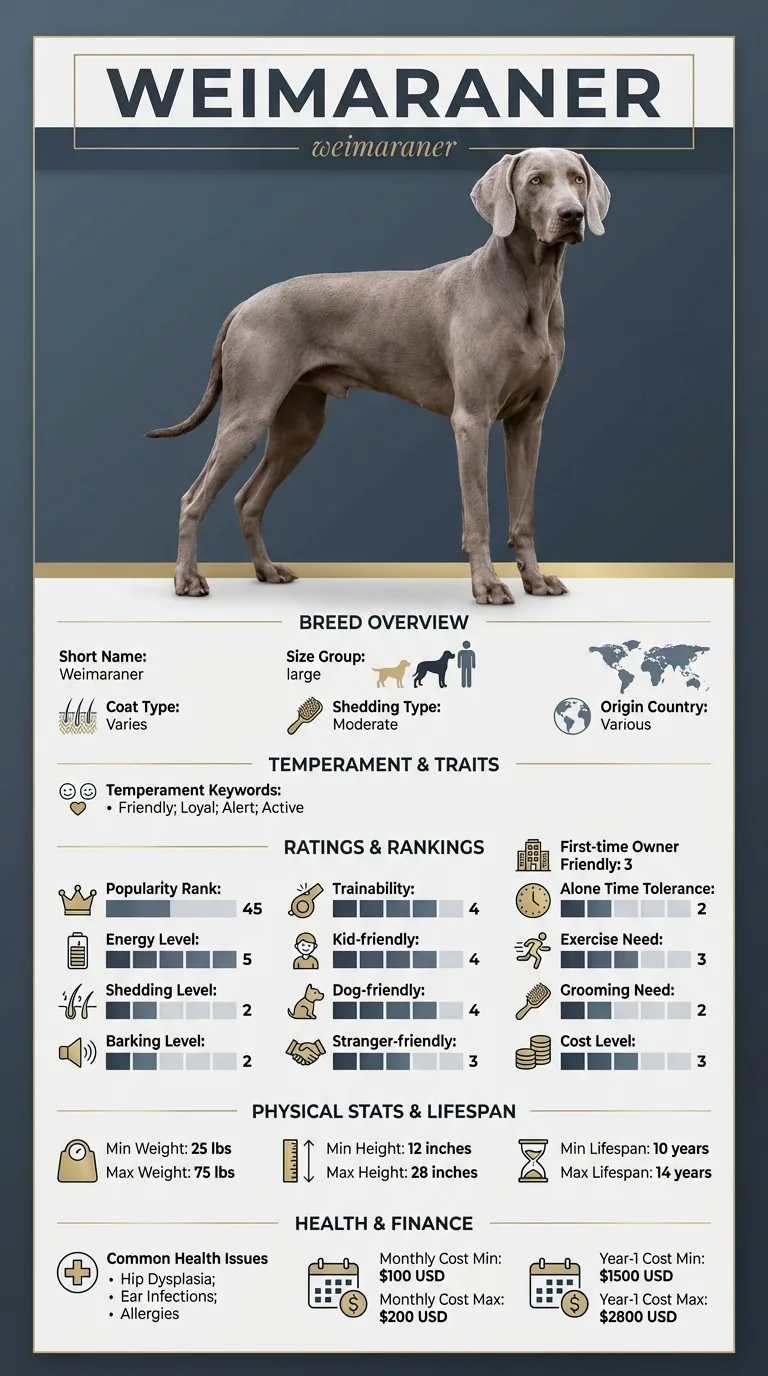
About $92–$202 a month and $1,428–$2,688 for year one at the lowest cost base on this list — with a cyclical local economy making a funded reserve or an early insurance quote worth more than usual for a high-variance breed.
A Weimaraner in Wichita costs about $92 to $202 a month, with year one between $1,428 and $2,688 — among the lowest figures on this site. The local consideration is not the level of those costs but the shape of the income that meets them. Wichita is the Air Capital, its employment is built around aircraft manufacturing, and that industry moves in cycles of overtime and slowdown that a household does not control.
Why costs vary
Separation Anxiety, also on the documented list, is the entry that generates steady monthly costs rather than sudden ones. The rest of the list is lumpy by nature, which is precisely the problem this page is about.
Cost summary
Wichita's ongoing costs are the lowest on this list, which makes the funding decision for the rare expensive event the most useful thing on this page.
Estimate · source: estimation · confidence: medium · updated 2026-09-06 · not a quote
First year
$1428 - $2688
Ongoing monthly
$92 - $202
First-year expenses
Item
Cost range
One-time setup: exam, spay or neuter, crate, gear and winter coat
Large-breed sizing throughout, at the lowest retail rates on this list.
$403 - $672
Monthly expenses
Item
Cost range
Food for a 55-to-90-pound sporting dog
Priced at Kansas's low retail for an athletic dog at this weight.
$46 - $80
Insurance premium or monthly transfer into a reserve
Whichever route you choose, treating it as a fixed line is what makes it survive a slow quarter.
$25 - $70
How these numbers are estimated
Each range starts from a national baseline for this breed's size class and is then adjusted for local cost of living and veterinary pricing. The baselines, and the source each one came from, are listed on our sources page (dataset 2026.09). Two inputs, the purchase price and the emergency reserve, have no published national figure we could verify, so we leave them to you rather than invent them.
These are planning estimates, not quotes. Your own numbers will move with the individual dog, your vet and your insurer. Build a budget with your own figures.
Is pet insurance worth it?
This is the city on this list where the choice between insuring and self-funding deserves the most deliberate thought, because the income side is the variable rather than the cost side.
When insurance makes sense
When household income moves with an order book rather than a salary, converting a four-figure risk into a fixed monthly premium is worth the arithmetic.
When you might skip it
When the reserve is already funded and will not be touched, low local costs make self-funding entirely realistic here.
Ways to save without cutting essentials
Wichita makes this breed cheap to keep, which means the useful discipline is about the rare expensive night rather than the ordinary month.
Build the reserve during the good stretches, and treat it as untouchable afterwards.
Get an insurance quote while the dog is young; the record only ever gets more complicated.
Buy prevention as an eight-month seasonal block rather than a year-round subscription.
Run the dog early through summer, when the heat still allows it.
Skip professional grooming entirely; the documented coat needs a home brush and nothing else.
Wichita Cost Factors: Cheap Every Month, Expensive on One Night
The routine side of owning this breed here is genuinely inexpensive. Wichita's general costs are among the lowest on this list, food and routine care price accordingly, and the eight-month prevention window keeps the annual veterinary line modest. A household can absorb the monthly figure comfortably in almost any year.
The difficulty is the tail. An emergency abdominal surgery does not scale down to match a local cost base, and it does not schedule itself for a quarter when overtime is plentiful. In an economy where hours expand and contract with the order book, the useful question is not whether you can afford the dog on an average month — you can — but what happens if the worst night coincides with the slowest quarter.
There are two honest answers. Build the reserve during the good stretches and genuinely leave it alone, or buy insurance while the dog is young and treat the premium as a fixed cost you have chosen deliberately. Either works. What does not work is assuming a low cost of living covers a high-variance risk, because those are different things.
The Lowest Costs on This List, and Eight Months of Prevention
Almost every line on this page comes in under national norms. Food for a large sporting dog, the annual exam, the one-time setup with a crate and gear for a 55-to-90-pound animal — all of it is cheaper here than in most of the country, which is exactly why building a reserve is realistic rather than aspirational.
The prevention window runs about eight months, a clearly seasonal schedule that saves real money on weight-dosed products compared with a Gulf Coast city. Kansas summers are hot enough to push the hard exercise into the early morning, and the winters are cold enough that this breed's documented short, sleek coat needs an insulated layer over it.
Grooming never appears at all. Low to moderate shedding on a short coat means a rubber curry brush at home for the life of the dog, which is one more small structural advantage in a budget that is already lean.
Weimaraner Cost in Wichita - The Lowest Costs on This List, and Eight Months of Prevention
The Slow Quarter and the Emergency That Did Not Wait
A Wichita household with a five-year-old Weimaraner had spent two comfortable years at a monthly cost well under two hundred dollars and had never seriously considered insurance. The dog bloated on a Tuesday night during a stretch when overtime had dried up, and the surgery consumed more than they had available. They covered it, but on terms they would not have chosen. Their second Weimaraner was insured from twelve weeks old, at a premium that costs less per month than the food does.
Key takeaway: In Wichita the ordinary months are easy and the rare night is not, so the decision worth making early is how that night gets funded when the hours are short.
Frequently asked questions
What does a Weimaraner cost per month in Wichita?
About $92 to $202, among the lowest ranges on this site, reflecting Kansas's low general cost of living.
What is the realistic first-year figure?
Roughly $1,428 to $2,688, covering the initial exam, vaccine series, spay or neuter if chosen, and large-breed crate, gear and a winter coat.
Why does income variability matter for this breed specifically?
Because this breed's documented health list is dominated by sudden, expensive events rather than small recurring ones. An emergency does not adjust its timing to suit a slow quarter.
Should I insure or self-fund?
Either works if it is done deliberately. Insurance converts a variable risk into a fixed premium; a reserve built during good stretches does the same thing, provided it is genuinely left alone.
Is pet insurance worth it in Wichita?
Worth quoting while the dog is young, before any orthopedic or gastrointestinal note appears on the record and narrows what a policy will cover.
How much emergency fund should a Wichita owner hold?
Around $710, which is a realistic target given how modest the ongoing costs are here.
About $92–$202 a month and $1,428–$2,688 for year one at the lowest cost base on this list — with a cyclical local economy making a funded reserve or an early insurance quote worth more than usual for a high-variance breed.
Related DogBreedCompass guides
Weimaraner breed guide – The documented health list that makes this breed financially lumpy rather than steady.
bloat risk in Weimaraners – The single event this page's reserve and insurance discussion is sized against.
This guide is not medical advice. If your dog shows pain, sudden behavior change, or worsening symptoms, consult a licensed veterinarian.
Some links may be affiliate links. We may earn a commission at no extra cost to you. We only suggest products we believe are helpful for dog owners.
We research and check what we publish, but we do not warrant that any figure, date, price, or statement is accurate, complete, or current, and we accept no liability for any loss, cost, injury, or other harm arising from the use of this site. Use it as one reference among several. You remain responsible for your own decisions and for your dog's care - confirm anything that matters with a licensed veterinarian or another qualified professional before you act on it. Full disclaimer.