Living
Which is the better apartment dog?
The Basset Hound by far -- 4/5 apartment suitability against the Weimaraner's 1/5.

Quick answer
Which is the better apartment dog?
The Basset Hound by far -- 4/5 apartment suitability against the Weimaraner's 1/5.
Basset Hound or Weimaraner? On paper they differ most on exercise need, and on the scales Weimaraner is the heavier at 55–90 lbs. Here is how the two compare on everything that shapes an ordinary week.
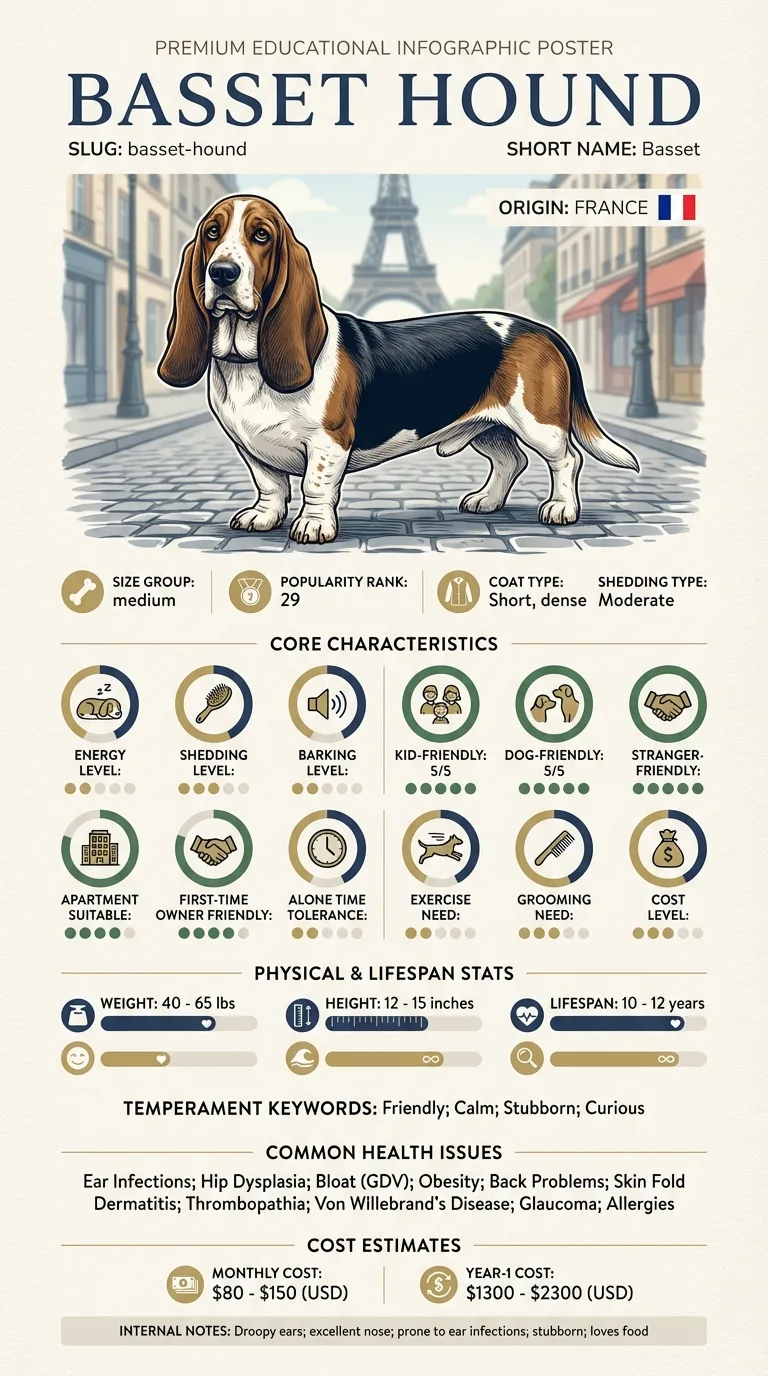
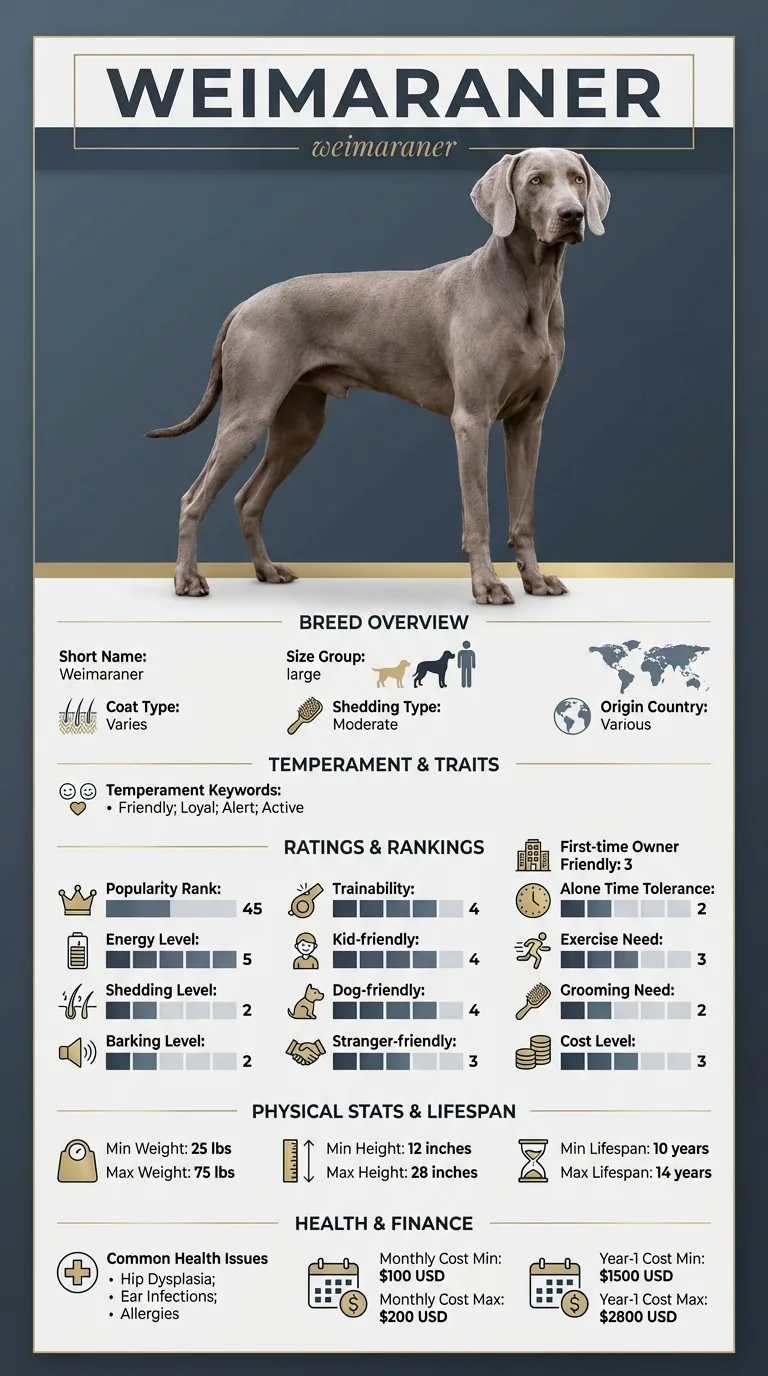
This is for someone already down to Basset Hound and Weimaraner and deciding between them. For this pair the decision usually turns on exercise need and energy level, so those are covered first and in most detail. Anyone choosing from a flat has a clear answer here: Basset Hound rates 4/5 against 1/5. The focus throughout is on daily consequences rather than breed background.
Between Basset Hound and Weimaraner, exercise need is what separates them, and Basset Hound is the lower-effort dog of the two to keep.
Choose Basset Hound if you are in a flat or a smaller home, this is your first dog and your walking routine is modest.
Choose Weimaraner if you do not want a standing grooming appointment, shedding is a problem in your house and you want a dog that picks up training quickly.
| Feature | basset hound | weimaraner | Winner |
|---|---|---|---|
| Size class | medium | large | Equal |
| Weight | 40–65 lbs | 55–90 lbs | Equal |
| Height | 12–15 in | 23–27 in | Equal |
| Lifespan | 10–12 years | 10–13 years | weimaraner |
| Exercise need | Low (2/5) | Very high (5/5) | basset hound |
| Grooming need | Moderate (3/5) | Very low (1/5) | weimaraner |
| Shedding | Moderate (3/5) | Low (2/5) | weimaraner |
| Energy level | Low (2/5) | Very high (5/5) | Equal |
| Barking | Low (2/5) | Moderate (3/5) | basset hound |
| Apartment suitability | High (4/5) | Very low (1/5) | basset hound |
| Good for first-time owners | High (4/5) | Low (2/5) | basset hound |
| Tolerates being alone | Low (2/5) | Very low (1/5) | basset hound |
| Trainability | Low (2/5) | High (4/5) | weimaraner |
| Good with kids | Very high (5/5) | High (4/5) | basset hound |
| Good with other dogs | Very high (5/5) | Moderate (3/5) | basset hound |
| Friendly to strangers | Very high (5/5) | Moderate (3/5) | basset hound |
| Cost level | Moderate (3/5) | Moderate (3/5) | Equal |
| Coat | Short, dense | Short and sleek | Equal |
| Origin | France | Various | Equal |
| Typical monthly cost | $80–$150 | $110–$240 | Equal |
| Typical first-year cost | $1,300–$2,300 | $1,700–$3,200 | Equal |
The Weimaraner is a genuinely large dog -- 55 to 90 pounds and 23 to 27 inches at the shoulder -- while the Basset Hound stays in the 40-to-65-pound medium range on a frame barely 12 to 15 inches tall. Stand them side by side and the height difference alone tells the story: the Weimaraner looks down on the Basset by nearly a foot. Both are classified as medium/large working breeds, but only one of them will need a car with real cargo room.
No contest here. The Weimaraner rates 5/5 for both exercise need and energy level, a dog bred to hunt for hours across open country and still have gas left. The Basset sits at 2/5 on both counts and is content with modest daily walks. Owners often underestimate what a Weimaraner needs day after day -- this isn't a breed you tire out with one good Saturday hike and then coast.
Coat care tips the advantage to the Weimaraner: 1/5 grooming need and 2/5 shedding against the Basset's 3/5 in both categories. The Weimaraner's short, sleek coat needs little beyond an occasional wipe-down. The Basset's coat sheds more and its loose skin and long ears need regular attention to avoid infections and odor -- a maintenance routine the Weimaraner simply doesn't require.
The Basset rates 4/5 for apartment suitability and low-key barking (2/5), making it a workable fit for close-quarters living. The Weimaraner rates just 1/5 for apartments and barks somewhat more (3/5), and its separation anxiety -- literally listed among its health concerns -- means being left alone in a small space for long stretches is a genuine welfare problem, not just an inconvenience. Neither breed tolerates solitude well, but the Weimaraner's reaction to it is more severe.
The Weimaraner is more trainable on paper (4/5 versus the Basset's 2/5) and highly food- and praise-motivated once it's had its exercise. But both breeds rate low for first-time owners (2/5 each) for different reasons -- the Basset because it's stubborn and slow to respond to commands, the Weimaraner because its intensity and clinginess can overwhelm someone without a firm, consistent routine already in place.
The Basset outperforms the Weimaraner in nearly every social category: better with kids (5/5 vs. 4/5), other dogs (5/5 vs. 3/5), and strangers (5/5 vs. 3/5). None of the Weimaraner's numbers here are bad, but the Basset is simply more universally easygoing -- a trait that shows up as extra patience with a toddler grabbing an ear or a strange dog crowding it at the park.
Both breeds share two serious risks worth knowing before you commit: bloat (GDV) and hip dysplasia. Both also carry a Von Willebrand's Disease listing, a bleeding disorder relevant if either dog ever needs surgery. The Weimaraner edges out a slightly longer lifespan, 10 to 13 years against the Basset's 10 to 12, but the overlap on bloat in particular means both owners should learn the warning signs and consider a vet consult on feeding practices.
The Weimaraner runs more expensive across the board: $110 to $240 a month against the Basset's $80 to $150, and $1,700 to $3,200 in the first year versus $1,300 to $2,300. Part of that gap is size -- bigger dogs eat more and need bigger everything -- and part of it is the Weimaraner's higher activity level, which tends to mean more spent on exercise-related gear and services over time.
Basset Hound weighs 40–65 lbs and lives 10–12 years; Weimaraner weighs 55–90 lbs and lives 10–13 years. The two diverge most on exercise need, energy level and apartment suitability and 5 other rated axes. Almost every rated axis separates them at least slightly. The table below marks a winner only where one breed is genuinely easier for a typical owner; size and origin are facts rather than merits and stay level. Ratings come from one source applied to both breeds, so they are meaningful against each other rather than as absolute scores.

Considerably -- 55-90 lbs and 23-27 inches tall versus the Basset's 40-65 lbs and 12-15 inches. The Weimaraner is a true large breed; the Basset is a low-slung medium.
The Weimaraner, rated 1/5 for grooming against the Basset's 3/5. Its short coat needs almost no upkeep beyond occasional brushing.
Not really -- both rate low for first-time owners (2/5 each), the Basset for its stubbornness, the Weimaraner for its intensity and separation anxiety.
The Basset does, rating 5/5. The Weimaraner is more middling at 3/5 and can be more selective about canine company.
The Weimaraner costs more to keep -- $110-$240 a month versus the Basset's $80-$150 -- and its first-year cost runs roughly $400-$900 higher.
Yes, both are prone to bloat (GDV), hip dysplasia, and Von Willebrand's Disease, a clotting disorder worth flagging to your vet regardless of which breed you choose.
Neither handles it well, but the Weimaraner is worse -- separation anxiety is specifically listed among its health concerns, while the Basset merely rates low (2/5) on alone-tolerance.
The Basset Hound by far -- 4/5 apartment suitability against the Weimaraner's 1/5.
About $30-$90 more than a Basset -- $110-$240 versus $80-$150.
Both are prone to bloat (GDV) and hip dysplasia -- worth discussing feeding and exercise timing with a vet either way.
The Basset, rated 2/5 for energy against the Weimaraner's 5/5 -- a genuine gap in day-to-day intensity.
Secure checkout on Stripe. We never see your card.
7-day money-back guarantee. Instant access.
Health information here is general and is not veterinary advice. If your dog shows pain, sudden behaviour change, or worsening symptoms, consult a licensed veterinarian.
Some links on this site are affiliate links. We may earn a commission at no extra cost to you, and we only suggest products we believe are helpful for dog owners.
We research and check what we publish, but we do not warrant that any figure, date, price, or statement is accurate, complete, or current, and we accept no liability for any loss, cost, injury, or other harm arising from the use of this site. Use it as one reference among several. You remain responsible for your own decisions and for your dog's care - confirm anything that matters with a licensed veterinarian or another qualified professional before you act on it. Full disclaimer.
Match your lifestyle to the right dog.
Take quizNot sure which breed is right for you? Take our 2-minute quiz to find out.
Take the quiz