Health
What's the classic early sign of Legg-Calvé-Perthes disease?
A limp on one hind leg appearing in a puppy roughly four months to a year old, without any clear injury to explain it.

Quick answer
What's the classic early sign of Legg-Calvé-Perthes disease?
A limp on one hind leg appearing in a puppy roughly four months to a year old, without any clear injury to explain it.
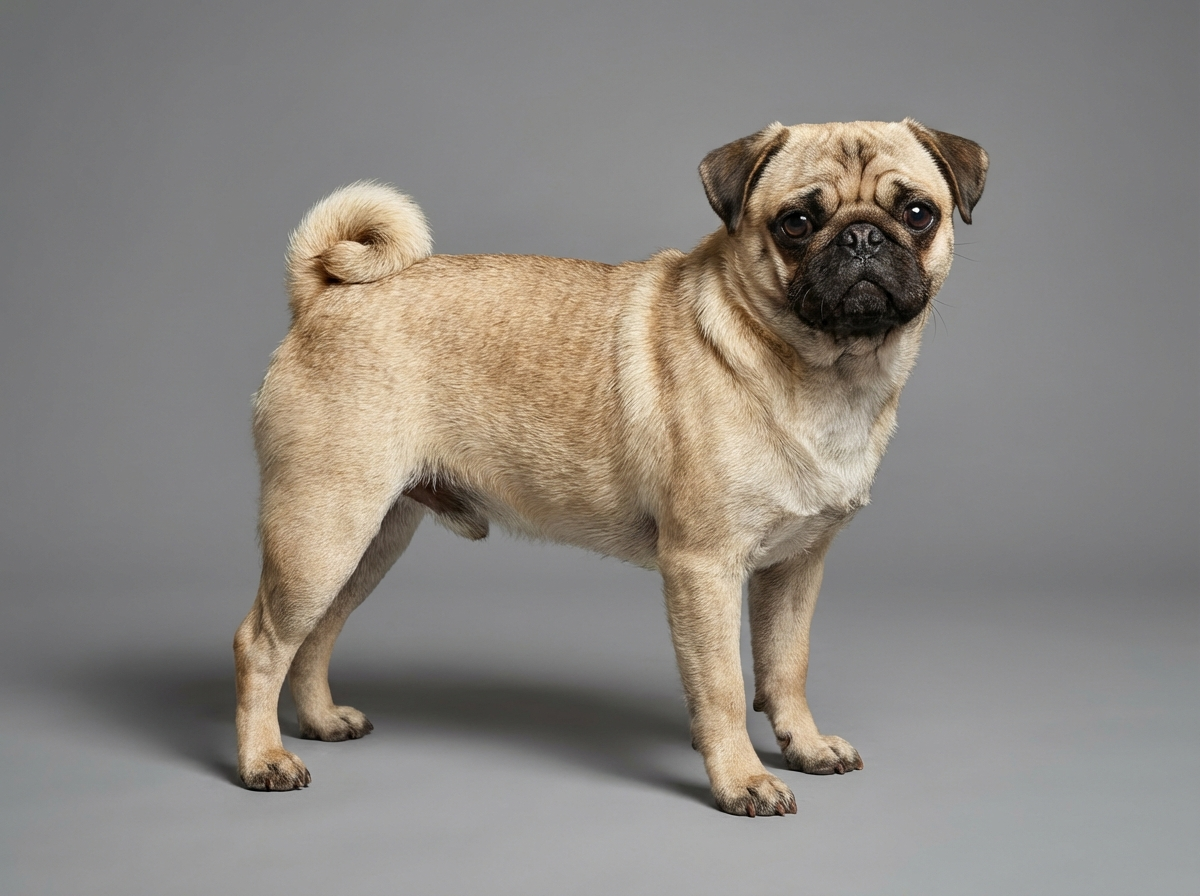
A limping young Pug puppy with no obvious injury is exactly the presentation that should raise suspicion for Legg-Calvé-Perthes disease — a condition tied specifically to small-breed growth, not to any accident.
Owners of Pug puppies between roughly four months and a year old who've noticed a limp appear without any clear injury to explain it.
This guide is not medical advice. If your dog shows pain, sudden behavior change, or worsening symptoms, consult a licensed veterinarian.
Some links may be affiliate links. We may earn a commission at no extra cost to you. We only suggest products we believe are helpful for dog owners.
We research and check what we publish, but we do not warrant that any figure, date, price, or statement is accurate, complete, or current, and we accept no liability for any loss, cost, injury, or other harm arising from the use of this site. Use it as one reference among several. You remain responsible for your own decisions and for your dog's care - confirm anything that matters with a licensed veterinarian or another qualified professional before you act on it. Full disclaimer.
Legg-Calvé-Perthes disease is a small and toy breed condition in which disrupted blood supply to the growing femoral head causes bone tissue death and collapse during puppyhood, producing progressive limping. It's mechanically distinct from hip dysplasia and typically requires surgical correction.
Legg-Calvé-Perthes disease is a recognized, though not extremely frequent, condition specifically documented in small and toy breeds during puppyhood, making it a relevant consideration for any young Pug showing an unexplained limp.
This condition is specifically associated with small and toy breeds, Pugs included, during a defined puppyhood growth window when the femoral head is actively developing and particularly vulnerable to blood supply disruption. A genetic predisposition is suspected given how consistently it appears in this size category rather than across dogs broadly.
No specific environmental trigger has been clearly established for the blood supply disruption itself. Normal weight-bearing activity during the vulnerable growth window is what causes the already-compromised bone to collapse and deform, rather than being the underlying cause of the disrupted blood supply.
Bring your puppy in promptly for any limping that persists more than a day or two, worsens over time, or is accompanied by reluctance to bear weight on one hind leg. Early diagnosis allows treatment before the bone collapse progresses further, which generally supports a better outcome.
Start here: Pug Most Common Genetic Disorders: What to Screen For
See all PUG health problems, which breeds are prone to legg calv perthes disease, or the full PUG breed guide for temperament, exercise needs and ownership costs.
Diagnosis typically happens within days to a few weeks of a limp appearing, given how quickly owners usually seek evaluation. Surgical recovery generally takes several weeks, with rehabilitation continuing for a few months to build full supporting strength.
Success is a dog that returns to comfortable, normal activity after surgery and rehabilitation, with a functional "false joint" that supports weight-bearing well — not a joint that's structurally identical to a healthy one, which isn't the outcome this surgery is designed to achieve.
In Legg-Calvé-Perthes disease, the blood vessels supplying the femoral head — the ball portion of the hip's ball-and-socket joint — become disrupted during a period when that bone is still actively growing. Without adequate blood supply, the bone tissue begins to die, a process called avascular necrosis, and the femoral head gradually collapses and deforms under normal weight-bearing stress. Because this happens during active growth rather than in a mature joint, the resulting deformity becomes essentially permanent by the time bone growth finishes, unlike some soft-tissue injuries that heal cleanly on their own.
This condition is specifically a small and toy breed phenomenon, and it's genuinely distinct from hip dysplasia even though both eventually affect the same joint — dysplasia is a laxity and malformation issue that can occur at any age and any breed size, while Perthes disease is a vascular event confined to a specific growth window in small dogs. The exact cause of the blood supply disruption isn't fully understood, though genetics are believed to play a role given how consistently it appears in certain small breeds.
This condition responds well to surgery, and outcomes are generally good — but success depends on getting an accurate diagnosis rather than assuming a puppy limp will simply resolve on its own.

If you think your Pug has legg-calvé-perthes disease, the plan is three steps: write down what you have seen and when it started, book a veterinary appointment rather than waiting for the next flare, and take video of the behaviour or symptom before you go — the thing you are worried about rarely happens in the consulting room. Screening in the parents covers brachycephalic airway syndrome (boas), pug dog encephalitis, corneal ulcers.
What the vet visit should produce is a diagnosis and a written plan, not just reassurance: what is being ruled out, what the monitoring interval is, and which signs mean you come back sooner. Ask what the treatment costs across a year rather than per visit, because that is the number that decides whether you are managing this condition or reacting to it.
Between appointments, keep a short log — dates, what you saw, what changed. It is the single most useful thing an owner brings to a follow-up, and for legg-calvé-perthes disease it is often what separates a clear pattern from a guess.
At five months old, Ruth's Pug puppy, Tofu, started favoring his right hind leg out of nowhere — no fall, no obvious cause. Ruth assumed he'd tweaked something playing and gave it a few days to settle. When the limp got worse instead of better, her vet took X-rays and found the classic signs of femoral head collapse — Legg-Calvé-Perthes disease. Given Tofu's age and the progression, surgery was recommended promptly rather than waiting further. Tofu had the affected bone portion surgically removed and spent the next two months in structured, gradually increasing rehabilitation exercises. By month three, he was running and playing normally, with no lasting limp — a puppy problem that resolved into an adult dog with no visible trace of it left.
Key takeaway: An unexplained limp in a young puppy is worth imaging rather than assuming it's a minor injury — Legg-Calvé-Perthes disease targets exactly this age group and responds well to timely surgery.
Most commonly between about four months and one year of age, coinciding with the period of active bone growth when the femoral head is most vulnerable to a blood supply disruption.
Perthes disease is caused by disrupted blood supply to the growing femoral head, leading to bone death and collapse during a specific growth window. Hip dysplasia is a joint malformation and looseness that can develop or worsen at any age, in dogs of any size, through a different mechanism entirely.
Yes — as the bone tissue deteriorates and the joint surface becomes irregular, affected puppies typically show progressive limping and discomfort, which is usually what prompts an owner to seek veterinary evaluation.
In most confirmed cases, yes — femoral head and neck excision surgery is the standard treatment, and dogs generally recover good function afterward, especially with a supported rehabilitation period.
Most dogs regain good, comfortable function after the surgery and recovery period, particularly small and toy breeds whose lighter body weight places less demand on the reconstructed joint compared with a larger dog.
The exact trigger for the blood supply disruption isn't fully understood, but a genetic predisposition is suspected given how consistently the condition appears in specific small and toy breeds rather than occurring randomly across all dogs.
The name and general disease process — avascular necrosis of the femoral head during growth — are similar, though the two are studied and treated within their respective fields rather than being directly interchangeable conditions.
The early signs are set out in the sections above, and they are the reason to book a veterinary appointment rather than wait. Legg-calvé-perthes Disease in Pugs is diagnosed by a vet, not from a symptom list, and the sooner it is on record the more options remain open.
A limp on one hind leg appearing in a puppy roughly four months to a year old, without any clear injury to explain it.
Hip X-rays showing characteristic bone flattening or collapse of the femoral head, in a puppy of the typical age range, confirm the diagnosis.
Femoral head and neck excision surgery commonly runs into the thousand-dollar range or more depending on the facility and region.
It can occur in one hip or, less commonly, both, which is part of why X-rays of both hips are typically taken during diagnosis.
It's strongly recommended — building supporting muscle around the reconstructed joint meaningfully improves long-term comfort and function.
A one-page prep sheet for this condition: the signs, the questions to ask, what to get priced. Unlocks here.
You get: Vet visit prep sheet
No spam. One-click unsubscribe. See our privacy policy.
Preview page 1 before you decide.