Choose the Pug for a small, low-exercise companion that's easy on first-time owners and friendly with everyone it meets. Choose the Doberman if you want an athletic, protective dog and have the experience and space to match its drive.
Doberman Pinscher or Pug? On paper they differ most on exercise need, and on the scales Doberman Pinscher is the heavier at 60–100 lbs. Here is how the two compare on everything that shapes an ordinary week.
This is for someone already down to Doberman Pinscher and Pug and deciding between them. For this pair the decision usually turns on exercise need and energy level, so those are covered first and in most detail. Anyone choosing from a flat has a clear answer here: Pug rates 5/5 against 2/5. It is written for the decision rather than the breed history.
Quick verdict
Between Doberman Pinscher and Pug, exercise need is what separates them, and Pug is the lower-effort dog of the two to keep.
Choose doberman pinscher if...
Choose Doberman Pinscher if you do not want a standing grooming appointment, shedding is a problem in your house and you want a dog that picks up training quickly.
Choose pug if...
Choose Pug if you are in a flat or a smaller home, this is your first dog and your walking routine is modest.
Head-to-head comparison
Feature
doberman pinscher
pug
Winner
Size class
large
small
Equal
Weight
60–100 lbs
14–18 lbs
Equal
Height
24–28 in
10–13 in
Equal
Lifespan
10–12 years
13–15 years
pug
Exercise need
Very high (5/5)
Low (2/5)
pug
Grooming need
Very low (1/5)
Low (2/5)
doberman pinscher
Shedding
Moderate (3/5)
High (4/5)
doberman pinscher
Energy level
Very high (5/5)
Low (2/5)
Equal
Barking
Moderate (3/5)
Low (2/5)
pug
Apartment suitability
Low (2/5)
Very high (5/5)
pug
Good for first-time owners
Low (2/5)
Very high (5/5)
pug
Tolerates being alone
Low (2/5)
Low (2/5)
Equal
Trainability
Very high (5/5)
Moderate (3/5)
doberman pinscher
Good with kids
High (4/5)
Very high (5/5)
pug
Good with other dogs
Moderate (3/5)
High (4/5)
pug
Friendly to strangers
Low (2/5)
Very high (5/5)
pug
Cost level
High (4/5)
Moderate (3/5)
pug
Coat
Short, sleek
Short, smooth double coat
Equal
Origin
Germany
Various
Equal
Typical monthly cost
$120–$250
$80–$150
Equal
Typical first-year cost
$1,800–$3,500
$1,100–$2,300
Equal
Deep dive
Size and build
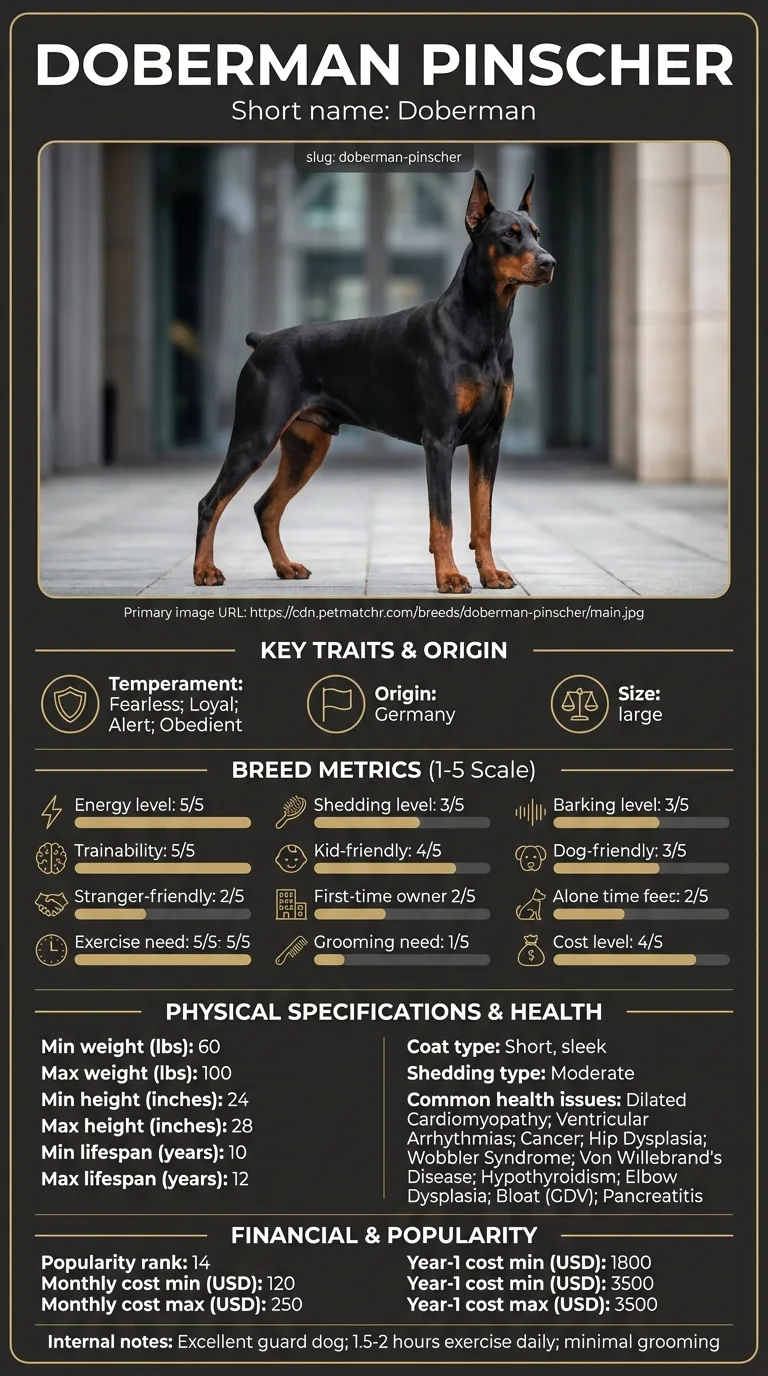
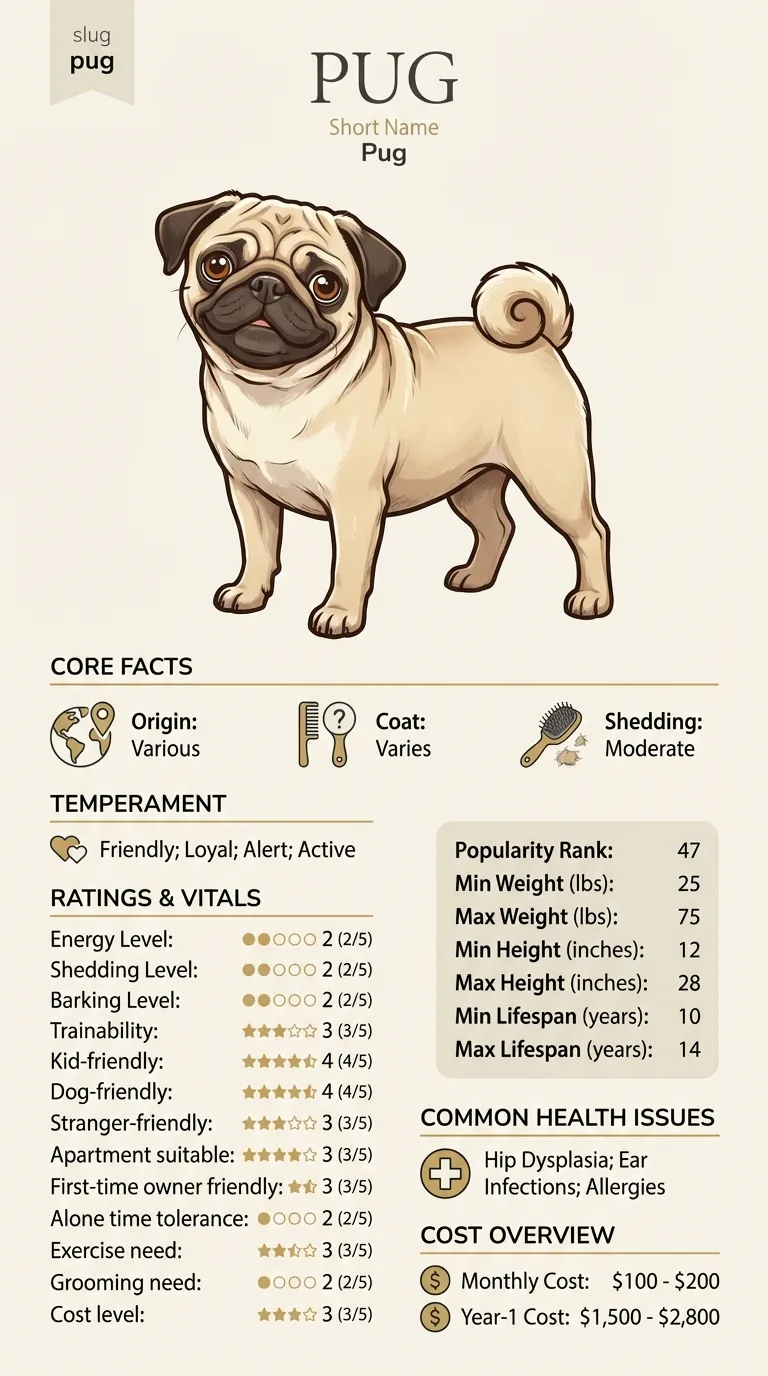
This is a mismatch by design. The Doberman stands up to 28 inches and weighs as much as 100 pounds; the Pug tops out at 18 pounds and 13 inches. You could plausibly own five Pugs for every Doberman by weight. The Pug's compact, wrinkled build and short muzzle put it in an entirely different physical category — a lap-and-couch dog next to a lean athlete.
Energy and exercise
The exercise gap is the widest number in this whole comparison: 5 out of 5 for the Doberman, just 2 out of 5 for the Pug. A Doberman needs a serious daily outlet or it will find one on its own, usually destructively. A Pug is content with short walks and indoor play — and given its flat face, you shouldn't push it much harder than that anyway, since brachycephalic dogs overheat easily.
Grooming and shedding
Grooming is close and low for both: 1 out of 5 for the Doberman, 2 out of 5 for the Pug — neither breed needs regular professional grooming. Shedding tells a different story. The Pug actually sheds more, rating 4 out of 5 against the Doberman's moderate 3 out of 5, which surprises people who assume a short-haired small dog means less hair around the house. It doesn't.
Apartment living, noise and time alone
The Pug is built for small spaces — a 5 out of 5 for apartment suitability and a quiet 2 out of 5 for barking. The Doberman rates just 2 out of 5 for apartment life and a moderate 3 out of 5 for barking. Neither dog handles being left alone well; both score a low 2 out of 5 there, so long solo hours during the workday aren't a good setup for either.
Training and owner experience
The Doberman is markedly easier to train on paper — 5 out of 5 versus the Pug's moderate 3 out of 5 — but it's rated much harder for a first-time owner, 2 out of 5 against the Pug's 5 out of 5. That combination makes sense: the Doberman learns fast but needs an owner who already knows how to lead a large, driven dog, while the Pug is slower to pick up commands but forgives beginner mistakes.
Kids, other dogs and visitors
The Pug edges the Doberman with kids (5 versus 4), other dogs (4 versus 3), and especially with strangers (5 versus 2) — it's one of the friendliest breeds toward people it's never met, while the Doberman's wariness is central to its role as a guardian. If your household hosts a lot of unfamiliar faces, the Pug adjusts without the management a Doberman requires.
Health and lifespan
The Pug lives longer on average, 13 to 15 years against the Doberman's 10 to 12, but its health list is its own concern: Brachycephalic Airway Syndrome, Pug Dog Encephalitis, corneal ulcers, hemivertebrae, and obesity — nearly all tied to its flat face and compact spine. The Doberman's risks are almost entirely different, centered on cardiac disease and cancer. There's no meaningful overlap between the two lists, which tells you these are genuinely different sets of medical bills to plan for.
Cost to keep
The Pug is the cheaper dog to keep: a moderate 3 out of 5 cost rating against the Doberman's high 4 out of 5, $80 to $150 a month versus $120 to $250, and $1,100 to $2,300 in year one versus $1,800 to $3,500. That gap can narrow fast, though, if a Pug develops airway or breathing complications that need surgical correction — a cost this comparison's numbers don't capture.
Doberman Pinscher vs Pug at a glance
Doberman Pinscher weighs 60–100 lbs and lives 10–12 years; Pug weighs 14–18 lbs and lives 13–15 years. The two diverge most on exercise need, energy level and apartment suitability and 3 other rated axes. Almost every rated axis separates them at least slightly. In the table, a "winner" means easier for an ordinary household — not better. Size, coat and origin are recorded without a verdict. Because both breeds are scored the same way, the gaps are reliable even where the absolute numbers are rough.
Doberman Pinscher vs Pug: Which Suits Your Home? - Doberman Pinscher vs Pug at a glance
Frequently asked questions
How much smaller is a Pug than a Doberman?
Dramatically — a Pug weighs 14 to 18 pounds against a Doberman's 60 to 100, and stands about half the height. This is one of the largest size gaps you'll find in a breed comparison.
Which sheds more, the Doberman or the Pug?
The Pug, somewhat surprisingly — it rates 4 out of 5 for shedding against the Doberman's moderate 3 out of 5. Its short double coat sheds more than its size would suggest.
Is a Pug a better first dog than a Doberman?
Yes, by a wide margin in this data — the Pug rates 5 out of 5 for first-time owners, the Doberman just 2 out of 5. The Doberman is actually the easier breed to train (5 versus 3), but it demands more experienced handling overall.
Which breed fits an apartment better?
The Pug, clearly — 5 out of 5 for apartment suitability against the Doberman's 2 out of 5. The Pug's low exercise needs and quiet nature (2 out of 5 barking) make it suited to small spaces.
Which costs less to keep?
The Pug — $80 to $150 a month and $1,100 to $2,300 in the first year, against $120 to $250 and $1,800 to $3,500 for the Doberman.
Do these breeds share health risks?
Barely any. The Pug's conditions are almost entirely tied to its flat face and short spine — airway syndrome, encephalitis, corneal ulcers, hemivertebrae — while the Doberman's are cardiac and orthopedic. There's essentially no overlap between the two lists.
Is the Pug friendlier to strangers than the Doberman?
Much friendlier — it rates 5 out of 5 versus the Doberman's 2 out of 5. That's part of why Dobermans make effective guard dogs and Pugs generally don't.
Choose the Pug for a small, low-exercise companion that's easy on first-time owners and friendly with everyone it meets. Choose the Doberman if you want an athletic, protective dog and have the experience and space to match its drive.
Costs
What's the monthly cost gap?
The Pug runs $80 to $150 a month; the Doberman runs $120 to $250. The Doberman carries a higher overall cost rating too.
Living
How much exercise does each need?
The Doberman needs the maximum, 5 out of 5, daily. The Pug needs far less, just 2 out of 5 — short walks and play are enough, and its flat face means you shouldn't push much harder anyway.
Health
Which lives longer?
The Pug, at 13 to 15 years against the Doberman's 10 to 12.
Related DogBreedCompass guides
Doberman Pinscher breed guide – Readers comparing the two usually want the full profile of Doberman Pinscher before deciding.
Pug breed guide – The same for Pug, so the comparison can be checked against the detail.
Doberman Pinscher vs Weimaraner – Weimaraner is the closest breed to Doberman Pinscher on the measured axes, so it is the natural next comparison.
Pug vs Boston Terrier – Boston Terrier sits closest to Pug, which makes it the alternative worth ruling out.
Health information here is general and is not veterinary advice. If your dog shows pain, sudden behaviour change, or worsening symptoms, consult a licensed veterinarian.
Some links on this site are affiliate links. We may earn a commission at no extra cost to you, and we only suggest products we believe are helpful for dog owners.
We research and check what we publish, but we do not warrant that any figure, date, price, or statement is accurate, complete, or current, and we accept no liability for any loss, cost, injury, or other harm arising from the use of this site. Use it as one reference among several. You remain responsible for your own decisions and for your dog's care - confirm anything that matters with a licensed veterinarian or another qualified professional before you act on it. Full disclaimer.