Health
What is the first sign of allergy in a Newfoundland?
Usually an ear, not the skin. Head shaking, a smell from the canal, or a second ear infection inside a year is the most common opening move in this breed.

Quick answer
What is the first sign of allergy in a Newfoundland?
Usually an ear, not the skin. Head shaking, a smell from the canal, or a second ear infection inside a year is the most common opening move in this breed.
Owners of this breed rarely bring in a dog because it is itchy. They bring in a dog with a third ear infection in eight months, or a weeping patch under the mane that appeared overnight.
This is written for owners stuck in a cycle of ear cleaners and repeat prescriptions who have started to suspect the ears are a symptom rather than the problem, and for anyone whose Newfoundland licks their front feet raw every August.
This guide is not medical advice. If your dog shows pain, sudden behavior change, or worsening symptoms, consult a licensed veterinarian.
Some links may be affiliate links. We may earn a commission at no extra cost to you. We only suggest products we believe are helpful for dog owners.
We research and check what we publish, but we do not warrant that any figure, date, price, or statement is accurate, complete, or current, and we accept no liability for any loss, cost, injury, or other harm arising from the use of this site. Use it as one reference among several. You remain responsible for your own decisions and for your dog's care - confirm anything that matters with a licensed veterinarian or another qualified professional before you act on it. Full disclaimer.
Chronic allergy in a Newfoundland is an inflammation problem that is usually discovered as an infection problem. The dog is repeatedly treated for ears, hot spots or a smelly coat, and the pattern only becomes clear when someone plots the dates. Left unaddressed, the underlying inflammation keeps generating new secondary infections, and the dog spends years on courses of treatment that work briefly.
Allergic skin disease is one of the most frequent reasons dogs of any breed are seen by a veterinarian. Prevalence figures specific to Newfoundlands are not well established, and it does not appear on the short list of conditions the breed is best known for. The practical point is that when it does occur here it is harder to spot early and slower to resolve than in a lighter-coated dog.
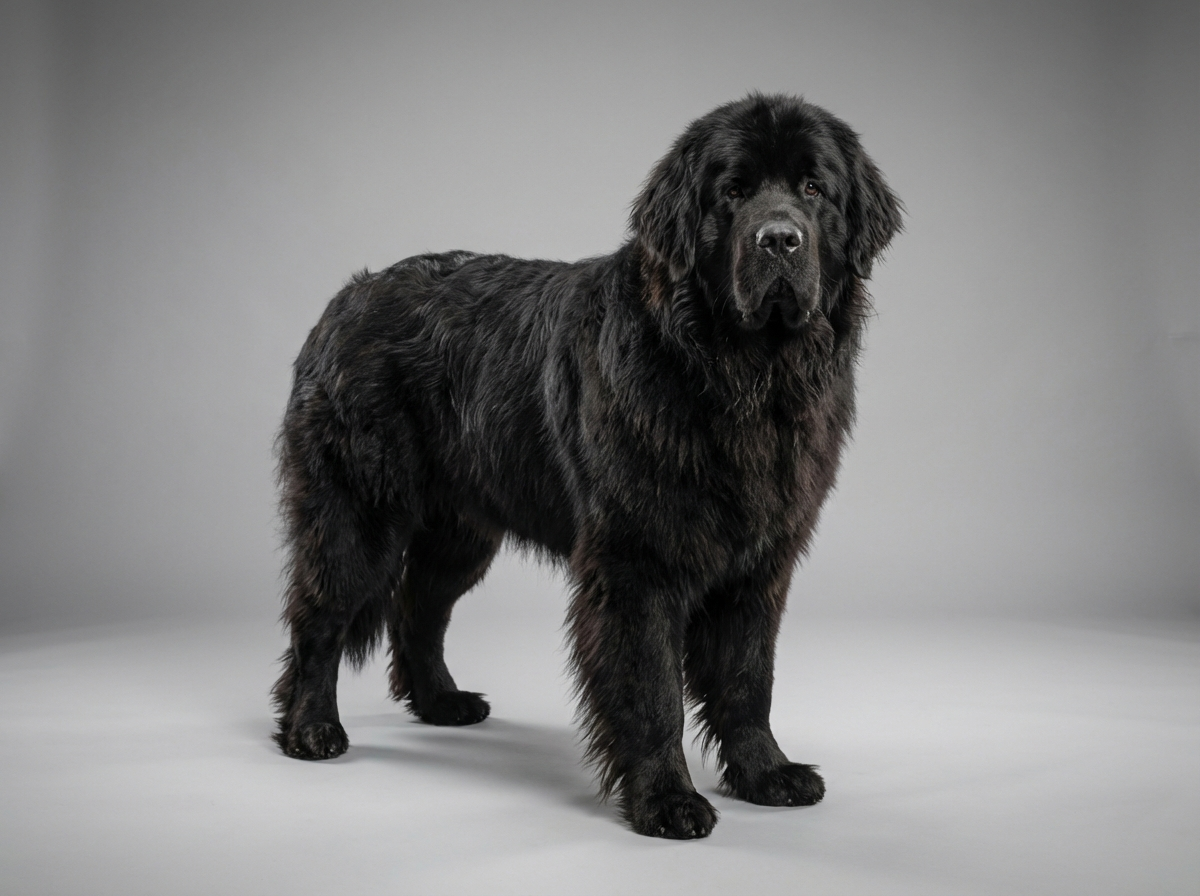
The relevant breed traits are the coat and the build. A dense, water-resistant double coat with heavy year-round shedding traps warmth and moisture at skin level, and a dog standing 26 to 28 inches at the shoulder and weighing 100 to 150 pounds has an enormous total skin surface to inspect and to bathe. Heavy drop ears cover the canal opening. None of this causes allergy. All of it changes allergy from a visible itch into a hidden, infection-driven condition, and it is the reason the same underlying disease costs more time and money in this breed.
The Newfoundland's affinity for water is the single most important environmental factor. Swimming, wading and lying on damp ground load the undercoat with moisture that can take many hours to dry without active drying. Warm indoor flooring, thick rugs and humid rooms extend the drying time further. Households that brush the coat surface but never line-brush to the skin allow shed undercoat to pack into a felt layer that holds allergen, moisture and infection against the dog.
Book an appointment for any ear infection, any hot spot, any patch of skin that is raw, weeping or smells, and any dog who is losing sleep to scratching. Ask for an underlying-cause investigation, not just another course of treatment, once you have had three or more infections in a year. Seek same-day care if a raw patch is spreading visibly by the hour, if the ear is painful enough that your dog will not let you near the head, if there is a head tilt, loss of balance or blood in the canal, or if the dog is off food and lethargic alongside skin disease. Sudden hind-end weakness, facial swelling or breathing difficulty are separate emergencies and need immediate attention.
See all Newfoundland health problems, which breeds are prone to allergies, or the full Newfoundland breed guide for temperament, exercise needs and ownership costs.
The secondary infection usually clears in two to four weeks. Understanding the underlying driver takes longer: a full food trial with rechallenge occupies three to four months, and confirming a seasonal environmental pattern needs a calendar year of dated records. Owners who expect an answer from a single appointment are almost always disappointed, and that disappointment is what pushes people from vet to vet.
Success is fewer and milder flares, not a permanently itch-free dog. A realistic good outcome is one or two short flares a year instead of continuous trouble, ears that stay clean between them, sleep that is no longer interrupted by scratching, and an owner who recognises a flare early enough that it is caught before it becomes an infection.
Allergic skin is inflamed skin, and inflamed skin leaks a little serum and loses some of its barrier function. On a thin-coated dog that dries in the open air. On a Newfoundland it does not.
The breed carries a heavy water-resistant double coat with a dense insulating undercoat, and heavy shedding year round means that undercoat is constantly loosening and packing down against the skin. Warmth plus moisture plus a mat of shed hair is a culture medium. The result is that a Newfoundland with a mild underlying allergy often skips the visibly itchy phase entirely and presents with a secondary bacterial or yeast infection: a hot spot behind the ear or under the collar, a greasy smell along the back, or otitis in a canal that is already covered by a heavy drop ear.
That is why treating only the infection feels so unsatisfying. The antibiotic or the ear drops clear the surface problem, the skin is comfortable for six weeks, and then it comes back, because nothing was done about the reason the skin was inflamed in the first place.

Allergy work is detective work, and vets are limited by the quality of the history they get. A Newfoundland owner who arrives with these five things saves months.
If you think your Newfoundland has allergies, the plan is three steps: write down what you have seen and when it started, book a veterinary appointment rather than waiting for the next flare, and take video of the behaviour or symptom before you go — the thing you are worried about rarely happens in the consulting room. Screening in the parents covers hip dysplasia, subaortic stenosis, dilated cardiomyopathy.
What the vet visit should produce is a diagnosis and a written plan, not just reassurance: what is being ruled out, what the monitoring interval is, and which signs mean you come back sooner. Ask what the treatment costs across a year rather than per visit, because that is the number that decides whether you are managing this condition or reacting to it.
Between appointments, keep a short log — dates, what you saw, what changed. It is the single most useful thing an owner brings to a follow-up, and for allergies it is often what separates a clear pattern from a guess.
Maggie was a six-year-old Newfoundland who had been treated for ear infections four times in fourteen months, each time by a different vet at a busy practice. Every course worked. Every time, she was back within a few months. Her owner Tom finally sat down and put the dates on a wall calendar. Three of the four episodes had begun in the second half of April or the first half of May. The fourth had followed a week at a lake house in August. He also realised he had stopped her flea preventative through the winter for three years running. His vet started with the simplest thing: unbroken year-round parasite control and a proper line-brushing and drying routine after swimming. That alone cut the licking. The following spring Maggie's ears began to redden on schedule in mid-April, which was itself the useful finding, and the practice began treating the inflammation early rather than waiting for the infection. Maggie is not cured. She has a predictable six weeks each spring that need managing, and Tom now books the appointment before the flare rather than after it.
Key takeaway: Repeat infections are a pattern, and patterns are only visible on a calendar. Dating every flare for a year is the cheapest diagnostic step available to a Newfoundland owner.
Allergy is not among the conditions most often flagged for the breed, which are hip dysplasia, subaortic stenosis, dilated cardiomyopathy, cystinuria and bloat. What the Newfoundland does have is a coat and a body shape that turn a modest allergy into a stubborn, infection-prone one, so the same underlying problem causes more trouble here than in a shorthaired dog.
Repeat otitis in an adult dog is usually a symptom of allergic inflammation in the ear canal lining rather than an isolated infection. A drop ear and a swimming habit add moisture on top of it. If your Newfoundland has had three or more ear infections in a year, ask your vet to investigate the underlying driver rather than treating each episode alone.
Eight to twelve weeks with absolutely nothing else passing your dog's lips, followed by a deliberate rechallenge with the old diet to confirm the result. Skipping the rechallenge is the most common reason owners end up unsure. It is a demanding process in a household with children who drop food.
This is a decision for you and your vet, not a general rule. The double coat provides insulation against both cold and heat and does not always grow back with its original texture. Vets do commonly clip affected areas so treatment can reach the skin, which is different from shaving the whole dog.
Yes. Environmental allergy most often begins between one and three years of age, but food-responsive disease can appear at any point, including in a dog who has eaten the same food for years. New itching in an older dog is worth a full workup, because several non-allergic conditions look the same at first.
Not usually an overnight emergency, but it does need a vet within a day or two. Hot spots spread astonishingly quickly under a dense coat, are genuinely painful, and a patch the size of a coin on Sunday can cover a hand by Tuesday. Do not try to manage one under the coat at home.
Usually an ear, not the skin. Head shaking, a smell from the canal, or a second ear infection inside a year is the most common opening move in this breed.
Weekly, during a proper line brushing. Part the coat down to the skin along the neck, behind the ears, under the collar and along the flanks, and look at the skin itself rather than the coat surface.
Yes, noticeably. A Newfoundland already needs a high grooming commitment, and allergy adds medicated bathing, more frequent full dries and often professional clipping of affected areas.
Indirectly but genuinely. A dog taught to accept ear handling, foot soaking and long bath sessions gets better care with less stress, and this breed's high trainability makes that teaching straightforward.
No. Environmental allergy is controlled for life rather than cured. Food-responsive itching can effectively disappear once the ingredient is removed, which is why the food trial is usually done first.
A one-page prep sheet for this condition: the signs, the questions to ask, what to get priced. Unlocks here.
You get: Vet visit prep sheet
No spam. One-click unsubscribe. See our privacy policy.
Preview page 1 before you decide.