Behavior
Which breed needs less exercise?
The Newfoundland.

Quick answer
Which breed needs less exercise?
The Newfoundland.
Golden Retriever or Newfoundland? On paper they differ most on exercise need, and on the scales Newfoundland is the heavier at 100–150 lbs. Here is how the two compare on everything that shapes an ordinary week.
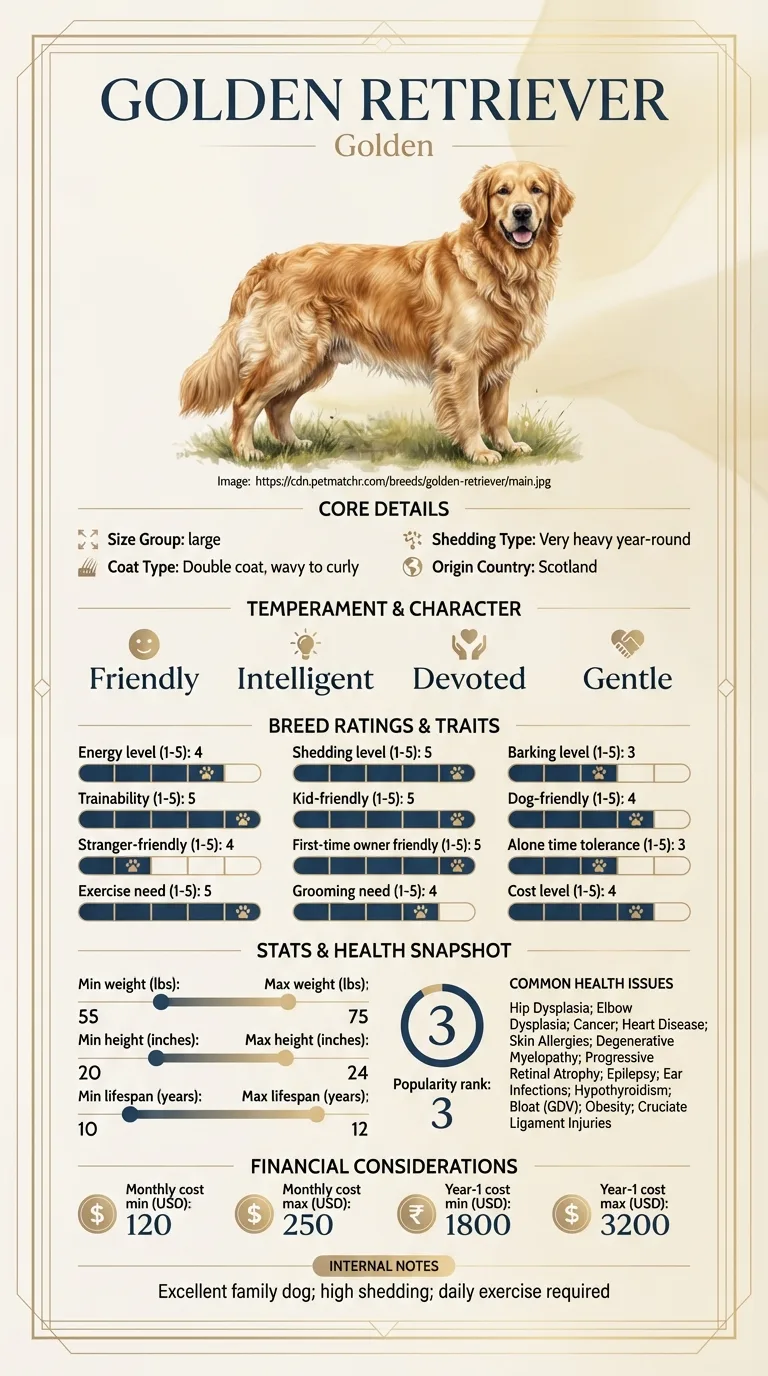
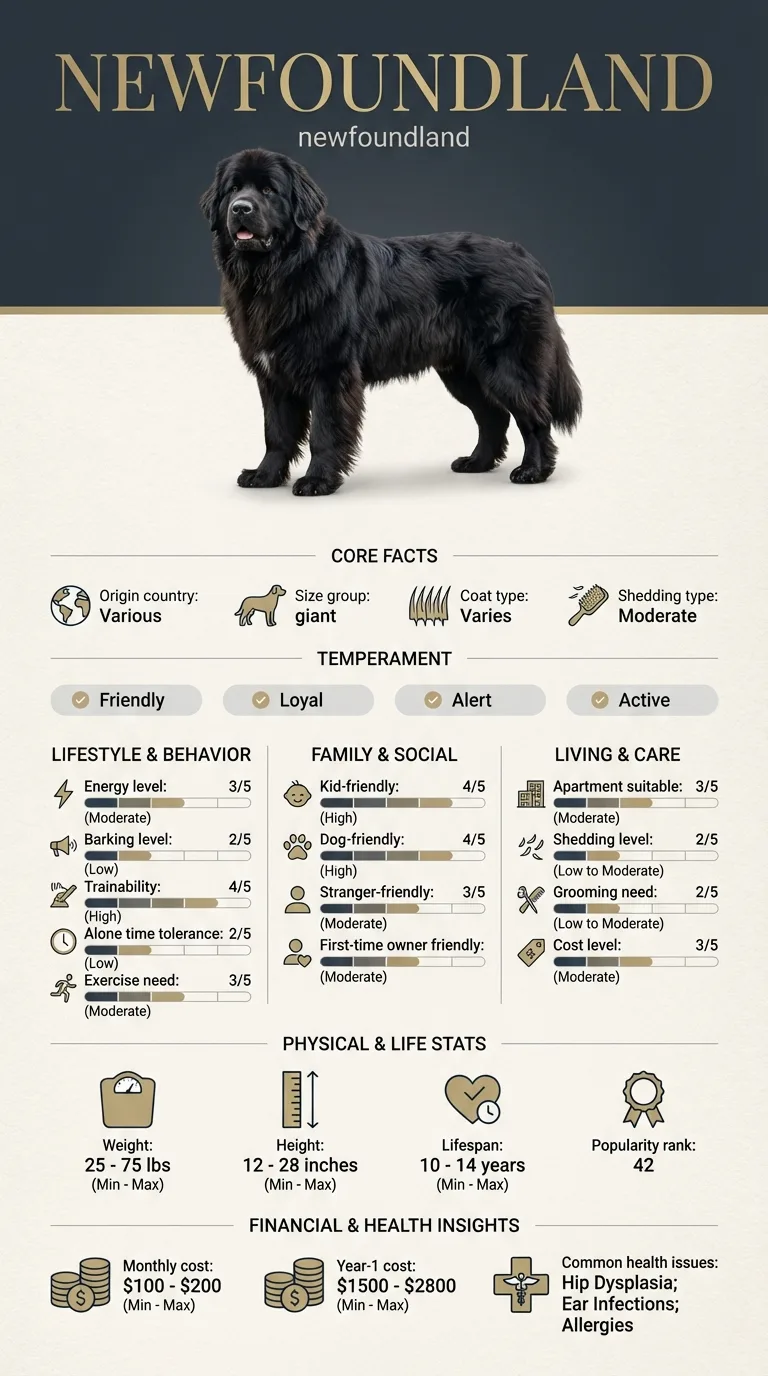
This is for someone already down to Golden Retriever and Newfoundland and deciding between them. For this pair the decision usually turns on exercise need and energy level, so those are covered first and in most detail. Anyone choosing from a flat has a clear answer here: Golden Retriever rates 2/5 against 1/5. It is written for the decision rather than the breed history.
Between Golden Retriever and Newfoundland, exercise need is what separates them, and Golden Retriever is the lower-effort dog of the two to keep.
Choose Golden Retriever if this is your first dog, you want a dog that picks up training quickly and a smaller dog suits your car, your home or your back.
Choose Newfoundland if your walking routine is modest.
| Feature | golden retriever | newfoundland | Winner |
|---|---|---|---|
| Size class | large | giant | Equal |
| Weight | 55–75 lbs | 100–150 lbs | Equal |
| Height | 20–24 in | 26–28 in | Equal |
| Lifespan | 10–12 years | 9–10 years | golden retriever |
| Exercise need | Very high (5/5) | Moderate (3/5) | newfoundland |
| Grooming need | High (4/5) | High (4/5) | Equal |
| Shedding | Very high (5/5) | Very high (5/5) | Equal |
| Energy level | High (4/5) | Low (2/5) | Equal |
| Barking | Moderate (3/5) | Low (2/5) | newfoundland |
| Apartment suitability | Low (2/5) | Very low (1/5) | golden retriever |
| Good for first-time owners | Very high (5/5) | Moderate (3/5) | golden retriever |
| Tolerates being alone | Moderate (3/5) | Moderate (3/5) | Equal |
| Trainability | Very high (5/5) | High (4/5) | golden retriever |
| Good with kids | Very high (5/5) | Very high (5/5) | Equal |
| Good with other dogs | High (4/5) | High (4/5) | Equal |
| Friendly to strangers | High (4/5) | High (4/5) | Equal |
| Cost level | High (4/5) | Very high (5/5) | golden retriever |
| Coat | Double coat, wavy to curly | Heavy water-resistant double coat | Equal |
| Origin | Scotland | Various | Equal |
| Typical monthly cost | $120–$250 | $150–$310 | Equal |
| Typical first-year cost | $1,800–$3,200 | $2,200–$4,200 | Equal |
The Newfoundland is a genuine giant, 100-150 lbs and 26-28 inches, well above the Golden's 55-75 lbs and 20-24 inches, though its height range is narrower than some giant breeds since Newfoundlands tend to be more heavily built than tall. Both are considered large, sturdy dogs by most standards, but the Newfoundland's mass alone puts it in a different practical category, more food, bigger gear, sturdier everything. Anyone drawn to the Newfoundland's calm, water-loving reputation should factor in that living with a 100+ lb dog changes daily logistics in ways a Golden's more moderate size simply doesn't.
The Newfoundland is notably calmer, Moderate (3/5) exercise need against the Golden's Very High (5/5), and Low (2/5) energy level against the Golden's High (4/5). Bred originally as a working water-rescue dog rather than a tireless retriever, the Newfoundland's Patient, Calm temperament shows up practically as a giant breed that's satisfied with moderate daily activity rather than demanding hours of vigorous exercise. That makes the Newfoundland a genuinely more restful choice for owners who want a big, gentle presence without the Golden's relentless drive to move, swim or fetch.
Grooming ties at High (4/5) for both, but that's actually notable, since the Newfoundland's heavy, water-resistant double coat demands just as much brushing time as the Golden's, and shedding ties too, both rate Very High (5/5), making this the rare pairing where the giant breed doesn't get an easy pass on coat care. Expect comparable fur volume around the house from either dog, and comparable brushing commitment to manage it. Owners hoping the Newfoundland's calmer energy would come with an easier coat should recalibrate, this is one area where size doesn't buy any convenience.
The Golden edges ahead on apartment suitability, Low (2/5) against the Newfoundland's Very Low (1/5), reflecting the Newfoundland's sheer physical bulk more than any energy mismatch, since its Moderate exercise need would otherwise suit smaller spaces reasonably well. Barking favors the Newfoundland though, Low (2/5) against the Golden's Moderate (3/5), consistent with its Calm, Sweet temperament. Both tolerate being alone at a tied Moderate (3/5). In practice, neither breed suits a true apartment, but a Newfoundland's size is the binding constraint here, not its temperament or noise level, both of which actually favor small-space living.
The Golden rates higher on both counts, Very High (5/5) trainability and first-time-owner suitability against the Newfoundland's still-solid High (4/5) and Moderate (3/5). The Newfoundland's Devoted, Patient nature makes it a naturally cooperative learner, but its size means early training matters just as much as with any giant breed, a grown Newfoundland that hasn't learned leash manners is a serious physical handful. First-time owners drawn to the breed's famously gentle reputation can absolutely succeed with one, the Moderate rating isn't a warning sign, just a reminder that size adds stakes to training that a Golden's frame doesn't carry as heavily.
Kids, other dogs and strangers all tie at the top or near it, Very High (5/5) with kids for both, High (4/5) with other dogs for both, and High (4/5) with strangers for both, making household fit essentially a wash between these two. The Newfoundland's storied reputation as a nanny dog for children is backed up directly by the data here, matching the Golden's own strong family credentials. Families choosing between them on this metric alone will find no real daylight, size, exercise needs and cost are the more useful differentiators for this particular pairing.
The Golden edges out a longer lifespan, 10-12 years against the Newfoundland's 9-10, though the Newfoundland's health list is notably shorter, just five named conditions, Hip Dysplasia, Subaortic Stenosis, Dilated Cardiomyopathy, Cystinuria and Bloat (GDV), against the Golden's thirteen. Cardiac risk stands out specifically for the Newfoundland, with both Subaortic Stenosis and Dilated Cardiomyopathy named, making heart screening a priority conversation with any breeder. The Golden's longer list adds Cancer, Degenerative Myelopathy and Cruciate Ligament Injuries to the shared Hip Dysplasia and Bloat risk. Both are deep-chested breeds, so bloat precautions apply equally regardless of which one a buyer chooses.
The Newfoundland costs more to keep, $150-310 monthly and $2,200-4,200 in year one, against the Golden's $120-250 and $1,800-3,200, and it rates Very High (5/5) overall cost against the Golden's High (4/5). Food volume at 100-150 lbs drives most of the everyday gap, and giant-breed veterinary care, particularly the cardiac screening its health list suggests, adds to the total. Grooming costs should run close to even given the tied High (4/5) rating for both, so the real budget difference comes down to food and the size-adjusted cost of any vet procedure, from anesthesia dosing to imaging.
Golden Retriever weighs 55–75 lbs and lives 10–12 years; Newfoundland weighs 100–150 lbs and lives 9–10 years. The two diverge most on exercise need, energy level and good for first-time owners. They are level on tolerates being alone, good with other dogs and grooming need, so those cannot decide it. In the table, a "winner" means easier for an ordinary household — not better. Size, coat and origin are recorded without a verdict. Because both breeds are scored the same way, the gaps are reliable even where the absolute numbers are rough.

Yes — it rates Moderate (3/5) for exercise need against the Golden's Very High (5/5).
Neither, both tie at Very High (5/5) for shedding, so expect comparable fur regardless of which you choose.
They're tied — both rate Very High (5/5) with kids, and the Newfoundland has a long-standing reputation as a gentle nanny dog.
The Golden Retriever, 10-12 years versus the Newfoundland's 9-10.
No, it rates Very Low (1/5) for apartment suitability, mainly due to its sheer physical size rather than energy level.
The Newfoundland, roughly $150-310 a month versus $120-250 for the Golden, mostly due to food volume.
Yes, both Subaortic Stenosis and Dilated Cardiomyopathy appear on its health list, making heart screening an important breeder question.
The Newfoundland.
The Newfoundland.
The Golden Retriever.
The Newfoundland.
Secure checkout on Stripe. We never see your card.
7-day money-back guarantee. Instant access.

Health information here is general and is not veterinary advice. If your dog shows pain, sudden behaviour change, or worsening symptoms, consult a licensed veterinarian.
Some links on this site are affiliate links. We may earn a commission at no extra cost to you, and we only suggest products we believe are helpful for dog owners.
We research and check what we publish, but we do not warrant that any figure, date, price, or statement is accurate, complete, or current, and we accept no liability for any loss, cost, injury, or other harm arising from the use of this site. Use it as one reference among several. You remain responsible for your own decisions and for your dog's care - confirm anything that matters with a licensed veterinarian or another qualified professional before you act on it. Full disclaimer.
Match your lifestyle to the right dog.
Take quizNot sure which breed is right for you? Take our 2-minute quiz to find out.
Take the quiz