Behavior
Which sheds less?
The Goldendoodle.

Quick answer
Which sheds less?
The Goldendoodle.
Golden Retriever or Goldendoodle? On paper they differ most on shedding, and on the scales Golden Retriever is the heavier at 55–75 lbs. Here is how the two compare on everything that shapes an ordinary week.
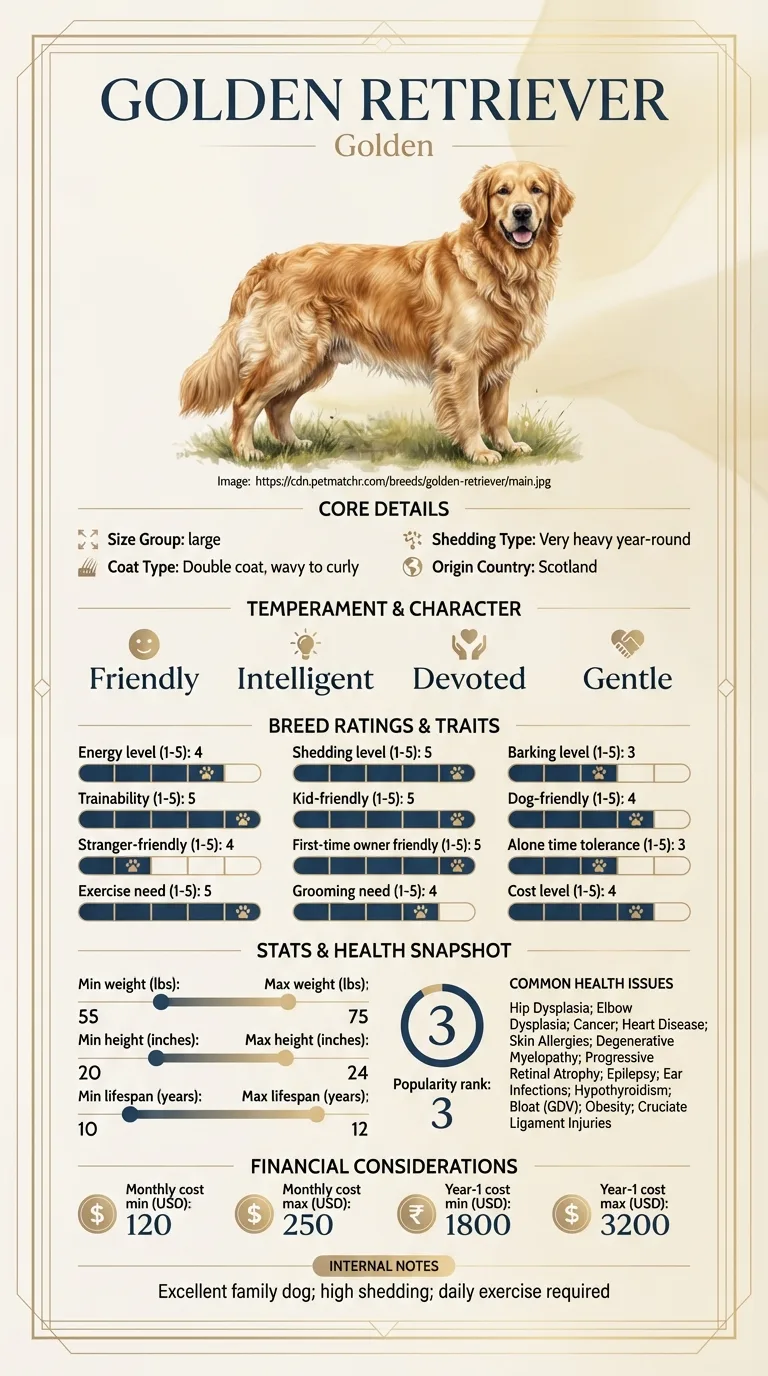
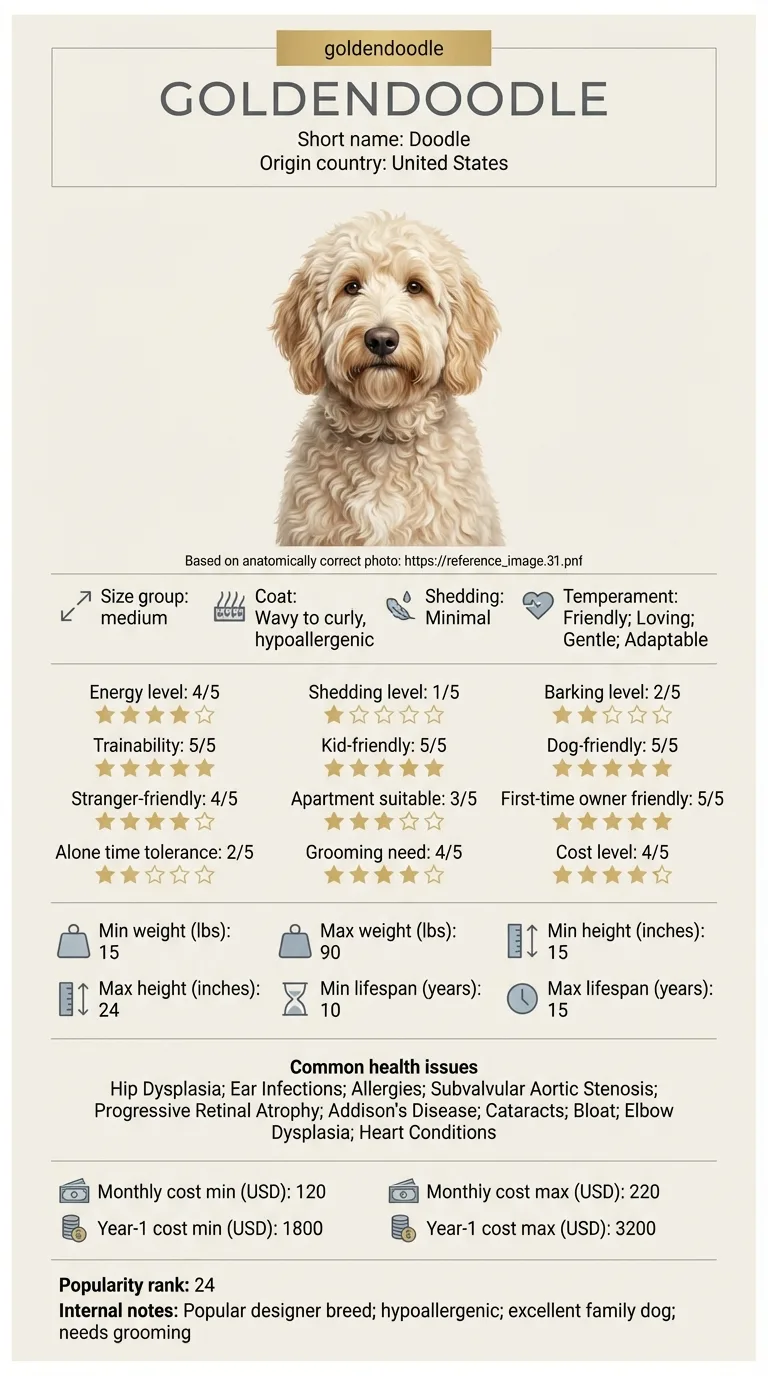
This is for someone already down to Golden Retriever and Goldendoodle and deciding between them. For this pair the decision usually turns on shedding, so those are covered first and in most detail. Anyone choosing from a flat has a clear answer here: Goldendoodle rates 3/5 against 2/5. There is no origin story here — only what changes about your week.
Between Golden Retriever and Goldendoodle, shedding is what separates them, and Goldendoodle is the lower-effort dog of the two to keep.
Choose Golden Retriever if the dog will be alone during the working day and you want a dog that can keep up with an active routine.
Choose Goldendoodle if you are in a flat or a smaller home, shedding is a problem in your house and your walking routine is modest.
| Feature | golden retriever | goldendoodle | Winner |
|---|---|---|---|
| Size class | large | medium | Equal |
| Weight | 55–75 lbs | 15–90 lbs | Equal |
| Height | 20–24 in | 15–24 in | Equal |
| Lifespan | 10–12 years | 10–15 years | goldendoodle |
| Exercise need | Very high (5/5) | High (4/5) | goldendoodle |
| Grooming need | High (4/5) | High (4/5) | Equal |
| Shedding | Very high (5/5) | Very low (1/5) | goldendoodle |
| Energy level | High (4/5) | High (4/5) | Equal |
| Barking | Moderate (3/5) | Low (2/5) | goldendoodle |
| Apartment suitability | Low (2/5) | Moderate (3/5) | goldendoodle |
| Good for first-time owners | Very high (5/5) | Very high (5/5) | Equal |
| Tolerates being alone | Moderate (3/5) | Low (2/5) | golden retriever |
| Trainability | Very high (5/5) | Very high (5/5) | Equal |
| Good with kids | Very high (5/5) | Very high (5/5) | Equal |
| Good with other dogs | High (4/5) | Very high (5/5) | goldendoodle |
| Friendly to strangers | High (4/5) | High (4/5) | Equal |
| Cost level | High (4/5) | High (4/5) | Equal |
| Coat | Double coat, wavy to curly | Wavy to curly, hypoallergenic | Equal |
| Origin | Scotland | United States | Equal |
| Typical monthly cost | $120–$250 | $120–$220 | Equal |
| Typical first-year cost | $1,800–$3,200 | $1,800–$3,200 | Equal |
A purebred Golden Retriever gives you a predictable 55-75 lb, 20-24 inch dog every time, while a Goldendoodle's 15-90 lb, 15-24 inch range reflects the reality that 'Goldendoodle' spans mini, medium and standard sizes depending on the poodle parent. That's the single biggest variable in this comparison: buyers choosing a Goldendoodle need to know exactly which size line they're getting, because a mini Goldendoodle and a standard Goldendoodle live almost as differently as a Yorkie and a Golden do. The Golden's consistency is its own selling point for anyone who wants to know precisely what dog they'll have at full grown, without guessing between litters or breeders.
The Golden edges out with a Very High (5/5) exercise need against the Goldendoodle's still-substantial High (4/5), though both share a High (4/5) energy level day to day. Both temperament lists include Friendly and Gentle, but the Goldendoodle also carries Adaptable, a trait that shows up practically as a dog somewhat more willing to settle for a shorter outing than a purebred Golden, which was bred specifically as a tireless retrieving gundog. Neither is a low-energy breed by any measure, and anyone hoping the poodle influence tames a Golden's drive significantly will be only partly right, the Goldendoodle still needs real daily exercise, just marginally less punishing than its purebred parent.
This is the category most people are actually shopping for, and the numbers are dramatic: both rate High (4/5) for grooming effort, but shedding is a different world entirely, Very High (5/5) for the Golden's double coat against a Very Low (1/5) for the Goldendoodle's curlier, poodle-influenced coat. That doesn't mean the Goldendoodle is low-maintenance, its coat still needs High grooming attention, regular brushing and professional trims, just that the hair stays on the dog instead of the furniture. Families choosing a Goldendoodle specifically for allergy or shedding reasons are making a reasonable trade, more grooming appointments in exchange for a much cleaner house and fewer allergic reactions.
The Goldendoodle is the modestly better apartment candidate, Moderate (3/5) suitability against the Golden's Low (2/5), and it barks less too, Low (2/5) versus the Golden's Moderate (3/5). The one place the Golden pulls ahead is tolerating solitude, Moderate (3/5) against the Goldendoodle's Low (2/5), which tracks with the Goldendoodle's Loving, Adaptable-but-attached temperament; poodle-mix dogs are frequently described as velcro companions. So a Goldendoodle handles small spaces and quiet buildings slightly better, but needs a person around more consistently than a Golden does. Neither breed is a true apartment dog given their shared High energy levels, but the Goldendoodle comes closer.
Both breeds rate Very High (5/5) for trainability and Very High (5/5) for first-time-owner suitability, making this one of the rare pairings where either choice is genuinely beginner-friendly. The Golden's Intelligent, Devoted temperament produces the classic eager-to-please obedience dog; the Goldendoodle inherits much of that plus the Poodle's problem-solving intelligence, sometimes making it even quicker in a training class, though individual variation is larger in mixed litters. First-time owners really cannot go wrong on the training front with either breed, so the deciding factor here should come down to coat care and space rather than trainability, since both dogs will happily meet a novice owner halfway.
Families score both breeds identically with kids, Very High (5/5), and nearly identically with strangers, both High (4/5), so warmth toward people isn't the differentiator. Other dogs is where the Goldendoodle nudges ahead, Very High (5/5) against the Golden's already-strong High (4/5), likely reflecting the Poodle's typically sociable temperament layered onto the Golden's own Friendly, Gentle base. In practice, both breeds are safe, standard choices for busy households with kids, visitors and other pets cycling through regularly. A multi-dog household with a slight edge case, a shy resident dog, for instance, might lean Goldendoodle for that marginally higher other-dogs score.
The Goldendoodle's projected 10-15 year lifespan beats the purebred Golden's tighter 10-12 year range, a meaningful gap driven partly by hybrid vigor. The Golden's health list runs to thirteen conditions, including Cancer, Heart Disease, Degenerative Myelopathy and Cruciate Ligament Injuries, reflecting known risks in the purebred gene pool. The Goldendoodle's ten-item list overlaps substantially, Hip Dysplasia, Ear Infections, Bloat and Progressive Retinal Atrophy appear on both, but adds Addison's Disease and Subvalvular Aortic Stenosis while notably omitting Cancer and Cruciate Ligament Injuries from the named risks. Prospective owners of either dog should ask breeders about hip and cardiac screening specifically, since both lines carry real orthopedic and heart-related risk.
Costs run nearly identical, $120-250 monthly for the Golden versus $120-220 for the Goldendoodle, and both land in the same $1,800-3,200 first-year range, with both rated High (4/5) overall. That parity makes sense once you factor in that both breeds need substantial grooming investment, the Golden for its heavy-shedding double coat, the Goldendoodle for its non-shedding but higher-maintenance curl. Where costs can diverge in practice is the Goldendoodle's less predictable size, since a standard-size Goldendoodle eats and needs medicating like a large dog while a mini Goldendoodle costs closer to a mid-size breed, so ask about parentage before budgeting.
Golden Retriever weighs 55–75 lbs and lives 10–12 years; Goldendoodle weighs 15–90 lbs and lives 10–15 years. The two diverge most on shedding. They are level on cost level, energy level and good for first-time owners, so those cannot decide it. Where the table declares a winner it means less work for the owner, nothing more; descriptive rows are left as ties on purpose. The value here is in the differences between the two columns; treat any single score as approximate.

Yes, dramatically — the Goldendoodle rates Very Low (1/5) for shedding against the Golden's Very High (5/5), even though both need similarly High (4/5) grooming effort.
The Golden Retriever, since it has a fixed 55-75 lb range, while Goldendoodles span 15-90 lbs depending on whether they're mini, medium or standard.
Not really — both rate Very High (5/5) for trainability, so this isn't a meaningful differentiator.
The Goldendoodle, with a 10-15 year range compared to the Golden's 10-12 years.
No, the opposite — Golden Retrievers rate Moderate (3/5) for tolerating alone time against the Goldendoodle's Low (2/5).
The Goldendoodle, rated Very High (5/5) versus the Golden's High (4/5).
Substantially — Hip Dysplasia, Ear Infections, Bloat and Progressive Retinal Atrophy appear on both lists, though the purebred Golden's list also includes Cancer and Cruciate Ligament Injuries.
The Goldendoodle.
The Golden Retriever.
The Goldendoodle.
The Goldendoodle.
Secure checkout on Stripe. We never see your card.
7-day money-back guarantee. Instant access.

Health information here is general and is not veterinary advice. If your dog shows pain, sudden behaviour change, or worsening symptoms, consult a licensed veterinarian.
Some links on this site are affiliate links. We may earn a commission at no extra cost to you, and we only suggest products we believe are helpful for dog owners.
We research and check what we publish, but we do not warrant that any figure, date, price, or statement is accurate, complete, or current, and we accept no liability for any loss, cost, injury, or other harm arising from the use of this site. Use it as one reference among several. You remain responsible for your own decisions and for your dog's care - confirm anything that matters with a licensed veterinarian or another qualified professional before you act on it. Full disclaimer.
Match your lifestyle to the right dog.
Take quizNot sure which breed is right for you? Take our 2-minute quiz to find out.
Take the quiz