Health
What grade of patellar luxation typically needs surgery?
Grade 3 and 4, involving persistent or permanent kneecap misalignment, are the grades most commonly recommended for surgical correction.

Quick answer
What grade of patellar luxation typically needs surgery?
Grade 3 and 4, involving persistent or permanent kneecap misalignment, are the grades most commonly recommended for surgical correction.
Once you've crossed the line from 'let's watch it' to 'let's schedule the surgery,' the questions change completely — and so do the answers you actually need.
This is written for owners who've already had the grading conversation and are now facing a specific surgical recommendation, trying to understand what the procedure involves and what recovery will actually look like.
This guide is not medical advice. If your dog shows pain, sudden behavior change, or worsening symptoms, consult a licensed veterinarian.
Some links may be affiliate links. We may earn a commission at no extra cost to you. We only suggest products we believe are helpful for dog owners.
We research and check what we publish, but we do not warrant that any figure, date, price, or statement is accurate, complete, or current, and we accept no liability for any loss, cost, injury, or other harm arising from the use of this site. Use it as one reference among several. You remain responsible for your own decisions and for your dog's care - confirm anything that matters with a licensed veterinarian or another qualified professional before you act on it. Full disclaimer.
Surgical correction for patellar luxation addresses the specific anatomical causes of kneecap misalignment, typically recommended for grade 3 or 4 cases with persistent or permanent dislocation. Success depends heavily on both a well-performed procedure and strict adherence to a structured post-operative recovery process spanning several weeks to months.
Patellar luxation surgery is a commonly performed orthopedic procedure for the more severe grades of this kneecap dislocation, which is documented as a joint condition in this breed and across many small-to-medium dog populations broadly.
Surgical need generally reflects the more severe end of the anatomical variation in knee groove depth and alignment documented across many breeds, contributed to by either Golden Retriever or Poodle lineage, rather than any single defect unique to this cross alone.
Excess body weight and ongoing high-impact activity on an already unstable joint can accelerate progression toward a surgical-grade severity, while delayed evaluation allows secondary joint changes to develop further before treatment begins.
Contact your surgeon promptly for any sign of complication during recovery, such as sudden increased lameness, swelling, or reluctance to bear any weight. This differs from the pre-surgical monitoring conversation, since post-operative concerns typically need prompt follow-up rather than routine scheduling.
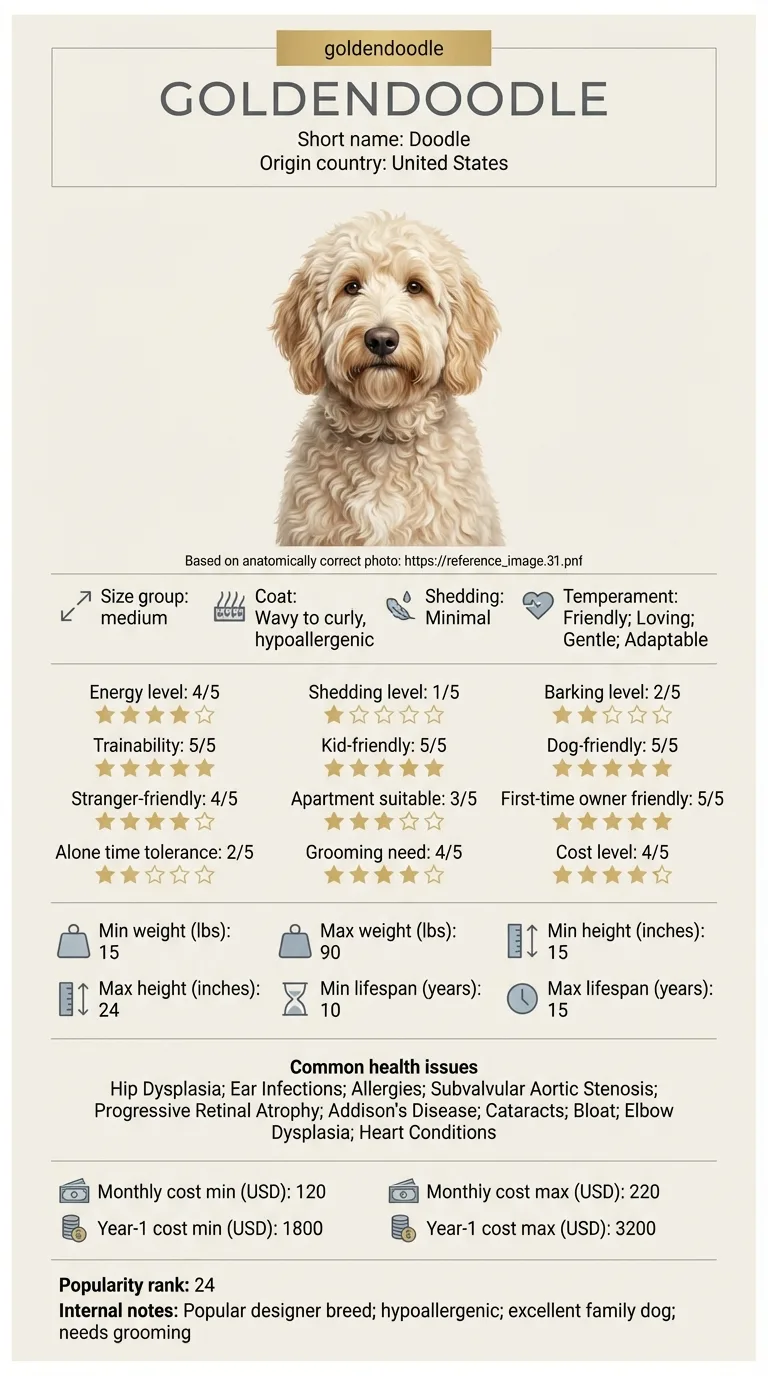
See all Goldendoodle health problems, which breeds are prone to patellar luxation, or the full Goldendoodle breed guide for temperament, exercise needs and ownership costs.
Surgery itself is typically a same-day or overnight procedure, with strict activity restriction for the first four to six weeks and a gradual return to full activity over roughly two to three months, depending on the surgeon's specific protocol and the dog's healing progress.
Success looks like a dog with a stable, well-aligned kneecap confirmed on follow-up exam, a full return to normal activity, and continued monitoring of the opposite leg — not necessarily a guarantee against ever needing the same surgery on the other side.
Surgical correction for a persistent or severe luxating patella typically addresses the underlying anatomical issues causing the kneecap to slip, which can include deepening the groove the kneecap should sit in, realigning the attachment point of the tendon below the kneecap, and tightening soft tissue on the side the kneecap tends to slip away from. The exact combination of techniques used depends on the specific anatomical findings in that dog's knee, which is why surgical planning generally includes a detailed pre-operative exam and imaging rather than a one-size-fits-all approach.
Recovery from this surgery is a genuinely structured process rather than something that resolves on its own timeline. Most dogs need strict activity restriction, often crate rest with only short leashed bathroom breaks, for the first several weeks, followed by a gradual, controlled increase in activity guided by your surgeon's specific recovery protocol. Skipping or rushing this restriction is one of the more common reasons for a less-than-ideal outcome, since healing soft tissue and bone need time to stabilize before full weight-bearing activity resumes.
Outcomes for surgical correction are generally good when performed by an experienced surgeon and paired with proper post-operative care, with most dogs returning to normal or near-normal activity. That said, surgery addresses the specific mechanical problem present at the time — it doesn't guarantee the opposite knee, if not yet symptomatic, will never develop the same issue, which is why some dogs end up needing the same surgery on the other leg at a later point.
A successful outcome depends heavily on following the structured recovery process precisely, not just on the surgery itself going well.

If you think your Doodle has patellar luxation, the plan is three steps: write down what you have seen and when it started, book a veterinary appointment rather than waiting for the next flare, and take video of the behaviour or symptom before you go — the thing you are worried about rarely happens in the consulting room. Screening in the parents covers hip dysplasia, ear infections, allergies.
What the vet visit should produce is a diagnosis and a written plan, not just reassurance: what is being ruled out, what the monitoring interval is, and which signs mean you come back sooner. Ask what the treatment costs across a year rather than per visit, because that is the number that decides whether you are managing this condition or reacting to it.
Between appointments, keep a short log — dates, what you saw, what changed. It is the single most useful thing an owner brings to a follow-up, and for patellar luxation it is often what separates a clear pattern from a guess.
Kristen's Goldendoodle, Hazel, had a grade 3 luxating patella that had progressed to persistent lameness despite months of conservative management. Her vet referred her to a board-certified surgeon, who performed a combination procedure to deepen the groove and realign the tendon attachment. Kristen followed the strict six-week crate-rest protocol precisely, resisting the urge to let Hazel move around more once she seemed comfortable earlier than expected. She also enrolled Hazel in a structured rehabilitation program for the following month. Hazel's follow-up X-rays showed excellent healing, and within three months of surgery she was back to normal off-leash play with no recurrence of the limp.
Key takeaway: Following the recovery protocol exactly, rather than easing up once the dog seemed comfortable, was as important to Hazel's good outcome as the surgery itself.
Costs vary by region, technique, and whether one or both knees need correction, but the procedure commonly runs into the low-to-mid thousands per knee, including pre-operative imaging and post-operative rechecks.
Most surgeons recommend strict activity restriction for at least the first four to six weeks, with a gradual return to normal activity over the following weeks to months depending on the specific procedure and the dog's healing progress.
Not necessarily, but patellar luxation is sometimes present to some degree in both knees even if only one is symptomatic enough to need surgery initially, so ongoing monitoring of the other leg is reasonable even after one side is corrected.
Delaying surgery in a persistent, severe case can allow secondary joint changes like arthritis to develop further, which can affect both the complexity of surgery and the ultimate outcome, making earlier intervention generally preferable once surgery is clearly indicated.
It's not strictly required in every case, but a structured rehabilitation program can meaningfully speed recovery and improve muscle strength around the joint, which many surgeons recommend particularly for more severe pre-surgical cases.
While uncommon with an experienced surgeon and proper aftercare, recurrence or complications can occur, which is part of why choosing a surgeon experienced specifically with this procedure and following the full recovery protocol matters.
Grade 3 and 4, involving persistent or permanent kneecap misalignment, are the grades most commonly recommended for surgical correction.
Strict restriction for four to six weeks initially, with a gradual return to full activity typically completed within two to three months.
It commonly runs into the low-to-mid thousands per knee including imaging and follow-up care, varying by region and technique used.
Most dogs return to normal or near-normal activity when the surgery is performed well and recovery protocol is followed precisely.
It's reasonable to consult a board-certified veterinary surgeon, especially for a significant procedure like this, to confirm the recommended approach.
A one-page prep sheet for this condition: the signs, the questions to ask, what to get priced. Unlocks here.
You get: Vet visit prep sheet
No spam. One-click unsubscribe. See our privacy policy.
Preview page 1 before you decide.