Health
When does cardiac screening for a Goldendoodle start?
At the very first puppy visits, since congenital heart conditions in this breed are present from birth.

Quick answer
When does cardiac screening for a Goldendoodle start?
At the very first puppy visits, since congenital heart conditions in this breed are present from birth.
The right cardiac question for a Goldendoodle changes depending on its age — what matters at eight weeks old is different from what matters at eight years old, and screening timed to each stage catches more.
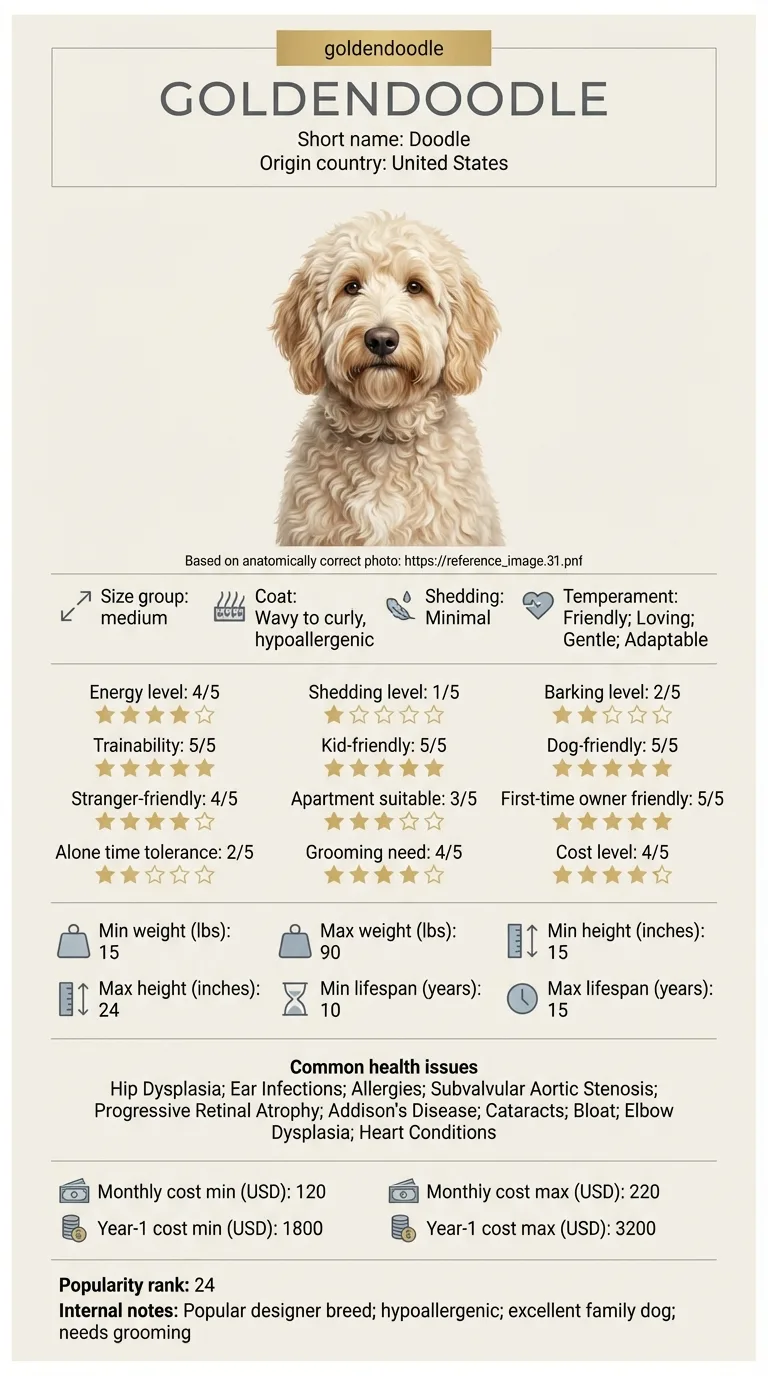
This is most useful for owners trying to build a sensible, ongoing screening habit rather than a one-time check, and for owners of Goldendoodles heading into their senior years who aren't sure what's actually worth monitoring for at this stage.
This guide is not medical advice. If your dog shows pain, sudden behavior change, or worsening symptoms, consult a licensed veterinarian.
Some links may be affiliate links. We may earn a commission at no extra cost to you. We only suggest products we believe are helpful for dog owners.
We research and check what we publish, but we do not warrant that any figure, date, price, or statement is accurate, complete, or current, and we accept no liability for any loss, cost, injury, or other harm arising from the use of this site. Use it as one reference among several. You remain responsible for your own decisions and for your dog's care - confirm anything that matters with a licensed veterinarian or another qualified professional before you act on it. Full disclaimer.
Check this first
Regardless of your dog's age or where they are on this timeline, certain symptoms mean the same thing: an emergency vet visit now. Fainting or collapse, labored breathing at rest, pale or blue-tinged gums, a distended abdomen with breathing difficulty, or sudden extreme weakness are all signs that need immediate attention rather than waiting for the next scheduled screening point.
A newly detected murmur at a routine exam, without any of those symptoms, is not itself an emergency — it's a signal to schedule follow-up diagnostics like an echocardiogram within a reasonable timeframe, typically weeks rather than the same day, to understand what's actually happening structurally.
Gradually declining exercise tolerance — a dog that used to keep up on walks and now lags behind, or tires unusually fast — is a slower-moving warning sign worth raising at your next vet visit rather than ignoring as 'just getting older,' since it's a common early sign of both congenital and age-related cardiac disease.
If any of these apply, call your vet or an emergency clinic now. The rest of this page is for the cases that are not an emergency.
Cardiac disease risk in Goldendoodles isn't static — it shifts from congenital concerns in puppyhood, most notably subvalvular aortic stenosis inherited through Golden Retriever lines, toward age-related valve and muscle changes in the senior years. A screening approach timed to each life stage catches more than a single early check or waiting for symptoms to appear.
Heart conditions are listed among this breed's documented common health issues, and the specific type of concern shifts meaningfully across a dog's lifespan rather than staying constant.
Golden Retriever ancestry carries a documented risk of congenital subvalvular aortic stenosis, typically detected as a puppy murmur, while the breed's overall medium-to-large body size and lifespan put it into the general population pattern of age-related valve degeneration later in life, distinct from the very different aging cardiac profile of toy breeds.
Consistency of veterinary screening across a dog's life, rather than any single environmental exposure, is the biggest controllable factor in catching cardiac disease early at each relevant stage.
Talk to your vet about any newly noted murmur, declining exercise tolerance, or a family history of cardiac disease, and make sure cardiac auscultation is part of every wellness visit throughout your dog's life. Seek emergency care immediately for collapse, labored breathing at rest, or pale or blue-tinged gums.
See all Goldendoodle health problems, which breeds are prone to cardiac disease, or the full Goldendoodle breed guide for temperament, exercise needs and ownership costs.
Cardiac screening is an ongoing, lifelong habit rather than a single event — expect a stethoscope check at every wellness visit and more specific diagnostics only if a murmur, symptom, or risk factor actually arises.
Success looks like catching any cardiac issue at the earliest reasonable point for that life stage, whether that's a puppy murmur or a senior valve change, rather than only discovering a problem once it's already causing symptoms.
Here's roughly what cardiac screening should look like at each stage of a Goldendoodle's life.
A soft murmur was noted at Oliver's very first puppy exam and monitored yearly without ever needing treatment through his adult years. His owner, Patrick, kept a simple note of it in his phone after every vet visit, always double-checking that his vet listened to Oliver's heart at each appointment. At age ten, that same murmur had progressed enough that Patrick's vet recommended an echocardiogram, which found mild, age-related valve changes layered on top of the original congenital finding. Because Patrick had a clear decade-long record, his vet could tell immediately that this was a new, gradual change rather than a mystery finding, which made the follow-up plan straightforward.
Key takeaway: A consistent, lifelong habit of cardiac screening turns a decade of vague murmur notes into a clear, useful history exactly when it matters most.
Cardiac screening should start at the very first puppy visits, since congenital conditions like subvalvular aortic stenosis are present from birth and often first detected as a murmur in puppies under a year old.
For a dog with no murmur, no symptoms, and no concerning family history, routine auscultation at annual wellness visits is generally considered sufficient. More specific testing becomes relevant once any of those factors change.
Many vets recommend more frequent or more detailed cardiac checks in senior dogs, since age-related valve degeneration and heart muscle changes become more relevant risks at that life stage.
A congenital issue, like subvalvular aortic stenosis, is present from birth and usually reveals itself as a murmur in puppyhood. Age-related issues, like valve degeneration, typically develop later in life in a heart that started out structurally normal.
This is a personal and vet-guided decision — some owners choose a baseline echocardiogram around middle age for peace of mind or breeding purposes, though it's not universally required for every dog without a murmur or symptoms.
Routine auscultation is included in standard wellness visit costs, while an echocardiogram, if needed, typically adds a few hundred dollars per instance whenever it's specifically recommended.
Yes, particularly as dogs age. A clean history at five years old doesn't guarantee a clean result at ten, which is why ongoing screening at each life stage matters more than a single early check.
At the very first puppy visits, since congenital heart conditions in this breed are present from birth.
Age-related valve and heart muscle changes become more relevant, alongside any congenital issue that was already present.
Commonly a few hundred dollars per exam, depending on the clinic and whether a specialist is involved.
Yes, asking a breeder or rescue about known cardiac history in either parent line is a reasonable and useful question.
Not always, but it's a common early sign worth raising with your vet rather than assuming it's simply aging or laziness.
A one-page prep sheet for this condition: the signs, the questions to ask, what to get priced. Unlocks here.
You get: Vet visit prep sheet
No spam. One-click unsubscribe. See our privacy policy.
See a sample page before you decide.
Early access list
The free prep sheet covers the same-day warning signs, a symptom log and the questions to ask. We are considering a fuller kit that adds a cost worksheet for the usual tests and treatments (US price ranges with their sources) and a plain-English guide to ways of covering the bill. It is not built yet; this list tells us whether it is worth building.
One email, no spam, unsubscribe anytime. Information only, not veterinary advice.