Brittany Spaniel vs Pomeranian: Which Suits Your Home?
Quick answer
Brittany or Pomeranian -- which is the better overall choice?
The Brittany is the more sociable, trainable all-rounder; the Pomeranian suits someone who specifically wants a small, apartment-friendly dog and doesn't mind extra grooming and barking.
Brittany Spaniel or Pomeranian? On paper they differ most on grooming need, and on the scales Brittany Spaniel is the heavier at 30–40 lbs. Here is how the two compare on everything that shapes an ordinary week.
This is for someone already down to Brittany Spaniel and Pomeranian and deciding between them. For this pair the decision usually turns on grooming need and apartment suitability, so those are covered first and in most detail. Anyone choosing from a flat has a clear answer here: Pomeranian rates 5/5 against 3/5. Breed history is left out; what follows is what you will actually live with.
Quick verdict
Between Brittany Spaniel and Pomeranian, grooming need is what separates them; neither is the lower-effort dog overall.
Choose brittany if...
Choose Brittany Spaniel if this is your first dog, you do not want a standing grooming appointment and shedding is a problem in your house.
Choose pomeranian if...
Choose Pomeranian if you are in a flat or a smaller home, your walking routine is modest and a smaller dog suits your car, your home or your back.
Head-to-head comparison
Feature
brittany
pomeranian
Winner
Size class
medium
small
Equal
Weight
30–40 lbs
3–7 lbs
Equal
Height
17–20 in
8–11 in
Equal
Lifespan
12–15 years
12–16 years
pomeranian
Exercise need
High (4/5)
Moderate (3/5)
pomeranian
Grooming need
Low (2/5)
High (4/5)
brittany
Shedding
Moderate (3/5)
High (4/5)
brittany
Energy level
High (4/5)
High (4/5)
Equal
Barking
Low (2/5)
High (4/5)
brittany
Apartment suitability
Moderate (3/5)
Very high (5/5)
pomeranian
Good for first-time owners
High (4/5)
Moderate (3/5)
brittany
Tolerates being alone
Low (2/5)
Low (2/5)
Equal
Trainability
Very high (5/5)
Moderate (3/5)
brittany
Good with kids
Very high (5/5)
Moderate (3/5)
brittany
Good with other dogs
Very high (5/5)
Moderate (3/5)
brittany
Friendly to strangers
High (4/5)
Low (2/5)
brittany
Cost level
Moderate (3/5)
Moderate (3/5)
Equal
Coat
Medium, wavy coat
Double coat, fluffy
Equal
Origin
France
Germany/Poland
Equal
Typical monthly cost
$90–$180
$80–$150
Equal
Typical first-year cost
$1,300–$2,500
$1,200–$2,200
Equal
Deep dive
Size and build
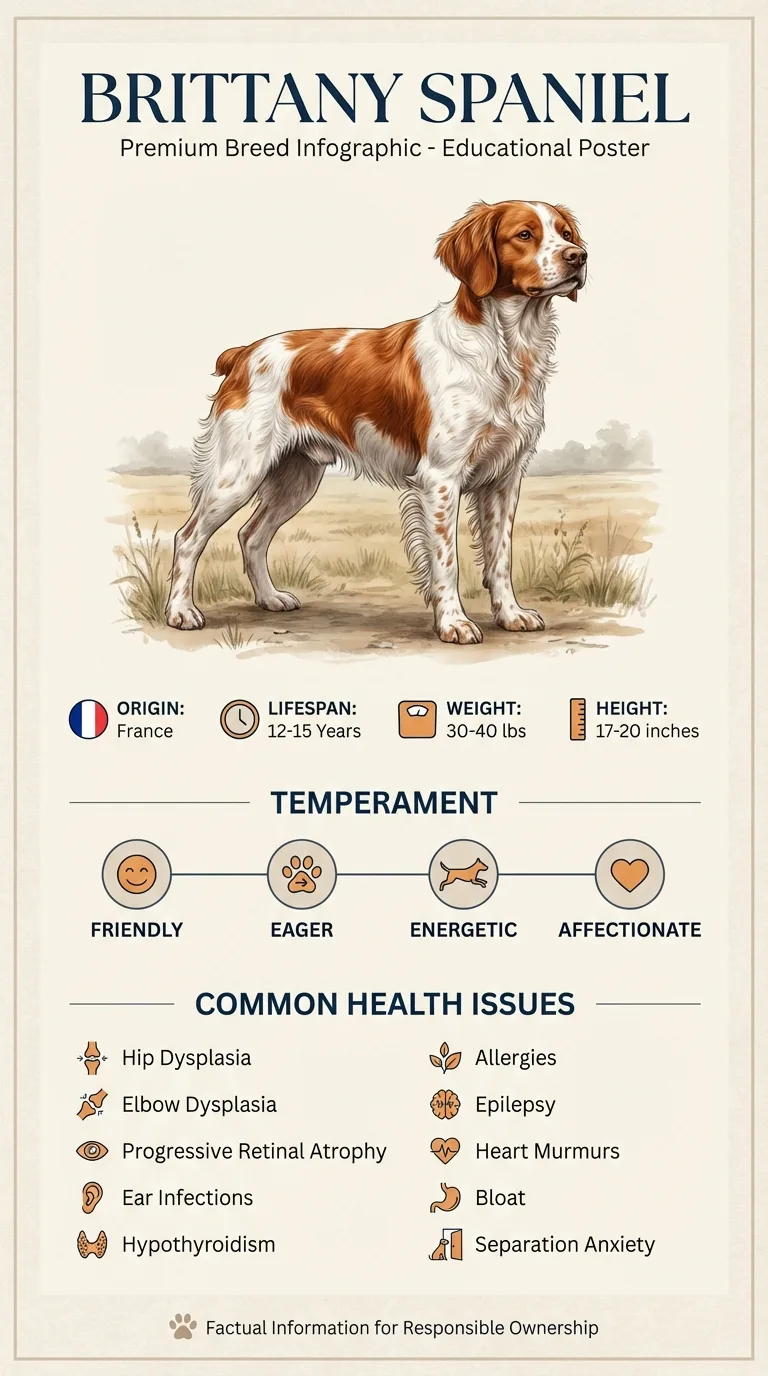
At 30-40 lbs, a Brittany can outweigh a Pomeranian -- which tops out around 7 lbs -- by more than ten times. Height follows suit: 17-20 inches against 8-11. This isn't really a size comparison so much as a reminder that "small dog" covers an enormous range, and the Pomeranian sits at the extreme end of it.
Energy and exercise
Energy level ties at high (4/5) for both breeds, but exercise need doesn't: 4/5 for the Brittany against moderate (3/5) for the Pomeranian. A Pomeranian's energy tends to burn off in short, intense bursts around the house rather than requiring the extended outdoor exercise a Brittany needs to stay settled.
Grooming and shedding
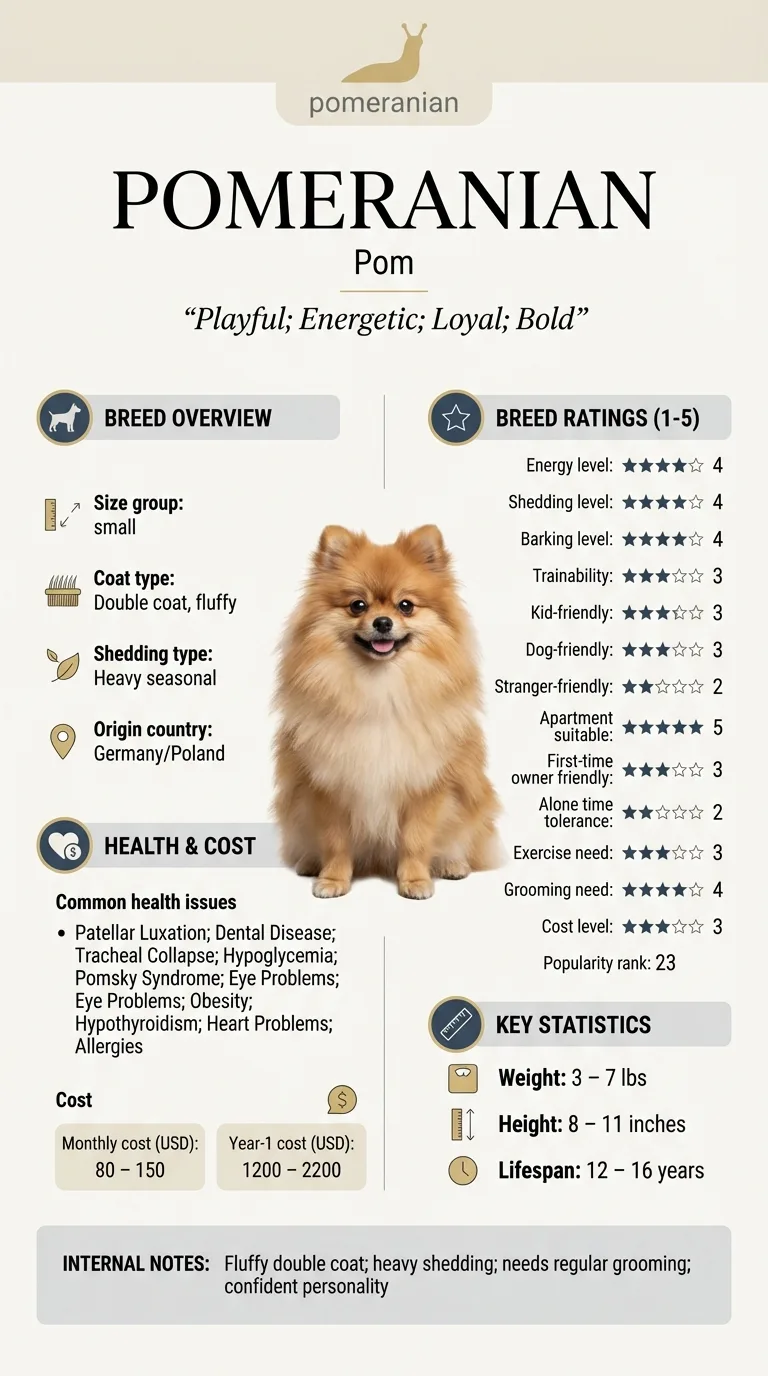
The Pomeranian demands noticeably more coat care: high (4/5) grooming need and high (4/5) shedding, against low (2/5) and moderate (3/5) for the Brittany. That fluffy double coat needs regular brushing to prevent matting near the ears and britches, and it blows seasonally like most double-coated breeds. The Brittany's coat, by comparison, is close to wash-and-go.
Apartment living, noise and time alone
The Pomeranian rates very high (5/5) for apartment living against the Brittany's moderate (3/5), but it's also the louder dog by a wide margin -- high (4/5) barking versus low (2/5). Small, alert dogs often bark at everything within earshot, and a Pomeranian in a thin-walled building can become a genuine neighbor issue if barking isn't addressed early.
Training and owner experience
The Brittany rates ahead on every training measure: very high (5/5) trainability and high (4/5) first-time-owner suitability, against moderate (3/5) on both counts for the Pomeranian. Poms are intelligent but can be willful, and their small size sometimes leads owners to skip the consistent training a larger dog would automatically get -- a mistake that shows up later as barking and possessiveness.
Kids, other dogs and visitors
This is a lopsided category: the Brittany rates very high (5/5) with kids and other dogs, while the Pomeranian sits at moderate (3/5) for both. More strikingly, the Pomeranian rates low (2/5) for friendliness to strangers against the Brittany's high (4/5) -- Poms are often reserved or wary around new people, not the instant-friend type. If you host often, that's worth factoring in.
Health and lifespan
The Pomeranian edges out a longer lifespan, 12-16 years against the Brittany's 12-15, though the ranges overlap. Health-wise the two lists barely intersect -- hypothyroidism and allergies are the only shared entries. The Pomeranian's ten-condition list leans toward small-breed issues like tracheal collapse, hypoglycemia, and patellar luxation, while the Brittany's leans toward the sporting-breed issues of bloat, epilepsy, and elbow dysplasia.
Cost to keep
Cost level ties at moderate (3/5) for both breeds, and the monthly ranges are close: $90-$180 for the Brittany against $80-$150 for the Pomeranian, with first-year costs of $1,300-$2,500 versus $1,200-$2,200. Don't assume the smaller dog is dramatically cheaper -- food costs less, but grooming and dental care on a Pomeranian eat into the savings.
Brittany Spaniel vs Pomeranian at a glance
Brittany Spaniel weighs 30–40 lbs and lives 12–15 years; Pomeranian weighs 3–7 lbs and lives 12–16 years. The two diverge most on grooming need, apartment suitability and barking and 4 other rated axes. They are level on tolerates being alone, cost level and energy level, so those cannot decide it. The comparison marks an easier option only where one exists. Facts like weight and country of origin are not scored. Both dogs are rated from the same dataset, which is what makes the numbers comparable with each other even though any individual dog sits somewhere inside its breed's range.
Brittany Spaniel vs Pomeranian: Which Suits Your Home? - Brittany Spaniel vs Pomeranian at a glance
Frequently asked questions
How much smaller is a Pomeranian than a Brittany?
Dramatically -- a Pomeranian weighs just 3-7 lbs against the Brittany's 30-40 lbs, more than a tenfold difference at the extremes. Height runs 8-11 inches versus 17-20.
Which breed sheds more?
The Pomeranian, rated high (4/5) shedding and high (4/5) grooming need against the Brittany's moderate (3/5) and low (2/5). That fluffy double coat needs regular brushing.
Is a Pomeranian friendly with strangers?
Less than you might expect -- it rates low (2/5) for friendliness to strangers, against high (4/5) for the Brittany. Poms tend to be more reserved or alert around new people.
Which does better in a small apartment?
The Pomeranian, rated very high (5/5) versus the Brittany's moderate (3/5). Just budget for its high (4/5) barking rate if you have close neighbors.
What's the monthly cost for each?
$90-$180 for a Brittany and $80-$150 for a Pomeranian, with first-year totals of $1,300-$2,500 and $1,200-$2,200 respectively -- closer than the size gap suggests.
Do the breeds share health risks?
Barely -- hypothyroidism and allergies are the only overlapping entries. Otherwise the Pomeranian's list runs toward small-breed conditions like tracheal collapse and hypoglycemia, while the Brittany's runs toward bloat and epilepsy.
Which is easier to train?
The Brittany, rated very high (5/5) trainability against the Pomeranian's moderate (3/5). Poms are smart but can be strong-willed, especially without consistent early training.
Brittany or Pomeranian -- which is the better overall choice?
The Brittany is the more sociable, trainable all-rounder; the Pomeranian suits someone who specifically wants a small, apartment-friendly dog and doesn't mind extra grooming and barking.
Costs
What's the monthly cost difference?
$90-$180 for a Brittany versus $80-$150 for a Pomeranian.
Living
Which needs more exercise?
The Brittany, at high (4/5) versus moderate (3/5) for the Pomeranian.
Health
Which breed lives longer?
The Pomeranian, at up to 16 years versus 15 for the Brittany, though the ranges overlap.
Related DogBreedCompass guides
Brittany Spaniel breed guide – Readers comparing the two usually want the full profile of Brittany Spaniel before deciding.
Pomeranian breed guide – The same for Pomeranian, so the comparison can be checked against the detail.
Brittany Spaniel vs Beagle – Beagle is the closest breed to Brittany Spaniel on the measured axes, so it is the natural next comparison.
Pomeranian vs Yorkshire Terrier – Yorkshire Terrier sits closest to Pomeranian, which makes it the alternative worth ruling out.
Brittany Spaniel vs Yorkshire Terrier – Yorkshire Terrier is the other breed Pomeranian is most often weighed against.
Pomeranian health problems – The health pages set out what each breed is actually screened for.
Health information here is general and is not veterinary advice. If your dog shows pain, sudden behaviour change, or worsening symptoms, consult a licensed veterinarian.
Some links on this site are affiliate links. We may earn a commission at no extra cost to you, and we only suggest products we believe are helpful for dog owners.
We research and check what we publish, but we do not warrant that any figure, date, price, or statement is accurate, complete, or current, and we accept no liability for any loss, cost, injury, or other harm arising from the use of this site. Use it as one reference among several. You remain responsible for your own decisions and for your dog's care - confirm anything that matters with a licensed veterinarian or another qualified professional before you act on it. Full disclaimer.