Living
What's the single easiest change to reduce bloat risk?
Splitting one large daily meal into two or three smaller ones is the change with the most consistent supporting evidence.

Quick answer
What's the single easiest change to reduce bloat risk?
Splitting one large daily meal into two or three smaller ones is the change with the most consistent supporting evidence.
If your Aussie inhales dinner in under thirty seconds and then wants to sprint around the yard, you're stacking two of the biggest known bloat risk factors on top of each other.
Owners of fast eaters and highly food-motivated dogs face the steepest uphill battle here, since slowing down a dog that's genuinely excited about food takes more than just a bigger bowl.
This guide is not medical advice. If your dog shows pain, sudden behavior change, or worsening symptoms, consult a licensed veterinarian.
Some links may be affiliate links. We may earn a commission at no extra cost to you. We only suggest products we believe are helpful for dog owners.
We research and check what we publish, but we do not warrant that any figure, date, price, or statement is accurate, complete, or current, and we accept no liability for any loss, cost, injury, or other harm arising from the use of this site. Use it as one reference among several. You remain responsible for your own decisions and for your dog's care - confirm anything that matters with a licensed veterinarian or another qualified professional before you act on it. Full disclaimer.
Preventing bloat in an Australian Shepherd means managing the handful of risk factors research has consistently linked to the condition: meal size and frequency, eating speed, and activity timing around meals. None of these guarantee prevention, but together they meaningfully shift the odds for an active, food-motivated breed.
GDV prevention is a relevant conversation for any active, deep-chested dog, and while Australian Shepherds carry less baseline risk than the largest giant breeds, the feeding-related risk factors apply just as much to this breed's fast, food-driven eating style.
This breed's high energy and food motivation often translate into fast eating and a strong urge to keep moving right after meals, both of which are established risk factors. None of this is unique to the breed's anatomy so much as its temperament and activity level around mealtimes.
Feeding routine is the single most controllable environmental factor: meal frequency, feeding speed, bowl height, and the timing of exercise around meals all interact to raise or lower risk in ways owners can actively manage.
Bring up prevention at a routine wellness visit, especially if your dog is a fast eater or has a family history of GDV. If you ever see a swollen abdomen, restless pacing, or unproductive retching, stop planning and go to an emergency vet immediately.
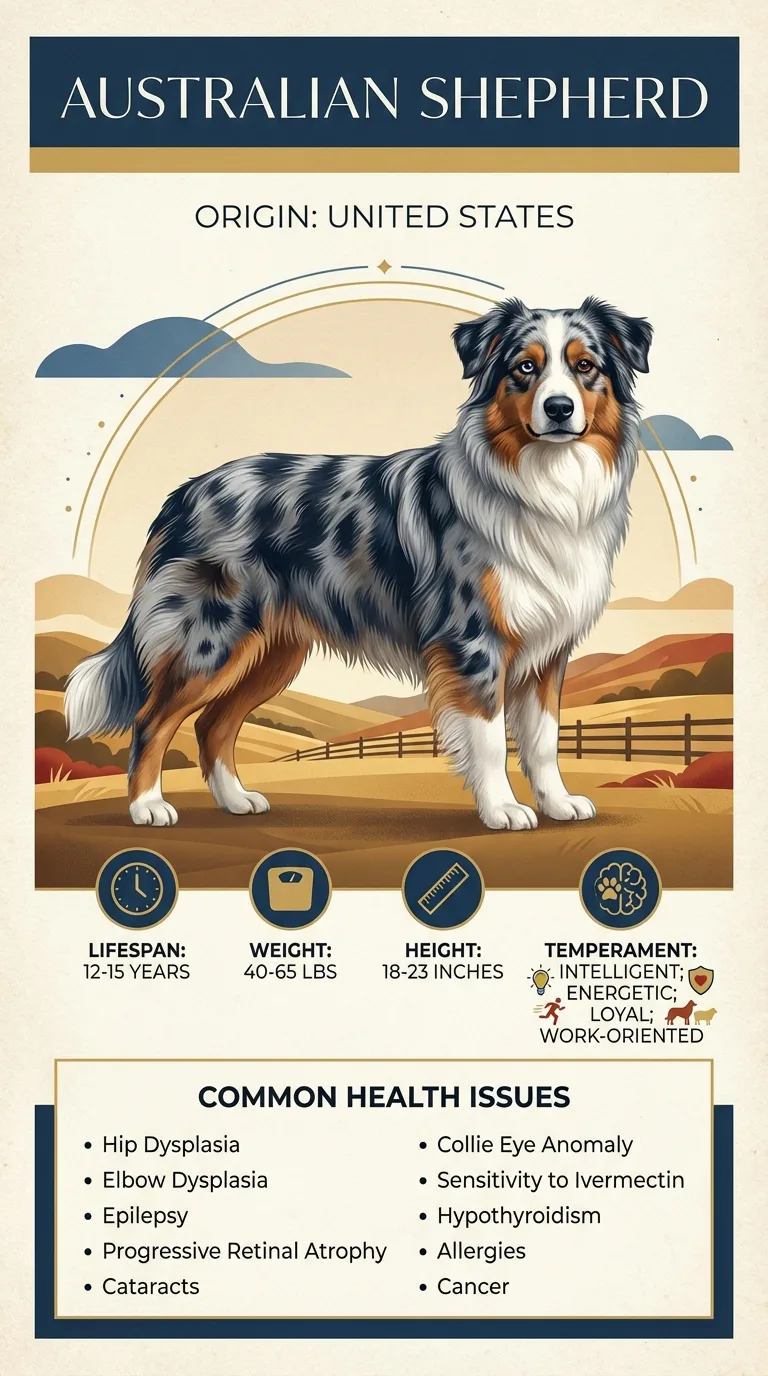
See all Australian Shepherd health problems, which breeds are prone to bloat gdv, or the full Australian Shepherd breed guide for temperament, exercise needs and ownership costs.
Feeding changes can be implemented immediately and maintained as a permanent routine rather than a temporary fix. A gastropexy, if chosen, is typically a single procedure with a two-week recovery period.
Success means a meaningfully lower-risk feeding routine, not a guarantee. Owners who combine good feeding habits with fast recognition of emergency signs give their dog the best realistic odds.
None of these guarantee prevention, but together they address the risk factors most consistently identified across veterinary research.
A gastropexy is a surgical procedure that tacks the stomach to the body wall, preventing it from rotating even if it does fill with gas. It doesn't stop bloat from happening, but it prevents the dangerous twist that turns simple gas buildup into a life-threatening emergency.
For Australian Shepherds, this isn't a routine recommendation the way it is for giant, deep-chested breeds at the highest documented risk, but it's a reasonable conversation to have with your vet, especially if your dog is already being sedated for another procedure or if there's a family history of the condition.

If you think your Aussie has bloat, the plan is three steps: write down what you have seen and when it started, book a veterinary appointment rather than waiting for the next flare, and take video of the behaviour or symptom before you go — the thing you are worried about rarely happens in the consulting room. Screening in the parents covers hip dysplasia, elbow dysplasia, epilepsy.
What the vet visit should produce is a diagnosis and a written plan, not just reassurance: what is being ruled out, what the monitoring interval is, and which signs mean you come back sooner. Ask what the treatment costs across a year rather than per visit, because that is the number that decides whether you are managing this condition or reacting to it.
Between appointments, keep a short log — dates, what you saw, what changed. It is the single most useful thing an owner brings to a follow-up, and for bloat it is often what separates a clear pattern from a guess.
Nash had always finished his dinner in under a minute, and his owner, Callie, hadn't thought much of it until she read about the link between fast eating and bloat. She switched Nash to a slow-feeder bowl and split his single evening meal into two smaller feedings, one after his morning walk and one in the early evening, well before his last play session of the day. Nash's mealtime now takes closer to eight minutes instead of under one, and Callie has kept the routine consistent for over a year without incident.
Key takeaway: None of these changes are dramatic on their own, but stacked together they turn a genuinely risky feeding pattern into a meaningfully safer one, without asking an active dog to eat less overall.
Research on the condition consistently links a single large daily meal to higher risk compared with two or three smaller meals, likely because of the larger volume of food and gas involved at once.
You don't need to eliminate activity, but holding off on vigorous exercise for about an hour before and after eating is a commonly recommended precaution.
Yes, they reduce the speed at which a dog eats and swallows air, both of which are linked to bloat risk, making them one of the simpler preventive tools available.
It's not a routine recommendation for Australian Shepherds the way it is for the highest-risk giant breeds, but it's worth discussing with your vet, especially if your dog has a family history or is already having another surgery.
Yes, dogs with a close relative who has had GDV appear to carry somewhat higher risk, which is one reason a family history is worth mentioning to your vet.
Some research has actually linked elevated feeding bowls to higher bloat risk rather than lower, so feeding from floor level is generally the safer default.
Splitting one large daily meal into two or three smaller ones is the change with the most consistent supporting evidence.
Yes, especially for a fast eater, since it reduces both eating speed and air swallowed during meals.
It adds a moderate cost when combined with an already-scheduled surgery like a spay or neuter, but costs more as a standalone procedure.
About an hour before and after meals is the commonly recommended buffer to reduce risk.
No, these steps reduce risk but don't eliminate it, so knowing the emergency signs still matters even with a careful feeding routine.
A one-page prep sheet for this condition: the signs, the questions to ask, what to get priced. Unlocks here.
You get: Vet visit prep sheet
No spam. One-click unsubscribe. See our privacy policy.
Preview page 1 before you decide.