Living
Which breed suits a quieter household?
Neither is quiet, but for different reasons — the Aussie is a poor apartment fit, the Sheltie is a notably vocal one. Weigh space against noise tolerance before choosing.

Quick answer
Which breed suits a quieter household?
Neither is quiet, but for different reasons — the Aussie is a poor apartment fit, the Sheltie is a notably vocal one. Weigh space against noise tolerance before choosing.
Australian Shepherd or Shetland Sheepdog? On paper they differ most on apartment suitability, and on the scales Australian Shepherd is the heavier at 40–65 lbs. Here is how the two compare on everything that shapes an ordinary week.
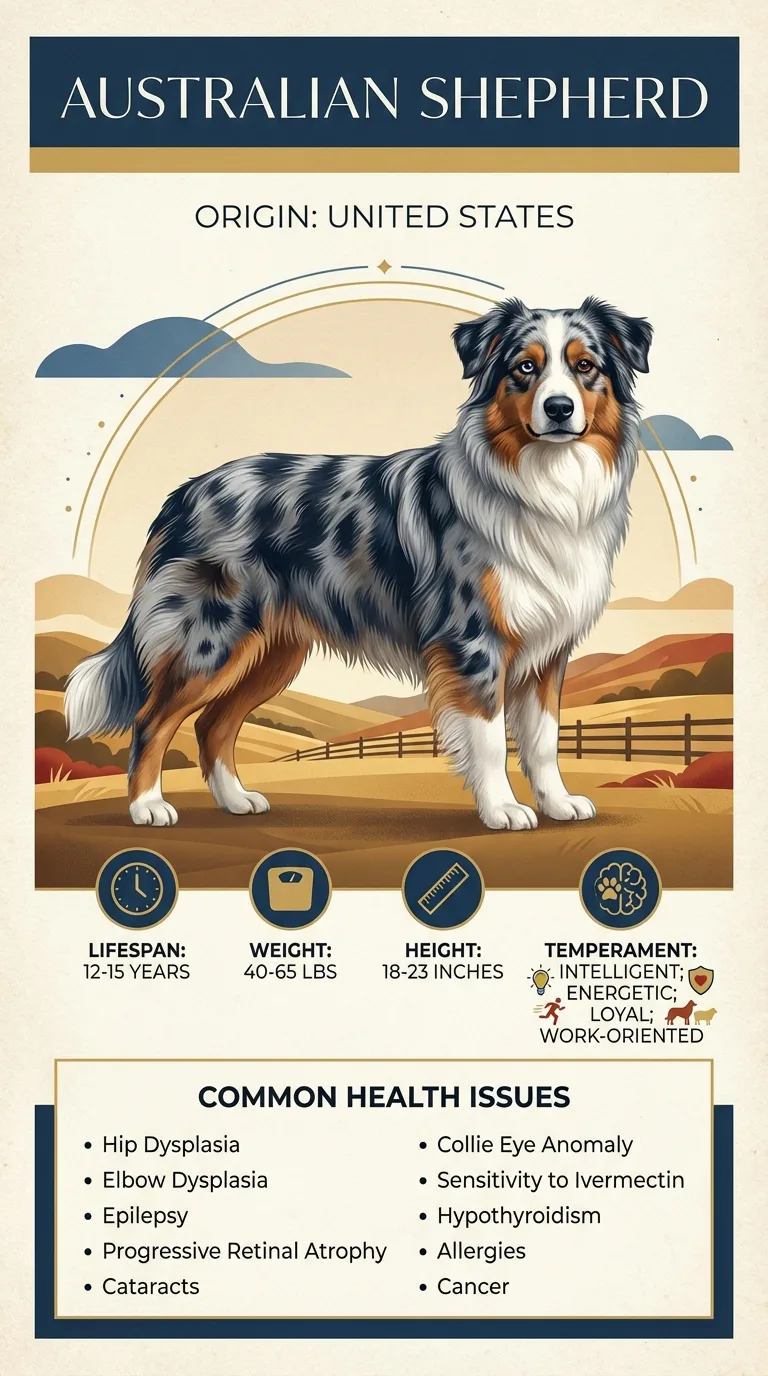
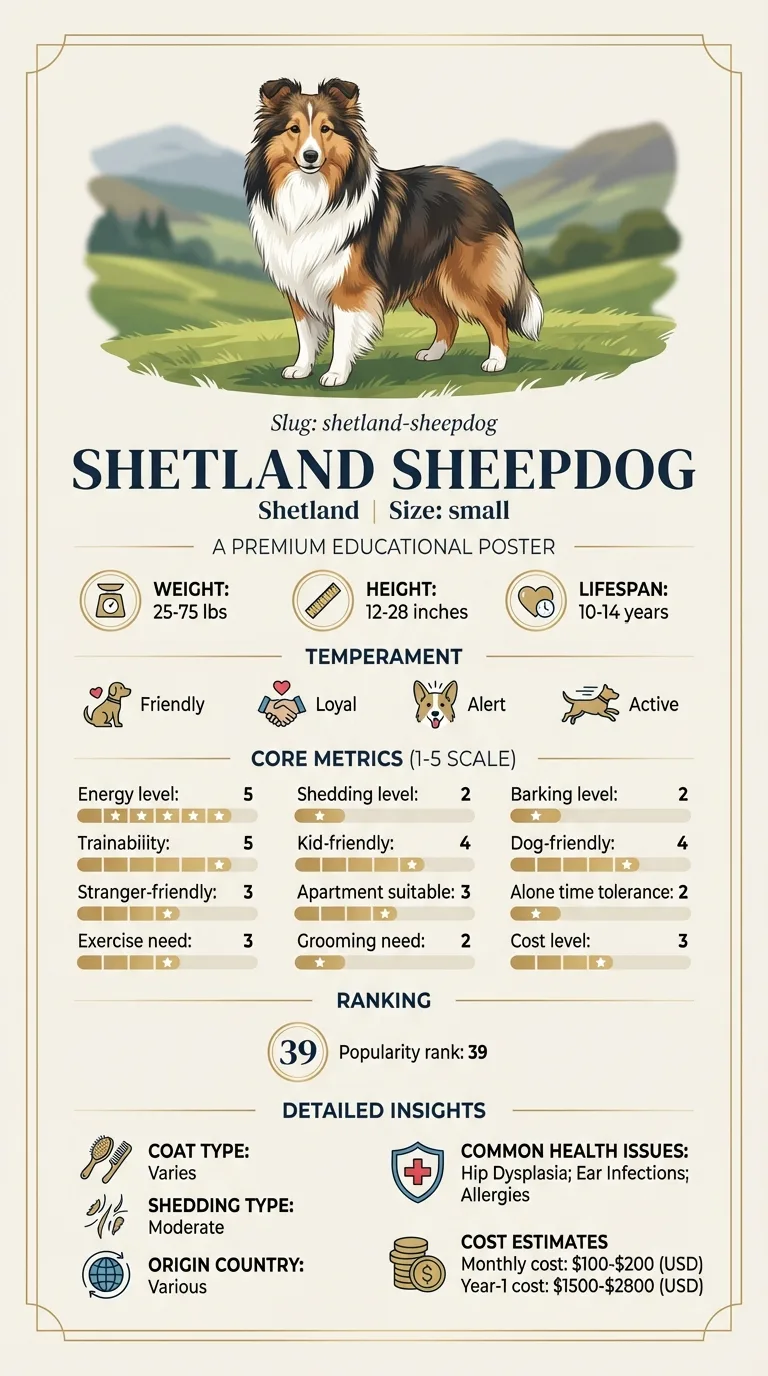
This is for someone already down to Australian Shepherd and Shetland Sheepdog and deciding between them. For this pair the decision usually turns on apartment suitability and good for first-time owners, so those are covered first and in most detail. Anyone choosing from a flat has a clear answer here: Shetland Sheepdog rates 3/5 against 1/5. Breed history is left out; what follows is what you will actually live with.
Between Australian Shepherd and Shetland Sheepdog, apartment suitability is what separates them, and Shetland Sheepdog is the lower-effort dog of the two to keep.
Choose Australian Shepherd if you do not want a standing grooming appointment and you want a dog that can keep up with an active routine.
Choose Shetland Sheepdog if you are in a flat or a smaller home, this is your first dog and your walking routine is modest.
| Feature | australian shepherd | shetland sheepdog | Winner |
|---|---|---|---|
| Size class | medium | small | Equal |
| Weight | 40–65 lbs | 15–25 lbs | Equal |
| Height | 18–23 in | 13–16 in | Equal |
| Lifespan | 12–15 years | 12–14 years | australian shepherd |
| Exercise need | Very high (5/5) | High (4/5) | shetland sheepdog |
| Grooming need | Moderate (3/5) | High (4/5) | australian shepherd |
| Shedding | High (4/5) | High (4/5) | Equal |
| Energy level | Very high (5/5) | High (4/5) | Equal |
| Barking | Moderate (3/5) | Very high (5/5) | australian shepherd |
| Apartment suitability | Very low (1/5) | Moderate (3/5) | shetland sheepdog |
| Good for first-time owners | Low (2/5) | High (4/5) | shetland sheepdog |
| Tolerates being alone | Low (2/5) | Low (2/5) | Equal |
| Trainability | Very high (5/5) | Very high (5/5) | Equal |
| Good with kids | High (4/5) | High (4/5) | Equal |
| Good with other dogs | High (4/5) | High (4/5) | Equal |
| Friendly to strangers | Low (2/5) | Low (2/5) | Equal |
| Cost level | Moderate (3/5) | Moderate (3/5) | Equal |
| Coat | Medium-length double coat | Long, dense double coat | Equal |
| Origin | United States | Various | Equal |
| Typical monthly cost | $100–$200 | $80–$150 | Equal |
| Typical first-year cost | $1,500–$2,800 | $1,100–$2,300 | Equal |
The Shetland Sheepdog is a genuinely small dog next to the Aussie — 15-25 lbs and 13-16 inches, against the Aussie's 40-65 lbs and 18-23 inches. Both are herding breeds at heart, and the Sheltie's build echoes the Aussie's proportions in miniature, just at roughly a third to a half the size and weight. People sometimes call it a "mini Aussie" or a "mini Collie" for exactly this reason, though the two breeds aren't directly related.
The Aussie rates very high (5/5) for exercise need, the Sheltie high (4/5) — both are herding dogs with real stamina, and neither will thrive on minimal activity. The gap here is smaller than it looks on paper; a Sheltie bred to work sheep all day still expects meaningful daily exercise, just scaled to its smaller frame. Don't mistake its size for low energy — a bored Sheltie finds its own outlet, usually a noisy one.
The Sheltie rates higher on grooming, high (4/5) against moderate (3/5) for the Aussie, thanks to a longer, denser double coat that mats more readily if neglected. Shedding ties at high (4/5) for both breeds — expect a comparable amount of hair around the house regardless of which one you choose. Both also blow their coats heavily around seasonal changes, so plan on a couple of intensive brushing weeks each year.
The Sheltie rates moderate (3/5) for apartment suitability against the Aussie's very low (1/5), a real advantage for smaller homes. But it's also the noisier of the two by a wide margin — very high (5/5) barking against the Aussie's moderate (3/5) — a well-known trait for the breed that's worth taking seriously if you have close neighbors. Early bark-management training tends to pay off more with a Sheltie than it does with most other herding breeds.
Trainability ties at very high (5/5) for both — Shelties are famously sharp, quick learners, matching the Aussie's reputation here directly. For first-time owners, the Sheltie rates notably better, high (4/5) against the Aussie's low (2/5), largely because its exercise and space needs are easier for a beginner to meet consistently. Both breeds do best with an owner who follows through on training daily, rather than expecting the dog's intelligence to fill the gaps on its own.
Kids and other dogs both tie at high (4/5) for each breed, a strong match on both counts. Strangers also tie, both rated low (2/5) — this is one of the few pairings where the two breeds line up almost identically on temperament around people, differing mainly in size and vocal habits. If household compatibility is your top concern, this comparison won't be the one that decides it either way.
The Aussie edges the Sheltie slightly on lifespan, 12-15 years against 12-14. They share Collie eye anomaly and hypothyroidism as known risks — not surprising, since both breeds descend from herding-dog lines with related genetics. The Aussie's documented ivermectin sensitivity and the Sheltie's MDR1 drug sensitivity are separately listed but reflect that same shared herding-breed ancestry, so mention any drug sensitivity history to your vet with either dog.
Both carry the same moderate (3/5) overall cost rating, but the numbers slightly favor the Sheltie: $80-150 monthly against $100-200 for the Aussie, and $1,100-2,300 in year one versus $1,500-2,800. The smaller dog costs less to feed, even with its heavier grooming routine factored in. Neither breed carries the kind of specialist vet costs that show up with giant or brachycephalic breeds elsewhere on this site, which keeps both budgets fairly predictable.
Australian Shepherd weighs 40–65 lbs and lives 12–15 years; Shetland Sheepdog weighs 15–25 lbs and lives 12–14 years. The two diverge most on apartment suitability, good for first-time owners and barking. They are level on tolerates being alone, cost level and good with other dogs, so those cannot decide it. The comparison marks an easier option only where one exists. Facts like weight and country of origin are not scored. Both dogs are rated from the same dataset, which is what makes the numbers comparable with each other even though any individual dog sits somewhere inside its breed's range.

Considerably — 15-25 lbs and 13-16 inches for the Sheltie against 40-65 lbs and 18-23 inches for the Aussie, roughly a third to half the size.
Yes, the data backs that reputation up — very high (5/5) for barking, against moderate (3/5) for the Aussie. It's one of the widest gaps in this comparison, and worth factoring in even though the Sheltie otherwise fits smaller spaces better.
The Sheltie, rated high (4/5) against the Aussie's low (2/5). Its smaller size and slightly lower exercise need make it more manageable for someone new to dog ownership.
Yes — Collie eye anomaly and hypothyroidism appear on both lists, tracing back to their shared herding-breed ancestry. Both breeds are also linked to drug sensitivities (ivermectin for the Aussie, MDR1 for the Sheltie), worth flagging to a vet before certain medications.
The Sheltie, modestly — $80-150 a month against $100-200 for the Aussie, and a lower first-year total too. Both share the same overall cost rating despite the dollar gap.
The Aussie, rated very high (5/5) against high (4/5) for the Sheltie — a narrower gap than most people expect given the size difference between the two breeds.
The Aussie, by a narrow margin — 12-15 years against 12-14 for the Sheltie, close enough that it shouldn't be a deciding factor on its own.
Neither is quiet, but for different reasons — the Aussie is a poor apartment fit, the Sheltie is a notably vocal one. Weigh space against noise tolerance before choosing.
The Sheltie runs $80-150, the Aussie $100-200 — both carry the same moderate overall cost rating.
Both are active herding breeds: very high (5/5) for the Aussie, high (4/5) for the Sheltie. Neither suits a low-activity household.
The Aussie, by a narrow margin — 12-15 years against 12-14 for the Sheltie.
Secure checkout on Stripe. We never see your card.
7-day money-back guarantee. Instant access.
Health information here is general and is not veterinary advice. If your dog shows pain, sudden behaviour change, or worsening symptoms, consult a licensed veterinarian.
Some links on this site are affiliate links. We may earn a commission at no extra cost to you, and we only suggest products we believe are helpful for dog owners.
We research and check what we publish, but we do not warrant that any figure, date, price, or statement is accurate, complete, or current, and we accept no liability for any loss, cost, injury, or other harm arising from the use of this site. Use it as one reference among several. You remain responsible for your own decisions and for your dog's care - confirm anything that matters with a licensed veterinarian or another qualified professional before you act on it. Full disclaimer.
Match your lifestyle to the right dog.
Take quizNot sure which breed is right for you? Take our 2-minute quiz to find out.
Take the quiz