Behavior
Needs way more exercise?
The Siberian Husky, rated Very high (5/5) versus the Pug's Low (2/5).

Quick answer
Needs way more exercise?
The Siberian Husky, rated Very high (5/5) versus the Pug's Low (2/5).
Pug or Siberian Husky? On paper they differ most on apartment suitability, and on the scales Siberian Husky is the heavier at 45–60 lbs. Here is how the two compare on everything that shapes an ordinary week.
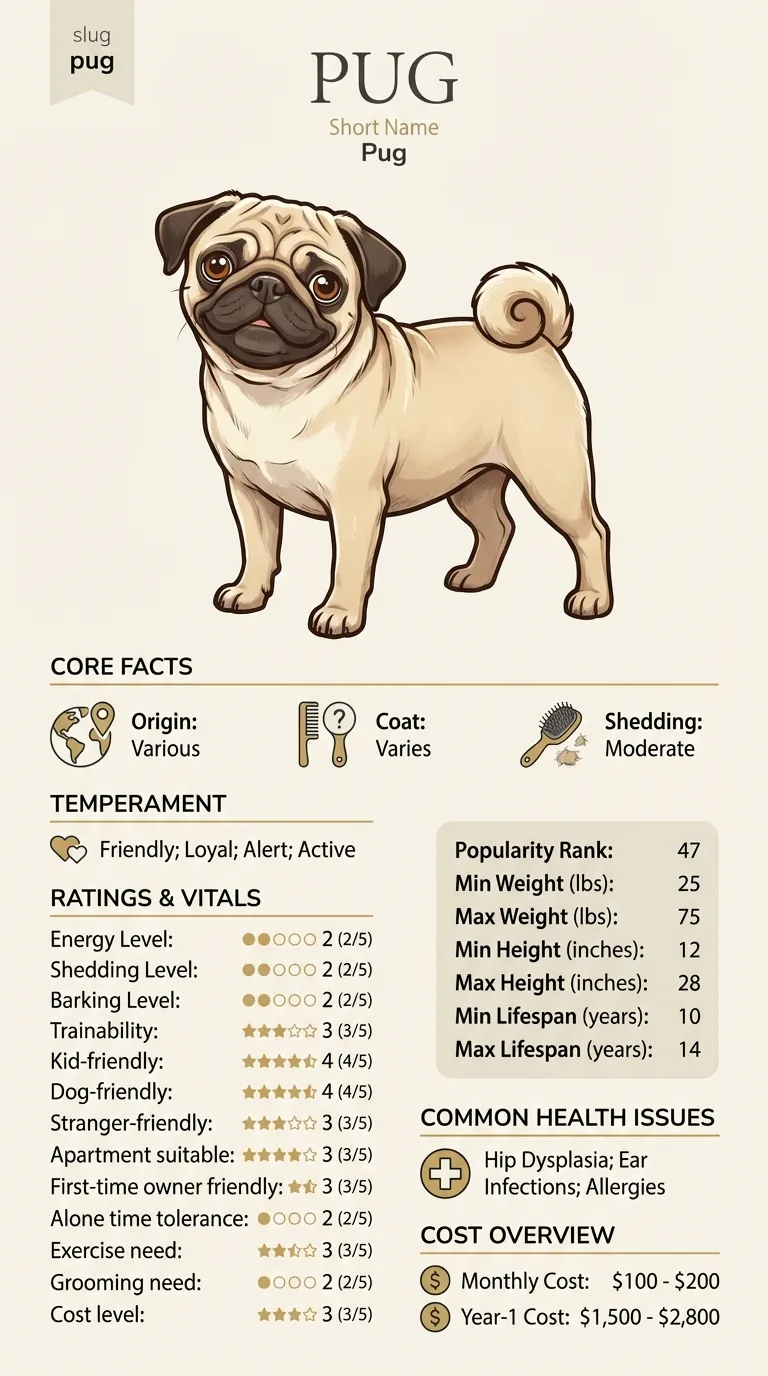
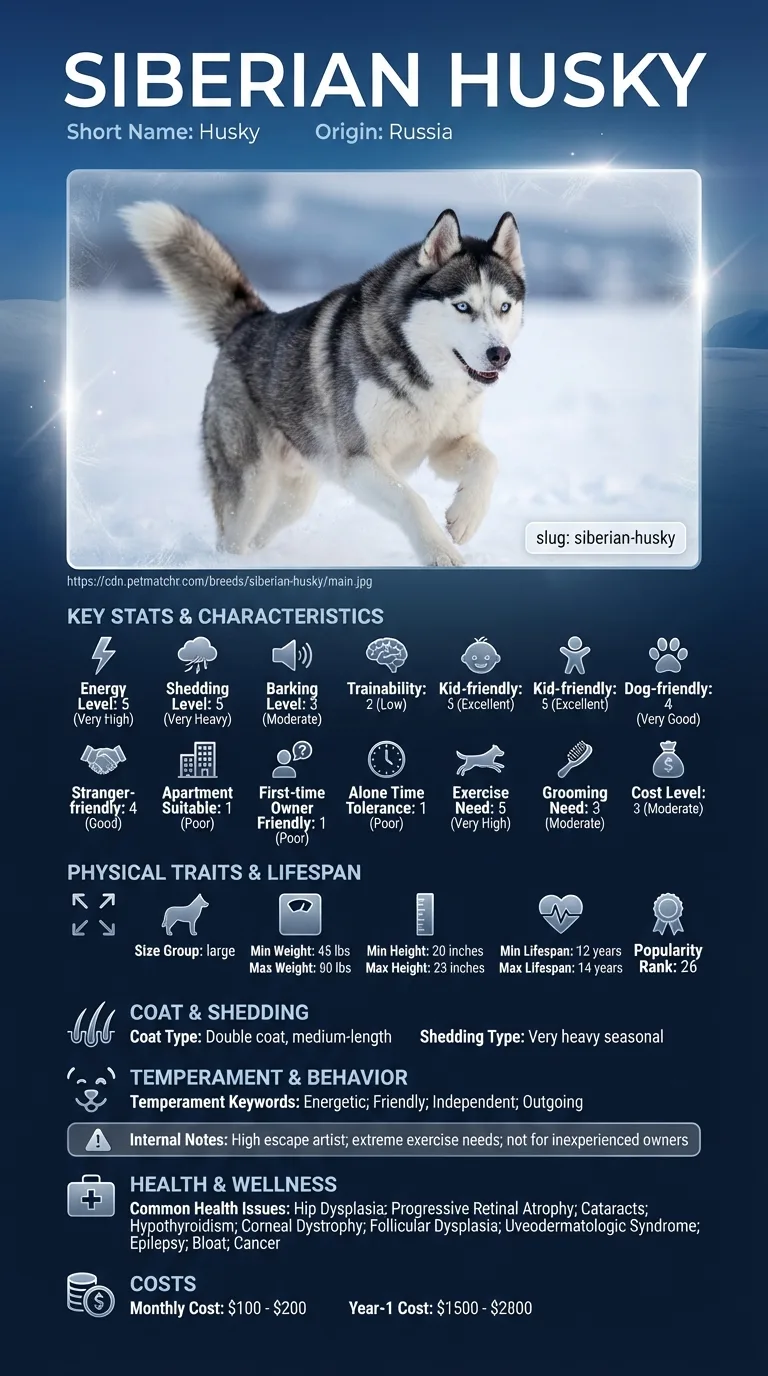
This is for someone already down to Pug and Siberian Husky and deciding between them. For this pair the decision usually turns on apartment suitability and good for first-time owners, so those are covered first and in most detail. Anyone choosing from a flat has a clear answer here: Pug rates 5/5 against 1/5. The focus throughout is on daily consequences rather than breed background.
Between Pug and Siberian Husky, apartment suitability is what separates them, and Pug is the lower-effort dog of the two to keep.
Choose Pug if you are in a flat or a smaller home, this is your first dog and you do not want a standing grooming appointment.
Choose Siberian Husky if you want a dog that can keep up with an active routine and you want a dog that is more watchful with visitors.
| Feature | pug | siberian husky | Winner |
|---|---|---|---|
| Size class | small | large | Equal |
| Weight | 14–18 lbs | 45–60 lbs | Equal |
| Height | 10–13 in | 20–23 in | Equal |
| Lifespan | 13–15 years | 12–14 years | pug |
| Exercise need | Low (2/5) | Very high (5/5) | pug |
| Grooming need | Low (2/5) | Moderate (3/5) | pug |
| Shedding | High (4/5) | Very high (5/5) | pug |
| Energy level | Low (2/5) | Very high (5/5) | Equal |
| Barking | Low (2/5) | Moderate (3/5) | pug |
| Apartment suitability | Very high (5/5) | Very low (1/5) | pug |
| Good for first-time owners | Very high (5/5) | Very low (1/5) | pug |
| Tolerates being alone | Low (2/5) | Very low (1/5) | pug |
| Trainability | Moderate (3/5) | Low (2/5) | pug |
| Good with kids | Very high (5/5) | Very high (5/5) | Equal |
| Good with other dogs | High (4/5) | High (4/5) | Equal |
| Friendly to strangers | Very high (5/5) | High (4/5) | pug |
| Cost level | Moderate (3/5) | Moderate (3/5) | Equal |
| Coat | Short, smooth double coat | Double coat, medium-length | Equal |
| Origin | Various | Russia | Equal |
| Typical monthly cost | $80–$150 | $100–$200 | Equal |
| Typical first-year cost | $1,100–$2,300 | $1,500–$2,800 | Equal |
A Siberian Husky can weigh more than three times what a Pug does — 45–60 pounds and 20–23 inches at the shoulder against the Pug's 14–18 pounds and 10–13 inches. The Husky's build reflects its sled-dog heritage: a lean, athletic frame with a thick double coat designed for pulling loads across snow for hours, worlds apart from the Pug's compact, flat-faced, purely companion-bred silhouette. That structural gap explains most of what follows in this comparison — a working sled dog and a lap-sized companion breed were never bred to solve the same problems, and it shows in nearly every category below.
Exercise need is about as far apart as this site ever records: Low (2/5) for the Pug against Very high (5/5) for the Siberian Husky, a breed built to run for miles pulling a sled and genuinely unhappy without serious daily output. Energy level readings show the same gap, Low for the Pug against Very high for the Husky. A bored, under-exercised Husky is a well-known recipe for destructive escape attempts and howling, while the Pug's brachycephalic airway makes sustained exertion actively risky rather than just unnecessary. These two occupy almost opposite ends of the exercise spectrum on this entire site.
Grooming need is Low (2/5) for the Pug against Moderate (3/5) for the Siberian Husky, and shedding follows a similar pattern — High (4/5) for the Pug versus Very high (5/5) for the Husky, whose dense double coat blows out twice a year in famously dramatic volume. Neither breed suits anyone hoping to avoid dog hair, but the Husky's seasonal 'coat blow' periods produce noticeably more fur in a shorter window than the Pug's steadier year-round shedding. A daily brushing routine during shedding season is close to mandatory for Husky owners, while Pug owners can generally manage with a weekly pass.
Three categories line up against the Husky at once: apartment suitability rates Very low (1/5) against the Pug's Very high (5/5), first-time-owner suitability is also Very low (1/5) against Very high (5/5), and tolerating time alone is Very low (1/5) versus the Pug's already-modest Low (2/5). Together these numbers describe a breed that struggles in small spaces, resists novice handling, and genuinely dislikes solitude — Huskies are notorious for vocal howling and escape attempts when left alone too long. None of that makes the Husky a bad dog, just a poor match for apartment life or a first-time owner's typical schedule.
Trainability adds one more point in the Pug's favor: Moderate (3/5) against the Husky's Low (2/5). The Husky's own temperament list — Energetic, Independent, Outgoing — captures why: it was bred to make its own decisions while running a sled team far from a musher's direct commands, and that independent streak persists as a stubborn streak at home. Recall training in particular is notoriously difficult with Huskies, whose prey drive and wanderlust can override training in an unfenced setting. The Pug's more people-focused, biddable nature makes it a meaningfully easier dog to train through basic obedience, even without professional help.
Family sociability is one area where the Husky holds its own: it ties the Pug at Very high (5/5) with kids and High (4/5) with other dogs, consistent with its reputation as a genuinely friendly, non-aggressive breed despite its independent streak. The only gap is strangers, Very high (5/5) for the Pug against High (4/5) for the Husky — still a solid score, just a notch behind the Pug's near-universal friendliness. A well-exercised Husky is typically a warm, social family dog; the real household challenge with this breed is almost entirely about space and stamina, not temperament toward people.
Lifespan tilts slightly toward the Pug at 13–15 years against the Husky's 12–14. The Husky's ten-item health list is broad, spanning Hip Dysplasia, Progressive Retinal Atrophy, several eye conditions, Epilepsy, Bloat, and Cancer — a wider net of hereditary concerns to screen for than the Pug's shorter five-item list of Brachycephalic Airway Syndrome, Pug Dog Encephalitis, Corneal Ulcers, Hemivertebrae, and Obesity. The two lists barely overlap, which underscores how differently these breeds were shaped: the Pug's issues stem almost entirely from its flattened face and compact build, while the Husky's reflect a working breed with a genetically wider range of inherited conditions.
Cost level ties at Moderate (3/5) for both breeds, though the actual numbers favor the Pug: $80–$150 monthly and $1,100–$2,300 in year one against the Husky's $100–$200 and $1,500–$2,800. Food is a meaningful piece of that gap given the Husky's larger frame, but fencing and containment can matter just as much — a Husky's Very high (5/5) exercise need and strong wanderlust often push owners toward secure yard fencing or regular structured exercise programs that carry their own real cost, something a low-energy, apartment-happy Pug rarely requires.
Pug weighs 14–18 lbs and lives 13–15 years; Siberian Husky weighs 45–60 lbs and lives 12–14 years. The two diverge most on apartment suitability, good for first-time owners and exercise need and 1 other rated axes. They are level on cost level, good with other dogs and good with kids, so those cannot decide it. The table below marks a winner only where one breed is genuinely easier for a typical owner; size and origin are facts rather than merits and stay level. Ratings come from one source applied to both breeds, so they are meaningful against each other rather than as absolute scores.

Not really — it rates Very low (1/5) for first-time owners against the Pug's Very high (5/5), largely due to its stubborn independence and high exercise demands.
A lot — it's rated Very high (5/5) for exercise need, essentially the opposite of the Pug's Low (2/5).
It's rated Very low (1/5) for apartment suitability, the lowest score on this comparison, mainly due to its exercise needs and dislike of being left alone.
Yes — they rate Very high (5/5) with kids, tying the Pug, despite their independent, high-energy reputation.
The Husky, rated Very high (5/5) versus the Pug's already-high (4/5), especially during its twice-yearly coat blow.
The Pug, rated Moderate (3/5) versus the Husky's Low (2/5); Huskies are known for an independent streak that resists commands.
Poorly — Very low (1/5), even lower than the Pug's already modest Low (2/5) rating; both breeds prefer company.
The Siberian Husky, rated Very high (5/5) versus the Pug's Low (2/5).
The Pug, by a very wide margin.
The Pug, rated Very high (5/5) versus the Husky's Very low (1/5).
The Siberian Husky, rated Very high (5/5) versus the Pug's High (4/5).
See every pug comparison.
Secure checkout on Stripe. We never see your card.
7-day money-back guarantee. Instant access.
Health information here is general and is not veterinary advice. If your dog shows pain, sudden behaviour change, or worsening symptoms, consult a licensed veterinarian.
Some links on this site are affiliate links. We may earn a commission at no extra cost to you, and we only suggest products we believe are helpful for dog owners.
We research and check what we publish, but we do not warrant that any figure, date, price, or statement is accurate, complete, or current, and we accept no liability for any loss, cost, injury, or other harm arising from the use of this site. Use it as one reference among several. You remain responsible for your own decisions and for your dog's care - confirm anything that matters with a licensed veterinarian or another qualified professional before you act on it. Full disclaimer.
Match your lifestyle to the right dog.
Take quizNot sure which breed is right for you? Take our 2-minute quiz to find out.
Take the quiz