Behavior
Quieter breed?
Chinese Shar-Pei, rated low for barking versus the Chihuahua's very high.

Quick answer
Quieter breed?
Chinese Shar-Pei, rated low for barking versus the Chihuahua's very high.
Chihuahua or Chinese Shar-Pei? On paper they differ most on barking, and on the scales Chinese Shar-Pei is the heavier at 45–60 lbs. Here is how the two compare on everything that shapes an ordinary week.
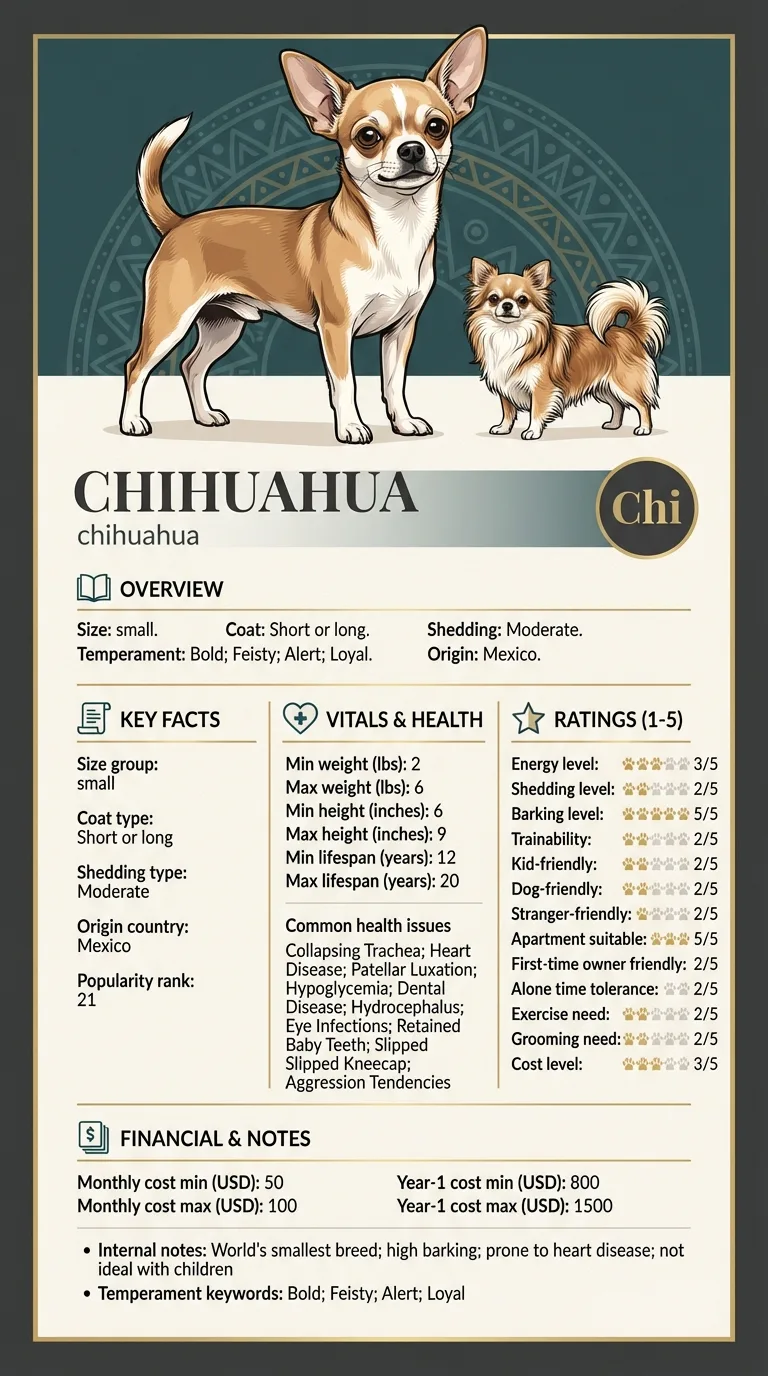
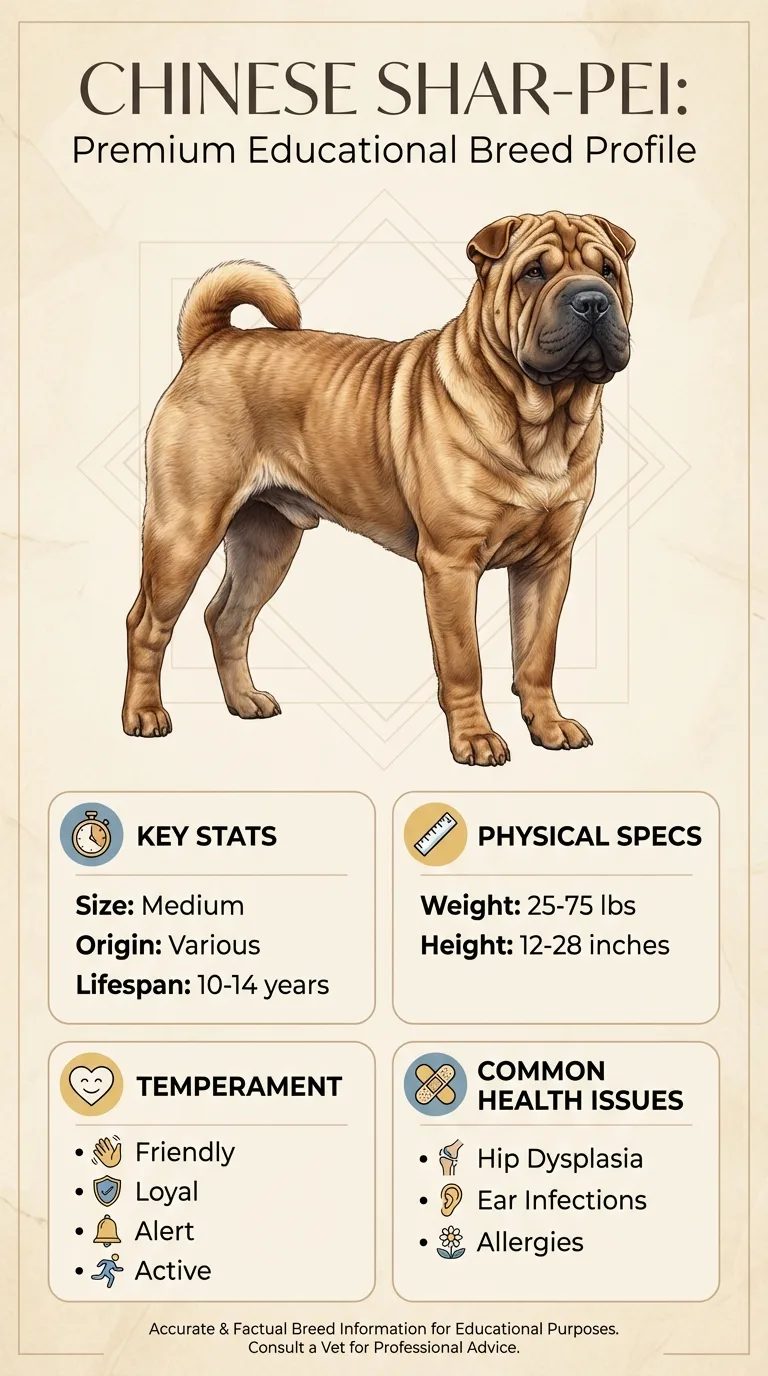
This is for someone already down to Chihuahua and Chinese Shar-Pei and deciding between them. For this pair the decision usually turns on barking, so those are covered first and in most detail. Anyone choosing from a flat has a clear answer here: Chihuahua rates 5/5 against 4/5. It is written for the decision rather than the breed history.
Between Chihuahua and Chinese Shar-Pei, barking is what separates them; neither is the lower-effort dog overall.
Choose Chihuahua if you are in a flat or a smaller home and a smaller dog suits your car, your home or your back.
Choose Chinese Shar-Pei if the dog will be alone during the working day.
| Feature | chihuahua | chinese shar pei | Winner |
|---|---|---|---|
| Size class | small | medium | Equal |
| Weight | 2–6 lbs | 45–60 lbs | Equal |
| Height | 6–9 in | 18–20 in | Equal |
| Lifespan | 12–20 years | 8–12 years | chihuahua |
| Exercise need | Low (2/5) | Low (2/5) | Equal |
| Grooming need | Low (2/5) | Low (2/5) | Equal |
| Shedding | Low (2/5) | Low (2/5) | Equal |
| Energy level | Moderate (3/5) | Low (2/5) | Equal |
| Barking | Very high (5/5) | Low (2/5) | chinese shar pei |
| Apartment suitability | Very high (5/5) | High (4/5) | chihuahua |
| Good for first-time owners | Low (2/5) | Low (2/5) | Equal |
| Tolerates being alone | Low (2/5) | Moderate (3/5) | chinese shar pei |
| Trainability | Low (2/5) | Low (2/5) | Equal |
| Good with kids | Low (2/5) | Moderate (3/5) | chinese shar pei |
| Good with other dogs | Low (2/5) | Low (2/5) | Equal |
| Friendly to strangers | Low (2/5) | Low (2/5) | Equal |
| Cost level | Moderate (3/5) | High (4/5) | chihuahua |
| Coat | Short or long | Short and harsh | Equal |
| Origin | Mexico | Various | Equal |
| Typical monthly cost | $50–$100 | $100–$200 | Equal |
| Typical first-year cost | $800–$1,500 | $1,400–$2,900 | Equal |
Picture the two side by side: a 2-6 lb Chihuahua standing 6-9 inches tall next to a 45-60 lb Chinese Shar-Pei at 18-20 inches -- a weight difference of up to 30 times. The Shar-Pei's distinctive loose, wrinkled skin and harsh short coat give it a blocky, muscular build that couldn't be more different from the Chihuahua's tiny, apple-headed frame. Both are officially small or medium size class in the data, but in practical terms the Shar-Pei is a substantial dog that needs real floor space, while the Chihuahua can travel in a bag. Anyone drawn to the Shar-Pei's look should be prepared for genuine large-breed presence in the home.
Exercise need is tied at low (2/5) for both breeds, and shedding and grooming also come out equal -- a rare case in this size range where the bigger dog isn't the higher-upkeep one physically. Energy level actually favors the Chihuahua as moderate (3/5) against the Shar-Pei's low (2/5), so the smaller dog is, if anything, the livelier of the two indoors. The Shar-Pei's calm temperament trait backs this up -- it's described as independent, reserved, and calm, a dog that's content to observe rather than constantly engage, while the Chihuahua's bold, feisty nature keeps it more active in short bursts around the house.
Despite that dramatic skin, the Shar-Pei's grooming and shedding both rate low (2/5), identical to the Chihuahua -- its short, harsh coat sheds minimally and needs little brushing. The real grooming consideration for the Shar-Pei isn't the coat at all but the skin folds themselves, which require regular cleaning and drying to prevent the skin fold dermatitis listed among its common health issues; neglect this and moisture-trapped folds can quickly become infected. The Chihuahua's short-or-long coat options are genuinely low-effort by comparison, with no structural skin concern to manage. So a low grooming score means something different for each breed here.
Both breeds can live in apartments, but not equally well: the Chihuahua rates very high (5/5) for apartment suitability, the Shar-Pei high (4/5) -- a smaller gap than most size-mismatched comparisons on this site, since the Shar-Pei's low exercise needs offset its bulk. The real noise difference is stark, though: the Chihuahua barks very high (5/5), the Shar-Pei just low (2/5), making the Shar-Pei the far quieter neighbor despite being ten times heavier. On alone-time tolerance the Shar-Pei also edges ahead, moderate (3/5) versus the Chihuahua's low (2/5), consistent with its more independent, reserved temperament.
Neither breed is rated highly for first-time owners -- both score a low 2 out of 5 -- and trainability is equally low (2/5) across the board. The Chihuahua's boldness and the Shar-Pei's independence both translate into stubbornness at the leash and in obedience work, just for different underlying reasons: the Chihuahua reacts fast and reactively, while the Shar-Pei's reserved, calm nature can shade into simple disinterest in pleasing a handler. Neither breed is a natural pick for someone who has never trained a dog before, and both reward an owner willing to invest in early, patient socialization rather than expecting quick obedience wins.
With kids, other dogs, and strangers, the Shar-Pei has a slight edge across the board -- moderate (3/5) with kids versus the Chihuahua's low (2/5), though both tie at low (2/5) with other dogs and low (2/5) with strangers. Neither breed is the natural choice for a boisterous household; the Chihuahua's list of temperament traits includes feisty and its health data even flags aggression tendencies, while the Shar-Pei's reserved, independent nature means it tends to tolerate rather than actively enjoy chaos. Families set on either breed should plan for careful, early socialization and supervised interactions with young children rather than assuming instant compatibility.
Lifespan tells a big story: the Chihuahua can live 12-20 years, nearly double the Shar-Pei's 8-12 year range, making it one of the longer-lived small breeds against a moderately short-lived medium one. The Chihuahua's ten-item health list includes structural issues typical of tiny dogs -- collapsing trachea, patellar luxation, hydrocephalus, retained baby teeth -- plus heart disease. The Shar-Pei's shorter list is narrower but breed-defining: skin fold dermatitis and entropion stem directly from its wrinkled structure, alongside familial Shar-Pei fever, a condition essentially unique to the breed, plus hypothyroidism and ear infections. Both lists demand real vigilance, just aimed at very different parts of the body.
The Shar-Pei costs meaningfully more to keep: a high (4/5) cost rating versus the Chihuahua's moderate (3/5), with monthly costs of $100-200 against the Chihuahua's $50-100 and first-year costs of $1,400-2,900 versus just $800-1,500. That roughly doubles the Chihuahua's ownership cost across the board, driven by the larger dog's food volume and the skin-fold maintenance and vet visits that come with its unique condition risk. Anyone budgeting on the assumption that small dog cheap, medium dog moderately more should note the Shar-Pei sits closer to large-breed cost territory than its size class label suggests.
Chihuahua weighs 2–6 lbs and lives 12–20 years; Chinese Shar-Pei weighs 45–60 lbs and lives 8–12 years. The two diverge most on barking. They are level on good with other dogs, exercise need and good for first-time owners, so those cannot decide it. In the table, a "winner" means easier for an ordinary household — not better. Size, coat and origin are recorded without a verdict. Because both breeds are scored the same way, the gaps are reliable even where the absolute numbers are rough.

The Shar-Pei, by a wide margin -- it rates low (2/5) for barking against the Chihuahua's very high (5/5), despite being the far larger dog.
Their coat itself is low-maintenance (2/5, tied with the Chihuahua), but the skin folds need regular cleaning to prevent skin fold dermatitis, a common breed-specific issue not captured in the basic grooming score.
The Chihuahua, often 12-20 years compared to the Shar-Pei's 8-12 years -- nearly double in some cases.
Not especially -- both rate a low 2 out of 5 for first-time owners, and both also score low on trainability, so plan on patience regardless of which you choose.
The Shar-Pei rates moderate (3/5) with kids versus the Chihuahua's low (2/5), though neither is a top pick for very young children without supervision.
Yes -- roughly double across monthly costs ($100-200 vs $50-100) and first-year costs ($1,400-2,900 vs $800-1,500), reflecting its larger size and skin-fold care needs.
No -- shedding rates low (2/5), identical to the Chihuahua, despite the Shar-Pei's much larger size.
Chinese Shar-Pei, rated low for barking versus the Chihuahua's very high.
Chihuahua, typically 12-20 years.
Chihuahua, roughly half the Shar-Pei's monthly cost.
Chinese Shar-Pei, described as independent, reserved and calm.
Secure checkout on Stripe. We never see your card.
7-day money-back guarantee. Instant access.
Health information here is general and is not veterinary advice. If your dog shows pain, sudden behaviour change, or worsening symptoms, consult a licensed veterinarian.
Some links on this site are affiliate links. We may earn a commission at no extra cost to you, and we only suggest products we believe are helpful for dog owners.
We research and check what we publish, but we do not warrant that any figure, date, price, or statement is accurate, complete, or current, and we accept no liability for any loss, cost, injury, or other harm arising from the use of this site. Use it as one reference among several. You remain responsible for your own decisions and for your dog's care - confirm anything that matters with a licensed veterinarian or another qualified professional before you act on it. Full disclaimer.
Match your lifestyle to the right dog.
Take quizNot sure which breed is right for you? Take our 2-minute quiz to find out.
Take the quiz