Boston Terrier vs Collie (Rough Collie): Which Suits Your Home?
Quick answer
Boston Terrier or Collie - which is the better fit?
If you're in an apartment or a smaller home, the Boston Terrier is the clear fit at a 5/5 apartment score against the Collie's 2/5. The Collie suits a house with space and an owner ready for serious grooming time.
Boston Terrier or Collie (Rough Collie)? On paper they differ most on grooming need, and on the scales Collie (Rough Collie) is the heavier at 50–75 lbs. Here is how the two compare on everything that shapes an ordinary week.
This is for someone already down to Boston Terrier and Collie (Rough Collie) and deciding between them. For this pair the decision usually turns on grooming need and apartment suitability, so those are covered first and in most detail. Anyone choosing from a flat has a clear answer here: Boston Terrier rates 5/5 against 2/5. It is written for the decision rather than the breed history.
Quick verdict
Between Boston Terrier and Collie (Rough Collie), grooming need is what separates them, and Boston Terrier is the lower-effort dog of the two to keep.
Choose boston terrier if...
Choose Boston Terrier if you are in a flat or a smaller home, this is your first dog and you do not want a standing grooming appointment.
Choose collie if...
Choose Collie (Rough Collie) if you want a dog that picks up training quickly and you want a dog that can keep up with an active routine.
Head-to-head comparison
Feature
boston terrier
collie
Winner
Size class
small
large
Equal
Weight
12–25 lbs
50–75 lbs
Equal
Height
15–17 in
22–26 in
Equal
Lifespan
11–13 years
11–14 years
collie
Exercise need
Low (2/5)
Moderate (3/5)
boston terrier
Grooming need
Very low (1/5)
High (4/5)
boston terrier
Shedding
Low (2/5)
High (4/5)
boston terrier
Energy level
Moderate (3/5)
Moderate (3/5)
Equal
Barking
Low (2/5)
Moderate (3/5)
boston terrier
Apartment suitability
Very high (5/5)
Low (2/5)
boston terrier
Good for first-time owners
Very high (5/5)
High (4/5)
boston terrier
Tolerates being alone
Moderate (3/5)
Moderate (3/5)
Equal
Trainability
High (4/5)
Very high (5/5)
collie
Good with kids
Very high (5/5)
Very high (5/5)
Equal
Good with other dogs
High (4/5)
High (4/5)
Equal
Friendly to strangers
High (4/5)
High (4/5)
Equal
Cost level
Moderate (3/5)
Moderate (3/5)
Equal
Coat
Short and smooth
Long double coat
Equal
Origin
Various
Scotland
Equal
Typical monthly cost
$80–$150
$100–$200
Equal
Typical first-year cost
$1,100–$2,300
$1,500–$2,800
Equal
Deep dive
Size and build
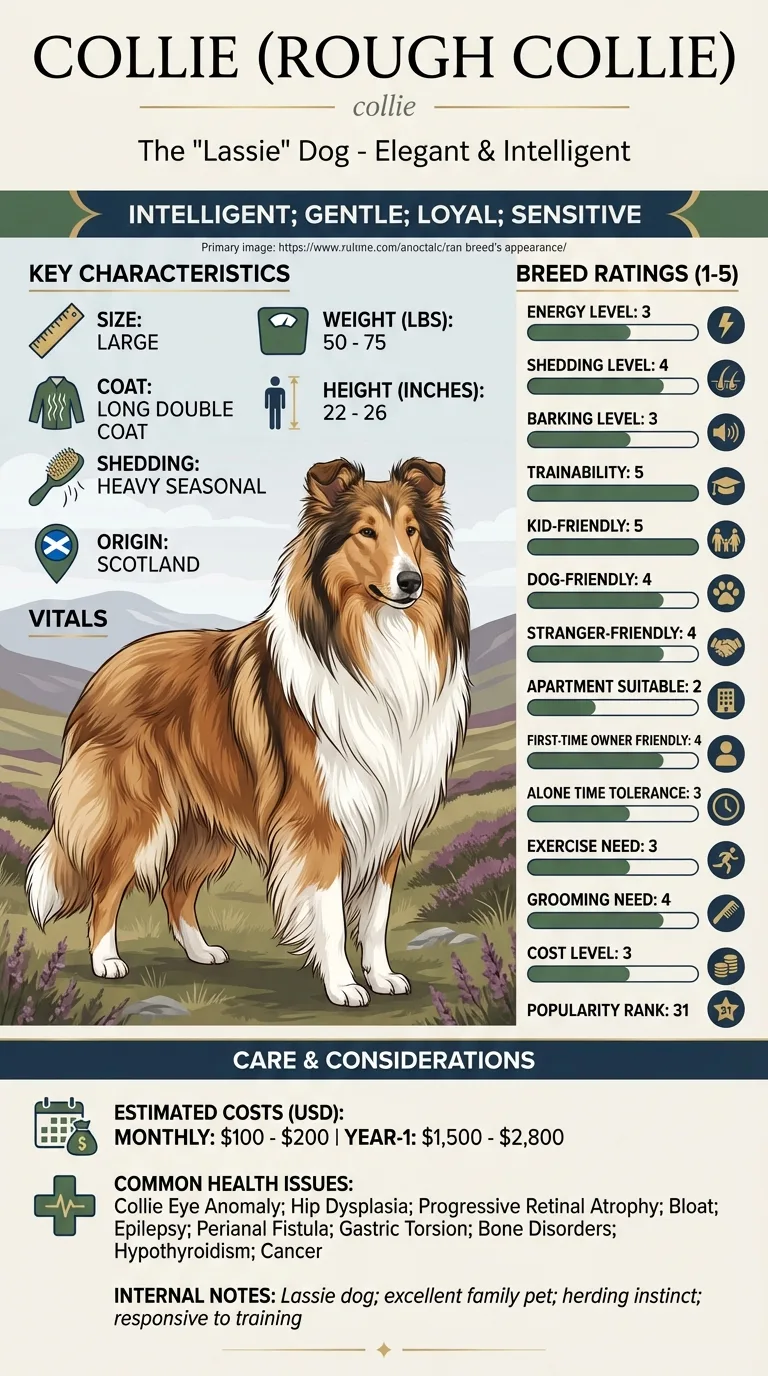
The Rough Collie is a large breed, 50-75 lbs and 22-26 inches, dwarfing the Boston's 12-25 lbs and 15-17 inches. Its long, flowing double coat adds to the visual size difference on top of the actual weight and height gap, and you'll want floor space and sturdy furniture that can handle a genuinely large dog moving through your home daily.
Energy and exercise
The Collie needs somewhat more exercise, rated moderate (3/5) against the Boston's low (2/5), though both tie on general energy level at moderate (3/5). A Collie's herding heritage means it appreciates a job or a longer daily walk more than the Boston does, and it tends to do best when given some kind of structured activity rather than idle time.
Grooming and shedding
The Collie's long double coat demands real upkeep - high (4/5) grooming and high (4/5) shedding, against the Boston's 1/5 and 2/5. Expect regular brushing sessions and a noticeable seasonal blow-out with a Collie that simply doesn't happen with a Boston, so factor a vacuum upgrade into the decision if shedding fur around the house is a dealbreaker for you.
Apartment living, noise and time alone
This is one of the widest gaps in the comparison: the Boston scores a perfect 5/5 for apartment suitability, the Collie just 2/5, reflecting its larger size and activity needs. The Collie also barks more (moderate 3/5 vs. low 2/5), a trait tied to its herding-alert instincts, and it tends to do noticeably better with a yard than confined to a small unit.
Training and owner experience
The Collie actually edges out the Boston on trainability, rated very high (5/5) against high (4/5) - its herding intelligence makes it highly responsive to training. Both remain good choices for newer owners, with the Boston slightly ahead (5/5 vs. 4/5) for first-time-owner fit, though a Collie's greater size means training consistency matters more for everyday manageability around the house.
Kids, other dogs and visitors
Kids, other dogs, and strangers all tie between the breeds, at very high, high, and high respectively. Both are naturally people-oriented dogs, though the Collie's larger size means more physical presence to manage around small children even with equally good temperament, since an excited large dog can easily knock a toddler over without any bad intent at all being involved in the incident.
Health and lifespan
The Collie lives slightly longer, 11-14 years against the Boston's 11-13, but its health list runs considerably longer and more serious: bloat, gastric torsion, epilepsy, cancer, and Collie Eye Anomaly, a condition specific to the breed. That's a heavier list to monitor than the Boston's airway-and-eye-focused concerns, even with a comparable lifespan, so regular vet checkups matter more with a Collie.
Cost to keep
Monthly cost runs $80-$150 for the Boston and $100-$200 for the Collie, with first-year costs of $1,100-$2,300 versus $1,500-$2,800. The gap reflects the Collie's larger size and grooming needs more than any single health cost, though its longer health-condition list can still add unplanned expenses over the years, so don't treat the monthly range as a hard ceiling on spending.
Boston Terrier vs Collie (Rough Collie) at a glance
Boston Terrier weighs 12–25 lbs and lives 11–13 years; Collie (Rough Collie) weighs 50–75 lbs and lives 11–14 years. The two diverge most on grooming need, apartment suitability and shedding. They are level on tolerates being alone, cost level and good with other dogs, so those cannot decide it. In the table, a "winner" means easier for an ordinary household — not better. Size, coat and origin are recorded without a verdict. Because both breeds are scored the same way, the gaps are reliable even where the absolute numbers are rough.
Boston Terrier vs Collie (Rough Collie): Which Suits Your Home? - Boston Terrier vs Collie (Rough Collie) at a glance
Frequently asked questions
Is a Collie good in an apartment?
Not really - it rates just 2 out of 5 for apartment suitability, well below the Boston Terrier's perfect 5/5, largely because of its size and exercise needs.
Which is easier to train?
The Collie edges ahead here, rated very high (5/5) against the Boston's high (4/5) - its herding background makes it especially responsive to training.
How much grooming does a Collie need?
A lot - high (4/5) for both grooming and shedding, driven by its long double coat, against the Boston Terrier's 1/5 and 2/5.
What's unique about Collie health risks?
Collie Eye Anomaly is specific to the breed, and the list also includes bloat, gastric torsion, and epilepsy - a longer list than the Boston Terrier's.
What's the monthly cost for each?
$80-$150 for the Boston Terrier, $100-$200 for the Collie.
Is a Collie good with kids?
Yes, rated very high (5/5), tying the Boston Terrier. Its larger size is worth factoring in around very young children even with equally strong temperament scores.
Which lives longer?
The Collie, at 11-14 years against the Boston's 11-13 - a narrow gap given the Collie's more extensive health list.
Boston Terrier or Collie - which is the better fit?
If you're in an apartment or a smaller home, the Boston Terrier is the clear fit at a 5/5 apartment score against the Collie's 2/5. The Collie suits a house with space and an owner ready for serious grooming time.
Costs
What's the monthly cost for each?
$80-$150 for the Boston Terrier, $100-$200 for the Collie.
Behavior
How much exercise does each need?
The Collie needs a bit more, rated moderate (3/5) against the Boston's low (2/5).
Health
Which breed lives longer?
The Collie, at 11-14 years versus the Boston Terrier's 11-13 years.
Related DogBreedCompass guides
Boston Terrier breed guide – Readers comparing the two usually want the full profile of Boston Terrier before deciding.
Health information here is general and is not veterinary advice. If your dog shows pain, sudden behaviour change, or worsening symptoms, consult a licensed veterinarian.
Some links on this site are affiliate links. We may earn a commission at no extra cost to you, and we only suggest products we believe are helpful for dog owners.
We research and check what we publish, but we do not warrant that any figure, date, price, or statement is accurate, complete, or current, and we accept no liability for any loss, cost, injury, or other harm arising from the use of this site. Use it as one reference among several. You remain responsible for your own decisions and for your dog's care - confirm anything that matters with a licensed veterinarian or another qualified professional before you act on it. Full disclaimer.