Behavior
Bloodhound or Newfoundland — which should most people pick?
For most households, the Newfoundland: it trains easier, handles alone time better, and is friendlier to first-time owners, even though it costs more to keep.

Quick answer
Bloodhound or Newfoundland — which should most people pick?
For most households, the Newfoundland: it trains easier, handles alone time better, and is friendlier to first-time owners, even though it costs more to keep.
Bloodhound or Newfoundland? On paper they differ most on grooming need, and on the scales Newfoundland is the heavier at 100–150 lbs. Here is how the two compare on everything that shapes an ordinary week.
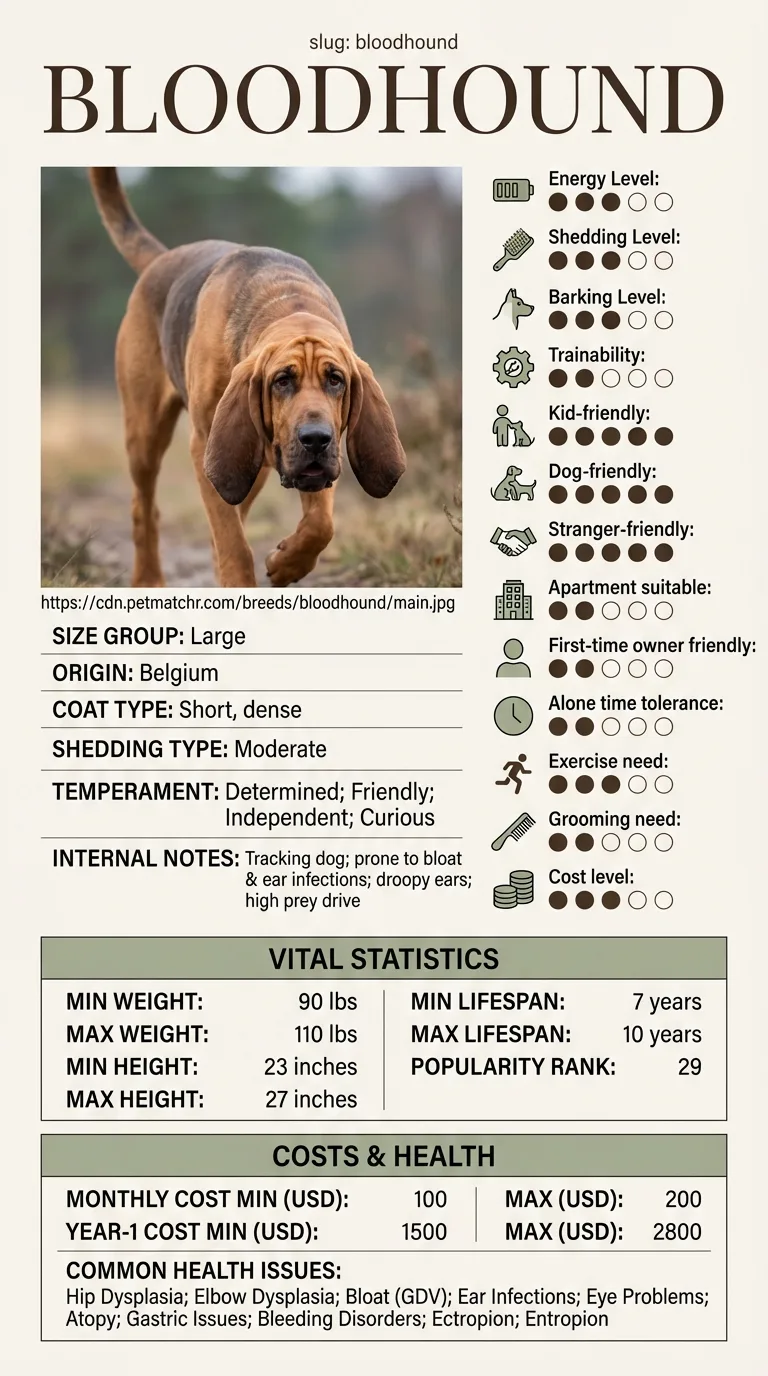
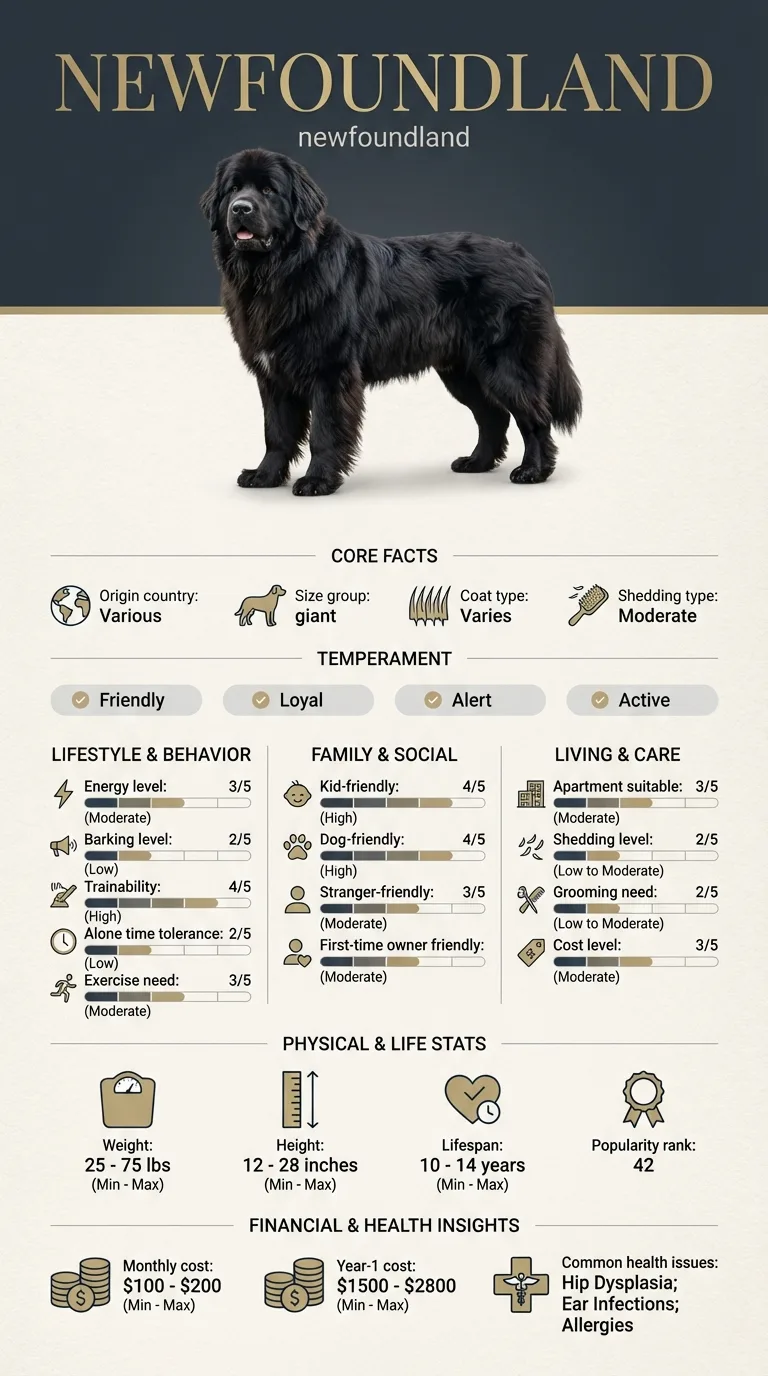
This is for someone already down to Bloodhound and Newfoundland and deciding between them. For this pair the decision usually turns on grooming need and shedding, so those are covered first and in most detail. Anyone choosing from a flat has a clear answer here: Bloodhound rates 2/5 against 1/5. It is written for the decision rather than the breed history.
Between Bloodhound and Newfoundland, grooming need is what separates them, and Bloodhound is the lower-effort dog of the two to keep.
Choose Bloodhound if you do not want a standing grooming appointment, shedding is a problem in your house and a smaller dog suits your car, your home or your back.
Choose Newfoundland if this is your first dog, the dog will be alone during the working day and there are young children at home.
| Feature | bloodhound | newfoundland | Winner |
|---|---|---|---|
| Size class | large | giant | Equal |
| Weight | 90–110 lbs | 100–150 lbs | Equal |
| Height | 23–27 in | 26–28 in | Equal |
| Lifespan | 7–10 years | 9–10 years | newfoundland |
| Exercise need | Moderate (3/5) | Moderate (3/5) | Equal |
| Grooming need | Low (2/5) | High (4/5) | bloodhound |
| Shedding | Moderate (3/5) | Very high (5/5) | bloodhound |
| Energy level | Moderate (3/5) | Low (2/5) | Equal |
| Barking | Moderate (3/5) | Low (2/5) | newfoundland |
| Apartment suitability | Low (2/5) | Very low (1/5) | bloodhound |
| Good for first-time owners | Low (2/5) | Moderate (3/5) | newfoundland |
| Tolerates being alone | Low (2/5) | Moderate (3/5) | newfoundland |
| Trainability | Low (2/5) | High (4/5) | newfoundland |
| Good with kids | High (4/5) | Very high (5/5) | newfoundland |
| Good with other dogs | High (4/5) | High (4/5) | Equal |
| Friendly to strangers | High (4/5) | High (4/5) | Equal |
| Cost level | Moderate (3/5) | Very high (5/5) | bloodhound |
| Coat | Short, dense | Heavy water-resistant double coat | Equal |
| Origin | Belgium | Various | Equal |
| Typical monthly cost | $100–$200 | $150–$310 | Equal |
| Typical first-year cost | $1,500–$2,800 | $2,200–$4,200 | Equal |
Neither dog is small. The Bloodhound runs 90-110 lbs and 23-27 inches at the shoulder, while the Newfoundland outweighs it at 100-150 lbs and stands a bit taller at 26-28 inches. Both are genuinely large-breed dogs that need furniture-clearance and a car big enough to carry them, but the Newfoundland's extra 40-plus pounds of bone and coat pushes it into giant-breed territory. Expect the Newf to eat, drool, and take up floor space accordingly.
Both breeds sit at moderate (3/5) exercise need, so daily walks and some off-leash time cover it for either one. The Bloodhound's drive comes out in its nose — a long tracking walk taps something a treadmill session won't. The Newfoundland's energy level actually rates lower (2/5) day to day; it's a calm, plodding companion that's happier ambling beside you or paddling in water than sprinting. Neither is a jogging partner by nature.
This is a clear split. The Bloodhound's short, dense coat needs minimal upkeep (2/5 grooming) and sheds moderately (3/5). The Newfoundland's heavy, water-resistant double coat is rated high for grooming demand (4/5) and very high for shedding (5/5) — expect regular brushing sessions and a serious coat-blow twice a year. If you don't want dog hair as a permanent home decor feature, that difference alone should steer the decision.
Both breeds score low on apartment suitability, but the Newfoundland is worse (1/5 vs the Bloodhound's 2/5) simply on square footage and drool radius. On barking, the Bloodhound is moderate (3/5) — it's a scent hound and will bay when it catches something interesting — while the Newf is quieter (2/5). The Newfoundland also tolerates solo time better (3/5 vs 2/5), making it the steadier choice for a household with a longer workday.
The Bloodhound rates low (2/5) on both trainability and first-time-owner suitability — it's independent-minded and will follow its nose over your recall command every time. The Newfoundland trains noticeably easier (4/5) and is a better bet for someone newer to dog ownership (3/5). If you want a dog that actually listens on the first or second try, the Newfoundland is the more forgiving pick of these two.
Both are good with kids, but the Newfoundland edges ahead at very high (5/5) versus the Bloodhound's high (4/5) — it's earned its reputation as a gentle giant. They're evenly matched with other dogs and with strangers, both rating high (4/5) on friendliness. Neither breed brings guarding instincts to the table; these are sociable dogs that will greet visitors rather than screen them.
The Newfoundland lives a bit longer on average, 9-10 years against the Bloodhound's 7-10. Both share hip dysplasia and bloat (GDV) risk, standard concerns for large, deep-chested breeds. Beyond that their health profiles diverge: the Bloodhound's list includes ear infections, eye problems, atopy, gastric issues, bleeding disorders, ectropion and entropion, while the Newfoundland carries its own cardiac risks — subaortic stenosis and dilated cardiomyopathy — plus cystinuria. Ask any breeder about heart screening on the Newf specifically.
The Bloodhound is the cheaper dog to keep, rated moderate (3/5) on overall cost versus the Newfoundland's very high (5/5). That shows up directly in the numbers: $100-200 a month and $1,500-2,800 in year one for the Bloodhound, versus $150-310 a month and $2,200-4,200 in year one for the Newfoundland. Food volume and grooming supplies for a 150-lb double-coated dog add up fast.
Bloodhound weighs 90–110 lbs and lives 7–10 years; Newfoundland weighs 100–150 lbs and lives 9–10 years. The two diverge most on grooming need, shedding and trainability and 1 other rated axes. They are level on good with other dogs, exercise need and friendly to strangers, so those cannot decide it. In the table, a "winner" means easier for an ordinary household — not better. Size, coat and origin are recorded without a verdict. Because both breeds are scored the same way, the gaps are reliable even where the absolute numbers are rough.

The Newfoundland, by a real margin. It runs 100-150 lbs and up to 28 inches tall, compared to the Bloodhound's 90-110 lbs and 23-27 inches. Both count as large dogs, but the Newf tips into giant-breed territory.
The Newfoundland, decisively — it rates very high (5/5) on shedding thanks to its heavy double coat, against moderate (3/5) for the Bloodhound. If shedding is your dealbreaker, the Bloodhound's short coat is the easier one to live with, even though it needs its own occasional brushing.
The Newfoundland is the friendlier option here, rated moderate (3/5) on first-time-owner suitability and high (4/5) on trainability. The Bloodhound rates low (2/5) on both — its independent, nose-driven nature makes it a harder dog to raise without prior experience.
Not comfortably. The Bloodhound rates low (2/5) and the Newfoundland even lower (1/5) on apartment suitability. Both need real space to spread out, and the Newfoundland's size and drool make small quarters especially impractical.
Budget $100-200 a month for a Bloodhound and $150-310 for a Newfoundland, reflecting the Newf's higher food volume and grooming needs. First-year costs follow the same pattern: $1,500-2,800 versus $2,200-4,200.
Yes — both are prone to hip dysplasia and bloat (GDV), so slow-feeding and careful exercise timing around meals matter for either breed. Past that overlap, the Bloodhound's risk list runs toward skin, eye and ear issues, while the Newfoundland's centers on cardiac conditions like subaortic stenosis.
The Newfoundland, rated low (2/5) on barking versus the Bloodhound's moderate (3/5). A Bloodhound's deep bay when it's caught a scent is part of the package; the Newf is generally the calmer, quieter presence indoors.
For most households, the Newfoundland: it trains easier, handles alone time better, and is friendlier to first-time owners, even though it costs more to keep.
The Bloodhound, at $100-200 a month versus $150-310 for the Newfoundland — a difference driven mostly by food volume and grooming.
They're rated the same, moderate (3/5), though the Bloodhound's needs are nose-work-driven while the Newfoundland is content with steadier, lower-key activity.
The Newfoundland, at 9-10 years versus the Bloodhound's 7-10 years — a modest but real edge for a giant breed.
Secure checkout on Stripe. We never see your card.
7-day money-back guarantee. Instant access.
Health information here is general and is not veterinary advice. If your dog shows pain, sudden behaviour change, or worsening symptoms, consult a licensed veterinarian.
Some links on this site are affiliate links. We may earn a commission at no extra cost to you, and we only suggest products we believe are helpful for dog owners.
We research and check what we publish, but we do not warrant that any figure, date, price, or statement is accurate, complete, or current, and we accept no liability for any loss, cost, injury, or other harm arising from the use of this site. Use it as one reference among several. You remain responsible for your own decisions and for your dog's care - confirm anything that matters with a licensed veterinarian or another qualified professional before you act on it. Full disclaimer.
Match your lifestyle to the right dog.
Take quizNot sure which breed is right for you? Take our 2-minute quiz to find out.
Take the quiz