Living
Which is the better overall choice?
The Weimaraner suits an active household with someone home most of the day; the Jack Russell tolerates alone time slightly better and costs meaningfully less to keep.

Quick answer
Which is the better overall choice?
The Weimaraner suits an active household with someone home most of the day; the Jack Russell tolerates alone time slightly better and costs meaningfully less to keep.
Jack Russell Terrier or Weimaraner? On paper they differ most on barking, and on the scales Weimaraner is the heavier at 55–90 lbs. Here is how the two compare on everything that shapes an ordinary week.
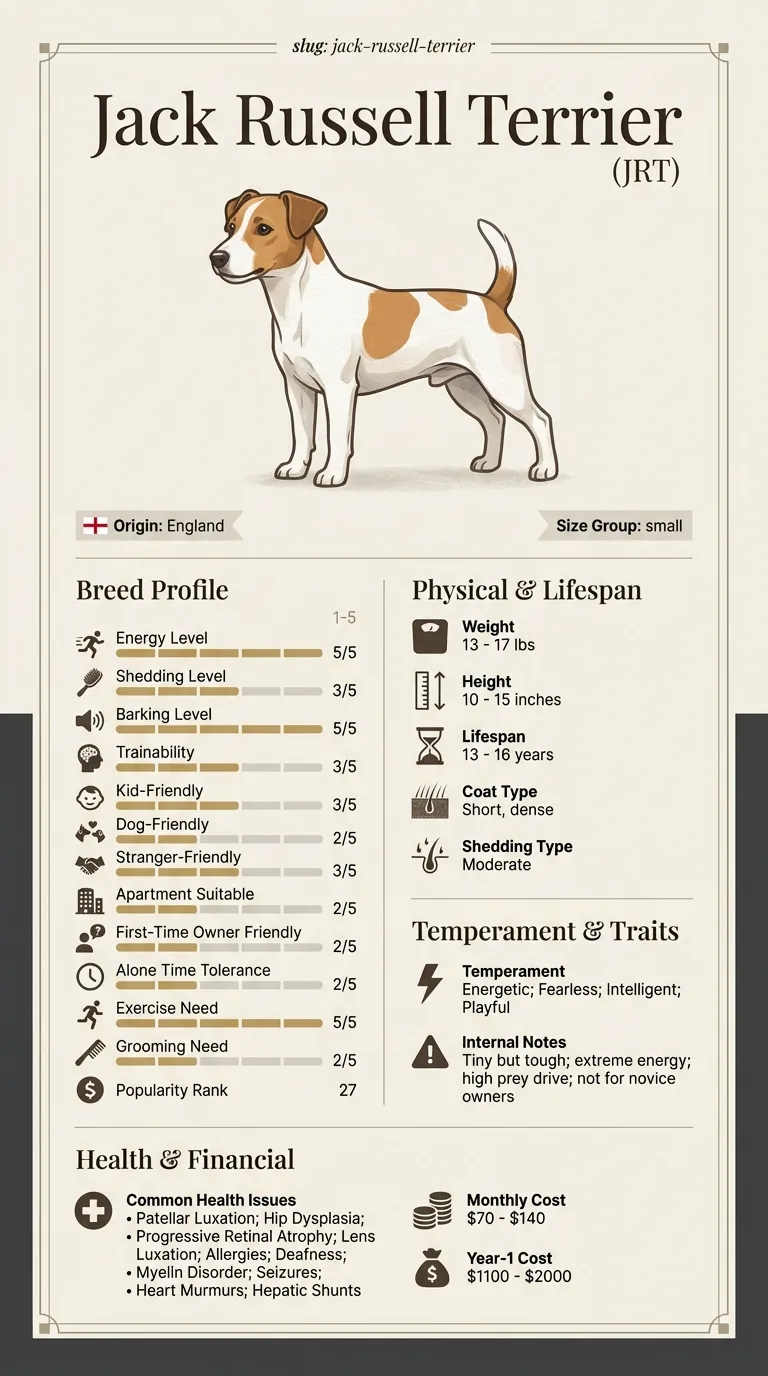
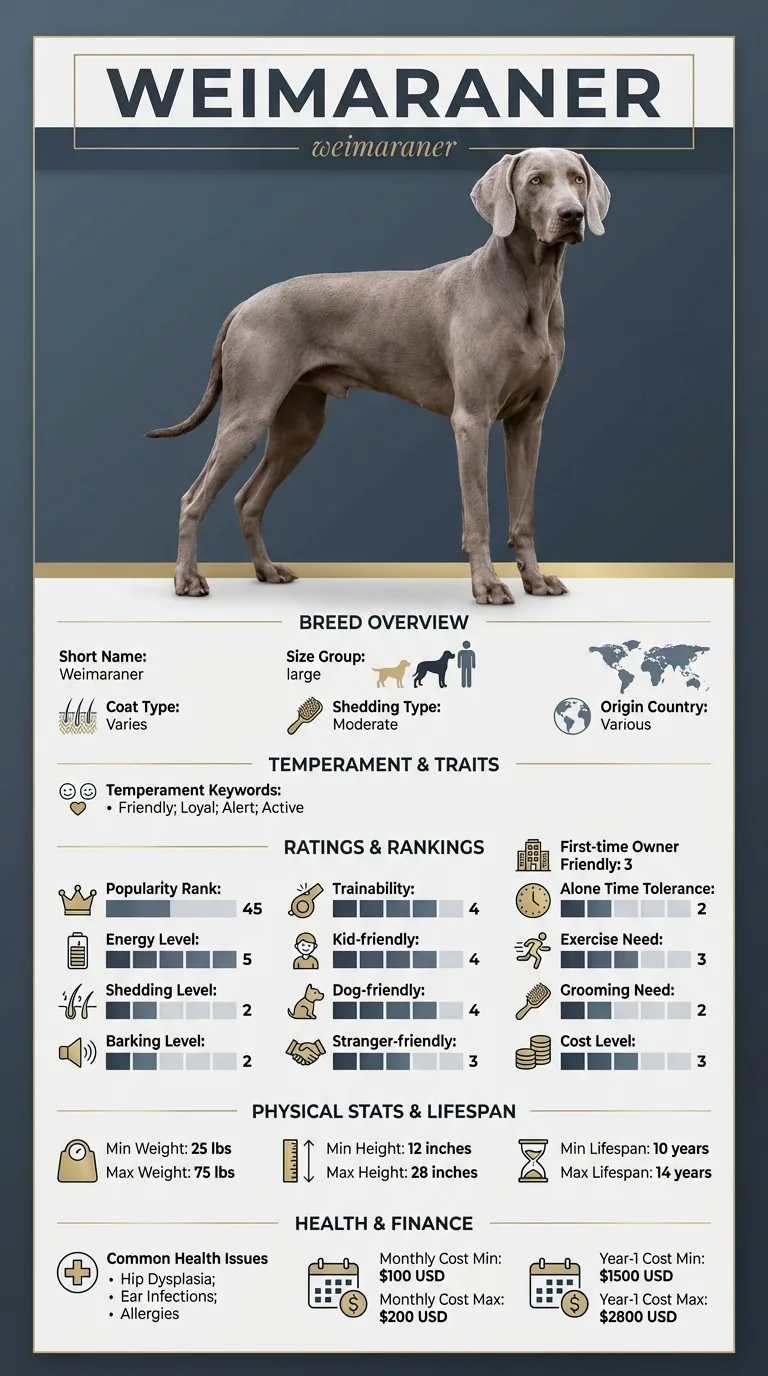
This is for someone already down to Jack Russell Terrier and Weimaraner and deciding between them. For this pair the decision usually turns on barking, so those are covered first and in most detail. Anyone choosing from a flat has a clear answer here: Jack Russell Terrier rates 2/5 against 1/5. It is written for the decision rather than the breed history.
Between Jack Russell Terrier and Weimaraner, barking is what separates them, and Jack Russell Terrier is the lower-effort dog of the two to keep.
Choose Jack Russell Terrier if a smaller dog suits your car, your home or your back.
Choose Weimaraner if you do not want a standing grooming appointment, shedding is a problem in your house and there are young children at home.
| Feature | jack russell terrier | weimaraner | Winner |
|---|---|---|---|
| Size class | small | large | Equal |
| Weight | 13–17 lbs | 55–90 lbs | Equal |
| Height | 10–15 in | 23–27 in | Equal |
| Lifespan | 13–16 years | 10–13 years | jack russell terrier |
| Exercise need | Very high (5/5) | Very high (5/5) | Equal |
| Grooming need | Low (2/5) | Very low (1/5) | weimaraner |
| Shedding | Moderate (3/5) | Low (2/5) | weimaraner |
| Energy level | Very high (5/5) | Very high (5/5) | Equal |
| Barking | Very high (5/5) | Moderate (3/5) | weimaraner |
| Apartment suitability | Low (2/5) | Very low (1/5) | jack russell terrier |
| Good for first-time owners | Low (2/5) | Low (2/5) | Equal |
| Tolerates being alone | Low (2/5) | Very low (1/5) | jack russell terrier |
| Trainability | Moderate (3/5) | High (4/5) | weimaraner |
| Good with kids | Moderate (3/5) | High (4/5) | weimaraner |
| Good with other dogs | Low (2/5) | Moderate (3/5) | weimaraner |
| Friendly to strangers | Moderate (3/5) | Moderate (3/5) | Equal |
| Cost level | Low (2/5) | Moderate (3/5) | jack russell terrier |
| Coat | Short, dense | Short and sleek | Equal |
| Origin | England | Various | Equal |
| Typical monthly cost | $70–$140 | $110–$240 | Equal |
| Typical first-year cost | $1,100–$2,000 | $1,700–$3,200 | Equal |
The Weimaraner is a large, rangy dog — 55 to 90 pounds and 23 to 27 inches — next to the compact Jack Russell at 13 to 17 pounds and 10 to 15 inches. Bred for hunting stamina, the Weimaraner's frame is built for covering ground fast, a different kind of athlete than the terrier's low, digging-suited build. You'll notice that difference immediately in how much space each dog needs to move.
Both breeds max out at 5/5 on exercise need, a genuine tie. Weimaraners have a reputation as one of the higher-drive sporting breeds, and matched against a Jack Russell's relentless terrier energy, this is a pairing where under-exercising either dog leads to real behavioral trouble. Expect destructive habits or excessive barking from either dog if the daily activity requirement goes unmet for long.
The Weimaraner's coat is the lower-maintenance one — 1/5 grooming need against the terrier's 2/5, and 2/5 shedding against the terrier's moderate 3/5. Its short, sleek coat needs little beyond routine brushing, which makes it one of the easier large breeds to keep clean. Between the two, coat care is genuinely the least of your concerns — that's a rare bright spot in an otherwise demanding breed to own.
Neither is suited to apartment living, and the Weimaraner is worse off at 1/5 against the terrier's 2/5, driven largely by its size and exercise needs. The terrier is far louder on a daily basis, rating 5/5 on barking against the Weimaraner's moderate 3/5. A house with a yard suits either breed far better than a unit with shared walls and no outdoor access.
Both breeds rate a low 2/5 for first-time owners, but the Weimaraner is meaningfully more trainable, 4/5 against the terrier's 3/5. That trainability matters more than the score alone suggests, since the Weimaraner's health list flags separation anxiety directly — a trait that responds better to structured training than to a stubborn temperament would. Crate training and gradual alone-time conditioning are worth starting on day one with a Weimaraner puppy.
The Weimaraner rates higher with kids (4/5 versus 3/5) and other dogs (3/5 versus 2/5), while the two tie on friendliness to strangers at 3/5. Its loyalty and alertness, both listed in its temperament profile, tend to come through as protectiveness around family rather than aloofness. Supervised introductions still matter with young kids and unfamiliar dogs, regardless of which breed you choose.
The Jack Russell lives considerably longer — 13 to 16 years against 10 to 13 for the Weimaraner. Hip dysplasia is the one shared item between their health lists; otherwise the Weimaraner's risks are distinct, including bloat (GDV), a real emergency risk in deep-chested breeds, and separation anxiety, worth taking seriously given its already-low 1/5 rating for tolerating being alone.
The Weimaraner costs more, rating 3/5 against the terrier's 2/5. Monthly costs run $110–$240 for the Weimaraner versus $70–$140 for the terrier, and first-year costs of $1,700–$3,200 against $1,100–$2,000 — a substantial gap tied to its larger size and higher food needs. Pet insurance is worth pricing out given the breed's bloat risk, which can mean an expensive emergency surgery.
Jack Russell Terrier weighs 13–17 lbs and lives 13–16 years; Weimaraner weighs 55–90 lbs and lives 10–13 years. The two diverge most on barking. They are level on energy level, exercise need and good for first-time owners, so those cannot decide it. In the table, a "winner" means easier for an ordinary household — not better. Size, coat and origin are recorded without a verdict. Because both breeds are scored the same way, the gaps are reliable even where the absolute numbers are rough.

Significantly — 55–90 pounds against 13–17, several times the terrier's weight, with a taller, more athletic build suited to sustained running.
Neither needs much — the Weimaraner actually needs less, 1/5 against the terrier's 2/5, and sheds less too (2/5 versus 3/5).
Both rate a low 2/5, though the Weimaraner is more trainable overall (4/5 versus 3/5) if you can commit to managing its attachment to you.
Not well — the Weimaraner rates a bottom-scale 1/5 for tolerating being alone, worse than the terrier's 2/5, and separation anxiety is explicitly listed as a risk for the breed.
$70–$140 for the Jack Russell, $110–$240 for the Weimaraner.
Hip dysplasia is the one item common to both lists. The Weimaraner's other risks, including bloat and separation anxiety, are distinct from the terrier's.
The Jack Russell, typically 13–16 years against 10–13 for the Weimaraner.
The Weimaraner suits an active household with someone home most of the day; the Jack Russell tolerates alone time slightly better and costs meaningfully less to keep.
$70–$140 for the Jack Russell, $110–$240 for the Weimaraner.
Both need maximum daily exercise, a tie at 5/5.
The Jack Russell, typically 13–16 years against 10–13 for the Weimaraner.
Secure checkout on Stripe. We never see your card.
7-day money-back guarantee. Instant access.

Health information here is general and is not veterinary advice. If your dog shows pain, sudden behaviour change, or worsening symptoms, consult a licensed veterinarian.
Some links on this site are affiliate links. We may earn a commission at no extra cost to you, and we only suggest products we believe are helpful for dog owners.
We research and check what we publish, but we do not warrant that any figure, date, price, or statement is accurate, complete, or current, and we accept no liability for any loss, cost, injury, or other harm arising from the use of this site. Use it as one reference among several. You remain responsible for your own decisions and for your dog's care - confirm anything that matters with a licensed veterinarian or another qualified professional before you act on it. Full disclaimer.
Match your lifestyle to the right dog.
Take quizNot sure which breed is right for you? Take our 2-minute quiz to find out.
Take the quiz