Behavior
Labradoodle or Weimaraner — which is the easier breed overall?
The Labradoodle, mainly on trainability and first-time-owner fit; the Weimaraner asks for more handling experience and more space to run.

Quick answer
Labradoodle or Weimaraner — which is the easier breed overall?
The Labradoodle, mainly on trainability and first-time-owner fit; the Weimaraner asks for more handling experience and more space to run.
Labradoodle or Weimaraner? On paper they differ most on grooming need, and on the scales Weimaraner is the heavier at 55–90 lbs. Here is how the two compare on everything that shapes an ordinary week.
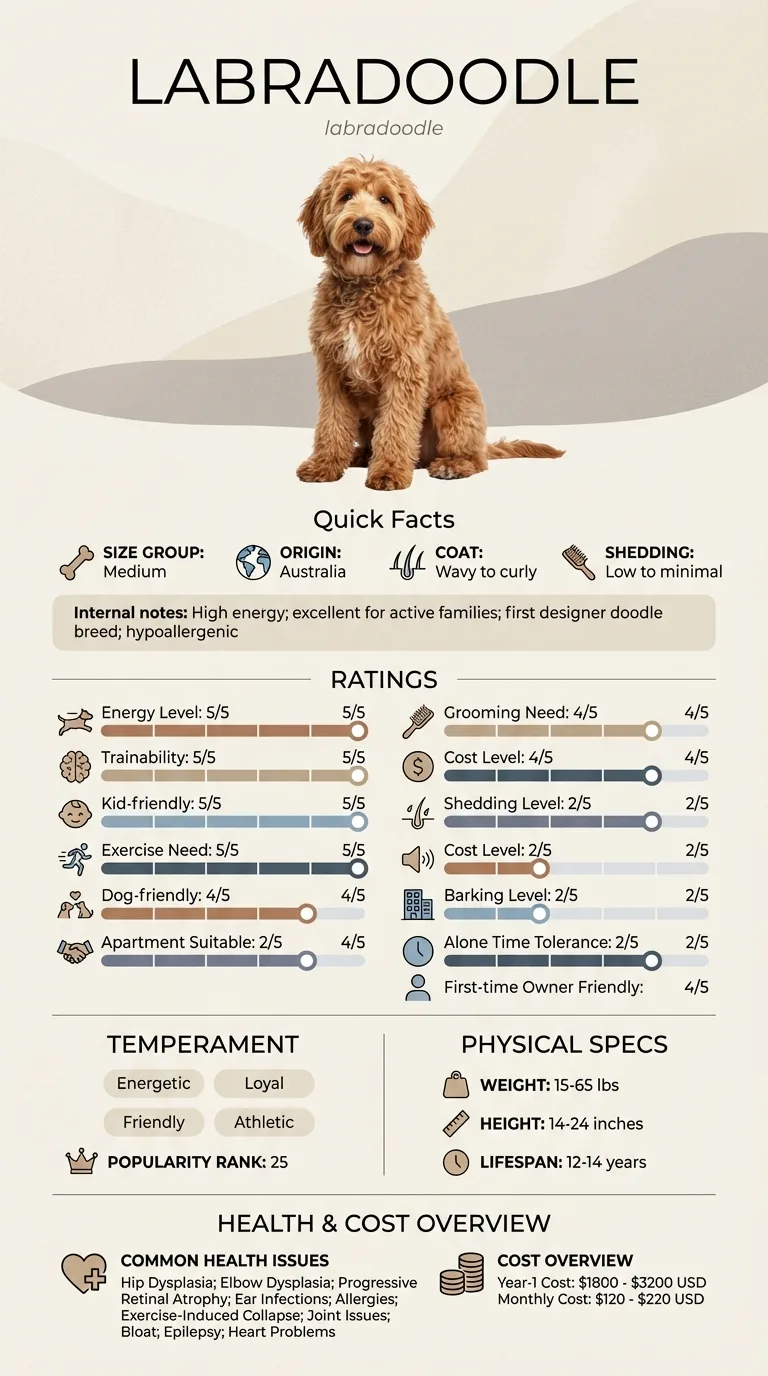
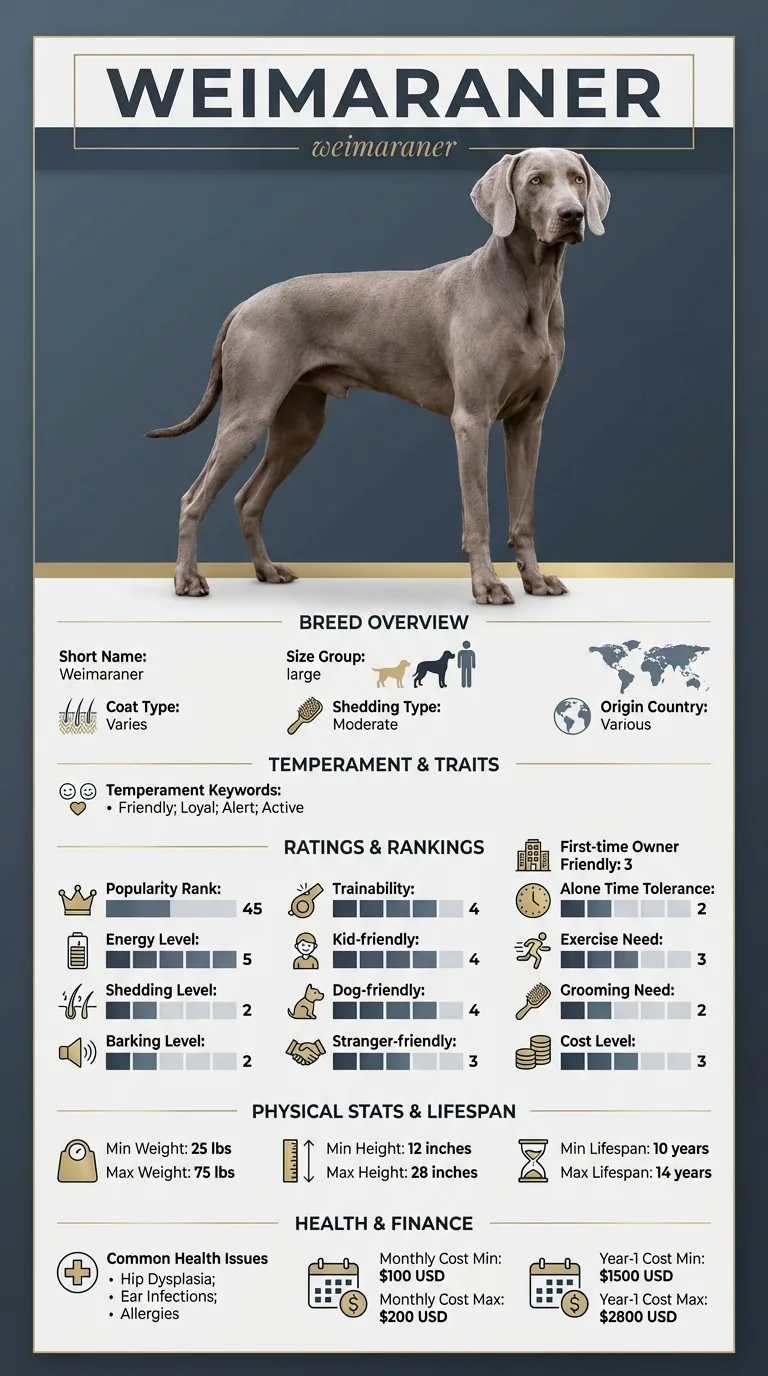
This is for someone already down to Labradoodle and Weimaraner and deciding between them. For this pair the decision usually turns on grooming need and good for first-time owners, so those are covered first and in most detail. Anyone choosing from a flat has a clear answer here: Labradoodle rates 2/5 against 1/5. The focus throughout is on daily consequences rather than breed background.
Between Labradoodle and Weimaraner, grooming need is what separates them, and Labradoodle is the lower-effort dog of the two to keep.
Choose Labradoodle if this is your first dog, there are young children at home and you already have another dog.
Choose Weimaraner if you do not want a standing grooming appointment and you want a dog that is more watchful with visitors.
| Feature | labradoodle | weimaraner | Winner |
|---|---|---|---|
| Size class | medium | large | Equal |
| Weight | 15–65 lbs | 55–90 lbs | Equal |
| Height | 14–24 in | 23–27 in | Equal |
| Lifespan | 12–14 years | 10–13 years | labradoodle |
| Exercise need | Very high (5/5) | Very high (5/5) | Equal |
| Grooming need | High (4/5) | Very low (1/5) | weimaraner |
| Shedding | Low (2/5) | Low (2/5) | Equal |
| Energy level | Very high (5/5) | Very high (5/5) | Equal |
| Barking | Low (2/5) | Moderate (3/5) | labradoodle |
| Apartment suitability | Low (2/5) | Very low (1/5) | labradoodle |
| Good for first-time owners | High (4/5) | Low (2/5) | labradoodle |
| Tolerates being alone | Low (2/5) | Very low (1/5) | labradoodle |
| Trainability | Very high (5/5) | High (4/5) | labradoodle |
| Good with kids | Very high (5/5) | High (4/5) | labradoodle |
| Good with other dogs | High (4/5) | Moderate (3/5) | labradoodle |
| Friendly to strangers | High (4/5) | Moderate (3/5) | labradoodle |
| Cost level | High (4/5) | Moderate (3/5) | weimaraner |
| Coat | Wavy to curly | Short and sleek | Equal |
| Origin | Australia | Various | Equal |
| Typical monthly cost | $120–$220 | $110–$240 | Equal |
| Typical first-year cost | $1,800–$3,200 | $1,700–$3,200 | Equal |
The Weimaraner is the bigger dog on the top end — up to 90 lbs and 27 inches, compared to the Labradoodle's ceiling of 65 lbs and 24 inches. At the low end the ranges get closer, but a full-grown standard Weimaraner is reliably a large dog, while a Labradoodle's final size depends on which variety you bought. Ask a breeder for the parents' sizes before you commit to either.
Both breeds tie at 5/5 for exercise need and energy level — this pairing is two high-drive dogs, not one calm option and one active one. The Weimaraner was bred to run alongside horses for a full day of hunting, and that history shows: it needs real mileage, not just yard time, to stay settled indoors.
The Weimaraner's short, sleek coat needs almost no grooming — 1/5, about as low as the scale goes — against the Labradoodle's 4/5. Shedding ties at a low 2/5 for both. If coat maintenance is your deciding factor, the Weimaraner removes nearly all of it while still keeping shedding manageable. That's a rare combination — most low-shed breeds ask for more brushing in return.
Apartment suitability is poor for both — 2/5 for the Labradoodle, 1/5 for the Weimaraner — and both tolerate being alone badly (2/5 and 1/5). The Weimaraner's barking runs slightly higher at 3/5 against the Labradoodle's 2/5. This is a pairing where neither dog belongs in a small space with an owner gone all day.
Trainability favors the Labradoodle slightly, 5/5 against the Weimaraner's still-solid 4/5. The bigger gap is first-time-owner suitability: 4/5 for the Labradoodle versus 2/5 for the Weimaraner, whose headstrong streak and sheer size make it more dog than a novice typically expects. Both are smart breeds, but the Weimaraner asks for a firmer, more consistent hand.
The Labradoodle rates higher with kids (5/5 vs. 4/5) and with other dogs (4/5 vs. 3/5). Strangers land close, 4/5 against 3/5. None of the gaps here are dramatic, but the Labradoodle is consistently the more socially easygoing breed. The Weimaraner's devotion tends to concentrate on its own family rather than spreading evenly to visitors.
The Labradoodle has the lifespan edge, 12-14 years against the Weimaraner's 10-13. Both share hip dysplasia and bloat risk — bloat in particular is serious for both breeds' deep chests and warrants a conversation with your vet about slow-feed bowls. The Weimaraner's list also names separation anxiety directly, plus hypertrophic osteodystrophy and Von Willebrand disease, both breed-specific concerns.
The Weimaraner runs slightly cheaper on cost level (3/5 vs. 4/5) but the dollar ranges nearly meet: $110-240 monthly against the Labradoodle's $120-220, and $1,700-3,200 for the first year against $1,800-3,200. Its larger size pushes food costs up even as its grooming costs stay near zero. In practice, budget similarly for either.
Labradoodle weighs 15–65 lbs and lives 12–14 years; Weimaraner weighs 55–90 lbs and lives 10–13 years. The two diverge most on grooming need and good for first-time owners. They are level on energy level, exercise need and shedding, so those cannot decide it. The table below marks a winner only where one breed is genuinely easier for a typical owner; size and origin are facts rather than merits and stay level. Ratings come from one source applied to both breeds, so they are meaningful against each other rather than as absolute scores.

The Weimaraner, on the top end — it can reach 90 lbs and 27 inches, compared to the Labradoodle's 65 lbs and 24-inch ceiling. Both start from a similar lower bound.
The Weimaraner, decisively — a 1/5 grooming score against the Labradoodle's 4/5. Its short, sleek coat needs almost no maintenance.
Neither scores especially well, but the Labradoodle (4/5) is a meaningfully easier first dog than the Weimaraner (2/5), whose size and headstrong nature ask more of a novice owner.
$120-220 for a Labradoodle and $110-240 for a Weimaraner — close enough that grooming savings on the Weimaraner roughly offset its higher food costs.
Both carry hip dysplasia and bloat risk. The Weimaraner's list separately names separation anxiety, hypertrophic osteodystrophy, and Von Willebrand disease as breed-specific concerns.
The Labradoodle, at 12-14 years against the Weimaraner's 10-13.
No — apartment suitability rates just 2/5 for the Labradoodle and 1/5 for the Weimaraner. Both also cope poorly with being left alone, so a house with a yard and a present owner suits either breed better.
The Labradoodle, mainly on trainability and first-time-owner fit; the Weimaraner asks for more handling experience and more space to run.
$120-220 for a Labradoodle versus $110-240 for a Weimaraner — grooming savings on the Weimaraner offset its bigger food bill.
Both need serious daily exercise, tying at 5/5 — this pairing has no low-energy option.
The Labradoodle, 12-14 years against the Weimaraner's 10-13.
Secure checkout on Stripe. We never see your card.
7-day money-back guarantee. Instant access.

Health information here is general and is not veterinary advice. If your dog shows pain, sudden behaviour change, or worsening symptoms, consult a licensed veterinarian.
Some links on this site are affiliate links. We may earn a commission at no extra cost to you, and we only suggest products we believe are helpful for dog owners.
We research and check what we publish, but we do not warrant that any figure, date, price, or statement is accurate, complete, or current, and we accept no liability for any loss, cost, injury, or other harm arising from the use of this site. Use it as one reference among several. You remain responsible for your own decisions and for your dog's care - confirm anything that matters with a licensed veterinarian or another qualified professional before you act on it. Full disclaimer.
Match your lifestyle to the right dog.
Take quizNot sure which breed is right for you? Take our 2-minute quiz to find out.
Take the quiz