Living
Malinois or Cocker Spaniel for a small apartment?
Cocker Spaniel, rated High for apartment living versus the Malinois's Very low.

Quick answer
Malinois or Cocker Spaniel for a small apartment?
Cocker Spaniel, rated High for apartment living versus the Malinois's Very low.
Belgian Malinois or Cocker Spaniel? On paper they differ most on grooming need, and on the scales Belgian Malinois is the heavier at 55–65 lbs. Here is how the two compare on everything that shapes an ordinary week.
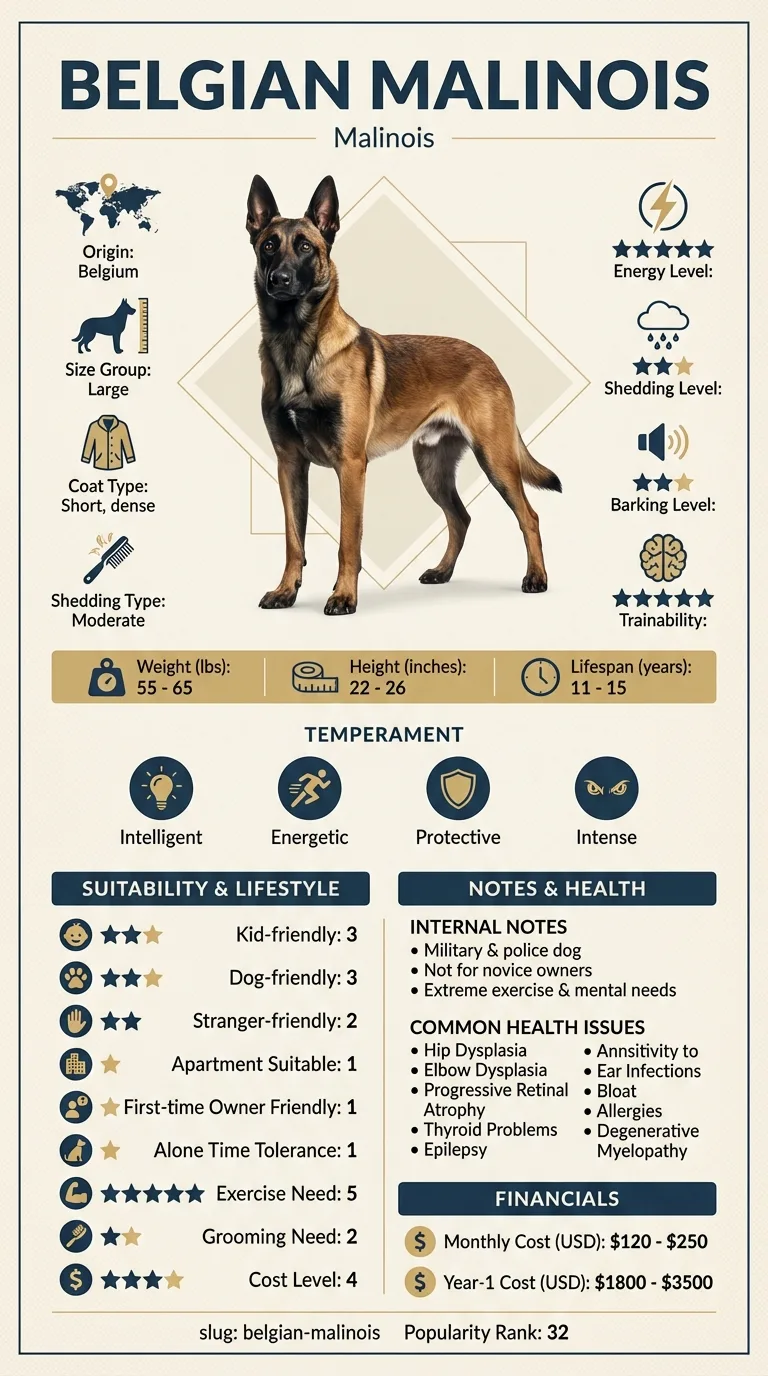
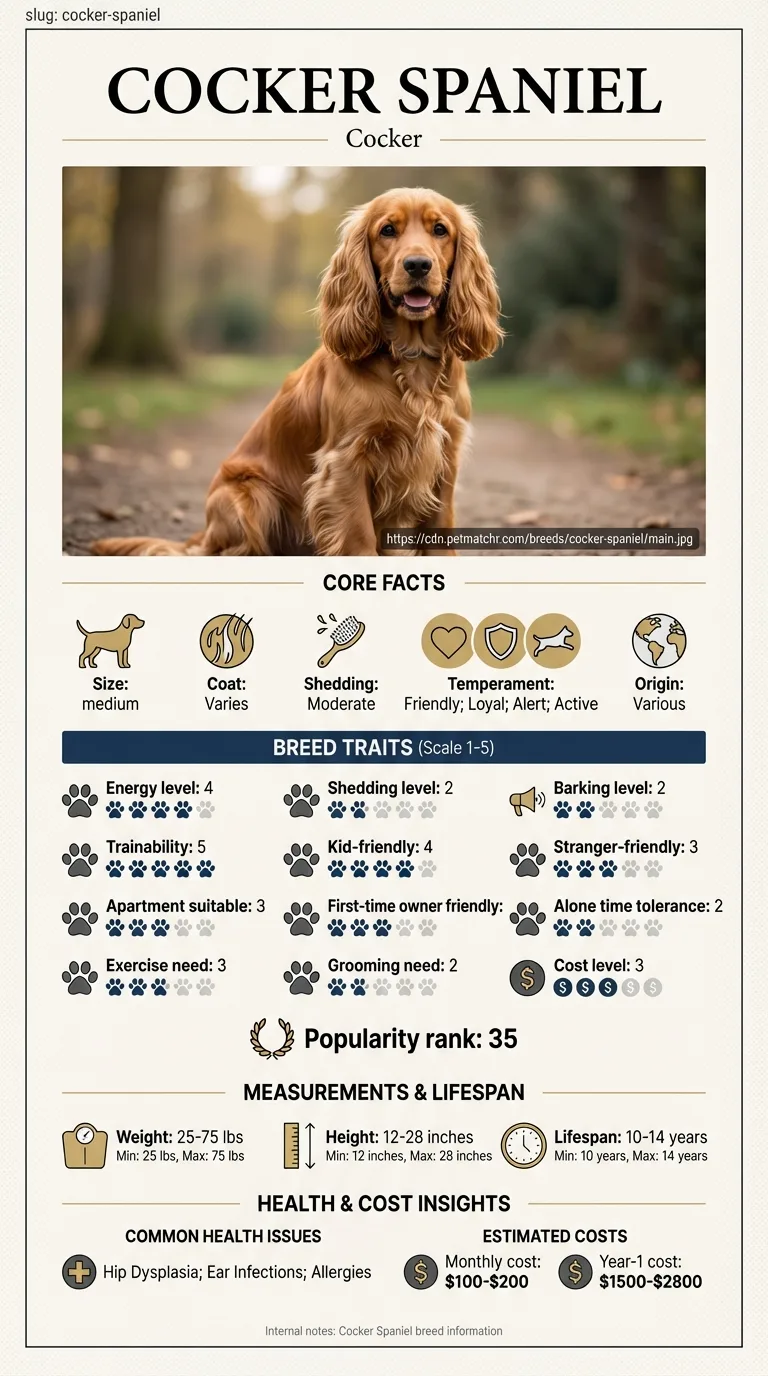
This is for someone already down to Belgian Malinois and Cocker Spaniel and deciding between them. For this pair the decision usually turns on grooming need and apartment suitability, so those are covered first and in most detail. Anyone choosing from a flat has a clear answer here: Cocker Spaniel rates 4/5 against 1/5. It is written for the decision rather than the breed history.
Between Belgian Malinois and Cocker Spaniel, grooming need is what separates them, and Cocker Spaniel is the lower-effort dog of the two to keep.
Choose Belgian Malinois if you do not want a standing grooming appointment, you want a dog that picks up training quickly and you want a dog that can keep up with an active routine.
Choose Cocker Spaniel if you are in a flat or a smaller home, this is your first dog and your walking routine is modest.
| Feature | belgian malinois | cocker spaniel | Winner |
|---|---|---|---|
| Size class | large | small | Equal |
| Weight | 55–65 lbs | 20–30 lbs | Equal |
| Height | 22–26 in | 13–16 in | Equal |
| Lifespan | 11–15 years | 10–14 years | belgian malinois |
| Exercise need | Very high (5/5) | Moderate (3/5) | cocker spaniel |
| Grooming need | Low (2/5) | Very high (5/5) | belgian malinois |
| Shedding | Moderate (3/5) | Moderate (3/5) | Equal |
| Energy level | Very high (5/5) | Moderate (3/5) | Equal |
| Barking | Moderate (3/5) | Moderate (3/5) | Equal |
| Apartment suitability | Very low (1/5) | High (4/5) | cocker spaniel |
| Good for first-time owners | Very low (1/5) | High (4/5) | cocker spaniel |
| Tolerates being alone | Very low (1/5) | Low (2/5) | cocker spaniel |
| Trainability | Very high (5/5) | High (4/5) | belgian malinois |
| Good with kids | Moderate (3/5) | Very high (5/5) | cocker spaniel |
| Good with other dogs | Moderate (3/5) | High (4/5) | cocker spaniel |
| Friendly to strangers | Low (2/5) | High (4/5) | cocker spaniel |
| Cost level | High (4/5) | Moderate (3/5) | cocker spaniel |
| Coat | Short, dense | Silky and feathered | Equal |
| Origin | Belgium | Various | Equal |
| Typical monthly cost | $120–$250 | $80–$150 | Equal |
| Typical first-year cost | $1,800–$3,500 | $1,100–$2,300 | Equal |
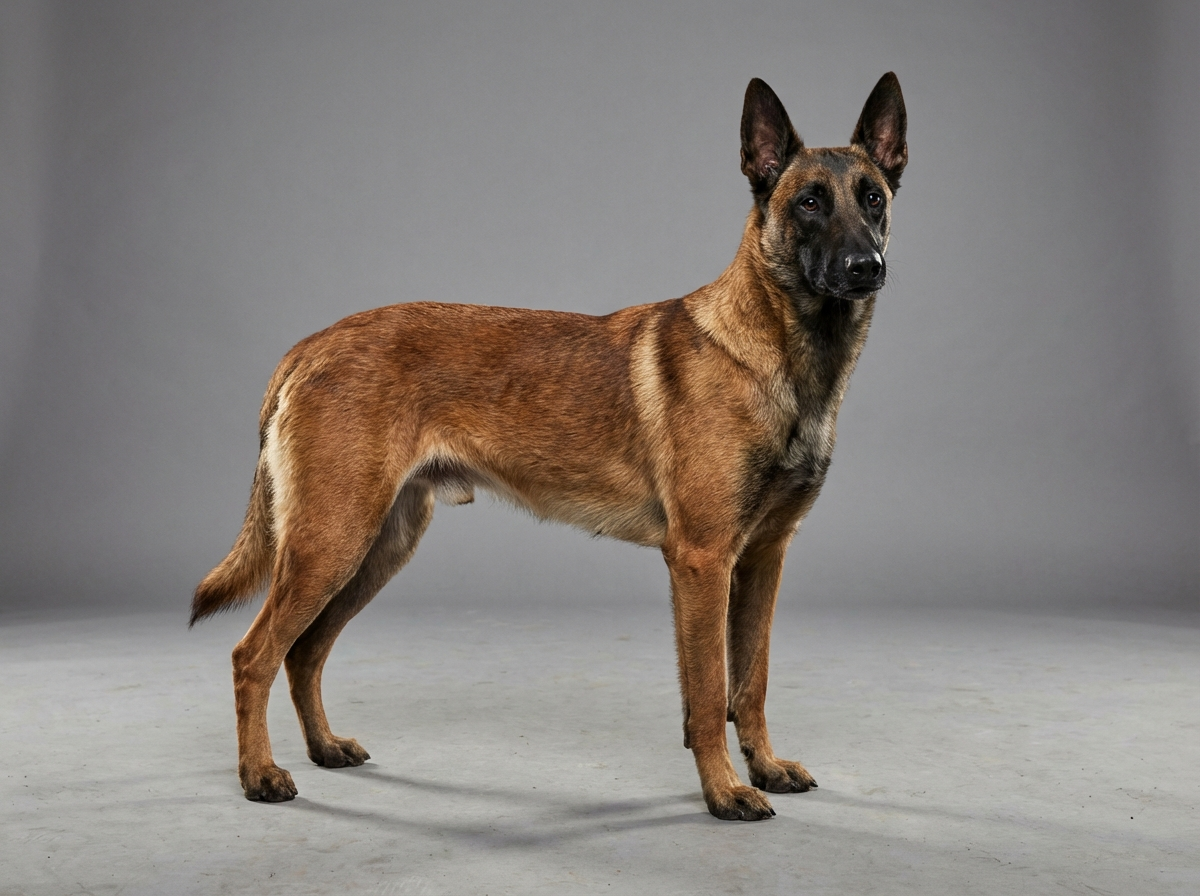
At 55–65 lbs and 22–26 inches, the Belgian Malinois is built like a working athlete, roughly double the mass of a 20–30 lb, 13–16 inch Cocker Spaniel. That size gap shows up everywhere, from the strength needed to hold a leash during a sighthound-speed sprint to the amount of floor space each dog wants at rest. The Malinois carries a lean, square-shouldered frame suited to sustained running and jumping, while the Cocker's compact, rounder body was bred for flushing game in dense brush rather than covering ground fast. A household choosing on size alone should also weigh that a Malinois this size needs real containment — fencing, leash strength, car space — that a Cocker simply doesn't demand.
Exercise need is rated Very high (5/5) for the Malinois against Moderate (3/5) for the Cocker Spaniel, and that gap is the single biggest fork in this comparison. A Malinois bred for Belgian police and military work expects running, scent work, or structured drills most days — a walk around the block will not touch its Energetic, Intense temperament. The Cocker Spaniel's Moderate energy level still wants a daily walk and some retrieving games, since its Merry disposition thrives on activity, but it settles into an evening far more readily. Owners underestimating the Malinois's drive are a common reason these dogs end up needing rehoming.
Grooming flips the size trend: the Malinois needs only Low (2/5) grooming thanks to a short, dense coat that sheds a manageable Moderate (3/5) amount, while the Cocker Spaniel demands Very high (5/5) grooming for its silky, feathered coat even though its shedding sits at the same Moderate (3/5) level. That feathered coat around the ears, legs, and belly mats quickly and needs brushing several times a week plus regular professional trims to avoid painful tangles near the Cocker's famously floppy, infection-prone ears. The Malinois, by contrast, is largely wash-and-go, needing just a weekly brush to manage its double coat's blow-outs.
Apartment suitability is rated Very low (1/5) for the Malinois versus High (4/5) for the Cocker Spaniel, and both dogs share a Moderate (3/5) barking tendency, so noise isn't the deciding factor — space and stimulation are. A Malinois confined to an apartment without a job to do tends to become destructive or reactive, consistent with its Protective, Intense temperament needing outlets. Tolerating time alone is Very low (1/5) for the Malinois and only slightly better at Low (2/5) for the Cocker, so neither breed is a good match for owners gone ten-hour workdays, though the Cocker adapts to close-quarters living far more gracefully than the Malinois ever will.
Trainability favors the Malinois at Very high (5/5) against the Cocker's still-strong High (4/5), but the rating for good for first-time owners tells the real story: Very low (1/5) for the Malinois versus High (4/5) for the Cocker. An Intelligent, Energetic dog that learns commands in a handful of repetitions can be a handful when that same intelligence gets pointed at problem behaviors instead of structured tasks, which is why the Malinois is typically recommended for owners with prior working-breed experience. The Cocker's Eager to please nature makes it forgiving of training mistakes in a way the Malinois, bred for high-stakes protection work, simply is not.
With kids, the Cocker Spaniel rates Very high (5/5) against the Malinois's Moderate (3/5), and the same pattern holds for strangers — Low (2/5) for the Malinois, High (4/5) for the Cocker — reflecting the Malinois's Protective temperament versus the Cocker's Gentle, Affectionate one. Good with other dogs also favors the Cocker, High (4/5) versus Moderate (3/5) for the Malinois. None of this makes the Malinois unsafe with a well-socialized family, but it does mean visitors, playdates, and dog-park trips require more active management than they would with a Cocker, whose temperament profile was shaped around being a merry, approachable companion rather than a guardian.
The Malinois edges the Cocker on longevity, 11–15 years versus 10–14, but carries a longer list of watch-outs: Hip Dysplasia, Elbow Dysplasia, Progressive Retinal Atrophy, Thyroid Problems, Epilepsy, sensitivity to anesthesia, Ear Infections, Bloat, Allergies, and Degenerative Myelopathy. The Cocker Spaniel's five flagged conditions — Ear Infections, Cataracts, Progressive Retinal Atrophy, Hip Dysplasia, and Autoimmune Hemolytic Anemia — overlap on ear issues and PRA but skip the joint and bloat risks tied to the Malinois's larger, more athletic frame. Cocker owners should budget for routine ear cleaning given that breed's floppy ears, while Malinois owners should plan pet insurance around orthopedic and anesthesia-related costs.
Typical monthly cost runs $120–$250 for the Malinois against $80–$150 for the Cocker Spaniel, and first-year costs follow the same ratio: $1,800–$3,500 versus $1,100–$2,300. Cost level is rated High (4/5) for the Malinois and Moderate (3/5) for the Cocker, a gap driven less by food, since the Cocker is the smaller dog, and more by the Malinois's need for structured training classes, secure fencing, and higher-calorie feeding to support its Very high energy output. The Cocker's costs skew toward grooming — its Very high (5/5) grooming need means regular professional trims that add up over a decade-plus lifespan.
Belgian Malinois weighs 55–65 lbs and lives 11–15 years; Cocker Spaniel weighs 20–30 lbs and lives 10–14 years. The two diverge most on grooming need, apartment suitability and good for first-time owners and 4 other rated axes. They are level on barking and shedding, so those cannot decide it. In the table, a "winner" means easier for an ordinary household — not better. Size, coat and origin are recorded without a verdict. Because both breeds are scored the same way, the gaps are reliable even where the absolute numbers are rough.

Very likely yes — the Malinois scores Very low (1/5) for first-time owners while the Cocker scores High (4/5). The Malinois's Very high exercise need and Intense, Protective temperament require handling experience the Cocker's Eager to please nature doesn't demand.
They're rated the same, Moderate (3/5) shedding for both, though the Cocker's feathered coat needs far more brushing (Very high grooming) to manage tangles even though the actual shedding volume is comparable to the Malinois's short double coat.
The Cocker Spaniel is rated High (4/5) for apartment suitability and can do reasonably well with daily walks, but the Malinois's Very low (1/5) rating reflects its need for space to run and a job to do — it is not a realistic apartment dog.
The Cocker Spaniel rates Very high (5/5) with kids versus Moderate (3/5) for the Malinois. The Cocker's Gentle, Affectionate temperament was bred for close companionship, while the Malinois's Protective drive needs careful socialization and supervision around children.
Only partly — both can develop Progressive Retinal Atrophy and Hip Dysplasia, but the Malinois's list adds Bloat, Epilepsy, and Degenerative Myelopathy tied to its larger, more athletic build, while the Cocker's includes Cataracts and Autoimmune Hemolytic Anemia.
The Cocker Spaniel, at $1,100–$2,300 in year one versus $1,800–$3,500 for the Malinois, though the Cocker's Very high grooming need adds recurring professional grooming costs the Malinois's low-maintenance coat avoids.
A lot — its Very high (5/5) trainability is a double-edged sword, since that same intelligence needs daily structured outlets or it turns into problem behavior; the Cocker's High (4/5) trainability combined with its eager-to-please nature makes it far more forgiving of an inconsistent training schedule.
Cocker Spaniel, rated High for apartment living versus the Malinois's Very low.
Neither — both are rated Moderate (3/5) for barking.
The Malinois, typically 11–15 years versus 10–14 for the Cocker.
The Malinois, rated Low (2/5) versus the Cocker's Very high (5/5).
Secure checkout on Stripe. We never see your card.
7-day money-back guarantee. Instant access.
Health information here is general and is not veterinary advice. If your dog shows pain, sudden behaviour change, or worsening symptoms, consult a licensed veterinarian.
Some links on this site are affiliate links. We may earn a commission at no extra cost to you, and we only suggest products we believe are helpful for dog owners.
We research and check what we publish, but we do not warrant that any figure, date, price, or statement is accurate, complete, or current, and we accept no liability for any loss, cost, injury, or other harm arising from the use of this site. Use it as one reference among several. You remain responsible for your own decisions and for your dog's care - confirm anything that matters with a licensed veterinarian or another qualified professional before you act on it. Full disclaimer.
Match your lifestyle to the right dog.
Take quizNot sure which breed is right for you? Take our 2-minute quiz to find out.
Take the quiz