Belgian Malinois vs English Cocker Spaniel: Which Suits Your Home?
Quick answer
Malinois or English Cocker Spaniel - which is the better choice?
Depends on your lifestyle: the Cocker suits most households (4/5 first-time owner rating), while the Malinois (1/5) needs an experienced owner ready for very high exercise demands.
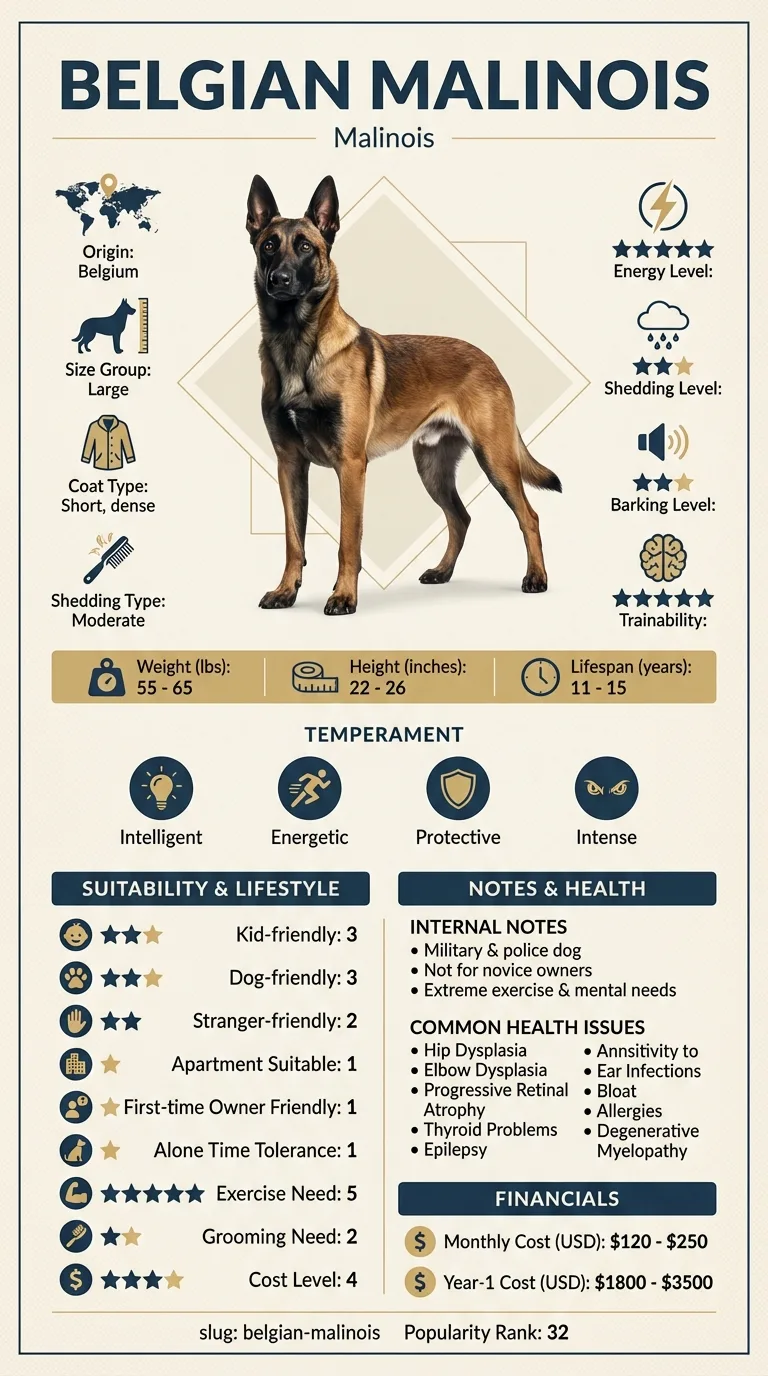
Belgian Malinois or English Cocker Spaniel? On paper they differ most on apartment suitability, and on the scales Belgian Malinois is the heavier at 55–65 lbs. Here is how the two compare on everything that shapes an ordinary week.
This is for someone already down to Belgian Malinois and English Cocker Spaniel and deciding between them. For this pair the decision usually turns on apartment suitability and good for first-time owners, so those are covered first and in most detail. Anyone choosing from a flat has a clear answer here: English Cocker Spaniel rates 4/5 against 1/5. There is no origin story here — only what changes about your week.
Quick verdict
Between Belgian Malinois and English Cocker Spaniel, apartment suitability is what separates them, and English Cocker Spaniel is the lower-effort dog of the two to keep.
Choose belgian malinois if...
Choose Belgian Malinois if you do not want a standing grooming appointment, you want a dog that picks up training quickly and you want a dog that can keep up with an active routine.
Choose english cocker spaniel if...
Choose English Cocker Spaniel if you are in a flat or a smaller home, this is your first dog and your walking routine is modest.
Head-to-head comparison
Feature
belgian malinois
english cocker spaniel
Winner
Size class
large
medium
Equal
Weight
55–65 lbs
26–34 lbs
Equal
Height
22–26 in
15–17 in
Equal
Lifespan
11–15 years
12–14 years
Equal
Exercise need
Very high (5/5)
High (4/5)
english cocker spaniel
Grooming need
Low (2/5)
High (4/5)
belgian malinois
Shedding
Moderate (3/5)
Moderate (3/5)
Equal
Energy level
Very high (5/5)
High (4/5)
Equal
Barking
Moderate (3/5)
Moderate (3/5)
Equal
Apartment suitability
Very low (1/5)
High (4/5)
english cocker spaniel
Good for first-time owners
Very low (1/5)
High (4/5)
english cocker spaniel
Tolerates being alone
Very low (1/5)
Low (2/5)
english cocker spaniel
Trainability
Very high (5/5)
High (4/5)
belgian malinois
Good with kids
Moderate (3/5)
Very high (5/5)
english cocker spaniel
Good with other dogs
Moderate (3/5)
High (4/5)
english cocker spaniel
Friendly to strangers
Low (2/5)
High (4/5)
english cocker spaniel
Cost level
High (4/5)
Moderate (3/5)
english cocker spaniel
Coat
Short, dense
Medium, silky and feathered
Equal
Origin
Belgium
Various
Equal
Typical monthly cost
$120–$250
$100–$200
Equal
Typical first-year cost
$1,800–$3,500
$1,400–$2,900
Equal
Deep dive
Size and build
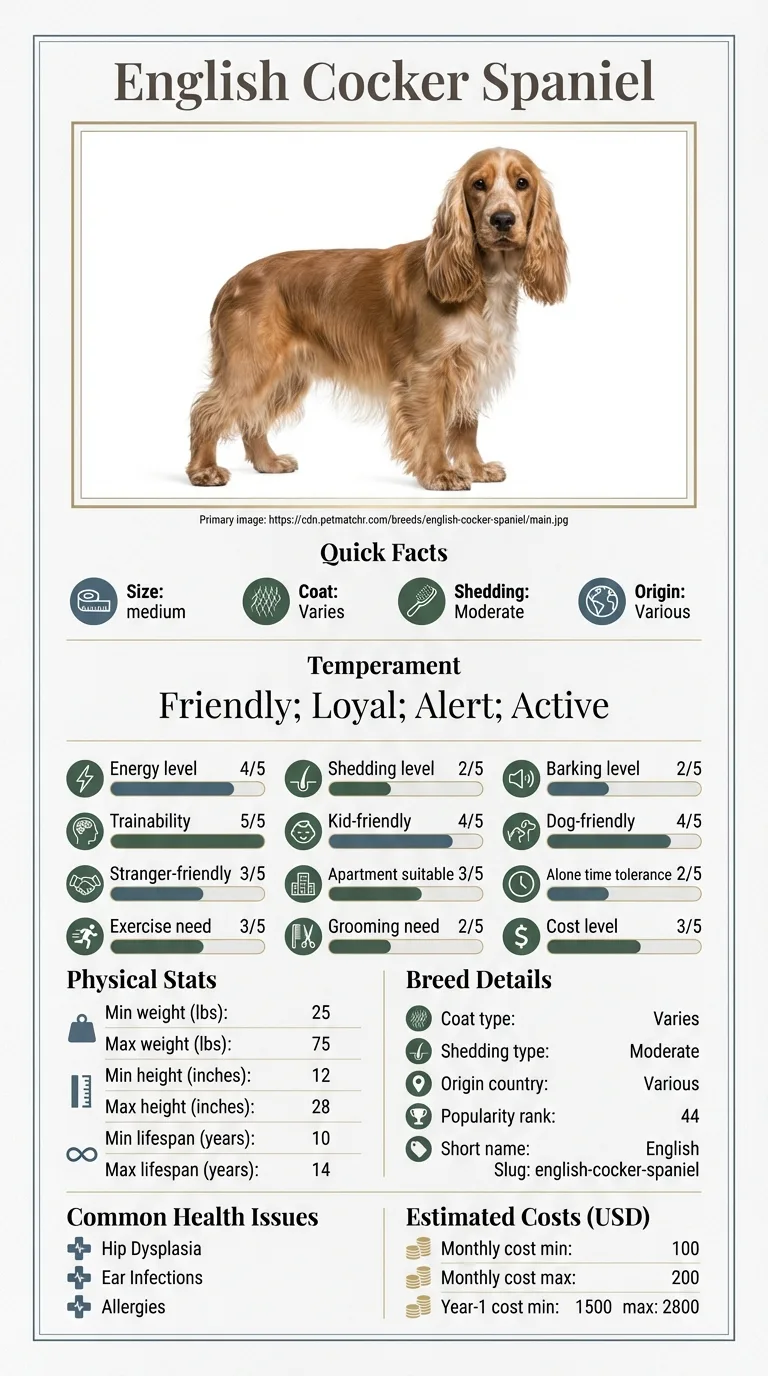
The Malinois runs 55-65 lbs and stands 22-26 inches; the English Cocker is roughly half that, at 26-34 lbs and 15-17 inches. That's not a small gap - you're comparing a large working dog against a compact gun dog. Build translates directly into handling: a Malinois pulling toward a squirrel on leash is a different physical event than a Cocker doing the same thing.
Energy and exercise
Both dogs want to work, but the Malinois tops the scale at 5/5 exercise need versus the Cocker's 4/5. That one point matters in practice - Malinois were bred for sustained, high-intensity tasks, while the Cocker's drive traces to short bursts flushing birds. A tired Malinois needs more than a long walk; the Cocker is satisfied by a solid daily outing plus some mental work.
Grooming and shedding
This is where the Cocker asks more of you. It rates 4/5 on grooming versus the Malinois's 2/5, driven by a medium, silky, feathered coat that mats without regular brushing and trims. Shedding is a wash at moderate (3/5) for both. The Malinois's short dense coat needs little beyond a weekly brush.
Apartment living, noise and time alone
The Malinois scores 1/5 for apartment suitability - about as low as this site rates any breed - while the Cocker comes in at 4/5. Neither dog tolerates being left alone well (Malinois 1/5, Cocker 2/5), but the Cocker's smaller size and lower exercise ceiling make it workable in a smaller home if you're around. A Malinois in an apartment is asking for trouble on both counts.
Training and owner experience
Both breeds train well - Malinois 5/5, Cocker 4/5 - but the good-for-first-time-owners rating tells the real story: 1/5 for the Malinois against 4/5 for the Cocker. A Malinois's trainability is real, but it needs an owner who can direct that intelligence with a job, not just basic obedience. The Cocker responds well to ordinary pet-owner training.
Kids, other dogs and visitors
The Cocker outscores the Malinois with kids (5/5 vs 3/5), other dogs (4/5 vs 3/5), and strangers (4/5 vs 2/5). Malinois temperament runs protective and intense by design, an asset for a working role but something that calls for more careful introductions at home. A household with a steady stream of kids' friends fits the Cocker's temperament with less management.
Health and lifespan
Lifespans overlap closely - Malinois 11-15 years, Cocker 12-14 - so this isn't a deciding factor. Both share risk for hip dysplasia, progressive retinal atrophy, and ear infections. The Malinois's list runs longer, adding elbow dysplasia, thyroid issues, epilepsy, bloat, and degenerative myelopathy, while the Cocker carries breed-specific familial nephropathy and adult-onset neuropathy.
Cost to keep
Monthly costs sit close - $120-250 for the Malinois versus $100-200 for the Cocker - reflecting the Malinois's larger size and higher overall cost rating (4/5 vs 3/5). First-year costs follow the same pattern: $1,800-3,500 versus $1,400-2,900. The gap is a few hundred dollars a year, not a different financial category.
Belgian Malinois vs English Cocker Spaniel at a glance
Belgian Malinois weighs 55–65 lbs and lives 11–15 years; English Cocker Spaniel weighs 26–34 lbs and lives 12–14 years. The two diverge most on apartment suitability, good for first-time owners and grooming need and 2 other rated axes. They are level on barking and shedding, so those cannot decide it. Where the table declares a winner it means less work for the owner, nothing more; descriptive rows are left as ties on purpose. The value here is in the differences between the two columns; treat any single score as approximate.
Belgian Malinois vs English Cocker Spaniel: Which Suits Your Home? - Belgian Malinois vs English Cocker Spaniel at a glance
Frequently asked questions
Which is bigger, the Belgian Malinois or the English Cocker Spaniel?
The Malinois, by a wide margin - 55-65 lbs and 22-26 inches versus the Cocker's 26-34 lbs and 15-17 inches. It's roughly double the weight and several inches taller at the shoulder.
Does one shed more than the other?
No - both land at moderate (3/5) shedding. The difference shows up in grooming effort instead: the Cocker's feathered coat needs regular brushing and trims (4/5 grooming need), while the Malinois's short coat is closer to wash-and-go (2/5).
Is either breed a good fit for a first-time dog owner?
The Cocker rates high (4/5) for first-time owners; the Malinois rates very low (1/5). A Malinois's combination of very high exercise need, low tolerance for being alone, and intense drive is a lot to manage without prior experience with working breeds.
Can either of these live in an apartment?
The Cocker is workable at 4/5 apartment suitability if you commit to its high exercise need. The Malinois scores 1/5 - its size and drive are genuinely mismatched with apartment living, regardless of how much you exercise it.
How much should I budget monthly?
Plan on $120-250 for a Malinois and $100-200 for a Cocker. First-year costs, which include setup expenses, run $1,800-3,500 and $1,400-2,900 respectively.
Do these breeds share any health risks?
Yes - both are listed for hip dysplasia, progressive retinal atrophy, and ear infections. Beyond that their risk profiles diverge: the Malinois adds conditions like bloat and epilepsy, while the Cocker's additional risks are familial nephropathy and adult-onset neuropathy.
Which is friendlier with strangers and kids?
The Cocker, clearly - it rates 4/5 with strangers and 5/5 with kids, against the Malinois's 2/5 and 3/5. The Malinois's protective, intense temperament makes it a more reserved, work-oriented dog around people it doesn't know.
Malinois or English Cocker Spaniel - which is the better choice?
Depends on your lifestyle: the Cocker suits most households (4/5 first-time owner rating), while the Malinois (1/5) needs an experienced owner ready for very high exercise demands.
Costs
What's the monthly cost for each?
$120-250 for the Malinois, $100-200 for the Cocker - the Malinois costs more mainly due to its larger size.
Training
How much exercise does each need?
Both need serious daily exercise - Malinois rates 5/5, Cocker 4/5. Neither is a once-around-the-block breed.
Health
Which breed lives longer?
They're close: the Cocker averages 12-14 years, the Malinois 11-15 years. Individual health and care matter more than the breed gap here.
Related DogBreedCompass guides
Belgian Malinois breed guide – Readers comparing the two usually want the full profile of Belgian Malinois before deciding.
Belgian Malinois vs German Shorthaired Pointer – German Shorthaired Pointer is the closest breed to Belgian Malinois on the measured axes, so it is the natural next comparison.
Health information here is general and is not veterinary advice. If your dog shows pain, sudden behaviour change, or worsening symptoms, consult a licensed veterinarian.
Some links on this site are affiliate links. We may earn a commission at no extra cost to you, and we only suggest products we believe are helpful for dog owners.
We research and check what we publish, but we do not warrant that any figure, date, price, or statement is accurate, complete, or current, and we accept no liability for any loss, cost, injury, or other harm arising from the use of this site. Use it as one reference among several. You remain responsible for your own decisions and for your dog's care - confirm anything that matters with a licensed veterinarian or another qualified professional before you act on it. Full disclaimer.