Living
Which is smaller?
The Cavalier King Charles Spaniel, at 13-18 lbs versus the Malinois's 55-65 lbs.

Quick answer
Which is smaller?
The Cavalier King Charles Spaniel, at 13-18 lbs versus the Malinois's 55-65 lbs.
Belgian Malinois or Cavalier King Charles Spaniel? On paper they differ most on apartment suitability, and on the scales Belgian Malinois is the heavier at 55–65 lbs. Here is how the two compare on everything that shapes an ordinary week.
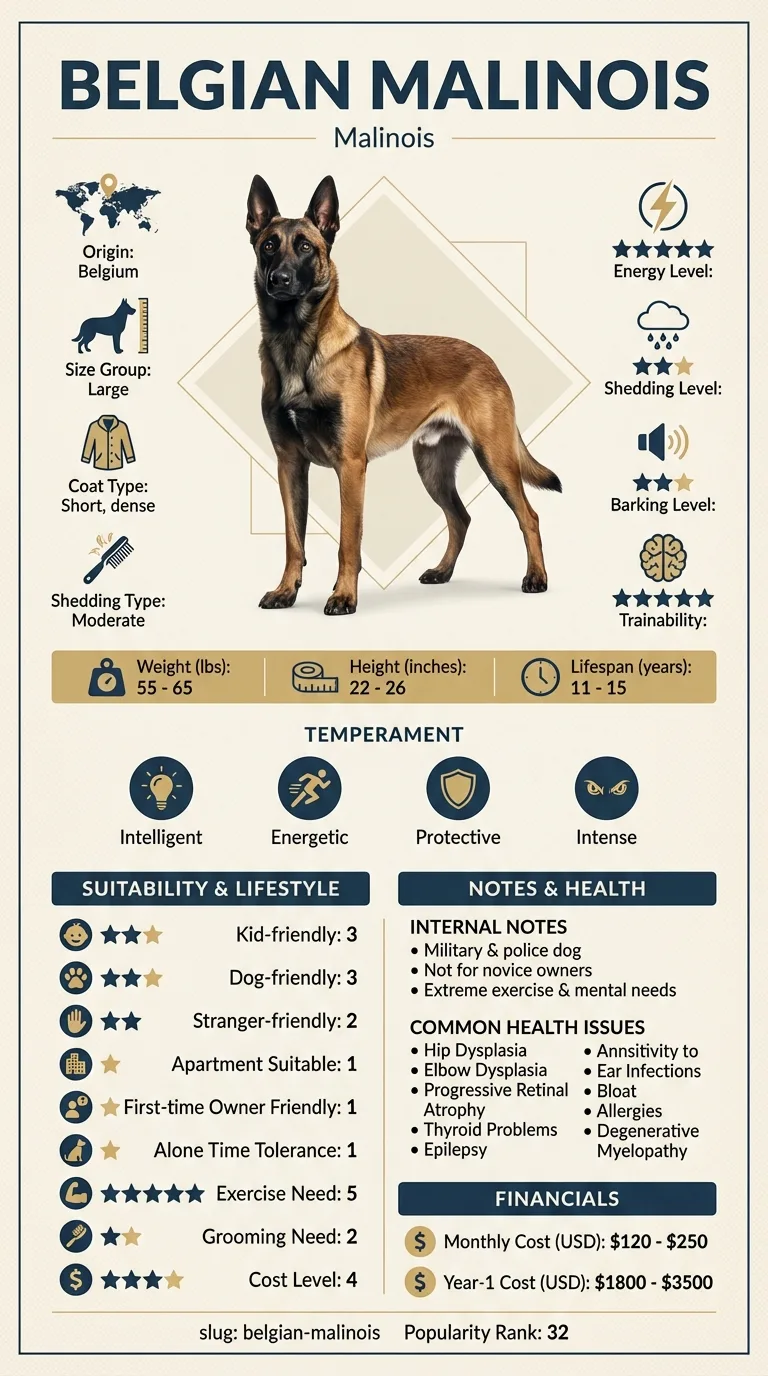
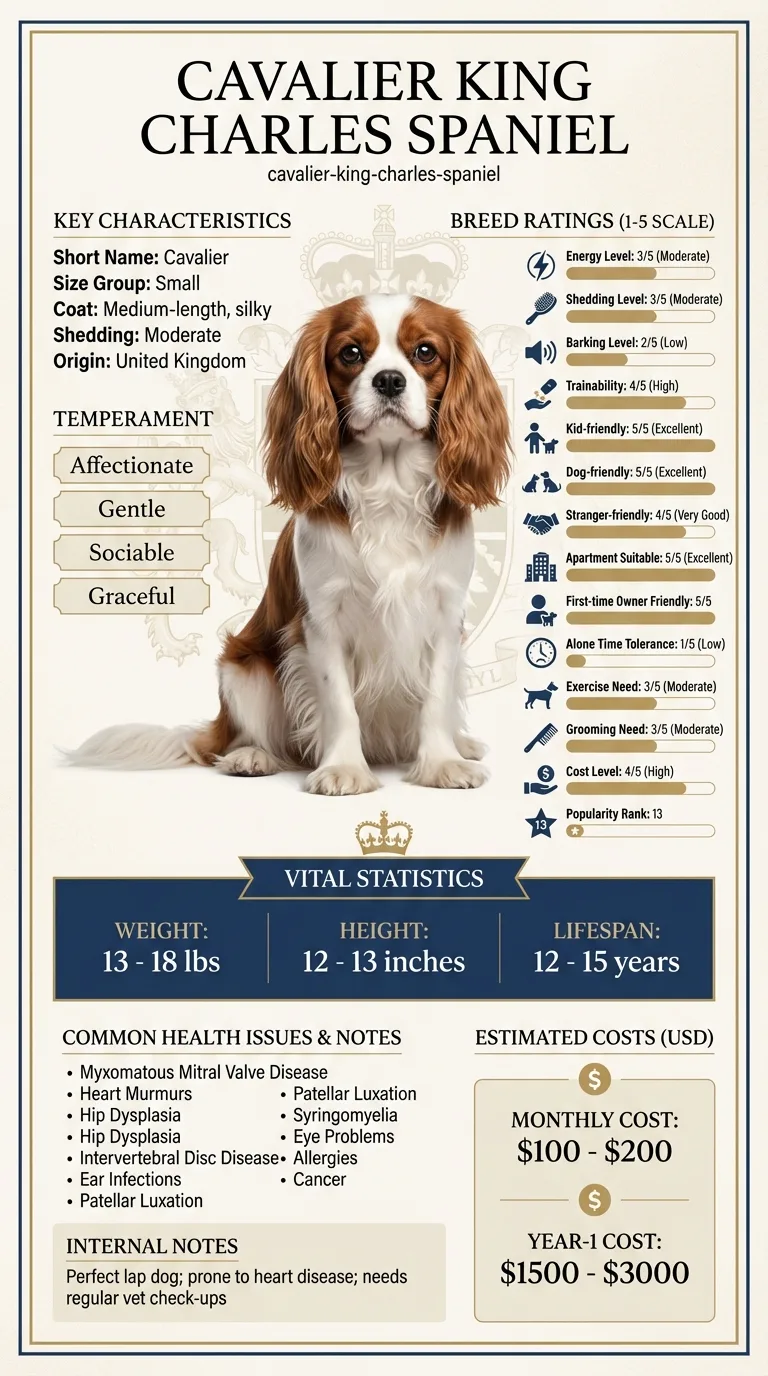
This is for someone already down to Belgian Malinois and Cavalier King Charles Spaniel and deciding between them. For this pair the decision usually turns on apartment suitability and good for first-time owners, so those are covered first and in most detail. Anyone choosing from a flat has a clear answer here: Cavalier King Charles Spaniel rates 5/5 against 1/5. There is no origin story here — only what changes about your week.
Between Belgian Malinois and Cavalier King Charles Spaniel, apartment suitability is what separates them, and Cavalier King Charles Spaniel is the lower-effort dog of the two to keep.
Choose Belgian Malinois if you do not want a standing grooming appointment, you want a dog that picks up training quickly and you want a dog that can keep up with an active routine.
Choose Cavalier King Charles Spaniel if you are in a flat or a smaller home, this is your first dog and your walking routine is modest.
| Feature | belgian malinois | cavalier king charles spaniel | Winner |
|---|---|---|---|
| Size class | large | small | Equal |
| Weight | 55–65 lbs | 13–18 lbs | Equal |
| Height | 22–26 in | 12–13 in | Equal |
| Lifespan | 11–15 years | 12–15 years | cavalier king charles spaniel |
| Exercise need | Very high (5/5) | Moderate (3/5) | cavalier king charles spaniel |
| Grooming need | Low (2/5) | Moderate (3/5) | belgian malinois |
| Shedding | Moderate (3/5) | Moderate (3/5) | Equal |
| Energy level | Very high (5/5) | Moderate (3/5) | Equal |
| Barking | Moderate (3/5) | Low (2/5) | cavalier king charles spaniel |
| Apartment suitability | Very low (1/5) | Very high (5/5) | cavalier king charles spaniel |
| Good for first-time owners | Very low (1/5) | Very high (5/5) | cavalier king charles spaniel |
| Tolerates being alone | Very low (1/5) | Very low (1/5) | Equal |
| Trainability | Very high (5/5) | High (4/5) | belgian malinois |
| Good with kids | Moderate (3/5) | Very high (5/5) | cavalier king charles spaniel |
| Good with other dogs | Moderate (3/5) | Very high (5/5) | cavalier king charles spaniel |
| Friendly to strangers | Low (2/5) | High (4/5) | cavalier king charles spaniel |
| Cost level | High (4/5) | High (4/5) | Equal |
| Coat | Short, dense | Medium-length, silky | Equal |
| Origin | Belgium | United Kingdom | Equal |
| Typical monthly cost | $120–$250 | $100–$200 | Equal |
| Typical first-year cost | $1,800–$3,500 | $1,500–$3,000 | Equal |
At 13 to 18 pounds and 12 to 13 inches tall, a Cavalier King Charles Spaniel could be carried in one arm; a Belgian Malinois, at 55 to 65 pounds and 22 to 26 inches, very much could not. This is one of the more lopsided size comparisons on the site - the Malinois outweighs the Cavalier by roughly four to five times. The Malinois's short, dense coat is built for outdoor work in variable weather, while the Cavalier's medium-length, silky coat is closer to a decorative feature than a functional one, suited to indoor life and gentle grooming rather than field conditions.
Exercise need runs Very High (5/5) for the Malinois against Moderate (3/5) for the Cavalier, and energy level is marked as tied despite that gap, which says something about how differently the two breeds express energy day to day. A Cavalier's Moderate energy shows up as enthusiastic play sessions and affectionate following-around rather than sustained physical exertion; a Malinois's Very High rating means genuine, structured daily work is closer to a requirement than a preference. A Cavalier can be satisfied with a couple of good walks; a Malinois generally cannot, no matter how long those walks run.
Grooming tips toward the Malinois, Low (2/5) against the Cavalier's Moderate (3/5) - that silky medium-length coat needs regular brushing to prevent matting, particularly around the ears, while the Malinois's short coat needs comparatively little. Shedding ties at Moderate (3/5) for both, so neither breed is the non-shedding option some buyers might expect from a smaller companion breed. The Cavalier's ear feathering in particular collects debris and needs checking alongside routine ear-infection prevention, a maintenance step the Malinois's coat structure doesn't really require.
Apartment suitability strongly favors the Cavalier, Very High (5/5) against the Malinois's Very Low (1/5), and barking follows the same direction - Low (2/5) for the Cavalier versus Moderate (3/5) for the Malinois. Tolerance for being alone is the one place these two actually agree, both rating Very Low (1/5): a Cavalier's famously affectionate, people-oriented nature makes solitude genuinely hard on it, just as a working-bred Malinois struggles without company or a job to focus on. Neither breed is a good candidate for long stretches alone, even though one is far better suited to small-space living overall.
Trainability favors the Malinois, Very High (5/5) against the Cavalier's still-solid High (4/5), but first-time-owner suitability flips dramatically: Very Low (1/5) for the Malinois, Very High (5/5) for the Cavalier - the single widest gap on this metric anywhere in this comparison set. A Cavalier's gentle, sociable temperament makes it one of the more forgiving breeds for a novice handler learning the basics of obedience. A Malinois's trainability is real, but it comes bundled with an intensity that requires an owner who already knows how to set structure, not one who's learning alongside the dog.
Good with kids and good with other dogs both rate Very High (5/5) for the Cavalier against Moderate (3/5) for the Malinois, and friendliness to strangers follows suit, High (4/5) versus Low (2/5). The Cavalier's affectionate, sociable, graceful temperament was quite literally bred for companionship in royal households, and it shows in how it handles nearly any social situation. The Malinois's protective, intense nature makes it more discerning by design - useful in a working context, but something a family with a busy, high-traffic household needs to actively manage rather than expect naturally.
Lifespan favors the Cavalier slightly, 12 to 15 years against the Malinois's 11 to 15, but the Cavalier's health list carries a well-documented severity: myxomatous mitral valve disease and heart murmurs are both listed, a heart condition that affects a very large share of the breed by middle age, alongside syringomyelia, a neurological condition tied to the breed's skull shape. The Malinois's ten-item list spreads across joints, thyroid, and nerve function instead, including degenerative myelopathy and epilepsy. Both lists run to ten conditions, but a Cavalier buyer in particular should ask breeders directly about cardiac testing on the parents.
Cost level ties at High (4/5) for both breeds, and the monthly ranges sit reasonably close - $120-$250 for the Malinois against $100-$200 for the Cavalier, with first-year totals of $1,800-$3,500 versus $1,500-$3,000. The Cavalier's cost pressure comes mostly from its health list, particularly ongoing cardiac monitoring for mitral valve disease as it ages; the Malinois's cost pressure comes from food volume, structured training, and its higher overall activity needs. Two very different dogs end up landing in a similar cost bracket for very different reasons.
Belgian Malinois weighs 55–65 lbs and lives 11–15 years; Cavalier King Charles Spaniel weighs 13–18 lbs and lives 12–15 years. The two diverge most on apartment suitability, good for first-time owners and exercise need and 4 other rated axes. They are level on tolerates being alone, cost level and shedding, so those cannot decide it. Where the table declares a winner it means less work for the owner, nothing more; descriptive rows are left as ties on purpose. The value here is in the differences between the two columns; treat any single score as approximate.

Yes - myxomatous mitral valve disease and heart murmurs are both on its health list, a well-known concern for the breed, so cardiac screening of the parents is worth asking a breeder about directly.
Neither - both the Malinois and the Cavalier rate Very Low (1/5) for tolerating solitude, though for different reasons: the Malinois needs a job, the Cavalier needs company.
No - it rates Very Low (1/5) for first-time owners, the lowest score available, against the Cavalier's Very High (5/5).
The Cavalier King Charles Spaniel, rated Moderate (3/5) versus the Malinois's Very High (5/5).
The Cavalier, rated High (4/5) with strangers and Very High (5/5) with other dogs, both ahead of the Malinois's Low (2/5) and Moderate (3/5) respectively.
They're close - High (4/5) cost level for both - with the Malinois running slightly higher monthly ($120-$250 versus $100-$200), though the Cavalier's cardiac care can add up over its lifetime.
The Malinois, rated Very High (5/5) against the Cavalier's High (4/5), though the Cavalier's gentle temperament makes it easier for a beginner specifically.
The Cavalier King Charles Spaniel, at 13-18 lbs versus the Malinois's 55-65 lbs.
The Cavalier, rated Very High (5/5) versus the Malinois's Very Low (1/5).
The Cavalier's list is dominated by a widely-documented heart condition (mitral valve disease); the Malinois's spreads across joints, thyroid, and nerve function.
The Cavalier King Charles Spaniel, rated Very High (5/5) versus the Malinois's Very Low (1/5).
Secure checkout on Stripe. We never see your card.
7-day money-back guarantee. Instant access.
Health information here is general and is not veterinary advice. If your dog shows pain, sudden behaviour change, or worsening symptoms, consult a licensed veterinarian.
Some links on this site are affiliate links. We may earn a commission at no extra cost to you, and we only suggest products we believe are helpful for dog owners.
We research and check what we publish, but we do not warrant that any figure, date, price, or statement is accurate, complete, or current, and we accept no liability for any loss, cost, injury, or other harm arising from the use of this site. Use it as one reference among several. You remain responsible for your own decisions and for your dog's care - confirm anything that matters with a licensed veterinarian or another qualified professional before you act on it. Full disclaimer.
Match your lifestyle to the right dog.
Take quizNot sure which breed is right for you? Take our 2-minute quiz to find out.
Take the quiz