Living
Which is better for apartments?
The Dachshund, rated Very high (5/5) versus the Malinois's Very low (1/5).

Quick answer
Which is better for apartments?
The Dachshund, rated Very high (5/5) versus the Malinois's Very low (1/5).
Belgian Malinois or Dachshund? On paper they differ most on apartment suitability, and on the scales Belgian Malinois is the heavier at 55–65 lbs. Here is how the two compare on everything that shapes an ordinary week.
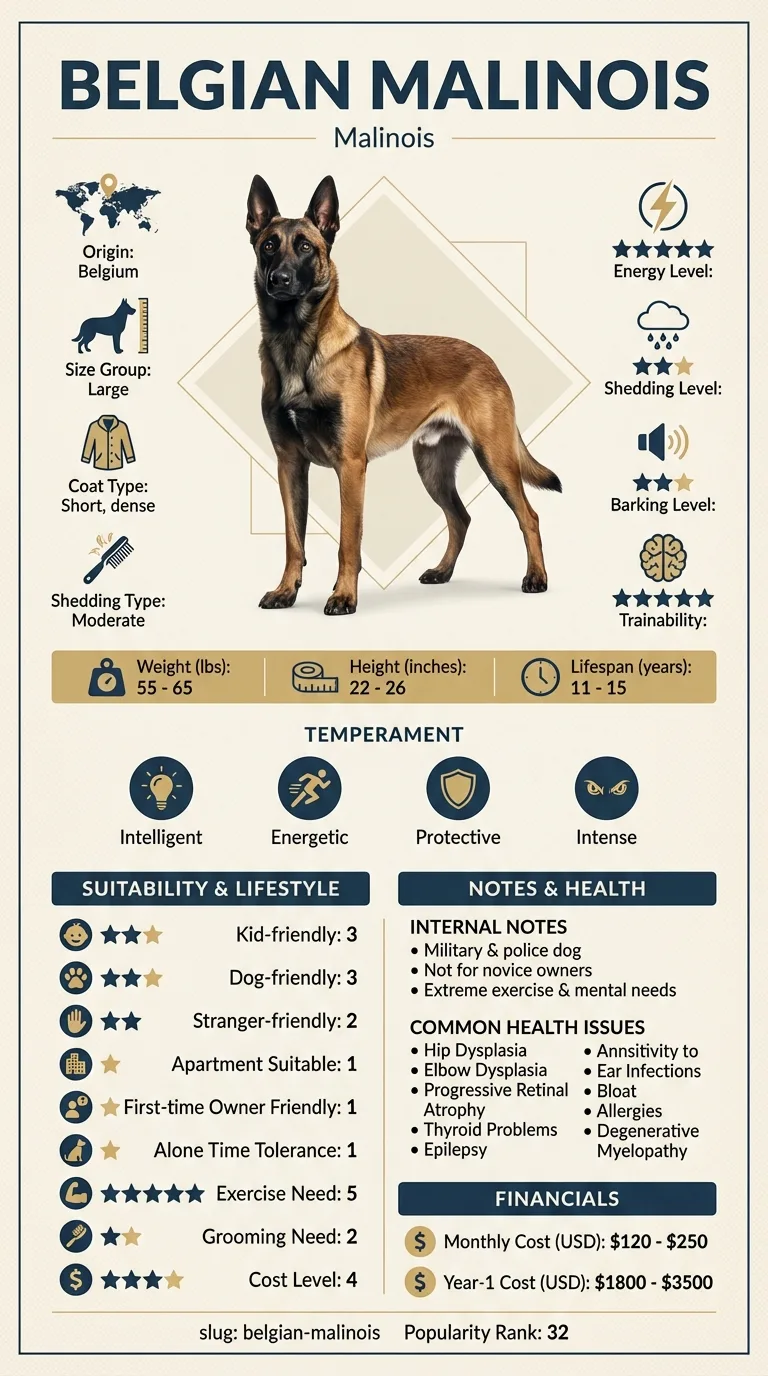
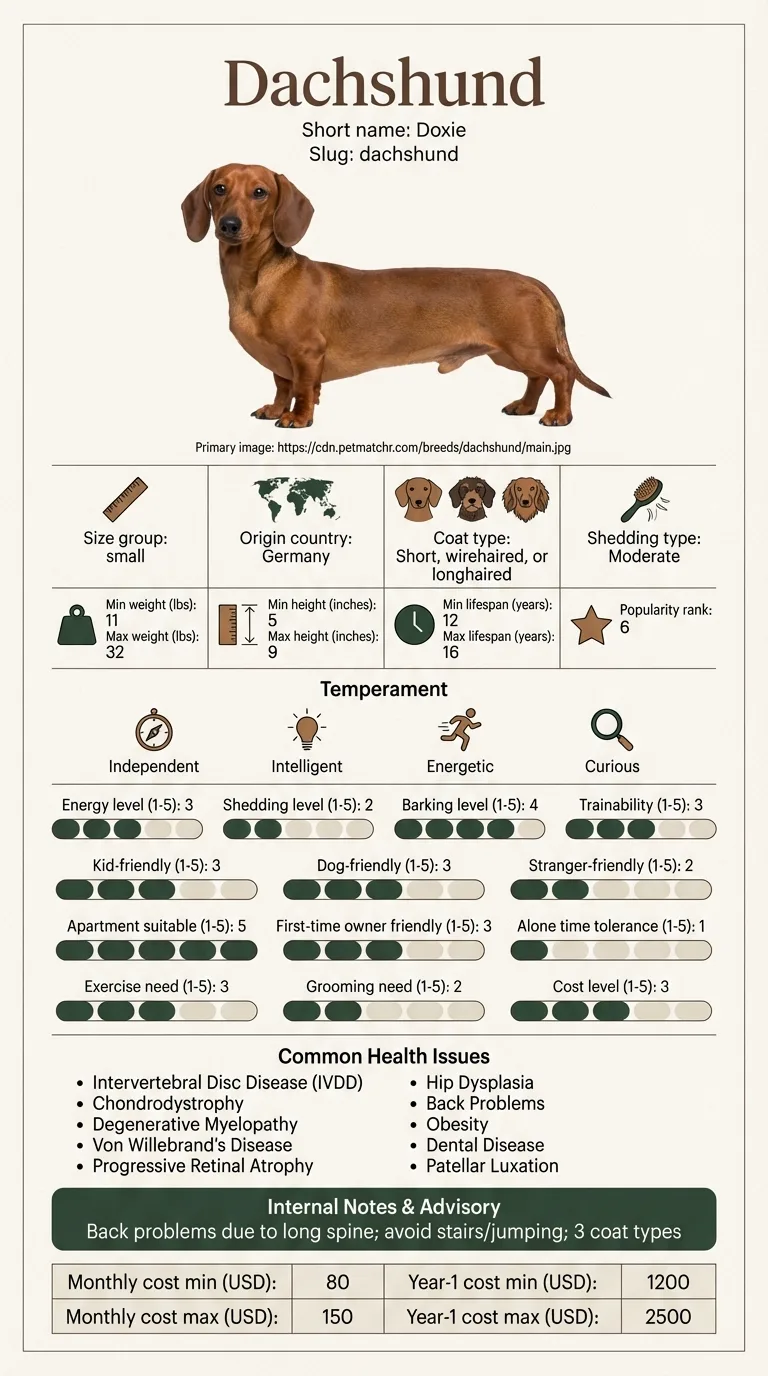
This is for someone already down to Belgian Malinois and Dachshund and deciding between them. For this pair the decision usually turns on apartment suitability and exercise need, so those are covered first and in most detail. Anyone choosing from a flat has a clear answer here: Dachshund rates 5/5 against 1/5. Breed history is left out; what follows is what you will actually live with.
Between Belgian Malinois and Dachshund, apartment suitability is what separates them, and Dachshund is the lower-effort dog of the two to keep.
Choose Belgian Malinois if you want a dog that picks up training quickly and you want a dog that can keep up with an active routine.
Choose Dachshund if you are in a flat or a smaller home, this is your first dog and shedding is a problem in your house.
| Feature | belgian malinois | dachshund | Winner |
|---|---|---|---|
| Size class | large | small | Equal |
| Weight | 55–65 lbs | 11–32 lbs | Equal |
| Height | 22–26 in | 5–9 in | Equal |
| Lifespan | 11–15 years | 12–16 years | dachshund |
| Exercise need | Very high (5/5) | Moderate (3/5) | dachshund |
| Grooming need | Low (2/5) | Low (2/5) | Equal |
| Shedding | Moderate (3/5) | Low (2/5) | dachshund |
| Energy level | Very high (5/5) | Moderate (3/5) | Equal |
| Barking | Moderate (3/5) | High (4/5) | belgian malinois |
| Apartment suitability | Very low (1/5) | Very high (5/5) | dachshund |
| Good for first-time owners | Very low (1/5) | Moderate (3/5) | dachshund |
| Tolerates being alone | Very low (1/5) | Very low (1/5) | Equal |
| Trainability | Very high (5/5) | Moderate (3/5) | belgian malinois |
| Good with kids | Moderate (3/5) | Moderate (3/5) | Equal |
| Good with other dogs | Moderate (3/5) | Moderate (3/5) | Equal |
| Friendly to strangers | Low (2/5) | Low (2/5) | Equal |
| Cost level | High (4/5) | Moderate (3/5) | dachshund |
| Coat | Short, dense | Short, wirehaired, or longhaired | Equal |
| Origin | Belgium | Germany | Equal |
| Typical monthly cost | $120–$250 | $80–$150 | Equal |
| Typical first-year cost | $1,800–$3,500 | $1,200–$2,500 | Equal |
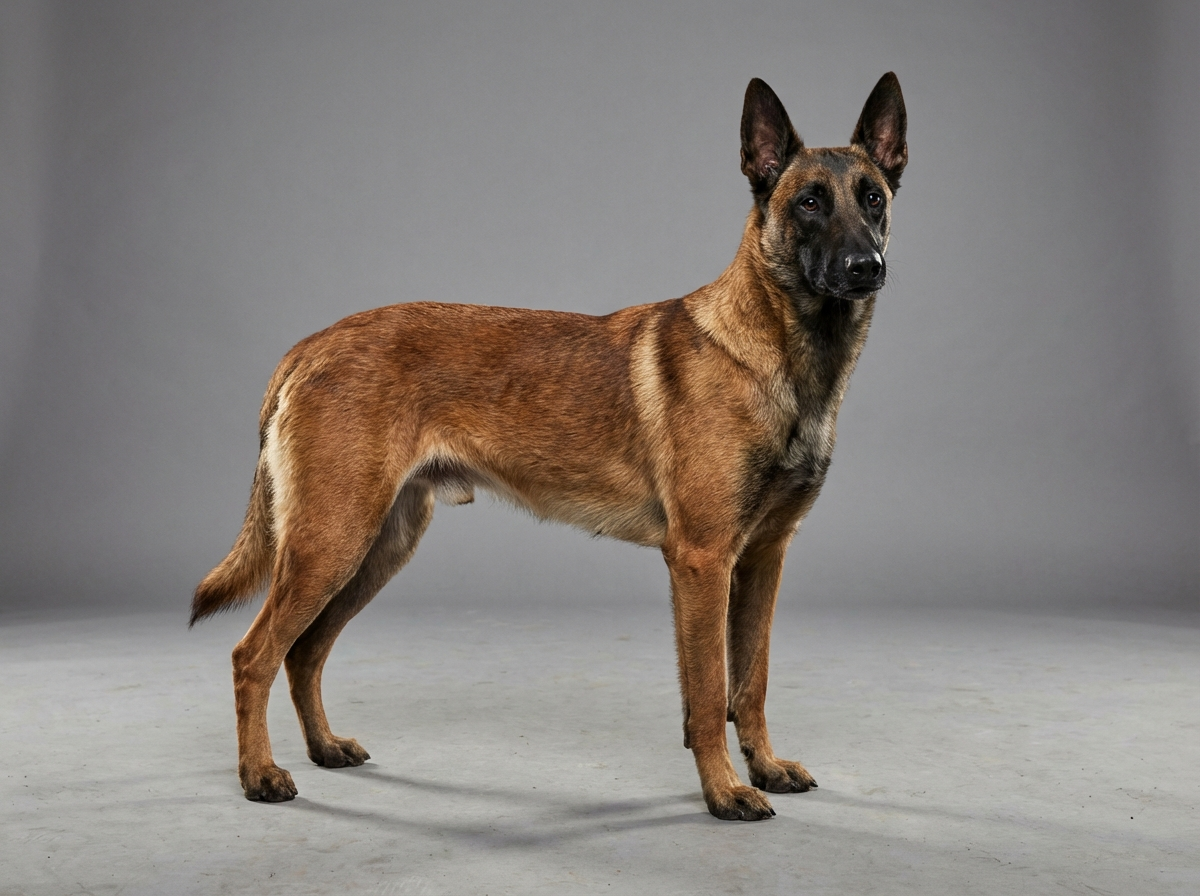
Picture the two side by side: a 55–65 lb Malinois standing 22–26 inches at the shoulder next to an 11–32 lb Dachshund that tops out at just 5–9 inches. This is one of the most extreme size mismatches in any comparison on this site — the Malinois can weigh five times more than a Dachshund and stand more than twice as tall. The Dachshund's long, low, chondrodystrophic build, meaning short legs relative to a long spine, is a completely different structural bet than the Malinois's square, athletic frame, and that spinal shape is directly responsible for some of the Dachshund's most serious health risks, discussed below.
Exercise need favors the Dachshund at Moderate (3/5) against the Malinois's Very high (5/5), though don't mistake that gap for the Dachshund being low-key — its Energetic, Curious temperament means it still wants daily walks and enrichment, just not the structured, high-intensity work a Malinois demands. A bored Dachshund tends to dig or bark rather than destroy furniture the way an under-exercised Malinois might, but both breeds get into trouble without an outlet. The Malinois's Very high energy level was built for sustained working shifts, a bar the Dachshund's shorter legs and different breeding purpose were never meant to clear.
Grooming is a rare tie at Low (2/5) for both breeds, though the reasons differ — the Malinois's short, dense coat is simply low-maintenance, while the Dachshund's coat varies by type, short, wirehaired, or longhaired, and even the higher-maintenance varieties stay manageable at a small dog's scale. Shedding tips slightly toward the Dachshund at Low (2/5) versus the Malinois's Moderate (3/5), so a smooth-coated Dachshund is genuinely one of the tidier options in this comparison. Neither breed demands professional grooming visits the way a longer-coated dog would.
Apartment suitability swings hard toward the Dachshund, Very high (5/5) against the Malinois's Very low (1/5), but the Dachshund's High (4/5) barking rating is worth weighing against the Malinois's more Moderate (3/5) — a small dog with big-dog opinions can be just as disruptive to neighbors as a large one, just in a different register. Tolerating being alone is a tie at Very low (1/5) for both, so despite the Dachshund's apartment-friendly size, it is not a low-maintenance choice for long workdays; its Independent streak doesn't mean independence from separation anxiety.
Trainability clearly favors the Malinois, Very high (5/5) against the Dachshund's Moderate (3/5), and the gap tracks the Dachshund's Independent temperament — a trait that made it effective working alone underground after badgers but makes it more inclined to decide for itself whether a command is worth following. First-time-owner suitability still favors the Dachshund, Moderate (3/5) versus the Malinois's Very low (1/5), because even a stubborn Dachshund is a far more forgiving daily companion than an under-stimulated Malinois with Protective, Intense instincts and nowhere to direct them.
Kids, other dogs, and strangers all land as ties between these two breeds — Moderate (3/5) with kids, Moderate (3/5) with other dogs, and Low (2/5) with strangers for both — which is unusual for this comparison and suggests neither breed is a natural fit for chaotic, high-traffic households without training. The Dachshund's Curious, Independent nature can make it snappish if startled or handled roughly by small children, while the Malinois's Protective drive requires early socialization to avoid wariness around visitors. Both benefit from structured introductions rather than assuming either breed is automatically family-ready.
The Dachshund actually outlives the Malinois on average, 12–16 years versus 11–15, but its low-slung, long-backed build brings a distinct risk profile: Intervertebral Disc Disease (IVDD), Chondrodystrophy, and Back Problems dominate its ten-item list alongside Obesity and Patellar Luxation. The Malinois's risks cluster instead around joints and organs — Hip Dysplasia, Elbow Dysplasia, Bloat, Epilepsy, Thyroid Problems — reflecting its larger, more athletic frame. Both breeds share Progressive Retinal Atrophy and Hip Dysplasia, but Dachshund owners specifically need to manage stairs, jumping, and weight to protect that vulnerable spine.
First-year costs run $1,800–$3,500 for the Malinois against a notably lower $1,200–$2,500 for the Dachshund, with monthly costs following the same pattern at $120–$250 versus $80–$150. Cost level is rated High (4/5) for the Malinois and Moderate (3/5) for the Dachshund, a gap driven mostly by the Malinois's larger food volume and higher training investment. Dachshund owners should still budget for the possibility of IVDD-related veterinary costs, which can be significant if surgery is ever needed, even though day-to-day expenses stay lower than the Malinois's.
Belgian Malinois weighs 55–65 lbs and lives 11–15 years; Dachshund weighs 11–32 lbs and lives 12–16 years. The two diverge most on apartment suitability, exercise need and energy level and 2 other rated axes. They are level on tolerates being alone, good with other dogs and grooming need, so those cannot decide it. The comparison marks an easier option only where one exists. Facts like weight and country of origin are not scored. Both dogs are rated from the same dataset, which is what makes the numbers comparable with each other even though any individual dog sits somewhere inside its breed's range.

Yes — the Dachshund rates Very high (5/5) for apartment suitability against the Malinois's Very low (1/5), though its High (4/5) barking level means it isn't silent.
The Dachshund, whose Independent temperament and Moderate (3/5) trainability reflect its history of working alone underground, compared to the Malinois's Very high (5/5) trainability and closer handler focus.
Their long-backed, short-legged build puts them at real risk for Intervertebral Disc Disease and Back Problems, so minimizing jumping on and off furniture and using ramps is a common recommendation.
Neither — both rate Very low (1/5) for tolerating being alone, so long workdays are a challenge with either breed.
Considerably — a 55–65 lb Malinois can weigh roughly five times as much as an 11–32 lb Dachshund and stands more than double its 5–9 inch height.
The Dachshund, rated Moderate (3/5) for first-time owners versus the Malinois's Very low (1/5), though its stubborn streak still calls for patience.
Not much — both rate Low (2/5) for grooming, though shedding is slightly lower for the Dachshund, Low (2/5), than the Malinois, Moderate (3/5).
The Dachshund, rated Very high (5/5) versus the Malinois's Very low (1/5).
The Dachshund, typically 12–16 years versus 11–15 for the Malinois.
The Malinois, rated Very high (5/5) versus the Dachshund's Moderate (3/5).
The Dachshund, at $1,200–$2,500 versus $1,800–$3,500 for the Malinois.
Secure checkout on Stripe. We never see your card.
7-day money-back guarantee. Instant access.
Health information here is general and is not veterinary advice. If your dog shows pain, sudden behaviour change, or worsening symptoms, consult a licensed veterinarian.
Some links on this site are affiliate links. We may earn a commission at no extra cost to you, and we only suggest products we believe are helpful for dog owners.
We research and check what we publish, but we do not warrant that any figure, date, price, or statement is accurate, complete, or current, and we accept no liability for any loss, cost, injury, or other harm arising from the use of this site. Use it as one reference among several. You remain responsible for your own decisions and for your dog's care - confirm anything that matters with a licensed veterinarian or another qualified professional before you act on it. Full disclaimer.
Match your lifestyle to the right dog.
Take quizNot sure which breed is right for you? Take our 2-minute quiz to find out.
Take the quiz