Training
Malinois or Labradoodle: which should most people pick?
The Labradoodle, unless you specifically want a working-style protection dog and have the experience to handle one; it rates 4/5 for first-time owners against the Malinois's 1/5.

Quick answer
Malinois or Labradoodle: which should most people pick?
The Labradoodle, unless you specifically want a working-style protection dog and have the experience to handle one; it rates 4/5 for first-time owners against the Malinois's 1/5.
Belgian Malinois or Labradoodle? On paper they differ most on good for first-time owners, and on the scales Belgian Malinois is the heavier at 55–65 lbs. Here is how the two compare on everything that shapes an ordinary week.
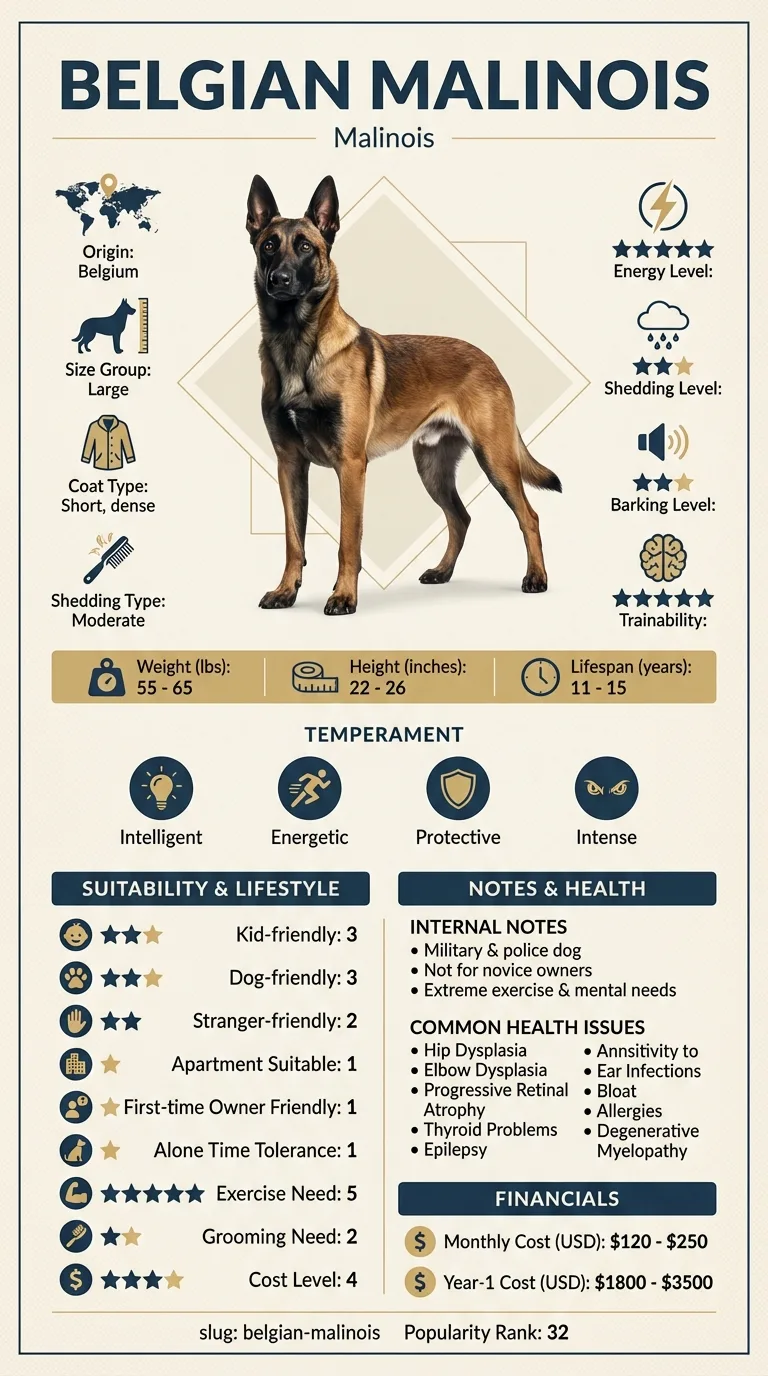
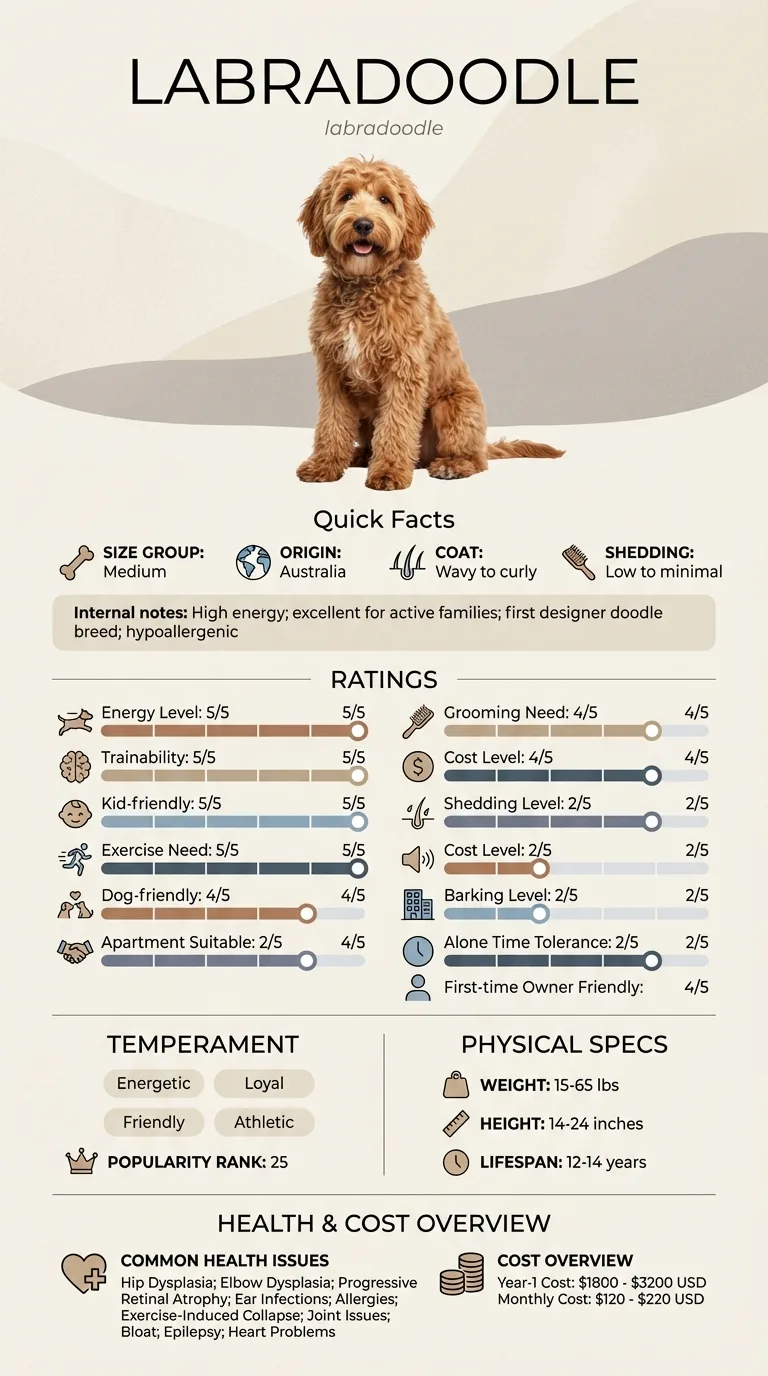
This is for someone already down to Belgian Malinois and Labradoodle and deciding between them. For this pair the decision usually turns on good for first-time owners and grooming need, so those are covered first and in most detail. Anyone choosing from a flat has a clear answer here: Labradoodle rates 2/5 against 1/5. The focus throughout is on daily consequences rather than breed background.
Between Belgian Malinois and Labradoodle, good for first-time owners is what separates them, and Labradoodle is the lower-effort dog of the two to keep.
Choose Belgian Malinois if you do not want a standing grooming appointment and you want a dog that is more watchful with visitors.
Choose Labradoodle if this is your first dog, shedding is a problem in your house and there are young children at home.
| Feature | belgian malinois | labradoodle | Winner |
|---|---|---|---|
| Size class | large | medium | Equal |
| Weight | 55–65 lbs | 15–65 lbs | Equal |
| Height | 22–26 in | 14–24 in | Equal |
| Lifespan | 11–15 years | 12–14 years | Equal |
| Exercise need | Very high (5/5) | Very high (5/5) | Equal |
| Grooming need | Low (2/5) | High (4/5) | belgian malinois |
| Shedding | Moderate (3/5) | Low (2/5) | labradoodle |
| Energy level | Very high (5/5) | Very high (5/5) | Equal |
| Barking | Moderate (3/5) | Low (2/5) | labradoodle |
| Apartment suitability | Very low (1/5) | Low (2/5) | labradoodle |
| Good for first-time owners | Very low (1/5) | High (4/5) | labradoodle |
| Tolerates being alone | Very low (1/5) | Low (2/5) | labradoodle |
| Trainability | Very high (5/5) | Very high (5/5) | Equal |
| Good with kids | Moderate (3/5) | Very high (5/5) | labradoodle |
| Good with other dogs | Moderate (3/5) | High (4/5) | labradoodle |
| Friendly to strangers | Low (2/5) | High (4/5) | labradoodle |
| Cost level | High (4/5) | High (4/5) | Equal |
| Coat | Short, dense | Wavy to curly | Equal |
| Origin | Belgium | Australia | Equal |
| Typical monthly cost | $120–$250 | $120–$220 | Equal |
| Typical first-year cost | $1,800–$3,500 | $1,800–$3,200 | Equal |
Both dogs top out at a 5/5 for exercise need, which is about where the resemblance ends on the size chart. The Malinois is a fixed large breed at 55-65 lbs and 22-26 inches. The Labradoodle's numbers span 15-65 lbs and 14-24 inches because it comes in mini and standard lines, so you're really choosing a range, not one dog. Ask the breeder or rescue which size line you're getting before you commit.
Both score a full 5/5 on exercise and energy, so there's no relaxed option here. Neither breed is satisfied with a yard and a leash walk; both need real daily work, ideally with a job attached. If your household can't deliver an hour-plus of structured activity most days, neither of these two belongs on your shortlist. Running, structured play, or scent and obedience work all count, but passive backyard time alone won't keep either dog settled for long.
Malinois grooming is low (2/5): brush it, done. The Labradoodle flips that around at 4/5, because the wavy-to-curly coat mats without regular brushing and usually needs professional trims. Shedding runs the other way; the Malinois sheds moderately (3/5) with a seasonal blowout, while the Labradoodle's low-shed coat (2/5) is the reason people choose it in the first place.
Neither is a great apartment prospect. The Malinois rates a 1/5 for apartment suitability and the Labradoodle only slightly better at 2/5. Barking runs moderate for the Malinois (3/5) versus low for the Labradoodle (2/5). Both tolerate being alone poorly, 1/5 and 2/5, so plan on a dog walker or daycare if you're out of the house all day.
This is where the two diverge sharply. The Malinois scores a 1/5 for first-time owners; it's a working-line dog bred for protection and detection work that needs a handler who can channel that drive. The Labradoodle scores 4/5 for first-timers despite matching the Malinois's 5/5 trainability, learning just as fast without the intensity. Malinois temperament runs intelligent, energetic, protective, and intense, traits that reward the right handler and punish the wrong one. The Labradoodle's profile, energetic, loyal, friendly, athletic, channels a similar work ethic into a far more forgiving package for someone new to dog ownership.
With kids the Labradoodle rates very high (5/5) against the Malinois's moderate 3/5, and it beats the Malinois with other dogs (4/5 vs 3/5) and strangers (4/5 vs 2/5). A Malinois can live with a family fine, but it tends to bond tightly to one or two people and stays reserved with everyone else, useful for protection work, less so for a house that gets a lot of visitors. These aren't marginal gaps; a two-point spread on three separate measures adds up to a genuinely different day-to-day temperament, not just a stylistic difference.
Lifespans sit close: 11-15 years for the Malinois, 12-14 for the Labradoodle. The two share seven conditions: hip and elbow dysplasia, progressive retinal atrophy, ear infections, allergies, bloat, and epilepsy. The Malinois's list adds thyroid problems, anesthesia sensitivity, and degenerative myelopathy; the Labradoodle's adds exercise-induced collapse, joint issues, and heart problems. That's an unusually high overlap for two breeds this different in background, worth flagging to your vet at intake so both risk profiles get tracked from year one.
Both land in the same high cost bracket (4/5), and the monthly ranges nearly overlap: $120-$250 for the Malinois against $120-$220 for the Labradoodle. First-year costs are close too, up to $3,500 versus $3,200. The extra grooming bills on the Labradoodle side roughly cancel out the Malinois's higher-drive care needs. Neither is a budget breed; if cost were the deciding factor here it wouldn't move the needle much, so look instead at the temperament and grooming gaps covered above.
Belgian Malinois weighs 55–65 lbs and lives 11–15 years; Labradoodle weighs 15–65 lbs and lives 12–14 years. The two diverge most on good for first-time owners, grooming need and good with kids and 1 other rated axes. They are level on cost level, energy level and exercise need, so those cannot decide it. The table below marks a winner only where one breed is genuinely easier for a typical owner; size and origin are facts rather than merits and stay level. Ratings come from one source applied to both breeds, so they are meaningful against each other rather than as absolute scores.

The Malinois is a consistent large dog at 55-65 lbs, while Labradoodle covers a wider range (15-65 lbs) depending on whether you get a mini or standard line. A standard Labradoodle can match the Malinois's size.
Yes, shedding is rated low (2/5) for the Labradoodle versus moderate (3/5) for the Malinois, though the Labradoodle needs far more brushing and trimming (4/5 grooming vs 2/5) to keep that coat from matting.
The Labradoodle is, rated 4/5. The Malinois is not, rated 1/5. The Malinois is a working-line dog that needs an owner who already knows how to manage drive and structure training.
Not comfortably. The Malinois scores 1/5 and the Labradoodle 2/5 for apartment suitability, and both tolerate being left alone poorly.
$120-$250 for a Malinois, $120-$220 for a Labradoodle, close enough that the choice should come down to fit rather than price.
Substantially. Both lists include hip and elbow dysplasia, PRA, ear infections, allergies, bloat, and epilepsy. The Labradoodle adds exercise-induced collapse and heart problems; the Malinois adds thyroid issues and degenerative myelopathy.
The Labradoodle, by a wide margin, 4/5 versus the Malinois's 2/5. The Malinois is bred to be reserved with unfamiliar people, which is intentional in working lines.
The Labradoodle, unless you specifically want a working-style protection dog and have the experience to handle one; it rates 4/5 for first-time owners against the Malinois's 1/5.
Roughly none: $120-$250 for the Malinois vs $120-$220 for the Labradoodle.
Neither needs less; both are rated 5/5 for exercise and energy.
About the same: 11-15 years for the Malinois, 12-14 for the Labradoodle.
Secure checkout on Stripe. We never see your card.
7-day money-back guarantee. Instant access.
Health information here is general and is not veterinary advice. If your dog shows pain, sudden behaviour change, or worsening symptoms, consult a licensed veterinarian.
Some links on this site are affiliate links. We may earn a commission at no extra cost to you, and we only suggest products we believe are helpful for dog owners.
We research and check what we publish, but we do not warrant that any figure, date, price, or statement is accurate, complete, or current, and we accept no liability for any loss, cost, injury, or other harm arising from the use of this site. Use it as one reference among several. You remain responsible for your own decisions and for your dog's care - confirm anything that matters with a licensed veterinarian or another qualified professional before you act on it. Full disclaimer.
Match your lifestyle to the right dog.
Take quizNot sure which breed is right for you? Take our 2-minute quiz to find out.
Take the quiz