Belgian Malinois vs Bernedoodle: Which Suits Your Home?
Quick answer
Belgian Malinois or Bernedoodle — which should you get?
Bernedoodle for nearly every household — it's friendlier, easier to train as a beginner, and better with kids. Malinois only if you're an experienced handler who can give it real daily work.
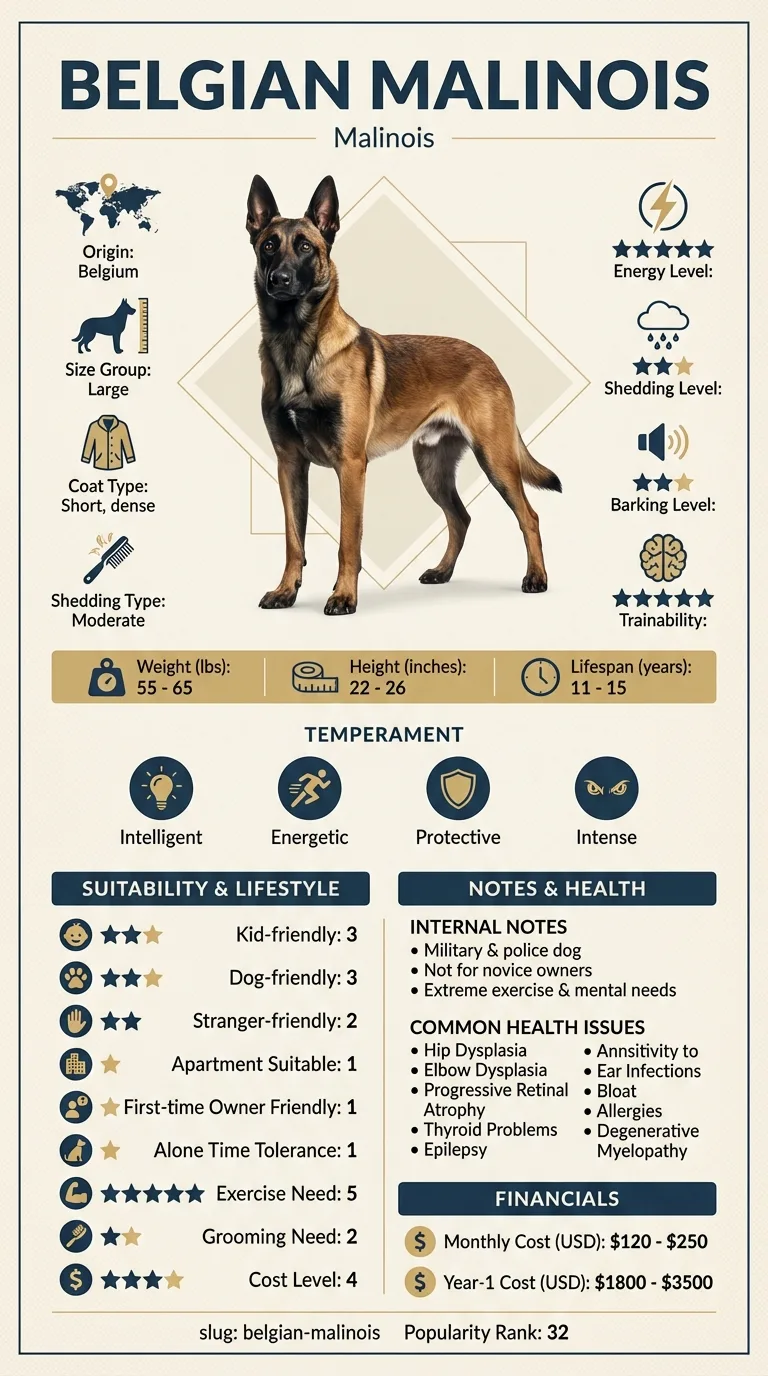
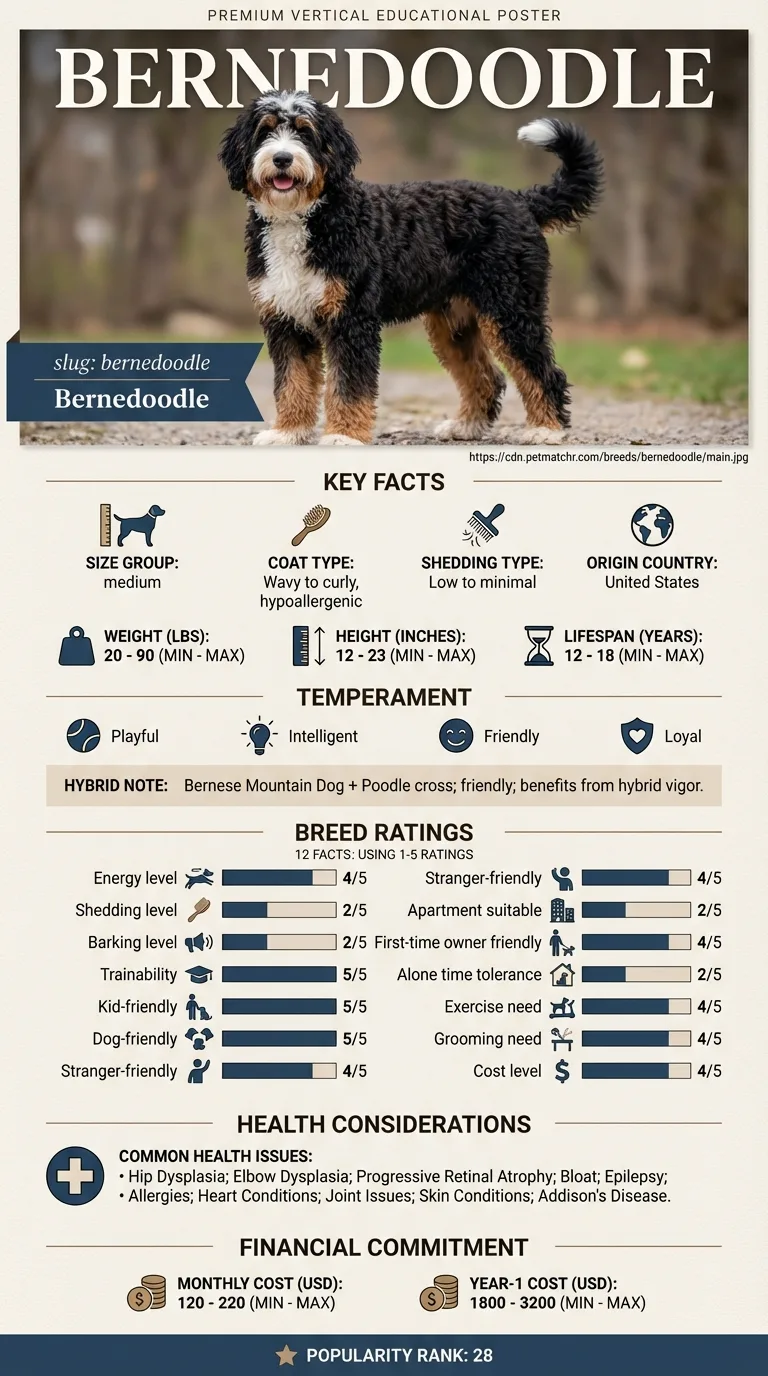
Belgian Malinois or Bernedoodle? On paper they differ most on good for first-time owners, and on the scales Belgian Malinois is the heavier at 55–65 lbs. Here is how the two compare on everything that shapes an ordinary week.
This is for someone already down to Belgian Malinois and Bernedoodle and deciding between them. For this pair the decision usually turns on good for first-time owners and grooming need, so those are covered first and in most detail. Anyone choosing from a flat has a clear answer here: Bernedoodle rates 2/5 against 1/5. There is no origin story here — only what changes about your week.
Quick verdict
Between Belgian Malinois and Bernedoodle, good for first-time owners is what separates them, and Bernedoodle is the lower-effort dog of the two to keep.
Choose belgian malinois if...
Choose Belgian Malinois if you do not want a standing grooming appointment, you want a dog that can keep up with an active routine and you want a dog that is more watchful with visitors.
Choose bernedoodle if...
Choose Bernedoodle if this is your first dog, shedding is a problem in your house and your walking routine is modest.
Head-to-head comparison
Feature
belgian malinois
bernedoodle
Winner
Size class
large
medium
Equal
Weight
55–65 lbs
20–90 lbs
Equal
Height
22–26 in
12–23 in
Equal
Lifespan
11–15 years
12–18 years
bernedoodle
Exercise need
Very high (5/5)
High (4/5)
bernedoodle
Grooming need
Low (2/5)
High (4/5)
belgian malinois
Shedding
Moderate (3/5)
Low (2/5)
bernedoodle
Energy level
Very high (5/5)
High (4/5)
Equal
Barking
Moderate (3/5)
Low (2/5)
bernedoodle
Apartment suitability
Very low (1/5)
Low (2/5)
bernedoodle
Good for first-time owners
Very low (1/5)
High (4/5)
bernedoodle
Tolerates being alone
Very low (1/5)
Low (2/5)
bernedoodle
Trainability
Very high (5/5)
Very high (5/5)
Equal
Good with kids
Moderate (3/5)
Very high (5/5)
bernedoodle
Good with other dogs
Moderate (3/5)
Very high (5/5)
bernedoodle
Friendly to strangers
Low (2/5)
High (4/5)
bernedoodle
Cost level
High (4/5)
High (4/5)
Equal
Coat
Short, dense
Wavy to curly, hypoallergenic
Equal
Origin
Belgium
United States
Equal
Typical monthly cost
$120–$250
$120–$220
Equal
Typical first-year cost
$1,800–$3,500
$1,800–$3,200
Equal
Deep dive
Size and build
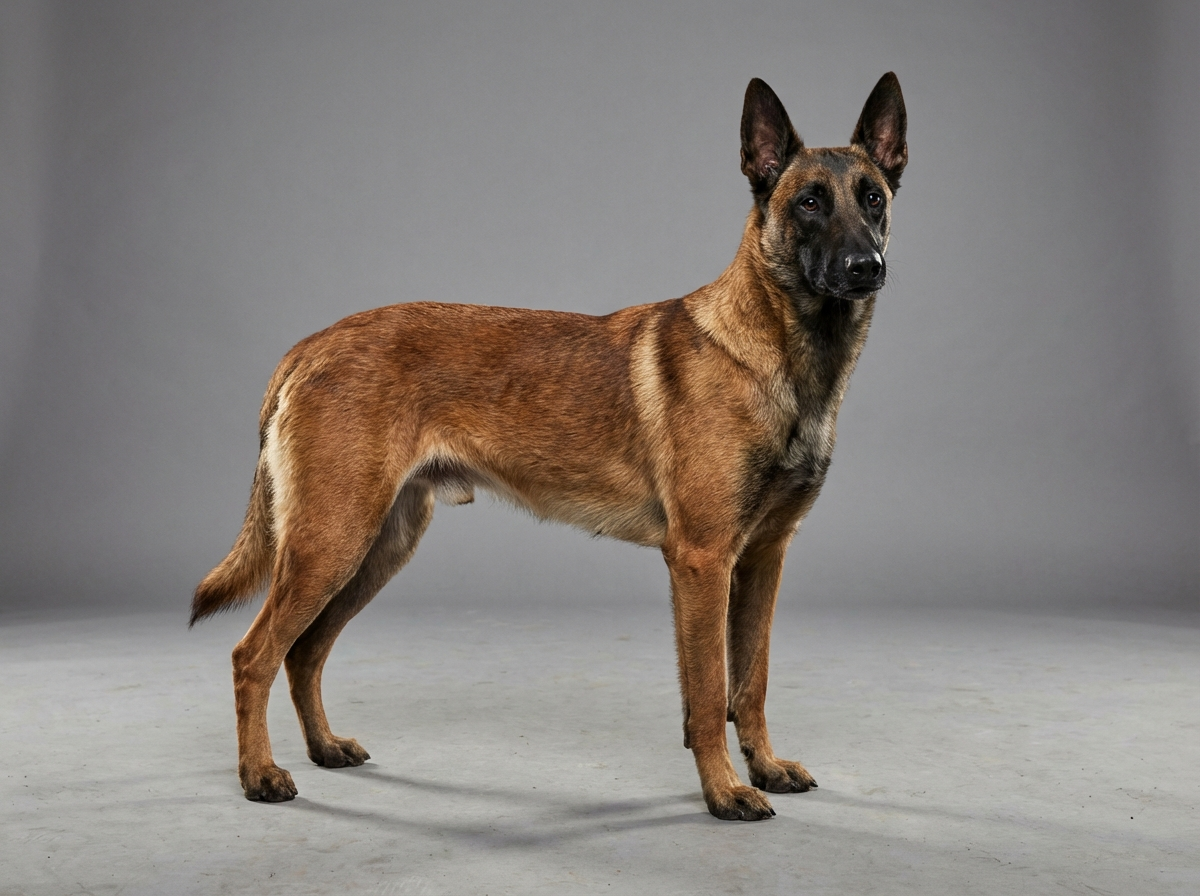
The Belgian Malinois is a tightly built 55-to-65-pound working dog standing 22 to 26 inches — all muscle, no wasted bulk. The Bernedoodle's range is far wider, 20 to 90 pounds and 12 to 23 inches, because it's a cross and comes in mini, medium, and standard sizes depending on the litter. That means a Bernedoodle could end up smaller than the Malinois or considerably heavier — worth confirming with a specific breeder rather than assuming from the breed name alone.
Energy and exercise
The Malinois rates very high (5/5) for exercise need, the top of the scale — this is a dog bred for police and military work, and it will find its own job if you don't give it one. The Bernedoodle is still demanding at high (4/5), but noticeably more livable: a couple of solid walks and some playtime generally cover it, where the Malinois wants structured, often mentally taxing work on top of physical exercise.
Grooming and shedding
Here the advantage flips from what you'd expect. The Malinois has the easier coat to maintain, rating low (2/5) for grooming, while the curlier, hypoallergenic Bernedoodle coat demands high (4/5) grooming — regular brushing and periodic professional trims to avoid matting. The tradeoff is shedding: the Bernedoodle's poodle-influenced coat sheds low (2/5), while the Malinois sheds moderate (3/5) year-round despite needing so little grooming effort.
Apartment living, noise and time alone
Neither breed is a natural apartment dog, but the Bernedoodle is the less-bad option — low (2/5) apartment suitability against the Malinois's very low (1/5), and lower barking too (low versus moderate). The Malinois's very low (1/5) tolerance for being alone is a genuine dealbreaker in a small unit with an empty-during-the-day schedule; the Bernedoodle's low (2/5) tolerance is still weak but more workable with a midday visitor.
Training and owner experience
Both breeds are highly trainable — very high (5/5) for each — but the resemblance ends there. The Malinois rates very low (1/5) for first-time owners; its intensity and drive need an experienced handler who can give it a real job, not just commands. The Bernedoodle rates high (4/5) for beginners, trainable in the same way a smart, people-pleasing dog is trainable without needing a working-dog background to manage it.
Kids, other dogs and visitors
The Bernedoodle wins comfortably on family-friendliness: very high (5/5) with both kids and other dogs versus the Malinois's moderate (3/5) on each, and high (4/5) friendliness to strangers against the Malinois's low (2/5). None of this makes the Malinois a bad dog — it's simply built as a protective, one-family working breed rather than a dog that warms easily to whoever walks through the door, which the Bernedoodle does by temperament.
Health and lifespan
The Bernedoodle edges out a longer life, 12 to 18 years against the Malinois's 11 to 15 — though that upper end depends heavily on which parent-breed genetics dominate, since Bernedoodles are a cross. The two share a striking amount of health overlap for such different breeds: hip and elbow dysplasia, progressive retinal atrophy, bloat, epilepsy, and allergies all appear on both lists, so hybrid vigor hasn't erased these particular risks in the Bernedoodle.
Cost to keep
Cost lands close to even: both rate high (4/5) overall, with the Malinois running $120 to $250 monthly against the Bernedoodle's $120 to $220, and first-year costs of $1,800 to $3,500 versus $1,800 to $3,200. The Bernedoodle's grooming bill is the wildcard — regular professional trims add up in a way that isn't fully captured in these ranges if you're not doing the brushing yourself.
Belgian Malinois vs Bernedoodle at a glance
Belgian Malinois weighs 55–65 lbs and lives 11–15 years; Bernedoodle weighs 20–90 lbs and lives 12–18 years. The two diverge most on good for first-time owners, grooming need and good with kids and 2 other rated axes. They are level on cost level and trainability, so those cannot decide it. Where the table declares a winner it means less work for the owner, nothing more; descriptive rows are left as ties on purpose. The value here is in the differences between the two columns; treat any single score as approximate.
Belgian Malinois vs Bernedoodle: Which Suits Your Home? - Belgian Malinois vs Bernedoodle at a glance
Frequently asked questions
Is a Bernedoodle bigger than a Belgian Malinois?
It depends on the litter — Bernedoodles range from 20 to 90 pounds depending on whether they're mini, medium, or standard, while the Malinois is a consistent 55 to 65 pounds. Confirm parent sizes with the breeder before assuming.
Which sheds less, Malinois or Bernedoodle?
The Bernedoodle, rated low (2/5) versus the Malinois's moderate (3/5), thanks to its poodle-influenced coat. It needs far more grooming to stay mat-free, though — high (4/5) versus the Malinois's low (2/5).
Is a Belgian Malinois a good first dog?
No — it rates very low (1/5) for first-time owners due to its intensity and working drive. The Bernedoodle rates high (4/5) and is a realistic option for a beginner.
Can a Bernedoodle live in an apartment?
Better than a Malinois can, though still not ideally — it rates low (2/5) versus the Malinois's very low (1/5). Both dogs' exercise needs push toward a house with a yard.
Which costs more, Malinois or Bernedoodle?
They're close — both rate high (4/5) overall cost, with the Malinois slightly pricier on the high end of first-year cost ($3,500 versus $3,200). Factor in the Bernedoodle's grooming bills separately.
Do Malinois and Bernedoodles share health risks?
Yes, heavily — hip dysplasia, elbow dysplasia, progressive retinal atrophy, bloat, epilepsy, and allergies appear on both lists, six shared conditions out of ten listed for each.
Which breed is easier around strangers and other dogs?
The Bernedoodle by a wide margin — very high (5/5) with other dogs and high (4/5) with strangers, against the Malinois's moderate (3/5) and low (2/5).
Belgian Malinois or Bernedoodle — which should you get?
Bernedoodle for nearly every household — it's friendlier, easier to train as a beginner, and better with kids. Malinois only if you're an experienced handler who can give it real daily work.
Costs
What's the monthly cost?
Almost identical — $120 to $250 for the Malinois, $120 to $220 for the Bernedoodle.
Living
Which needs more exercise?
The Malinois, rated very high (5/5) versus the Bernedoodle's high (4/5) — it needs structured work, not just physical activity.
Health
Which breed lives longer?
The Bernedoodle, typically 12 to 18 years versus the Malinois's 11 to 15, though the range varies with the individual dog's parentage.
Related DogBreedCompass guides
Belgian Malinois breed guide – Readers comparing the two usually want the full profile of Belgian Malinois before deciding.
Bernedoodle breed guide – The same for Bernedoodle, so the comparison can be checked against the detail.
Belgian Malinois vs German Shorthaired Pointer – German Shorthaired Pointer is the closest breed to Belgian Malinois on the measured axes, so it is the natural next comparison.
Bernedoodle vs Goldendoodle – Goldendoodle sits closest to Bernedoodle, which makes it the alternative worth ruling out.
Health information here is general and is not veterinary advice. If your dog shows pain, sudden behaviour change, or worsening symptoms, consult a licensed veterinarian.
Some links on this site are affiliate links. We may earn a commission at no extra cost to you, and we only suggest products we believe are helpful for dog owners.
We research and check what we publish, but we do not warrant that any figure, date, price, or statement is accurate, complete, or current, and we accept no liability for any loss, cost, injury, or other harm arising from the use of this site. Use it as one reference among several. You remain responsible for your own decisions and for your dog's care - confirm anything that matters with a licensed veterinarian or another qualified professional before you act on it. Full disclaimer.