Behavior
Which needs more exercise?
The Australian Shepherd, rated Very High (5/5) versus the Boston Terrier's Low (2/5).

Quick answer
Which needs more exercise?
The Australian Shepherd, rated Very High (5/5) versus the Boston Terrier's Low (2/5).
Australian Shepherd or Boston Terrier? On paper they differ most on apartment suitability, and on the scales Australian Shepherd is the heavier at 40–65 lbs. Here is how the two compare on everything that shapes an ordinary week.
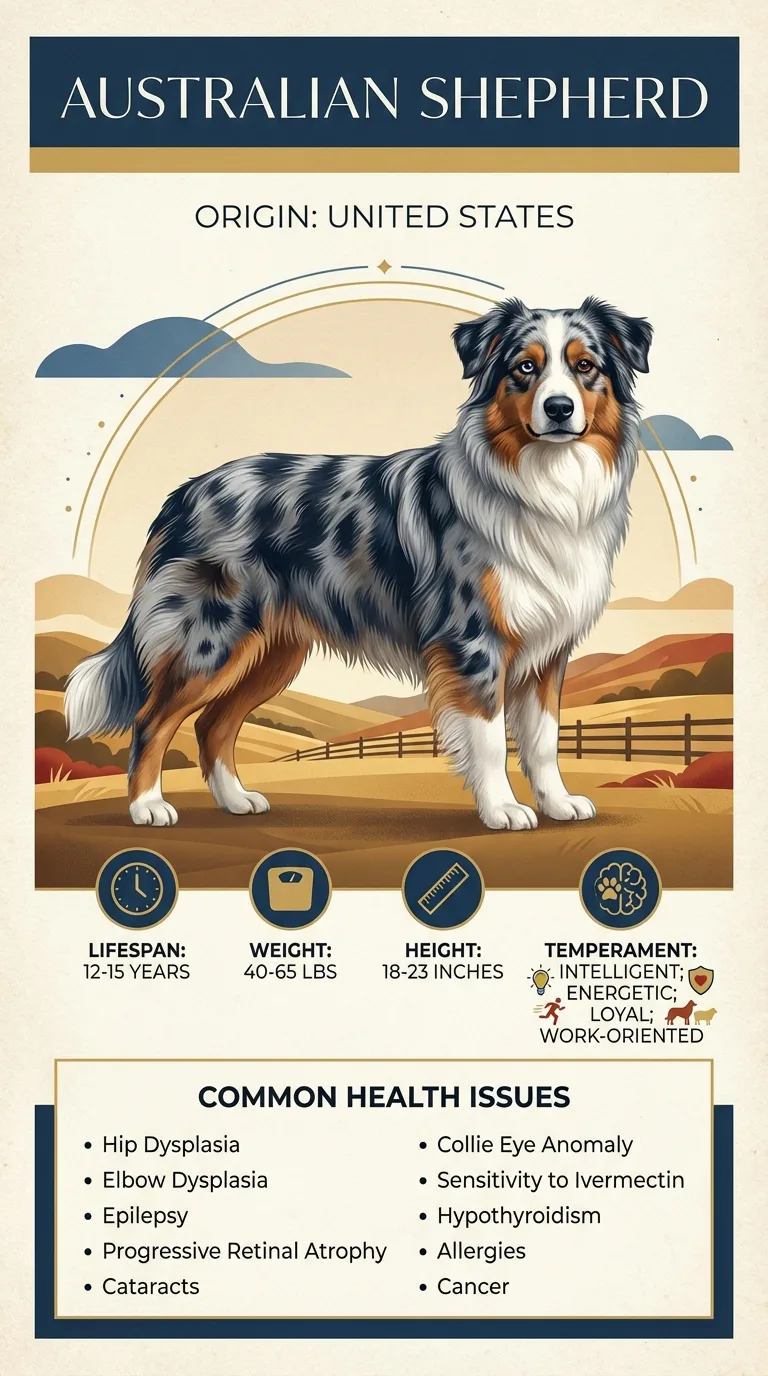
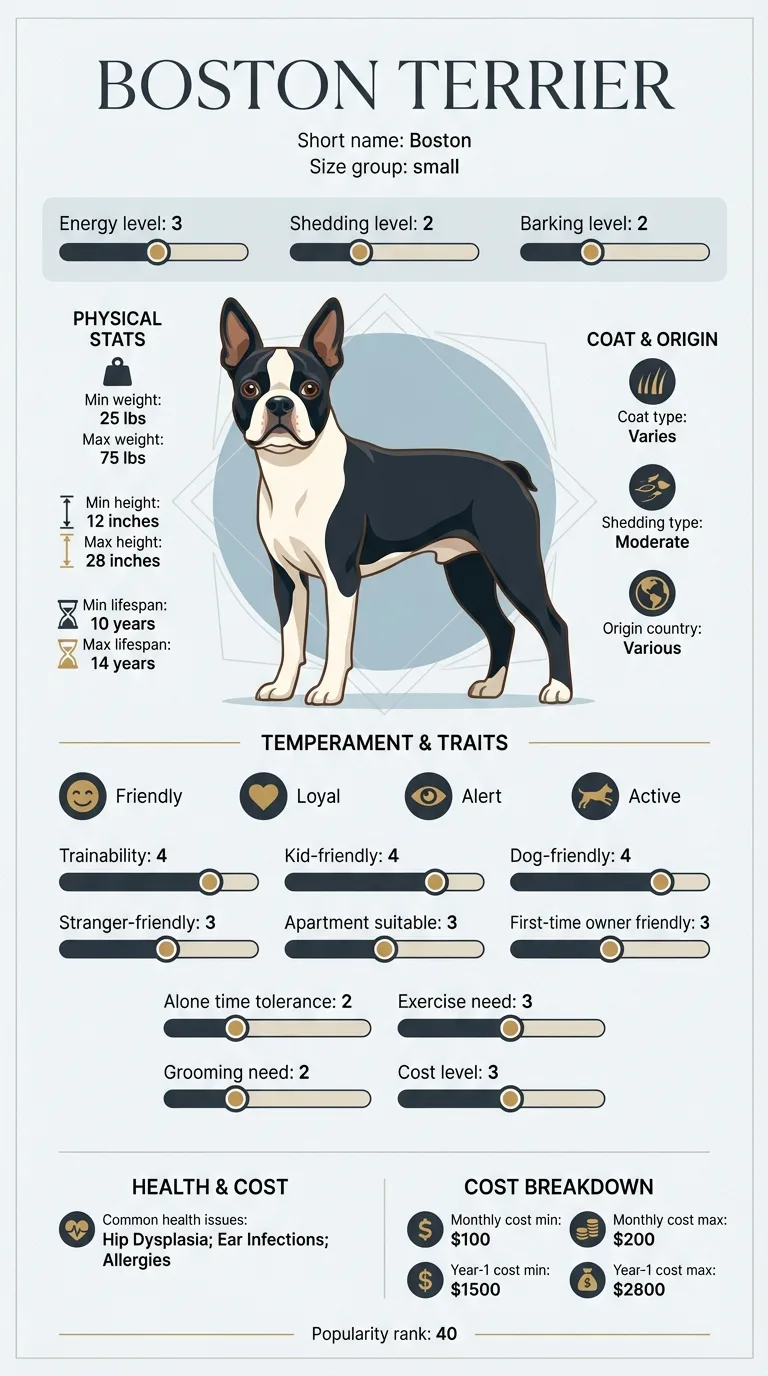
This is for someone already down to Australian Shepherd and Boston Terrier and deciding between them. For this pair the decision usually turns on apartment suitability and exercise need, so those are covered first and in most detail. Anyone choosing from a flat has a clear answer here: Boston Terrier rates 5/5 against 1/5. Breed history is left out; what follows is what you will actually live with.
Between Australian Shepherd and Boston Terrier, apartment suitability is what separates them, and Boston Terrier is the lower-effort dog of the two to keep.
Choose Australian Shepherd if you want a dog that picks up training quickly, you want a dog that can keep up with an active routine and you want a dog that is more watchful with visitors.
Choose Boston Terrier if you are in a flat or a smaller home, this is your first dog and you do not want a standing grooming appointment.
| Feature | australian shepherd | boston terrier | Winner |
|---|---|---|---|
| Size class | medium | small | Equal |
| Weight | 40–65 lbs | 12–25 lbs | Equal |
| Height | 18–23 in | 15–17 in | Equal |
| Lifespan | 12–15 years | 11–13 years | australian shepherd |
| Exercise need | Very high (5/5) | Low (2/5) | boston terrier |
| Grooming need | Moderate (3/5) | Very low (1/5) | boston terrier |
| Shedding | High (4/5) | Low (2/5) | boston terrier |
| Energy level | Very high (5/5) | Moderate (3/5) | Equal |
| Barking | Moderate (3/5) | Low (2/5) | boston terrier |
| Apartment suitability | Very low (1/5) | Very high (5/5) | boston terrier |
| Good for first-time owners | Low (2/5) | Very high (5/5) | boston terrier |
| Tolerates being alone | Low (2/5) | Moderate (3/5) | boston terrier |
| Trainability | Very high (5/5) | High (4/5) | australian shepherd |
| Good with kids | High (4/5) | Very high (5/5) | boston terrier |
| Good with other dogs | High (4/5) | High (4/5) | Equal |
| Friendly to strangers | Low (2/5) | High (4/5) | boston terrier |
| Cost level | Moderate (3/5) | Moderate (3/5) | Equal |
| Coat | Medium-length double coat | Short and smooth | Equal |
| Origin | United States | Various | Equal |
| Typical monthly cost | $100–$200 | $80–$150 | Equal |
| Typical first-year cost | $1,500–$2,800 | $1,100–$2,300 | Equal |
Stand them side by side and the size gap is immediate: an Australian Shepherd at 40 to 65 pounds and 18 to 23 inches at the shoulder next to a Boston Terrier that tops out around 25 pounds and 17 inches. That's roughly two and a half times the weight difference at the upper end, and the Boston Terrier could comfortably fit under an Aussie's chest. The Aussie carries a medium-length double coat built for outdoor work, where the Boston's coat is short and smooth with none of the undercoat bulk. Anyone comparing these two on size alone is really comparing a working ranch dog's frame to a compact companion breed's frame.
Five out of five versus two out of five is the exercise-need gap between these two, and it's the single biggest factor separating them. The Australian Shepherd rates Very High for both exercise need and energy level, a legacy of its herding-dog job description - hours of running, direction changes, and mental tasks are baseline expectations, not bonuses. The Boston Terrier rates Low (2/5) for exercise need and Moderate (3/5) for energy, content with a couple of short walks and some indoor play. An owner who wants a jogging partner or an agility prospect is describing the Aussie; an owner who wants a dog that naps through most of the afternoon is describing the Boston.
Grooming need sits at Moderate (3/5) for the Australian Shepherd against Very Low (1/5) for the Boston Terrier, and shedding follows the same direction - High (4/5) for the Aussie's double coat versus Low (2/5) for the Boston's short, smooth one. That double coat blows seasonally and needs regular brushing to manage loose undercoat; the Boston's coat needs little beyond an occasional wipe. For anyone weighing carpet cleaning and lint rollers into the decision, the Boston is the far easier housemate, though its short coat still offers no protection in genuinely cold weather the way the Aussie's does.
A renter in a studio apartment considering an Australian Shepherd should look hard at its apartment suitability score: Very Low, 1 out of 5, the lowest rating on this whole comparison. The Boston Terrier sits at the opposite extreme, Very High (5/5), reflecting its low exercise need and compact size. Barking tilts toward the Aussie too, Moderate (3/5) against the Boston's Low (2/5), and time alone follows the same pattern - Aussies rate Low (2/5) for tolerating solitude, Bostons Moderate (3/5). Put together, the data points toward the Boston Terrier as the realistic apartment dog of this pair, not the Aussie.
Trainability actually favors the Australian Shepherd here, Very High (5/5) against the Boston Terrier's still-respectable High (4/5) - Aussies were bred to take direction quickly in the field. But suitability for first-time owners flips hard the other way: Low (2/5) for the Aussie versus Very High (5/5) for the Boston. The disconnect makes sense once you separate the two traits: an Aussie learns commands fast but needs an owner who can channel its work-oriented drive into structured activity, while a Boston is forgiving of a less experienced or less athletic household even if it learns somewhat more slowly.
A family with young kids and an established dog already at home gets good news on both fronts from either breed. Good with kids runs High (4/5) for the Aussie and Very High (5/5) for the Boston, and good with other dogs ties at High (4/5) for both. The real divide is strangers: the Aussie rates Low (2/5) for friendliness to visitors, consistent with its wary, work-oriented temperament, while the Boston rates High (4/5) and tends to greet guests as enthusiastically as its own family. A household that hosts often will notice that gap the first time company arrives.
Twelve to fifteen years for the Australian Shepherd against eleven to thirteen for the Boston Terrier gives the Aussie a real lifespan edge, but its health list is also the longer one: hip and elbow dysplasia, epilepsy, progressive retinal atrophy, cataracts, collie eye anomaly, a known sensitivity to ivermectin, hypothyroidism, allergies, and cancer. The Boston Terrier's list is shorter but centers on structural issues tied to its flat face and prominent eyes - brachycephalic airway syndrome, corneal ulcers, patellar luxation, cataracts, and deafness. In short: the Aussie faces a broader spread of inherited conditions, while the Boston's risks cluster around breathing and eye health specifically.
Cost level ties at Moderate (3/5) for both breeds, and the monthly ranges overlap closely: $100-$200 for the Australian Shepherd, $80-$150 for the Boston Terrier. First-year costs show the same modest gap, $1,500-$2,800 against $1,100-$2,300. The Aussie's higher end reflects its exercise needs - dog walkers, larger food portions for a 65-pound dog, and fenced-yard requirements add up - while the Boston's lower end reflects its small size and minimal grooming. Neither breed is expensive relative to the other purebred options in this size range, but the Boston is consistently the cheaper dog to keep month to month.
Australian Shepherd weighs 40–65 lbs and lives 12–15 years; Boston Terrier weighs 12–25 lbs and lives 11–13 years. The two diverge most on apartment suitability, exercise need and good for first-time owners and 4 other rated axes. They are level on cost level and good with other dogs, so those cannot decide it. The comparison marks an easier option only where one exists. Facts like weight and country of origin are not scored. Both dogs are rated from the same dataset, which is what makes the numbers comparable with each other even though any individual dog sits somewhere inside its breed's range.

Likely yes - it rates Very Low (1/5) for apartment suitability, the lowest score in this comparison, largely because its Very High exercise need is hard to meet without yard access or serious daily mileage.
The Boston Terrier, rated High (4/5) versus the Aussie's Low (2/5); Aussies tend to be reserved with unfamiliar people, a trait rooted in their herding-guard heritage.
Their health list includes Brachycephalic Airway Syndrome (BOAS), a structural airway issue common to flat-faced breeds, so heat and heavy exercise both need extra caution.
The Aussie rates higher on trainability (5/5 vs 4/5), but the Boston is rated far more forgiving for first-time owners (5/5 vs 2/5) - training speed and training ease for a novice aren't the same thing here.
Roughly $20-$50 more per month and a few hundred dollars more in the first year, driven mostly by its larger size and higher exercise-related expenses.
The Australian Shepherd, rated High (4/5) for shedding against the Boston Terrier's Low (2/5), thanks to its medium-length double coat.
Yes - rated Very High (5/5), the top score on this table for that trait, edging out the Aussie's still-strong High (4/5).
The Australian Shepherd, rated Very High (5/5) versus the Boston Terrier's Low (2/5).
The Boston Terrier, rated Very High (5/5) for apartment suitability.
The Australian Shepherd, at 12-15 years versus the Boston Terrier's 11-13 years.
The Boston Terrier, rated Very High (5/5) for first-time owners against the Aussie's Low (2/5).
Secure checkout on Stripe. We never see your card.
7-day money-back guarantee. Instant access.
Health information here is general and is not veterinary advice. If your dog shows pain, sudden behaviour change, or worsening symptoms, consult a licensed veterinarian.
Some links on this site are affiliate links. We may earn a commission at no extra cost to you, and we only suggest products we believe are helpful for dog owners.
We research and check what we publish, but we do not warrant that any figure, date, price, or statement is accurate, complete, or current, and we accept no liability for any loss, cost, injury, or other harm arising from the use of this site. Use it as one reference among several. You remain responsible for your own decisions and for your dog's care - confirm anything that matters with a licensed veterinarian or another qualified professional before you act on it. Full disclaimer.
Match your lifestyle to the right dog.
Take quizNot sure which breed is right for you? Take our 2-minute quiz to find out.
Take the quiz