DogBreedCompass

Malamute or Weimaraner: The Only Breed Here With Anxiety on Its Health List

Separation anxiety appears on the Weimaraner's list of common health issues alongside bloat and hip dysplasia. No other breed on this site has a behavioural condition treated as a medical one, and that placement is deserved.

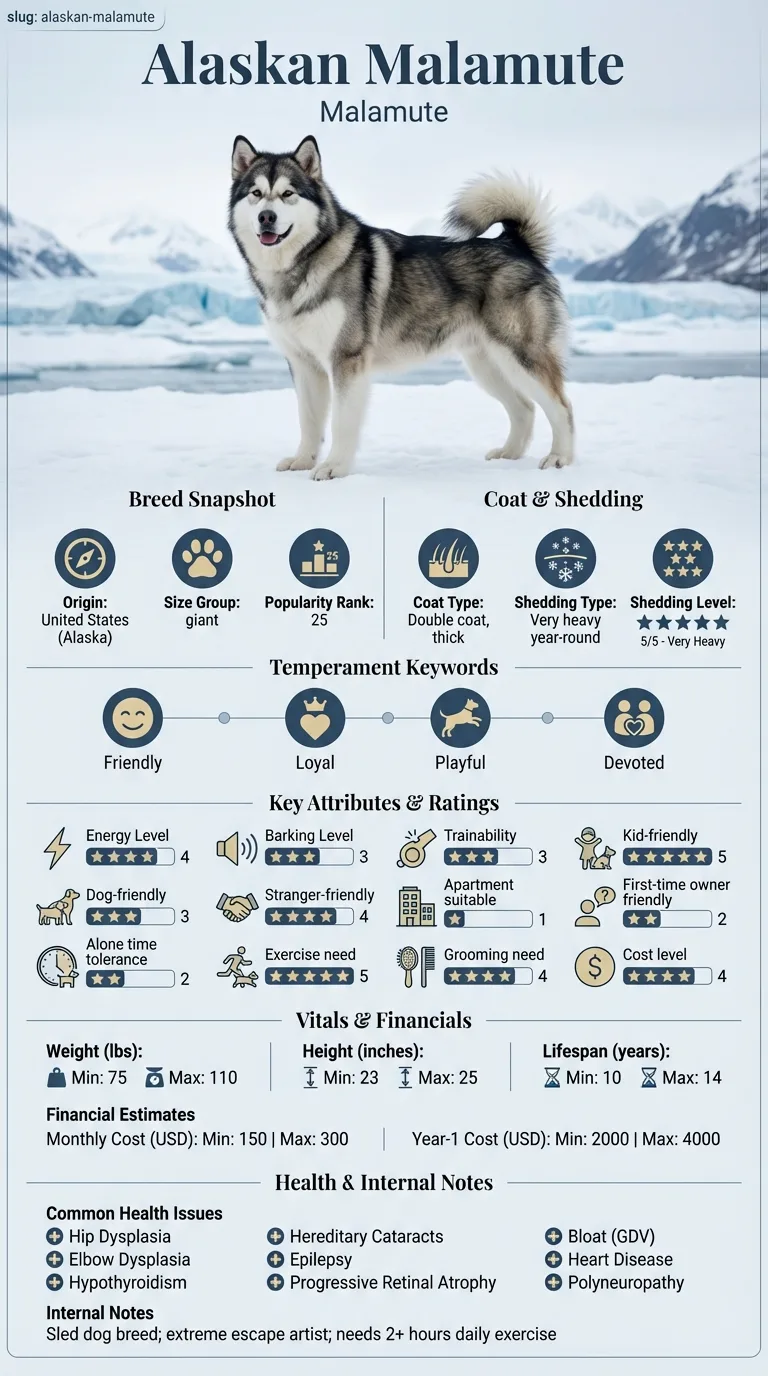
alaskan malamute infographic
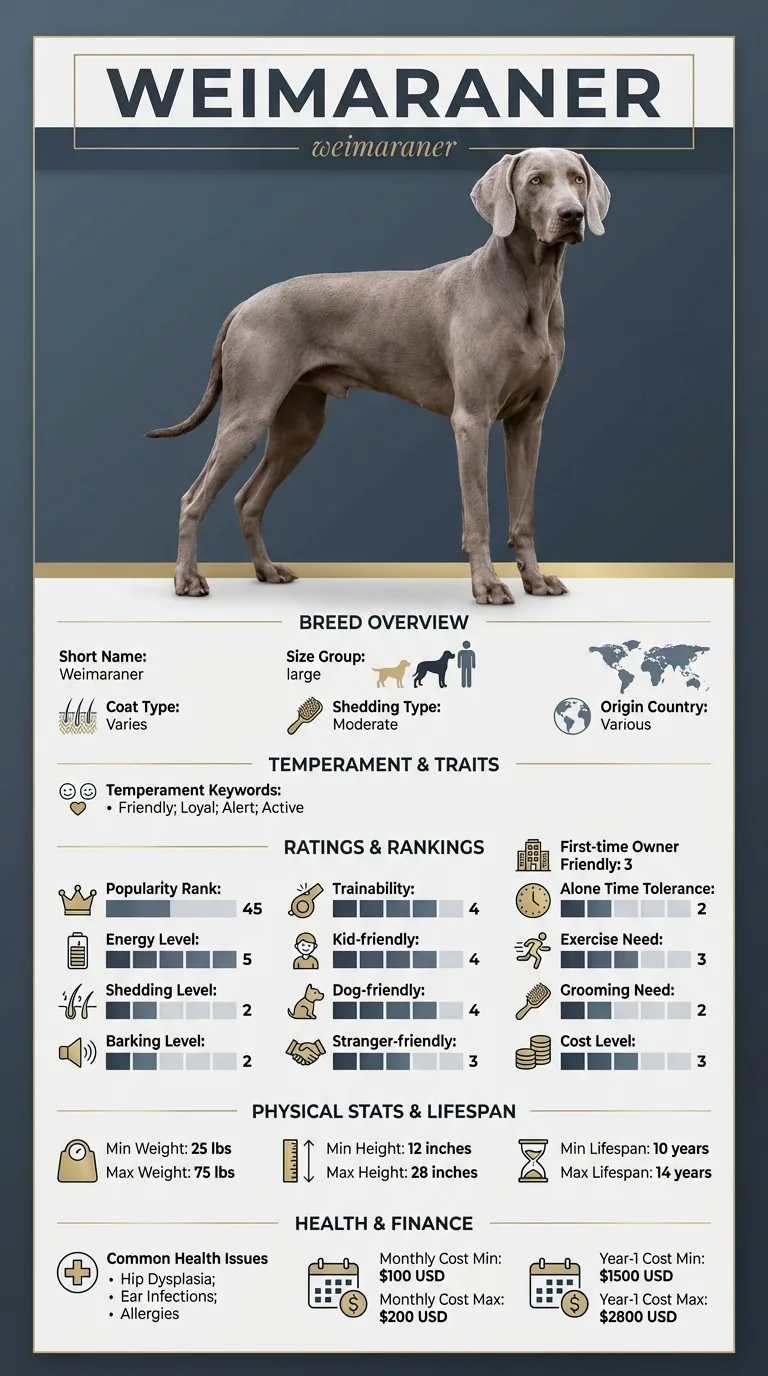
weimaraner infographic

This page is for someone weighing two large, demanding, low-first-timer-rated breeds and deciding which kind of demand fits their household — physical work outdoors, or an animal that needs a person in the building.

Quick verdict

The Weimaraner is cheaper, cleaner, more trainable and just as athletic, and it will struggle badly in a house that empties every morning in a way the Malamute will not.

Choose alaskan malamute if...

Choose the Alaskan Malamute if your household is out during the day, you have cold weather and secure fencing, and you want a large dog that is genuinely affectionate without needing you in the room.

Choose weimaraner if...

Choose the Weimaraner if someone is home most of the time, you want a fast athletic partner for running, hiking or fieldwork in a temperate climate, and you want a coat that takes five minutes a week.

Head-to-head comparison

Featurealaskan malamuteweimaranerWinner
Weight75–110 lbs55–90 lbsEqual
Height23–25 in23–27 inEqual
Lifespan10–14 years10–13 yearsalaskan malamute
CoatThick double coatShort and sleekweimaraner
Grooming need4/51/5weimaraner
Shedding5/5 — very heavy year-round2/5 — low to moderateweimaraner
Energy level4/55/5alaskan malamute
Exercise need5/55/5Equal
Trainability3/54/5weimaraner
Barking3/53/5Equal
Good with kids5/54/5alaskan malamute
Good with other dogs3/53/5Equal
Friendly to strangers4/53/5alaskan malamute
Apartment suitability1/51/5Equal
Good for first-time owners2/52/5Equal
Tolerates being alone2/51/5alaskan malamute
Typical monthly cost$150–300$110–240weimaraner
Typical first-year cost$2,000–4,000$1,700–3,200weimaraner

Deep dive

Separation anxiety listed as a health condition

Most breed health lists name diseases. The Weimaraner's names bloat, hip dysplasia, a bone disorder, a clotting disorder — and separation anxiety. That inclusion is not a categorisation error; it reflects how central the problem is to the breed and how often it is the reason a Weimaraner ends up rehomed.

The origin is the same as with several close-working gundogs. Weimaraners were bred to hunt in constant contact with a handler and were housed indoors with the family rather than in kennels. Selection favoured dogs that stayed close, watched their person and did not range. That is exactly the temperament that struggles with a closed door.

What it looks like in a home is specific and distinguishable from boredom. Destruction concentrated at exit points — door frames, window sills, the inside of a crate — rather than spread through the house. Self-injury from attempts to escape confinement, including broken teeth and torn nails. Continuous vocalising for the whole absence rather than intermittent barking. Refusal to eat while alone. Drooling, pacing and house-soiling in a dog that is otherwise reliable.

The fix is not more exercise, which is the intuitive response and largely ineffective. It is graduated desensitisation to absence, often measured in seconds at first, usually with professional guidance, sometimes with medication as a bridge. It takes months and it works better when started early.

The practical filter is simple: if your house is empty from eight until six with no mid-day break, this is the wrong breed. The Malamute's 2/5 in the same house is a boredom problem — real, destructive, but responsive to exercise, enrichment and a garden it cannot escape.

Hypertrophic osteodystrophy: the puppy condition to recognise

Hypertrophic osteodystrophy sits on the Weimaraner's health list and is one of the few conditions here that is genuinely urgent, genuinely breed-associated, and frequently misread by first-time owners.

It is an inflammatory bone disease of fast-growing large-breed puppies, typically appearing between about two and six months. The growth plates at the ends of the long bones — usually the forelegs, just above the wrist — become inflamed, and the presentation is distinctive: hot, firm, painful swellings just above the joints, a puppy that is reluctant to stand or move, and, critically, a fever. Some puppies are systemically unwell with lethargy and loss of appetite. It can be severe.

The reason it matters to recognise: a lame puppy with a temperature is not a sprain, and it needs veterinary attention promptly. Treatment is supportive — pain relief and anti-inflammatories — and most cases resolve, though relapses within the growth period are common.

The risk factors point toward practical prevention. Over-nutrition and rapid growth are implicated, as is over-supplementation with calcium. That means feeding a large-breed puppy formulation with controlled calcium, resisting the urge to grow the puppy quickly, keeping it lean, and not adding mineral supplements to a complete food. The same regime protects the hips.

Von Willebrand's disease is the other entry worth naming. It is an inherited clotting disorder that usually causes no problem until the dog needs surgery or suffers an injury, and there is a DNA test in the breed. Ask for both parents' status, and make sure any surgeon knows the result before an elective procedure.

Bloat heads the list, and the Weimaraner's deep narrow chest earns it that position. Split meals, quiet time around eating, a slow-feeder bowl if needed, and a known route to an out-of-hours clinic. Prophylactic gastropexy is a legitimate conversation for this breed.

Two 5/5 ratings and two different definitions of a hard day

The exercise requirement matches, and the Weimaraner is a point higher on energy at 5/5 against 4/5.

What satisfies a Weimaraner is speed and scope. It is a fast, ground-covering dog that wants an hour or more of running, ideally off-lead in open country, with scent work, retrieving and directional handling in the mix. It is one of the better distance-running companions among the gundogs, and it takes to agility, tracking and fieldwork readily at 4/5 trainability. Mental work counts for a real share of the total, which gives an owner options in poor weather.

What satisfies a Malamute is load. Two hours minimum with resistance — a weighted pack, a pulling harness, a rig, snow, steep ground. It does not run fast for long, mental work does not register, and there is no indoor version. Heat is its hard limit: the Arctic coat pushes summer exercise to first and last light for months.

The Weimaraner's limit runs the other way. A short sleek coat with negligible undercoat and little body fat means it feels cold quickly, needs a coat for standing about in winter, and picks up scratches working through cover.

Both rate 1/5 for apartments and 2/5 for first-time owners. Both fail badly when under-exercised, and the failure modes differ: the Malamute digs, chews and works on the fence, while the Weimaraner becomes frantic, mouthy and physically unable to settle — a state that then feeds straight into the anxiety problem.

The headstrong keyword in the Weimaraner's temperament is worth noting. It is trainable at 4/5 but opinionated, particularly through an adolescence that runs long, and consistency matters more than firmness.

1/5 grooming against 4/5: five minutes a week or five hours a month

The Weimaraner's coat is one of the lowest-maintenance in existence and the contrast here is about as wide as this site gets.

A short, sleek, close-lying coat with no meaningful undercoat sheds at 2/5. The routine is a rubber curry mitt once a week and a bath when the dog has rolled in something. No matting, no seasonal blow, no undercoat rake, no professional appointment, no equipment. The short grey hairs do work into fabric, so it is not a hair-free dog, but the volume is small and the time cost is close to zero.

What the coat does not do is protect. A thin-coated dog gets scraped in brambles, chills quickly when standing still in winter, and can get sunburn on a pale belly. Drop ears on a dog that swims and works cover mean ear checks are a routine job.

The Malamute's 4/5 grooming and 5/5 shedding is the other extreme: an undercoat rake taken to the skin two or three times a week, ten to fifteen minutes a session, plus two annual blows during which the wool leaves in sheets for a fortnight. Matting behind the ears and in the trousers if the routine slips. And the coat must never be clipped, because it insulates in both directions and often regrows wrong.

Over a decade this is a genuine difference in hours and in the state of the house. It is also a difference in money — the Malamute may need professional de-shedding twice a year and will wear out a vacuum cleaner faster.

On cost overall the Weimaraner is the cheaper dog at $110–240 a month against $150–300, with cost level 3/5 against 4/5 and a first year of $1,700–3,200 against $2,000–4,000.

Family fit and the honest recommendation

The Malamute leads on the two social ratings that matter most in a busy home: 5/5 with children against 4/5, and 4/5 with strangers against 3/5.

The Weimaraner's 4/5 with children is genuine but comes with a physical caveat. This is a fast, powerful, mouthy dog that jumps, leans and carries things, and an adolescent one will knock a small child over without malice. Its 3/5 with strangers is a working dog's mild reserve rather than suspicion — it will announce a visitor and then usually accept them.

With other dogs both rate 3/5, and both have some same-sex friction as adults. The Weimaraner also has a real prey drive from its hunting background, so cats and small pets are a managed situation rather than a safe one — though less absolutely than with the Malamute, whose drive is stronger.

Lifespan is close: 10 to 13 years against 10 to 14.

The honest recommendation comes down to one question, and it is not about exercise, because both breeds ask for more than most people can give. It is about who is home. A Weimaraner in a household with someone present most of the day, in a temperate climate, with an hour of real running available daily, is a superb dog — athletic, clean, affectionate and trainable. The same dog in an empty house is one of the most difficult behavioural cases a first-time owner can encounter.

The Malamute asks for infrastructure instead: a fence it cannot beat, a cold enough climate, and two hours of physical work every day regardless of weather. It does not ask you to be in the room, and for a lot of households that is the more achievable requirement.

Alaskan Malamute vs Weimaraner at a glance

Separation anxiety appears on the Weimaraner's list of common health issues, alongside bloat and hip dysplasia. No other breed on this site has a behavioural condition treated as a medical one, and for the Weimaraner that placement is deserved.

The Weimaraner is cheaper to run than the Malamute, cleaner in the house, more trainable, and just as athletic. What it will not do is cope with a house that empties every morning — where the Malamute can settle into that routine, the Weimaraner struggles badly with it.

Choose the Malamute if your household is out during the day, you have cold weather and secure fencing, and you want a large dog that is genuinely affectionate without needing you in the room. Choose the Weimaraner if someone is home most of the time and you want a fast athletic partner for running, hiking, or fieldwork in a temperate climate.

Frequently asked questions

Why is separation anxiety on the Weimaraner's health list?

Because it is that central to the breed. Weimaraners were bred to work in close contact with a handler and to live indoors with the family, and the resulting temperament copes badly with being left. It is the most common reason the breed is rehomed.

How do I tell separation anxiety from boredom?

Anxiety concentrates on exit points — door frames, window sills, crate doors — often with self-injury, continuous vocalising for the whole absence, refusal to eat alone and house-soiling in a clean dog. Boredom is spread through the house and responds to exercise.

What is hypertrophic osteodystrophy?

An inflammatory bone disease of fast-growing large-breed puppies, usually between two and six months. Look for hot painful swellings just above the wrists, reluctance to move, and a fever. A lame puppy with a temperature needs a vet promptly.

How should I feed a Weimaraner puppy?

A large-breed puppy formulation with controlled calcium, fed to keep the puppy lean rather than to grow it quickly, and no added mineral supplements. Over-nutrition and rapid growth are implicated in both the bone disease and hip dysplasia.

Which is easier to groom?

The Weimaraner overwhelmingly — 1/5 grooming and 2/5 shedding against 4/5 and 5/5. A curry mitt once a week is the entire routine, against an undercoat rake two or three times a week plus two annual blows.

Which needs more exercise?

Both rate 5/5, with the Weimaraner higher on energy at 5/5 against 4/5. The Weimaraner wants a fast hour of running and scent work; the Malamute wants two hours of load-bearing work at a slower pace.

What should I ask a Weimaraner breeder?

Von Willebrand's DNA status on both parents, hip scores, and how the adults in the line cope with being left. That last question is as important as any health test in this breed.

Quick answers

View more answers
Living

Malamute or Weimaraner: which should I choose?

The Weimaraner if someone is home most of the day and you want a fast, clean, trainable athlete for running or fieldwork. The Malamute if the house empties every morning and you want an affectionate dog that copes with being separate.

Costs

Which is cheaper to keep?

The Weimaraner at $110–240 a month against $150–300, and $1,700–3,200 in the first year against $2,000–4,000. Cost level 3/5 against 4/5, with no grooming spend at all.

Health

What is the most urgent health risk?

Bloat, which heads the Weimaraner's list and reflects its deep narrow chest. Split meals, quiet time around eating and a known emergency route matter, and prophylactic gastropexy is worth discussing with a vet.

Behavior

Can a Weimaraner be left alone during a workday?

It rates 1/5 for tolerating solitude, the lowest available. Many develop genuine panic rather than boredom, which needs graduated desensitisation over months rather than more exercise.

Related DogBreedCompass guides

  • Alaskan Malamute breed guideThe Malamute profile covers exercise load, coat raking and the containment the breed requires.
  • Weimaraner breed guideThe Weimaraner profile covers the breed's companionship needs, growth-stage care and exercise demands.
  • common genetic disorders in WeimaranersThe breed's inherited risks are few and specific, and two of them affect puppies rather than adults.
  • bloat in Alaskan MalamutesBloat heads the Weimaraner's list and sits on the Malamute's, so the same precautions apply either way.
  • separation anxiety in Alaskan MalamutesBoth breeds struggle with solitude, and telling anxiety from boredom changes what actually helps.
  • Alaskan Malamute vs VizslaThe other close-working gundog has the same companionship problem and a different health profile.

Related guides

Important reminder

Health information here is general and is not veterinary advice. Growth-stage nutrition, clotting status before surgery and bloat prevention should be discussed with your own veterinarian.

Some links on this site are affiliate links. We may earn a commission if you buy through them, at no additional cost to you.

Find Your Perfect Breed

Match your lifestyle to the right dog.

Take quiz

Find your match

Not sure which breed is right for you? Take our 2-minute quiz to find out.

Take the quiz