DogBreedCompass

Malamute or Goldendoodle: The Rake and the Clipper

Both breeds rate 4/5 for grooming need. One earns it by shedding at 5/5; the other earns it by shedding at 1/5. That single inversion explains most of what follows.

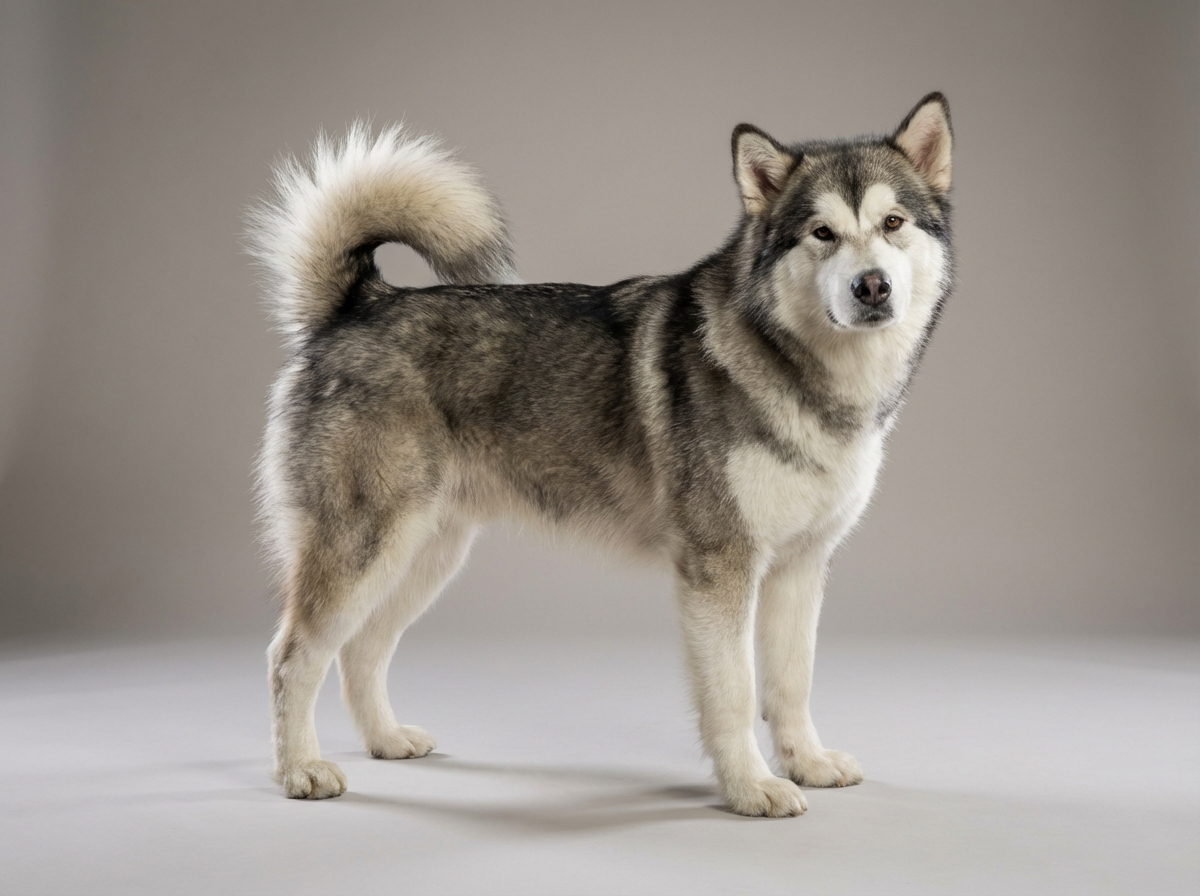
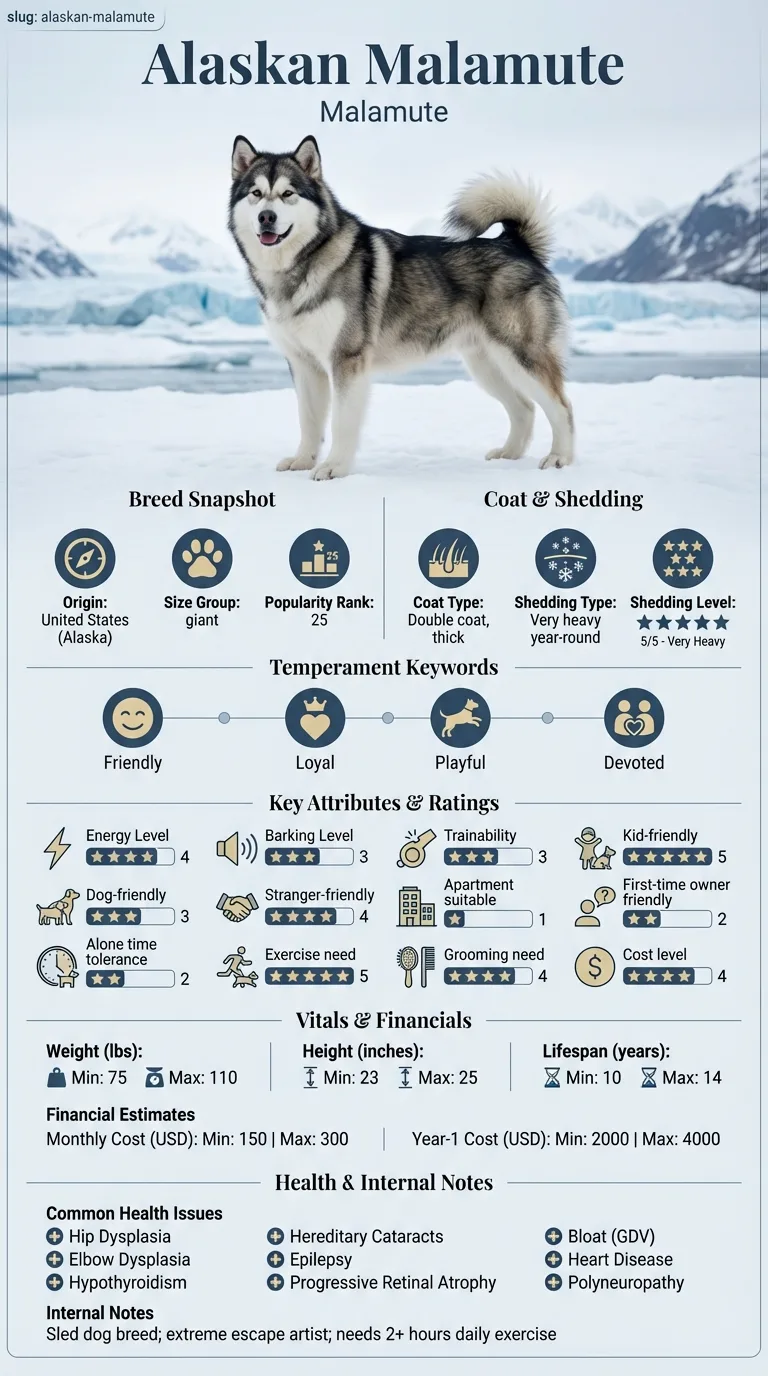
alaskan malamute infographic
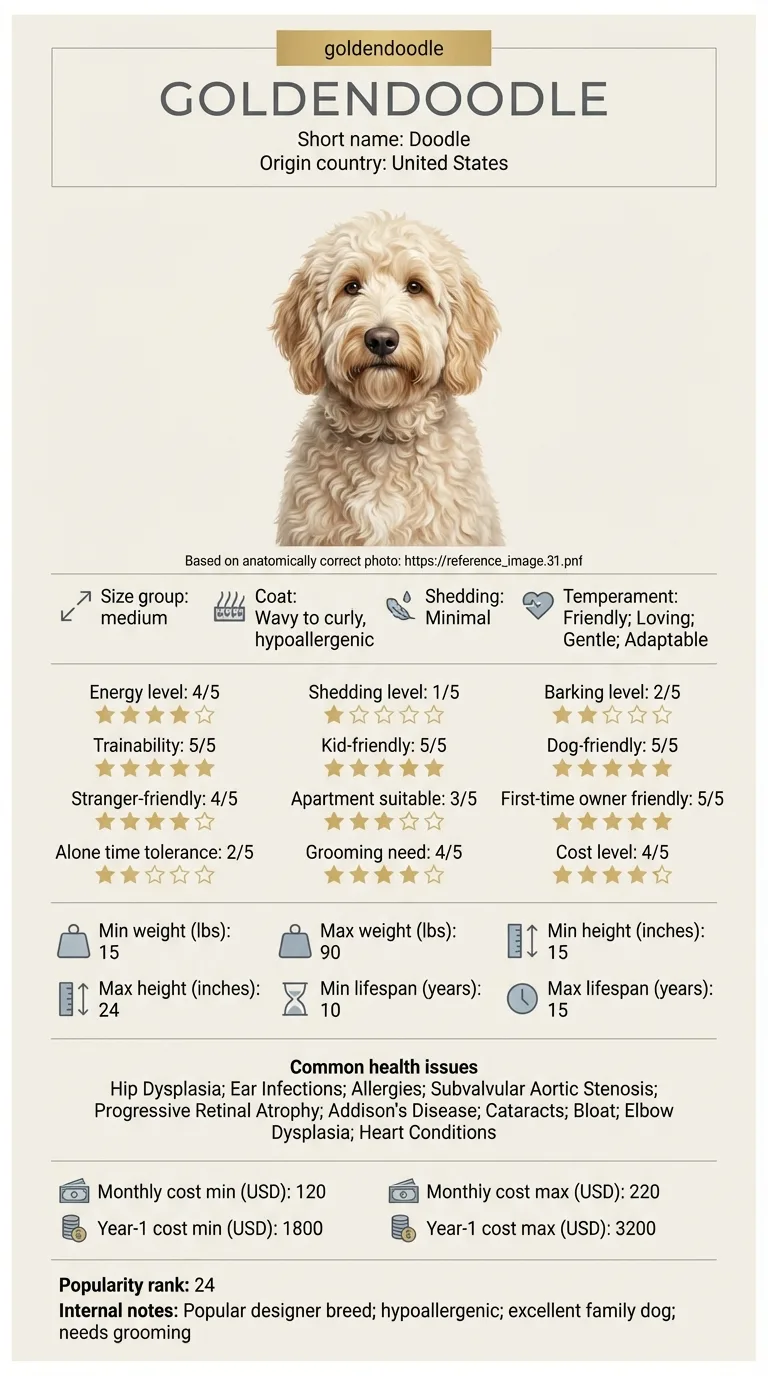
goldendoodle infographic

This page is for someone drawn to a big impressive coat but worried about hair in the house, and for anyone comparing a low-shedding designer cross against a traditional working breed without realising that low-shedding does not mean low-maintenance.

Quick verdict

The Goldendoodle is the easier dog in almost every household category — trainability, first-time suitability, sociability, apartment tolerance and hair on the sofa — but it swaps a vacuum bill for a groomer's bill and its adult size is a genuine unknown.

Choose alaskan malamute if...

Choose the Alaskan Malamute if you want a fixed, predictable working breed with a known adult size and temperament, you have cold weather and load-bearing activity, and you would rather brush at home than book a professional groom every six weeks.

Choose goldendoodle if...

Choose the Goldendoodle if minimal shedding matters, you want a sociable dog that trains at 5/5 and gets on with other dogs at 5/5, and you have both the budget for regular clipping and the patience to research an unregulated crossbreed market.

Head-to-head comparison

Featurealaskan malamutegoldendoodleWinner
Weight75–110 lbs15–90 lbs (varies by size)alaskan malamute
Height23–25 in15–24 inalaskan malamute
Lifespan10–14 years10–15 yearsgoldendoodle
CoatThick double coatWavy to curly, low-shedEqual
Grooming need4/54/5Equal
Shedding5/5 — very heavy year-round1/5 — minimalgoldendoodle
Energy level4/54/5Equal
Exercise need5/54/5goldendoodle
Trainability3/55/5goldendoodle
Barking3/52/5goldendoodle
Good with kids5/55/5Equal
Good with other dogs3/55/5goldendoodle
Friendly to strangers4/54/5Equal
Apartment suitability1/53/5goldendoodle
Good for first-time owners2/55/5goldendoodle
Tolerates being alone2/52/5Equal
Typical monthly cost$150–300$120–220goldendoodle
Typical first-year cost$2,000–4,000$1,800–3,200goldendoodle

Deep dive

Same 4/5 rating, opposite jobs — and only one of them is free

This is the most instructive tie on the site, because two dogs arrive at an identical grooming score from opposite directions and the household consequences are nothing alike.

The Malamute's 4/5 is a shedding management job. Rated 5/5 and described as very heavy year-round, the coat needs an undercoat rake worked down to the skin two or three times a week, ten to fifteen minutes a session, rising sharply during the two annual coat blows when the wool comes away in sheets for a fortnight. All of it can be done at home with about forty dollars of equipment. The recurring cost is a vacuum cleaner, replaced more often than most households expect, and possibly a professional de-shed twice a year if you would rather not do the blows yourself. The coat must never be shaved.

The Goldendoodle's 4/5 is a matting prevention job, and it is the one people are unprepared for. A shedding rating of 1/5 does not mean the dog produces no dead hair — it means the dead hair stays in the coat instead of falling out. That hair twists into the live coat and forms a dense felted layer close to the skin, and it does so fastest in exactly the places that are hardest to see: behind the ears, in the armpits, along the collar line, at the base of the tail, between the back legs. Prevention is line-brushing, which means parting the coat and brushing from the skin outwards, section by section, most days. Not a brush over the top — that only tidies the surface while the pelt forms underneath.

On top of that sits a professional groom every six to eight weeks for a full body clip, feet, face and sanitary trim. In most regions that is one of the larger recurring costs of Goldendoodle ownership, and a coat that has already pelted cannot be brushed out humanely — the groomer will shave it short and the owner will not be happy. Coat type varies within the cross: a flat or wavy coat is manageable, a tight curly coat is a serious commitment, and the puppy coat that changes at around ten months is when many owners discover which one they bought.

A fixed breed against a designed cross: what you can actually know in advance

The Malamute has been what it is for a very long time. Buy a Malamute puppy from a decent breeder and you can predict the adult with real confidence: 75 to 110 pounds, thick double coat, two or more hours of daily exercise, a determined escape artist, warm with people, indifferent to instructions it does not fancy. Almost nothing about the adult dog will surprise you.

The Goldendoodle's recorded range is 15 to 90 pounds and 15 to 24 inches. That is not a rating quirk — it reflects a cross that can be built on a Toy, Miniature or Standard Poodle and can be a first generation, a backcross, or a multigenerational dog several removes from either parent breed. Each of those produces different adult sizes, different coat types and different shedding outcomes, and the market that produces them is unregulated. Two Goldendoodle puppies from different litters can be as unalike as two different breeds.

This is a research problem, not a reason to avoid the cross. The questions that actually reduce the uncertainty are specific: which generation is the litter, what did each parent weigh, what coat type does each parent have, and were both parents health-tested to the standard of their own breed — hips, elbows, eyes, and for the Poodle side progressive retinal atrophy and von Willebrand's. A breeder who cannot answer the generation question is not a breeder you can predict a dog from.

The practical framing: with the Malamute you are choosing a known set of demands and deciding whether you can meet them. With the Goldendoodle you are choosing a range of possible dogs and doing the work to narrow it.

Sociability, training and the household test

The Goldendoodle wins on nearly every household rating, and the margins are large. Trainability 5/5 against 3/5. First-time owner friendliness 5/5 against 2/5. Other dogs 5/5 against 3/5. Apartment suitability 3/5 against 1/5. Barking 2/5 against 3/5.

Those numbers make sense from the parentage. Both the Golden Retriever and the Poodle are among the most trainable breeds there are, and both are strongly handler-oriented. The cross produces a dog that offers behaviour, stays close, reads a training session eagerly and forgives beginner mistakes. A 5/5 with other dogs is unusually high and reflects a genuinely uncomplicated social temperament — daycare, group walks and multi-dog homes tend to go smoothly.

The Malamute's numbers are not a criticism of its character. It is 5/5 with children and 4/5 with strangers, and its keywords are friendly, loyal, playful and devoted. It is warm. It is simply independent: a freighting breed selected to keep working without checking in with a handler, which shows up as a 3/5 trainability and a recall most owners never fully trust. Its 3/5 with other dogs concentrates in same-sex adult pairings.

The one rating they share is the one that catches both sets of owners out: 2/5 for tolerating time alone. The Goldendoodle's easiness in every other category leads people to assume it will cope with a full working day, and it frequently does not — separation distress is one of the most common complaints in the cross, inherited honestly from two intensely people-oriented parent breeds. Neither of these dogs is a good match for an empty house.

5/5 against 4/5, and what actually satisfies each dog

The Malamute is the more demanding animal by one rating point and by a much wider practical margin. Its breed notes specify two or more hours daily, and the activity has to involve resistance to count — a loaded pack, a pulling harness, a rig or scooter, steep ground, snow. An hour of flat lead-walking leaves a Malamute unspent. There is no indoor substitute and no bad-weather version, and in a warm climate the whole routine shifts to dawn and dusk for several months because the Arctic coat sets a hard thermal ceiling.

The Goldendoodle at 4/5 wants around an hour, and crucially it can be satisfied in more than one way. Retrieving games, scent work, training sessions, agility, swimming and puzzle work all count, because both parent breeds respond to mental work as genuine exercise. On a bad day you can tire a Goldendoodle in the living room with fifteen minutes of nose work. You cannot do that with a Malamute, on any day.

Size is a variable here too. A Standard-based Goldendoodle at 60 pounds needs more than a Miniature-based one at 25, and the 4/5 rating sits somewhere in the middle of that range. Ask what the parents weighed and scale your expectations accordingly.

For the Malamute the exercise requirement is also the containment requirement: a dog that is genuinely tired is a dog less interested in the fence. Under-exercised Malamutes dig, climb and test gates, and the breed's own notes flag it as an extreme escape artist. Under-exercised Goldendoodles chew, pace and bark — noisier, cheaper to fix, and much less likely to end with the dog three streets away.

Health lists and where the money actually goes

Monthly costs land close: $120–220 for the Goldendoodle against $150–300 for the Malamute, with both at cost level 4/5 and first-year totals of $1,800–3,200 against $2,000–4,000. The composition differs sharply. The Malamute's spend is food volume and weight-based dosing. The Goldendoodle's is grooming — a full groom every six to eight weeks over a twelve to fifteen year life is a substantial figure that rarely appears in anyone's initial budget.

The shared health entries are hip dysplasia, elbow dysplasia, bloat and cataracts. Both breeds are worth feeding in split meals, and both merit hip and elbow screening on the parents.

The Goldendoodle's list carries its parentage plainly. Ear infections and allergies come largely from the Poodle side and from a coat that traps moisture in drop ears — ear cleaning is a routine job, not an occasional one. Subvalvular aortic stenosis and other heart conditions come from the Golden side and are detectable by a cardiac examination in the parents. Addison's disease is a Poodle-line concern that is easy to miss because its early signs are vague: intermittent lethargy, poor appetite, a dog that seems off and then seems fine. Progressive retinal atrophy has a DNA test available on the Poodle side and is worth asking about directly.

The Malamute's list is shorter and includes hypothyroidism, epilepsy, progressive retinal atrophy and three northern specifics: zinc-responsive dermatosis, inherited polyneuropathy and hereditary cataracts.

Lifespan slightly favours the Goldendoodle at 10 to 15 years against 10 to 14, and smaller Goldendoodles sit at the top of that range while Standard-based ones sit nearer the bottom.

Alaskan Malamute vs Goldendoodle at a glance

Both breeds rate 4/5 for grooming need, and that shared number hides two opposite jobs. The Malamute earns it by shedding at 5/5 — a coat that never sees a groomer but blows out in sheets twice a year. The Goldendoodle earns it by shedding at only 1/5, holding onto its dead hair until a professional clip removes it.

The Goldendoodle is the easier dog almost everywhere else: it trains at 5/5, gets on with other dogs at 5/5, suits an apartment far better, and leaves little hair behind. What it asks in return is a groomer's bill every six to eight weeks and a genuine unknown about adult size, since Doodle litters vary by generation and parentage.

Choose the Malamute if you want a fixed, predictable working breed with a known adult size, cold weather and load-bearing activity to offer, and you would rather brush at home. Choose the Goldendoodle if minimal shedding matters more than certainty about size, and you have the budget and patience for a professional groomer.

Frequently asked questions

If the Goldendoodle barely sheds, why does it rate 4/5 for grooming?

Because the dead hair stays in the coat instead of falling out, and felts into a mat close to the skin. Preventing that needs line-brushing most days plus a professional clip every six to eight weeks. Low shedding and low maintenance are not the same thing.

Which one costs more to groom?

The Goldendoodle, decisively. Malamute coat care is a rake and fifteen minutes at home. Goldendoodle care is a recurring professional appointment every six to eight weeks for the dog's whole life, and a matted coat has to be shaved rather than brushed out.

How big will a Goldendoodle actually get?

Anywhere from 15 to 90 pounds. It depends on whether the Poodle parent was Toy, Miniature or Standard and on the generation of the cross. Ask what both parents weighed — that is the only reliable guide.

Which is better for a first-time owner?

The Goldendoodle at 5/5 against 2/5. It trains readily, stays close and forgives mistakes. The Malamute is warm but independent, and beginners tend to discover that through escapes and failed recalls rather than through disobedience.

Can either live in a flat?

The Goldendoodle can at 3/5, particularly a smaller one with an hour of daily activity and something to do indoors. The Malamute rates 1/5 and is a poor fit in any small space, especially in a warm climate where it needs cooling for months at a time.

Are Goldendoodles genuinely hypoallergenic?

No dog is, and the outcome varies within the cross. A tightly curled coat from a Poodle-dominant dog sheds least; a flat or wavy coat from a first-generation dog can shed noticeably. Spend time with the actual litter before assuming.

Can either be left alone all day?

No — both rate 2/5. Separation distress is one of the most common Goldendoodle complaints, inherited from two very people-focused parent breeds. The Malamute's version is destructive and escape-oriented rather than vocal.

Quick answers

View more answers
Living

Malamute or Goldendoodle: which should I choose?

The Goldendoodle for most households — easier to train, better with other dogs, workable in a flat and almost no hair. The Malamute if you want a predictable fixed breed with a known adult size and you can supply cold-weather, load-bearing exercise.

Costs

Which is cheaper over a lifetime?

Closer than it looks. The Malamute costs $150–300 a month against $120–220, but the Goldendoodle adds a professional groom every six to eight weeks for twelve to fifteen years, which erases much of the difference.

Health

Which health issues should I ask a breeder about?

For both: hip and elbow scores on the parents. For the Goldendoodle add cardiac testing, progressive retinal atrophy DNA status and Addison's history. For the Malamute add eye certification and any polyneuropathy in the line.

Training

Which needs more exercise?

The Malamute at 5/5 against 4/5, and the gap is wider in practice. A Goldendoodle can be satisfied with an hour that includes mental work; a Malamute needs two hours with real physical resistance.

Related DogBreedCompass guides

  • Alaskan Malamute breed guideThe Malamute profile covers coat raking, exercise load and the breed's containment problem.
  • Goldendoodle breed guideThe Goldendoodle profile covers coat types, size variation across generations and grooming schedules.
  • common genetic disorders in GoldendoodlesThe cross inherits from two parent breeds, so its genetic risk profile is worth reading as a whole.
  • elbow dysplasia in Alaskan MalamutesElbow dysplasia sits on both health lists and is a standard screening question for either parent.
  • Alaskan Malamute vs Golden RetrieverHalf of the Goldendoodle's temperament comes from the Golden Retriever, which is worth comparing directly.
  • apartment dogs that do not shedReaders choosing on shedding alone usually want the wider list of low-shed options for small homes.

Related guides

Important reminder

Health information here is general and is not veterinary advice. Crossbreed risk depends on both parent lines — discuss screening and any specific concern with your own veterinarian.

Some links on this site are affiliate links. We may earn a commission if you buy through them, at no additional cost to you.

Find Your Perfect Breed

Match your lifestyle to the right dog.

Take quiz

Find your match

Not sure which breed is right for you? Take our 2-minute quiz to find out.

Take the quiz