DogBreedCompass

Akita or Miniature Poodle: Ten to Thirteen Years, or Seventeen

The Miniature Poodle can live seventeen years. That is the longest figure on this site, and it is the number that should shape the whole decision — not because long is good, but because seventeen years of a 5/5 grooming requirement is a different commitment from twelve years of one.

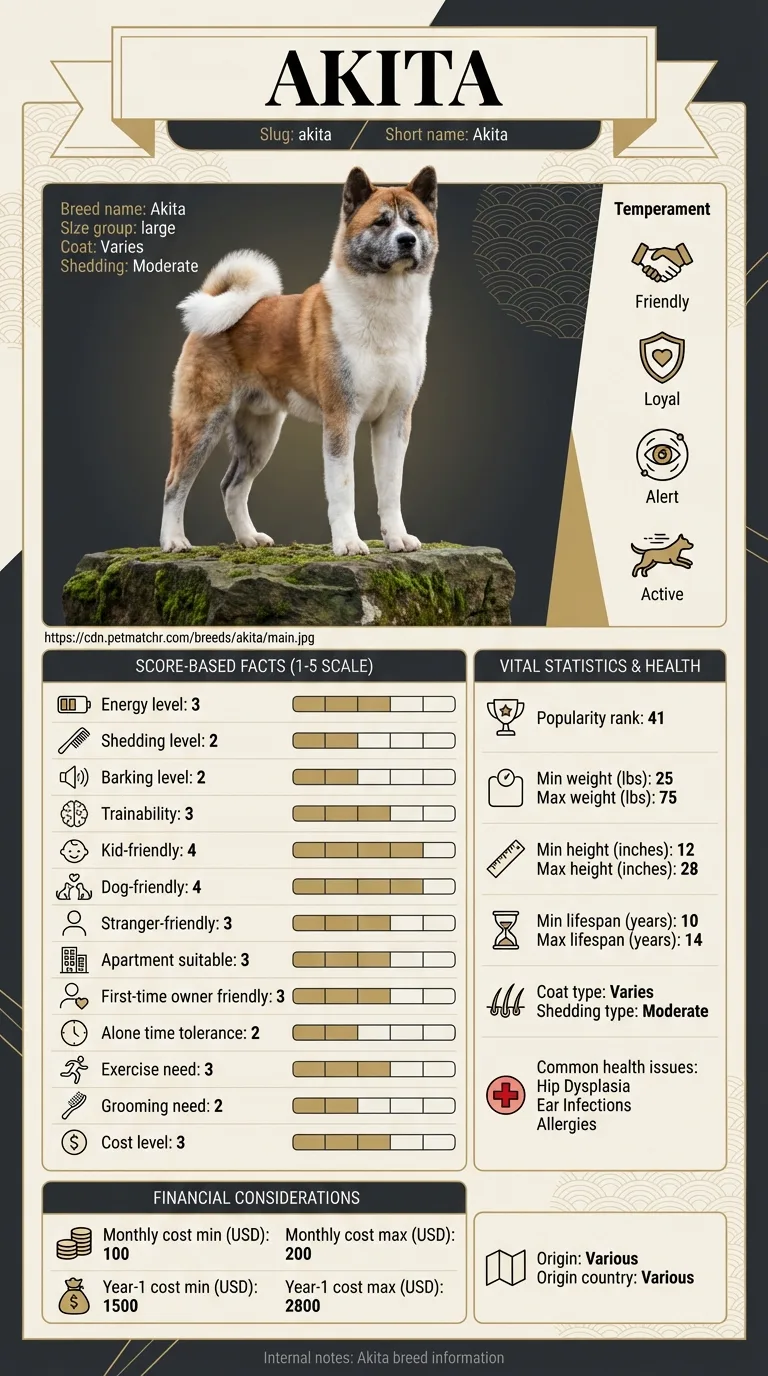
akita infographic
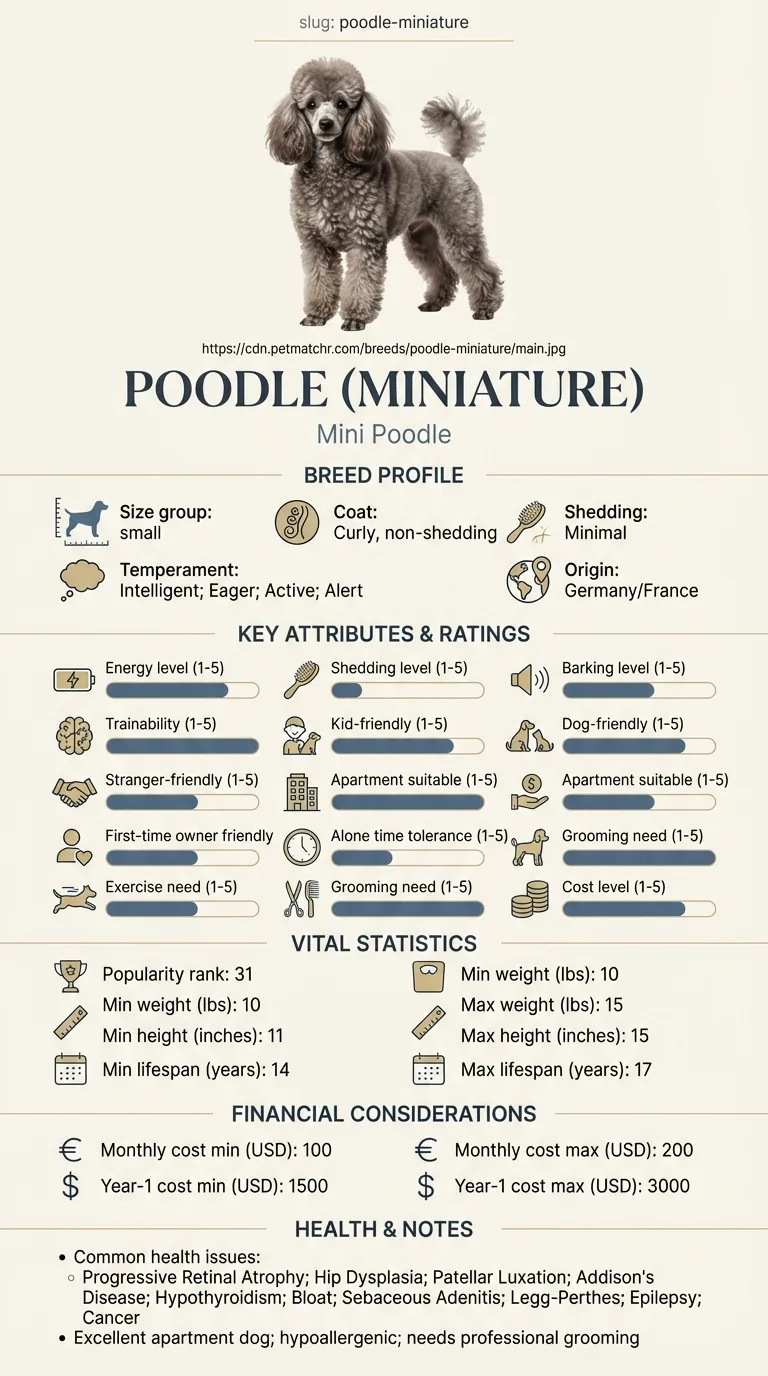
poodle miniature infographic

This page is for someone weighing a small, bright, low-shedding companion against a large guardian. It covers the lifespan and what it commits you to, coat work, two conditions specific to small and curly-coated dogs, and cost.

Quick verdict

The Miniature Poodle is the better flat dog, the more trainable dog and the longer-lived dog, and it needs a groomer every six to eight weeks for up to seventeen years.

Choose akita if...

Choose the Akita if you will not fund lifelong grooming or want a dog that copes with an empty house. It grooms at 3/5 against the Poodle's 5/5, barks at 2/5 against 3/5, and tolerates being alone at 3/5 against 2/5. You are accepting 5/5 shedding, 1/5 for first-time owners and up to 130 pounds.

Choose poodle miniature if...

Choose the Miniature Poodle if you live in a flat and want a small dog you can genuinely train. It rates 5/5 for apartments and trainability, 1/5 for shedding, 4/5 with children and other dogs, and lives 14 to 17 years at $100–$200 a month. You are accepting a 5/5 coat and a 2/5 tolerance for solitude.

Head-to-head comparison

Featureakitapoodle miniatureWinner
Weight70–130 lbs10–15 lbsEqual
Height24–28 in11–15 inEqual
Lifespan10–13 years14–17 yearspoodle miniature
CoatDense double coatCurly, non-sheddingEqual
Grooming needModerate (3/5)Very high (5/5)akita
SheddingVery high (5/5)Very low (1/5)poodle miniature
Energy levelModerate (3/5)High (4/5)Equal
Exercise needModerate (3/5)Moderate (3/5)Equal
TrainabilityModerate (3/5)Very high (5/5)poodle miniature
BarkingLow (2/5)Moderate (3/5)akita
Good with kidsModerate (3/5)High (4/5)poodle miniature
Good with other dogsLow (2/5)High (4/5)poodle miniature
Friendly to strangersLow (2/5)Moderate (3/5)poodle miniature
Apartment suitabilityLow (2/5)Very high (5/5)poodle miniature
Good for first-time ownersVery low (1/5)Moderate (3/5)poodle miniature
Tolerates being aloneModerate (3/5)Low (2/5)akita
Typical monthly cost$110–$240$100–$200poodle miniature
Typical first-year cost$1,700–$3,200$1,500–$3,000poodle miniature

Deep dive

Akita vs Miniature Poodle: what seventeen years commits you to

Fourteen to seventeen years against ten to thirteen. At the extremes that is a seven-year difference, which is most of another dog.

It is worth thinking about concretely rather than as a selling point. A Miniature Poodle bought when a child is five will still be there when that child leaves home. It will need a groomer every six to eight weeks throughout, its teeth brushed daily throughout, and its brain occupied throughout — a 5/5 trainable dog does not become undemanding at twelve.

Exercise ties at 3/5, which surprises people who expect a small dog to need less. The Miniature rates 4/5 for energy and wants proper walks plus something to think about.

The Akita's advantages here are grooming at 3/5, barking at 2/5 against 3/5, and solitude at 3/5 against 2/5 — a shorter life that asks less of every week in it.

5/5 grooming for the whole of that life

The Miniature Poodle's coat sheds almost nothing at 1/5, and that is the reason most buyers are looking. The dead hair stays in the curl rather than landing on the sofa.

What follows is a 5/5 grooming requirement. A coat that keeps its dead hair mats densely and quickly, particularly behind the ears, in the armpits, on the collar line and around the tail. The routine is combing to the skin several times a week — the test is whether a metal comb passes through without catching — plus a professional groom every six to eight weeks.

Over seventeen years that is more than a hundred appointments. It should be in the budget from the first week.

The transition at eight to twelve months is the moment most owners lose the coat. The adult hair pushes through underneath the puppy coat, the two felt together, and the dog gets clipped short. Line brushing with a comb from the start prevents it.

Ear hair grows inside the canal and traps moisture, so plucking or trimming and drying after baths is routine.

The Akita's bargain is the inverse: no mats, no groomer, 5/5 shedding and two intensive raking periods a year.

A working brain in a fifteen-pound dog

The Miniature Poodle rates 5/5 for trainability, the same as a Border Collie, and it earns it. Poodles at every size are among the most capable dogs in obedience, agility and scent work, and the Miniature is small enough to train indoors on a wet evening.

That is the practical point. Fifteen focused minutes of trick training, scent games or puzzle work does more for this dog than an extra mile, and it is available in any weather and any size of home.

An under-occupied Miniature Poodle becomes barky, demanding and inventive. The 3/5 barking rating is largely a function of occupation, and a well-worked dog sits closer to the bottom of it.

It is a sensitive breed. Sharp correction stalls progress; cheerful consistency does not.

At 2/5 for solitude it is closely bonded and does not suit a household that is out all day without cover. The Akita at 3/5 needs no company, no occupation and no ideas — which is genuinely the point for some households.

Legg-Perthes, sebaceous adenitis and Addison's

Three items on this list are worth naming because they are easy to misread.

Legg-Perthes disease affects small breeds and appears young — typically between four and twelve months. The blood supply to the head of the femur fails, the bone degenerates, and the puppy becomes progressively lame on one hind leg. It is painful and it is surgically treatable. Persistent hind limb lameness in a young small-breed dog is never a growth phase to wait out.

Sebaceous adenitis is a coat disease in which the glands that oil the skin are destroyed by inflammation. It shows as scaling, a dull brittle coat, patchy hair loss and a musty smell. It is diagnosed by skin biopsy and managed rather than cured, and it is more common in Poodles than in most breeds.

Addison's disease is the third — vague, relapsing illness, often worse after stress, that resolves and returns. It is treatable and dangerous if missed.

Patellar luxation, progressive retinal atrophy, hip dysplasia, hypothyroidism, epilepsy, cancer and bloat complete the list.

The Akita's burden is autoimmune and endocrine, with hip dysplasia and bloat.

The monthly figure and the one that is missing

The Miniature Poodle runs $100–$200 a month against the Akita's $110–$240, and $1,500–$3,000 against $1,700–$3,200 in the first year.

Neither figure includes grooming, and for this breed that omission is the whole story. Every six to eight weeks for up to seventeen years is a large cumulative number, and unless you learn to clip the dog yourself it is unavoidable.

Dental care is the other predictable line, as in every small breed — daily brushing genuinely reduces the anaesthetics needed across a very long life.

The Akita's spending is food-dominated and flat, with autoimmune disease and bloat as the large uncertain risks.

On housing the Miniature rates 5/5 for apartments against 2/5 and needs the same 3/5 exercise, which makes it one of the most practical small dogs available — provided the grooming and the occupation are both accounted for honestly before you buy.

Akita vs Poodle (Miniature) at a glance

The Miniature Poodle can live seventeen years, the longest figure on this site, against the Akita's 10 to 13. That gap is the number that should shape the decision — not because longer is automatically better, but because seventeen years of a 5/5 grooming requirement is a very different commitment from twelve years of one.

The Miniature is the more trainable dog at 5/5, the better flat dog at 5/5 for apartments against 2/5, and sheds almost nothing at 1/5. In exchange it needs a professional groomer every six to eight weeks for its whole life and tolerates solitude worse, at 2/5 against the Akita's 3/5.

The Akita's advantages are what it does not ask for: no grooming appointments, quieter at 2/5 barking against 3/5, and a genuine tolerance for an empty house.

Choose the Akita if you will not fund lifelong grooming. Choose the Miniature Poodle if you live in a flat and want a small dog you can genuinely train.

Frequently asked questions

How long do Miniature Poodles live?

14 to 17 years, the longest figure on this site, against the Akita's 10 to 13. That is worth planning for rather than treating as a bonus: a groomer every six to eight weeks, daily tooth brushing and a 5/5 trainable brain that still wants occupying at fourteen.

How much grooming does a Miniature Poodle need?

5/5 — combing to the skin several times a week plus a professional groom every six to eight weeks, for the whole of a very long life. The test between appointments is whether a metal comb passes to the skin without catching anywhere.

How much exercise does it need?

3/5 — the same as an Akita, which surprises people. It rates 4/5 for energy and wants proper walks plus mental work. Fifteen focused minutes of trick training or scent games does more for this dog than an extra mile, and it works indoors on a wet evening.

What is Legg-Perthes disease?

A failure of the blood supply to the head of the femur, causing the bone to degenerate. It appears in small breeds between four and twelve months as progressive lameness on one hind leg, and it is painful. It is surgically treatable, so persistent lameness in a young small dog should never be waited out.

What is sebaceous adenitis?

An inflammatory disease that destroys the glands which oil the skin, producing scaling, a dull brittle coat, patchy hair loss and a musty smell. It is diagnosed by skin biopsy and managed rather than cured. It appears more often in Poodles than in most breeds and is worth asking a breeder about.

Which is better for a flat?

The Miniature Poodle at 5/5 against the Akita's 2/5 — small, low-shedding, trainable indoors and content with the same amount of exercise. The two caveats are 3/5 barking, largely a function of how occupied the dog is, and a 2/5 tolerance for being left alone.

Which is cheaper to keep?

The Poodle on the headline figures — $100–$200 a month against $110–$240 — until grooming is added, which neither number includes. More than a hundred professional appointments across seventeen years is the honest comparison, against an Akita that needs a rake and nothing else.

Quick answers

View more answers
Living

Akita vs Miniature Poodle: which should I choose?

The Miniature Poodle if you live in a flat, want a small dog you can genuinely train, and will fund grooming for up to seventeen years. The Akita if you want no grooming appointments and a dog that copes alone.

Costs

How much does each cost per month?

The Miniature Poodle runs $100–$200 a month and the Akita $110–$240, with first-year totals of $1,500–$3,000 and $1,700–$3,200. Neither figure includes the Poodle's grooming.

Living

Do they need the same exercise?

Yes — both rate 3/5, around forty-five to sixty minutes a day. The Poodle also wants mental work, which the Akita does not. That difference is available indoors and costs fifteen minutes, not extra miles.

Health

What should I ask a Miniature Poodle breeder?

Eye certification for progressive retinal atrophy, patella scores, hip scores, and whether Addison's disease or sebaceous adenitis has appeared in the line. Ask what ages the grandparents reached.

Related DogBreedCompass guides

  • Akita breed guideThe Akita profile covers guardian temperament and the long socialisation window the breed needs.
  • Miniature Poodle breed guideThe Miniature Poodle profile covers coat care, training outlets and health testing.
  • Akita vs Poodle (all sizes)The all-sizes overview explains how the three Poodle sizes differ in daily life.
  • Akita vs Standard PoodleThe Standard is the athletic large size with a higher exercise requirement.
  • Miniature Poodle ear infectionsEar infections are routine maintenance in coats with hair growing in the canal.
  • Akita autoimmune diseasesAutoimmune disease is the Akita's most distinctive burden and the first question for a breeder.

Related guides

Important reminder

Health information here is general and is not veterinary advice. If your dog shows pain, sudden behaviour change, or worsening symptoms, consult a licensed veterinarian.

Some links on this site are affiliate links. We may earn a commission at no extra cost to you, and we only suggest products we believe are helpful for dog owners.

Find Your Perfect Breed

Match your lifestyle to the right dog.

Take quiz

Find your match

Not sure which breed is right for you? Take our 2-minute quiz to find out.

Take the quiz