Behavior
Bigger shedder?
The Saint Bernard, rated high (4/5) versus the Yorkie's very low (1/5).

Quick answer
Bigger shedder?
The Saint Bernard, rated high (4/5) versus the Yorkie's very low (1/5).
Saint Bernard or Yorkshire Terrier? On paper they differ most on apartment suitability, and on the scales Saint Bernard is the heavier at 120–180 lbs. Here is how the two compare on everything that shapes an ordinary week.
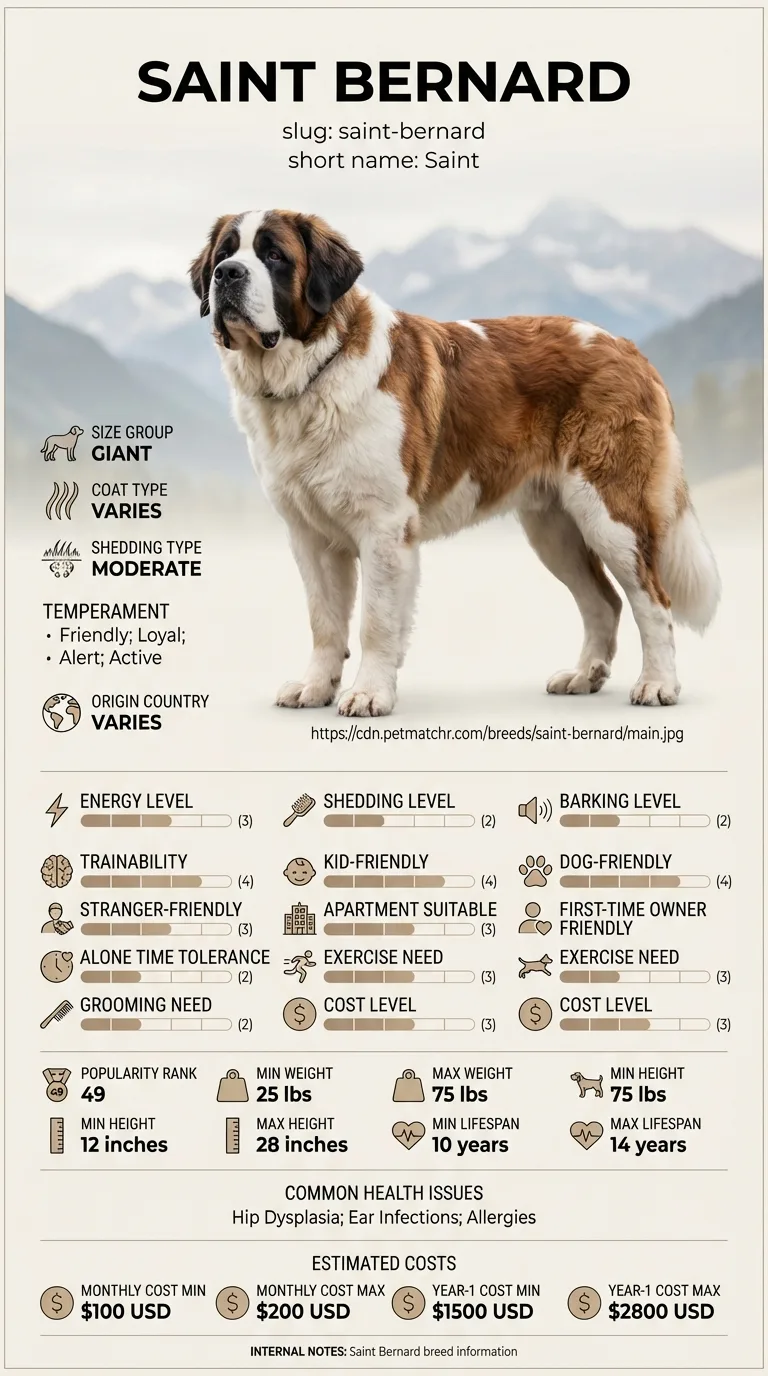
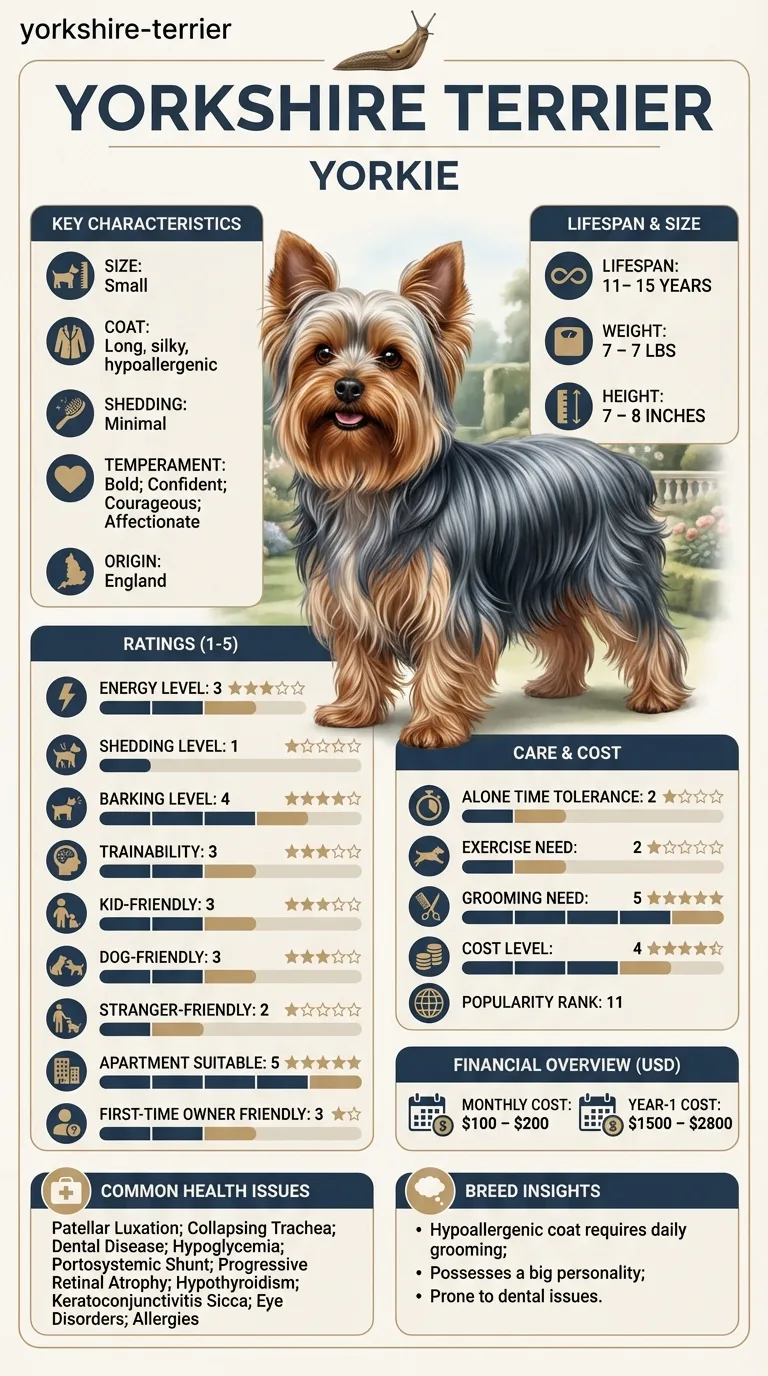
This is for someone already down to Saint Bernard and Yorkshire Terrier and deciding between them. For this pair the decision usually turns on apartment suitability and shedding, so those are covered first and in most detail. Anyone choosing from a flat has a clear answer here: Yorkshire Terrier rates 5/5 against 1/5. There is no origin story here — only what changes about your week.
Between Saint Bernard and Yorkshire Terrier, apartment suitability is what separates them, and Yorkshire Terrier is the lower-effort dog of the two to keep.
Choose Saint Bernard if you do not want a standing grooming appointment, the dog will be alone during the working day and there are young children at home.
Choose Yorkshire Terrier if you are in a flat or a smaller home, shedding is a problem in your house and a smaller dog suits your car, your home or your back.
| Feature | saint bernard | yorkshire terrier | Winner |
|---|---|---|---|
| Size class | giant | small | Equal |
| Weight | 120–180 lbs | 4–7 lbs | Equal |
| Height | 26–30 in | 7–8 in | Equal |
| Lifespan | 8–10 years | 11–15 years | yorkshire terrier |
| Exercise need | Low (2/5) | Low (2/5) | Equal |
| Grooming need | Moderate (3/5) | Very high (5/5) | saint bernard |
| Shedding | High (4/5) | Very low (1/5) | yorkshire terrier |
| Energy level | Low (2/5) | Moderate (3/5) | Equal |
| Barking | Low (2/5) | High (4/5) | saint bernard |
| Apartment suitability | Very low (1/5) | Very high (5/5) | yorkshire terrier |
| Good for first-time owners | Moderate (3/5) | Moderate (3/5) | Equal |
| Tolerates being alone | Moderate (3/5) | Low (2/5) | saint bernard |
| Trainability | Moderate (3/5) | Moderate (3/5) | Equal |
| Good with kids | Very high (5/5) | Moderate (3/5) | saint bernard |
| Good with other dogs | High (4/5) | Moderate (3/5) | saint bernard |
| Friendly to strangers | High (4/5) | Low (2/5) | saint bernard |
| Cost level | Very high (5/5) | High (4/5) | yorkshire terrier |
| Coat | Short or long double coat | Long, silky, hypoallergenic | Equal |
| Origin | Various | England | Equal |
| Typical monthly cost | $150–$310 | $100–$190 | Equal |
| Typical first-year cost | $2,200–$4,200 | $1,400–$2,900 | Equal |
Few pairings on this site show a size gap as extreme as this one: the Saint Bernard's 120–180 lbs versus the Yorkshire Terrier's 4–7 lbs is roughly a twenty-five-to-thirty-times weight difference, and the height gap — 26–30 inches versus 7–8 inches — is just as dramatic. A Yorkie could realistically be mistaken for a Saint Bernard puppy's chew toy in terms of relative scale, which matters for households considering both: unsupervised play between a giant and a toy breed carries real injury risk to the smaller dog, however gentle the giant's temperament.
Both breeds rate low-to-moderate on activity: the Saint Bernard rates low (2/5) for exercise need and energy level, while the Yorkshire Terrier rates low (2/5) for exercise but moderate (3/5) for energy — a small dog with more indoor spunk than outdoor stamina requirements. Yorkies are often happy with short walks and vigorous indoor play, consistent with their "Bold" and "Courageous" temperament tags belying their tiny size. This is a comparison where activity level is not the deciding factor; both dogs suit a relatively low-key household.
The Yorkshire Terrier's long, silky, hypoallergenic coat needs very high (5/5) grooming — daily brushing and regular trims are standard — while shedding rates very low (1/5), making it a genuinely low-hair-around-the-house option. The Saint Bernard runs the opposite way: moderate (3/5) grooming need but high (4/5) shedding. A Yorkie owner trades vacuum time for a brush-and-scissors routine (or professional grooming visits), while a Saint Bernard owner deals with more visible fur but less hands-on coat maintenance per session.
The Yorkshire Terrier rates very high (5/5) for apartment suitability, about as good as this metric gets, against the Saint Bernard's very low (1/5) — a nearly complete role reversal. Barking cuts the other way: the Yorkie rates high (4/5), a trait tied to its "Bold" personality and long history as an alert little watchdog, while the Saint Bernard rates low (2/5). Alone-time tolerance favors the Saint Bernard, moderate (3/5) versus the Yorkie's low (2/5) — small size doesn't necessarily mean the dog is fine being left on its own.
Trainability rates moderate (3/5) for both breeds, an even match, and first-time-owner suitability lands at moderate (3/5) for both as well. The Yorkshire Terrier's "Confident" and "Courageous" temperament tags can translate into a small dog with a big attitude — sometimes described as 'small dog syndrome' when boundaries aren't set early, since owners are less likely to firmly correct a 5-pound dog than a 150-pound one. The Saint Bernard's training challenges are more about consistency given its size, while the Yorkie's are more about not letting its confidence go unchecked.
The Saint Bernard rates ahead with kids, very high (5/5) against the Yorkie's moderate (3/5), and with other dogs, high (4/5) versus moderate (3/5). Strangers show the widest gap: high (4/5) for the Saint Bernard versus low (2/5) for the Yorkie, whose small size can make it warier or more defensive around unfamiliar people and situations. Households with young, exuberant children are generally safer pairing with the sturdier Saint Bernard, since a Yorkie's small frame is genuinely more vulnerable to accidental injury during rough play.
The Yorkshire Terrier's 11–15 year lifespan comfortably outlasts the Saint Bernard's 8–10 years, but its health list is long and toy-breed-specific: Patellar Luxation, Collapsing Trachea, Dental Disease, Hypoglycemia, Portosystemic Shunt, Progressive Retinal Atrophy, Hypothyroidism, Keratoconjunctivitis Sicca, Eye Disorders, and Allergies. The Saint Bernard's shorter list (Hip Dysplasia, Elbow Dysplasia, Dilated Cardiomyopathy, Entropion, Bloat) skews toward giant-breed orthopedic and cardiac risk instead. Yorkie owners should watch dental health closely — small-breed dental disease is common — while Saint Bernard owners should prioritize joint and cardiac screening.
Cost level rates very high (5/5) for the Saint Bernard against high (4/5) for the Yorkshire Terrier — closer than the size difference would suggest, since the Yorkie's very-high (5/5) grooming needs and toy-breed veterinary specialization keep its costs elevated despite its tiny food bill. Monthly costs run $150–310 for the Saint Bernard versus $100–190 for the Yorkie, and first-year costs run $2,200–4,200 versus $1,400–2,900. Dental care in particular can be a recurring, non-trivial expense for Yorkies given how prominently dental disease appears on their health list.
Saint Bernard weighs 120–180 lbs and lives 8–10 years; Yorkshire Terrier weighs 4–7 lbs and lives 11–15 years. The two diverge most on apartment suitability, shedding and grooming need and 3 other rated axes. They are level on exercise need, good for first-time owners and trainability, so those cannot decide it. Where the table declares a winner it means less work for the owner, nothing more; descriptive rows are left as ties on purpose. The value here is in the differences between the two columns; treat any single score as approximate.

Enormous — a 120–180 lb Saint Bernard can outweigh a 4–7 lb Yorkshire Terrier by twenty-five times or more, one of the largest gaps on this site.
Not as cheap as you'd expect — it rates high (4/5) for cost level thanks to very high (5/5) grooming needs and toy-breed vet care, versus the Saint Bernard's very high (5/5).
The Yorkshire Terrier, rated high (4/5) versus the Saint Bernard's low (2/5) — Yorkies have a long history as vocal little watchdogs.
The Saint Bernard, rated very high (5/5) with kids and far sturdier physically; the Yorkie's small size makes it more vulnerable to accidental injury during rough play.
The Yorkshire Terrier, rated very high (5/5) for apartment suitability against the Saint Bernard's very low (1/5).
The Yorkshire Terrier, at 11–15 years versus the Saint Bernard's 8–10.
The Saint Bernard, rated high (4/5) versus the Yorkie's low (2/5).
The Saint Bernard, rated high (4/5) versus the Yorkie's very low (1/5).
The Yorkshire Terrier, rated high (4/5) for barking versus the Saint Bernard's low (2/5).
The Saint Bernard, rated very high (5/5) versus the Yorkie's moderate (3/5).
The Yorkshire Terrier, at $1,400–2,900 versus the Saint Bernard's $2,200–4,200.
Secure checkout on Stripe. We never see your card.
7-day money-back guarantee. Instant access.
Health information here is general and is not veterinary advice. If your dog shows pain, sudden behaviour change, or worsening symptoms, consult a licensed veterinarian.
Some links on this site are affiliate links. We may earn a commission at no extra cost to you, and we only suggest products we believe are helpful for dog owners.
We research and check what we publish, but we do not warrant that any figure, date, price, or statement is accurate, complete, or current, and we accept no liability for any loss, cost, injury, or other harm arising from the use of this site. Use it as one reference among several. You remain responsible for your own decisions and for your dog's care - confirm anything that matters with a licensed veterinarian or another qualified professional before you act on it. Full disclaimer.
Match your lifestyle to the right dog.
Take quizNot sure which breed is right for you? Take our 2-minute quiz to find out.
Take the quiz