Living
Which breed is larger?
The German Wirehaired Pointer, by a wide margin.

Quick answer
Which breed is larger?
The German Wirehaired Pointer, by a wide margin.
German Wirehaired Pointer or Yorkshire Terrier? On paper they differ most on apartment suitability, and on the scales German Wirehaired Pointer is the heavier at 60–70 lbs. Here is how the two compare on everything that shapes an ordinary week.
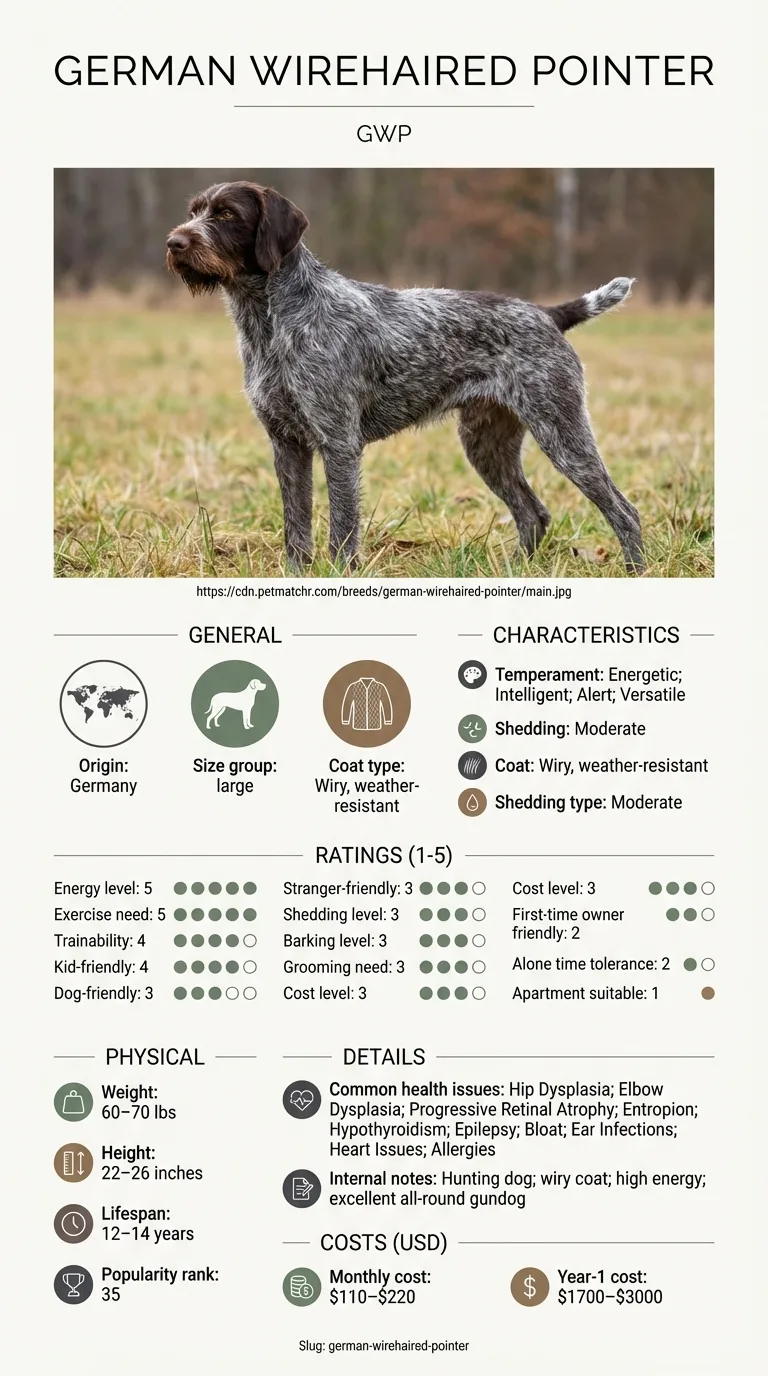
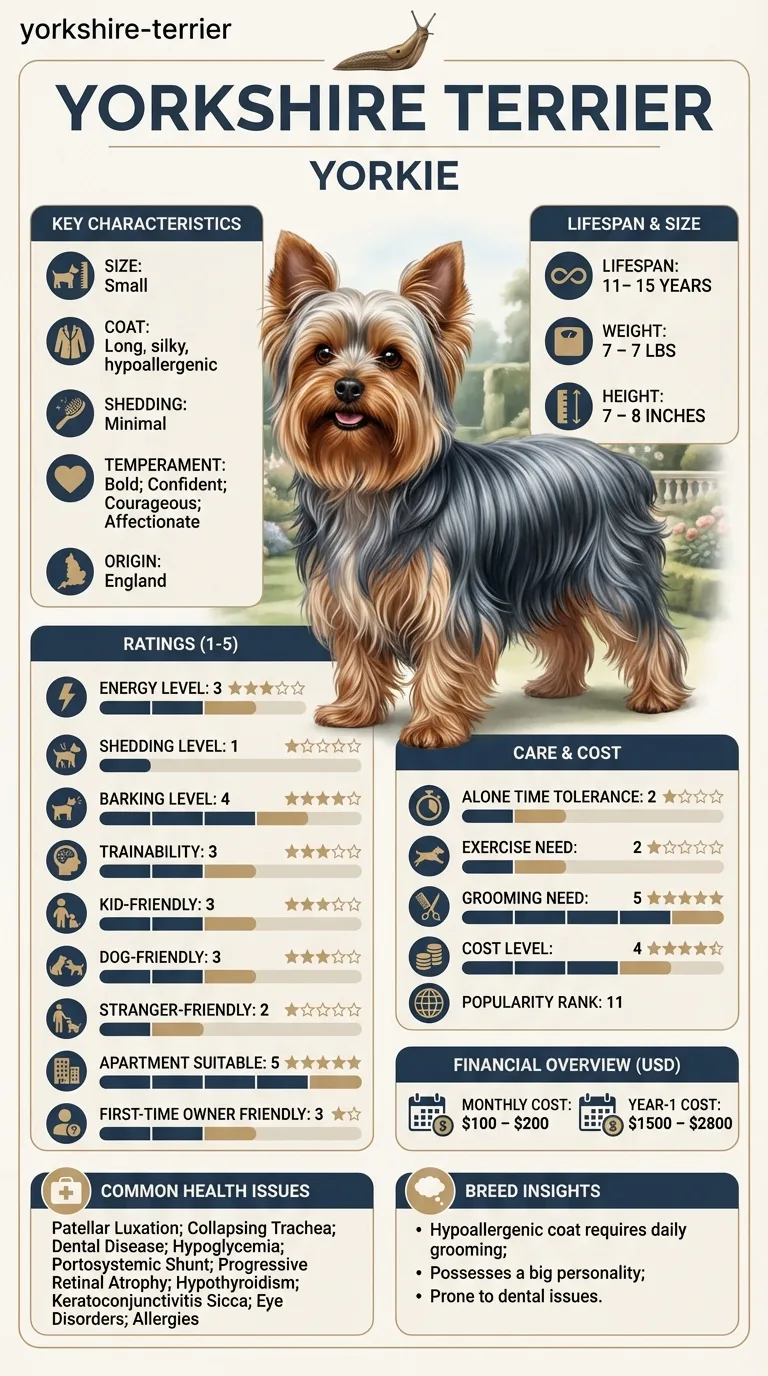
This is for someone already down to German Wirehaired Pointer and Yorkshire Terrier and deciding between them. For this pair the decision usually turns on apartment suitability and exercise need, so those are covered first and in most detail. Anyone choosing from a flat has a clear answer here: Yorkshire Terrier rates 5/5 against 1/5. Breed history is left out; what follows is what you will actually live with.
Between German Wirehaired Pointer and Yorkshire Terrier, apartment suitability is what separates them, and Yorkshire Terrier is the lower-effort dog of the two to keep.
Choose German Wirehaired Pointer if you do not want a standing grooming appointment, there are young children at home and you want a dog that picks up training quickly.
Choose Yorkshire Terrier if you are in a flat or a smaller home, this is your first dog and shedding is a problem in your house.
| Feature | german wirehaired pointer | yorkshire terrier | Winner |
|---|---|---|---|
| Size class | large | small | Equal |
| Weight | 60–70 lbs | 4–7 lbs | Equal |
| Height | 22–26 in | 7–8 in | Equal |
| Lifespan | 12–14 years | 11–15 years | Equal |
| Exercise need | Very high (5/5) | Low (2/5) | yorkshire terrier |
| Grooming need | Moderate (3/5) | Very high (5/5) | german wirehaired pointer |
| Shedding | Moderate (3/5) | Very low (1/5) | yorkshire terrier |
| Energy level | Very high (5/5) | Moderate (3/5) | Equal |
| Barking | Moderate (3/5) | High (4/5) | german wirehaired pointer |
| Apartment suitability | Very low (1/5) | Very high (5/5) | yorkshire terrier |
| Good for first-time owners | Low (2/5) | Moderate (3/5) | yorkshire terrier |
| Tolerates being alone | Low (2/5) | Low (2/5) | Equal |
| Trainability | High (4/5) | Moderate (3/5) | german wirehaired pointer |
| Good with kids | High (4/5) | Moderate (3/5) | german wirehaired pointer |
| Good with other dogs | Moderate (3/5) | Moderate (3/5) | Equal |
| Friendly to strangers | Moderate (3/5) | Low (2/5) | german wirehaired pointer |
| Cost level | Moderate (3/5) | High (4/5) | german wirehaired pointer |
| Coat | Wiry, weather-resistant | Long, silky, hypoallergenic | Equal |
| Origin | Germany | England | Equal |
| Typical monthly cost | $110–$220 | $100–$190 | Equal |
| Typical first-year cost | $1,700–$3,000 | $1,400–$2,900 | Equal |
This is the most size-mismatched pairing here: a 60-70 lb, 22-26 inch GWP against a 4-7 lb, 7-8 inch Yorkshire Terrier. Height alone tells the story, the Yorkie can stand entirely within the GWP's paw span. Anyone comparing these two side by side isn't choosing between similar dogs with different coats, they're choosing between a large working gundog and a toy companion breed built for laps rather than fields. That gap carries into everything downstream, exercise needs, apartment suitability, even how much food and medication dosing costs per month, so treat any 'tie' on the size-class line as a technicality rather than a real similarity.
The GWP rates Very High (5/5) for exercise need while the Yorkshire Terrier sits at Low (2/5), and energy level tells a similar story at Very High versus Moderate (3/5). A GWP was bred to hunt for hours across open country; a Yorkie was bred to be a companion and occasional ratter, and its exercise needs reflect that, a couple of short walks and some indoor play cover most days. Households drawn to the GWP's Energetic, Versatile drive need serious outdoor access and time; households drawn to the Yorkie's more modest activity needs can meet its requirements inside a city apartment. This single line of data probably decides the comparison for most buyers.
Grooming flips the size expectation on its head: the tiny Yorkshire Terrier needs Very High (5/5) grooming attention for its long, silky coat, more than the GWP's Moderate (3/5) wiry coat, even though it sheds far less, Very Low (1/5) against the GWP's Moderate (3/5). That long, hypoallergenic-leaning Yorkie coat needs near-daily brushing and regular trims to avoid matting, while the GWP's wiry coat mostly needs periodic hand-stripping a few times a year. Shedding-averse owners will lean Yorkie; owners who want a coat they can mostly ignore between stripping sessions will find the GWP's higher-shed, lower-fuss profile easier to live with day to day.
The Yorkshire Terrier is built for small spaces, rating Very High (5/5) for apartment suitability against the GWP's rock-bottom Very Low (1/5), the widest gap on this whole comparison table. The tradeoff is noise: Yorkies rate High (4/5) for barking, a full point above the GWP's Moderate (3/5), and that vocal, Bold, Courageous temperament can become a real issue for apartment neighbors even in a dog that's otherwise apartment-appropriate. Both breeds tolerate being alone at just Low (2/5), so neither is suited to long solo days regardless of square footage. A GWP in a city apartment is a mismatch on space; a noisy Yorkie is a mismatch on sound.
Trainability favors the GWP, High (4/5) versus the Yorkie's Moderate (3/5), and the GWP is rated worse for first-time owners in the raw numbers, Low (2/5) against the Yorkie's Moderate (3/5), because a Yorkie's smaller size makes handling mistakes lower-stakes even if its Bold, Confident temperament can produce classic small-dog stubbornness. The GWP's Intelligent, Versatile profile makes it a quick study for someone experienced with working breeds, but its size and drive punish inconsistent handling much harder than a Yorkie's would. First-time owners nervous about a large, high-drive dog may find the Yorkie's smaller footprint more forgiving day to day, size mismatch aside.
The GWP outperforms the Yorkie on nearly every household-fit metric here: High (4/5) with kids versus Moderate (3/5), Moderate (3/5) friendliness to strangers versus Low (2/5), though both tie at Moderate (3/5) with other dogs. A Yorkie's small size makes rough play with young kids genuinely risky regardless of temperament, while the GWP's larger, sturdier build tolerates typical kid energy better. The Yorkie's Bold, Courageous nature, sometimes described as small-dog syndrome, can also mean it doesn't back down from bigger dogs or unfamiliar visitors, which is charming in a companion breed but worth managing carefully around toddlers or boisterous guests.
Lifespans land close, 12-14 years for the GWP against 11-15 for the Yorkie, but both carry substantial ten-item health lists. The GWP's includes Hip and Elbow Dysplasia, Progressive Retinal Atrophy, Epilepsy, Bloat and Heart Issues, risks tied to its larger frame and field-dog intensity. The Yorkie's list, Patellar Luxation, Collapsing Trachea, Hypoglycemia, Portosystemic Shunt and Progressive Retinal Atrophy among them, reflects small-breed-specific fragility, tiny joints, tiny airways, tiny blood sugar reserves. Interestingly, Progressive Retinal Atrophy and Hypothyroidism appear on both lists despite the size gap. Prospective owners should budget for very different vet conversations, orthopedic and cardiac screening for the GWP, dental and tracheal monitoring for the Yorkie.
Monthly costs run close, $110-220 for the GWP against $100-190 for the Yorkie, and first-year costs are nearly identical at $1,700-3,000 versus $1,400-2,900. But the overall cost-level rating tells a different story, Moderate (3/5) for the GWP against High (4/5) for the Yorkie, since small-breed grooming, dental care and the fragility reflected in its health list, hypoglycemia and portosystemic shunt among them, tend to generate frequent vet visits despite the lower sticker price on food. A GWP eats more but needs fewer specialist visits in a typical year; a Yorkie eats little but its grooming and health-monitoring costs add up in smaller, more frequent increments.
German Wirehaired Pointer weighs 60–70 lbs and lives 12–14 years; Yorkshire Terrier weighs 4–7 lbs and lives 11–15 years. The two diverge most on apartment suitability, exercise need and grooming need and 2 other rated axes. They are level on tolerates being alone and good with other dogs, so those cannot decide it. The comparison marks an easier option only where one exists. Facts like weight and country of origin are not scored. Both dogs are rated from the same dataset, which is what makes the numbers comparable with each other even though any individual dog sits somewhere inside its breed's range.

Yes — the GWP weighs 60-70 lbs and stands 22-26 inches, while the Yorkie weighs just 4-7 lbs and stands 7-8 inches, easily the biggest size gap in any comparison involving either breed.
The Yorkshire Terrier by a wide margin, rating Very High (5/5) for apartment suitability against the GWP's Very Low (1/5).
The Yorkshire Terrier, rated High (4/5) for barking versus the GWP's Moderate (3/5).
Yes — its long silky coat rates Very High (5/5) for grooming need, above the GWP's Moderate (3/5) wiry coat.
The GWP rates higher with kids (High, 4/5) and its sturdier build tolerates rough play better than the much smaller, more fragile Yorkie.
Yes, Progressive Retinal Atrophy and Hypothyroidism appear on both breeds' health lists despite their very different sizes.
Neither clearly — monthly and first-year costs are close, but the Yorkie carries a higher overall cost-level rating (4/5 versus 3/5) due to grooming and health-monitoring needs.
The German Wirehaired Pointer, by a wide margin.
The Yorkshire Terrier.
The German Wirehaired Pointer.
The Yorkshire Terrier.
Secure checkout on Stripe. We never see your card.
7-day money-back guarantee. Instant access.
Health information here is general and is not veterinary advice. If your dog shows pain, sudden behaviour change, or worsening symptoms, consult a licensed veterinarian.
Some links on this site are affiliate links. We may earn a commission at no extra cost to you, and we only suggest products we believe are helpful for dog owners.
We research and check what we publish, but we do not warrant that any figure, date, price, or statement is accurate, complete, or current, and we accept no liability for any loss, cost, injury, or other harm arising from the use of this site. Use it as one reference among several. You remain responsible for your own decisions and for your dog's care - confirm anything that matters with a licensed veterinarian or another qualified professional before you act on it. Full disclaimer.
Match your lifestyle to the right dog.
Take quizNot sure which breed is right for you? Take our 2-minute quiz to find out.
Take the quiz