Living
Which is better for apartments?
The Yorkshire Terrier, rated Very High (5/5) versus the Schnauzer's High (4/5).

Quick answer
Which is better for apartments?
The Yorkshire Terrier, rated Very High (5/5) versus the Schnauzer's High (4/5).
Schnauzer (Standard) or Yorkshire Terrier? On paper they differ most on exercise need, and on the scales Schnauzer (Standard) is the heavier at 26–50 lbs. Here is how the two compare on everything that shapes an ordinary week.
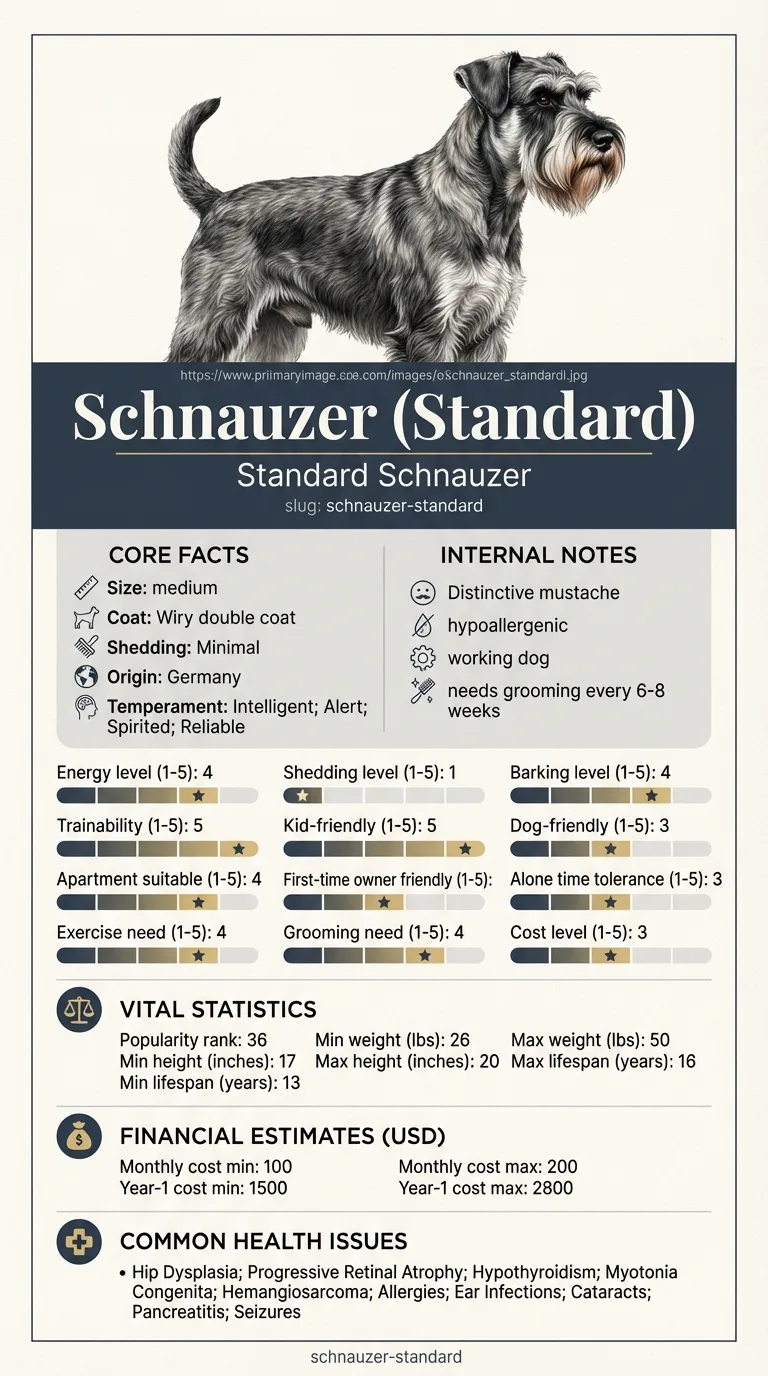
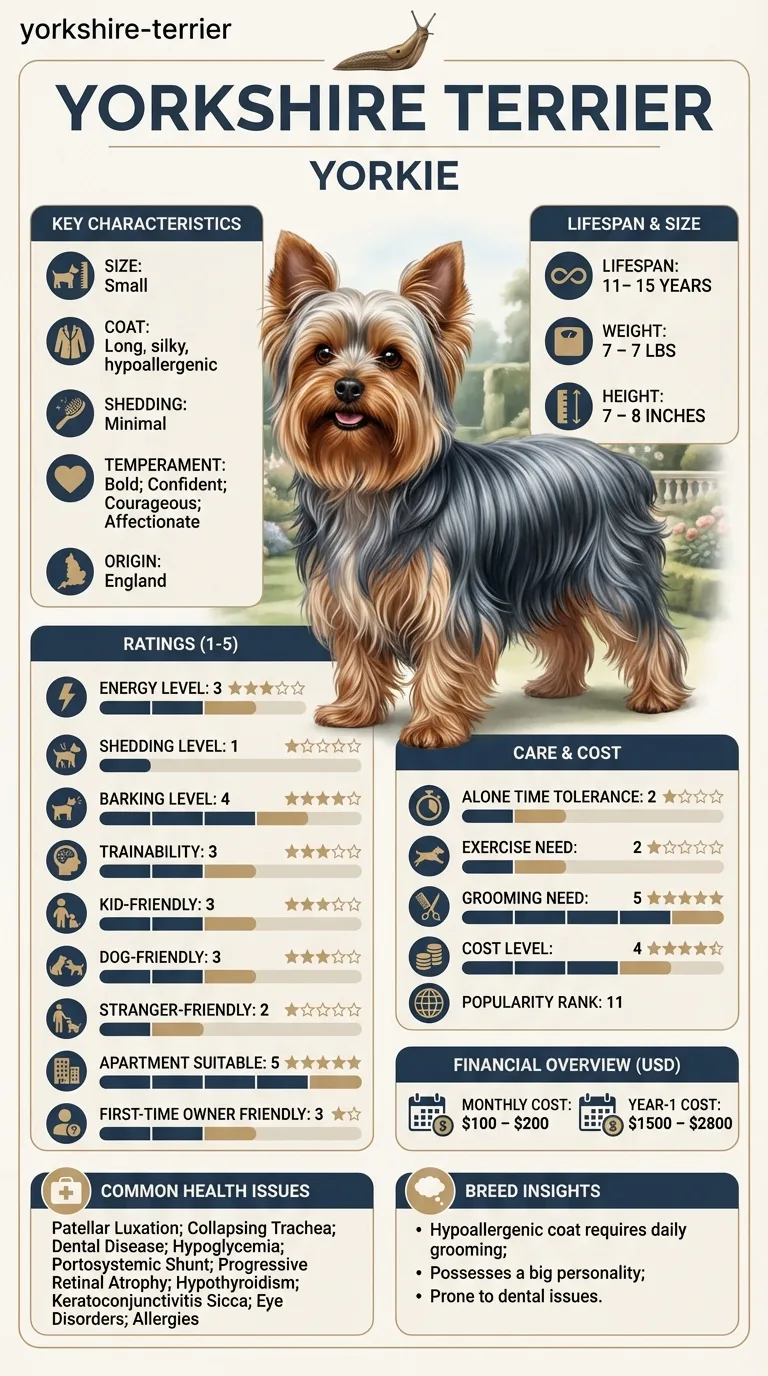
This is for someone already down to Schnauzer (Standard) and Yorkshire Terrier and deciding between them. For this pair the decision usually turns on exercise need and good with kids, so those are covered first and in most detail. Anyone choosing from a flat has a clear answer here: Yorkshire Terrier rates 5/5 against 4/5. Breed history is left out; what follows is what you will actually live with.
Between Schnauzer (Standard) and Yorkshire Terrier, exercise need is what separates them, and Yorkshire Terrier is the lower-effort dog of the two to keep.
Choose Schnauzer (Standard) if you do not want a standing grooming appointment, the dog will be alone during the working day and there are young children at home.
Choose Yorkshire Terrier if you are in a flat or a smaller home, your walking routine is modest and a smaller dog suits your car, your home or your back.
| Feature | schnauzer standard | yorkshire terrier | Winner |
|---|---|---|---|
| Size class | medium | small | Equal |
| Weight | 26–50 lbs | 4–7 lbs | Equal |
| Height | 17–20 in | 7–8 in | Equal |
| Lifespan | 13–16 years | 11–15 years | schnauzer standard |
| Exercise need | High (4/5) | Low (2/5) | yorkshire terrier |
| Grooming need | High (4/5) | Very high (5/5) | schnauzer standard |
| Shedding | Very low (1/5) | Very low (1/5) | Equal |
| Energy level | High (4/5) | Moderate (3/5) | Equal |
| Barking | High (4/5) | High (4/5) | Equal |
| Apartment suitability | High (4/5) | Very high (5/5) | yorkshire terrier |
| Good for first-time owners | Moderate (3/5) | Moderate (3/5) | Equal |
| Tolerates being alone | Moderate (3/5) | Low (2/5) | schnauzer standard |
| Trainability | Very high (5/5) | Moderate (3/5) | schnauzer standard |
| Good with kids | Very high (5/5) | Moderate (3/5) | schnauzer standard |
| Good with other dogs | Moderate (3/5) | Moderate (3/5) | Equal |
| Friendly to strangers | Moderate (3/5) | Low (2/5) | schnauzer standard |
| Cost level | Moderate (3/5) | High (4/5) | schnauzer standard |
| Coat | Wiry double coat | Long, silky, hypoallergenic | Equal |
| Origin | Germany | England | Equal |
| Typical monthly cost | $100–$200 | $100–$190 | Equal |
| Typical first-year cost | $1,500–$2,800 | $1,400–$2,900 | Equal |
A Yorkshire Terrier could nearly fit inside a Standard Schnauzer's food bowl — at just 4–7 lbs and 7–8 inches, the Yorkie is one of the smallest toy breeds around, while the Schnauzer stands 17–20 inches and weighs 26–50 lbs, up to twelve times heavier at the extremes. This isn't a subtle size difference like some medium-vs-medium comparisons; it's a genuine toy-versus-medium contrast that affects everything from crate size to how rough play with kids should be supervised. Anyone drawn to both breeds for their personalities should sit with this gap before deciding, since it shapes daily handling more than almost any other factor.
The Schnauzer rates High (4/5) for exercise need against the Yorkie's Low (2/5), a gap that tracks with their very different original jobs — farm guardian versus lap companion bred down from ratting terriers. Energy level shows a smaller gap, High (4/5) for the Schnauzer against Moderate (3/5) for the Yorkie, since Yorkies retain some of that Bold, Confident terrier spunk in short bursts even if they don't need marathon walks. A couple of short daily walks plus play satisfies most Yorkies, while the Schnauzer wants a longer, more structured outlet for its energy.
Both breeds rate Very Low (1/5) for shedding, so neither leaves much hair behind, but grooming effort tells a different story: the Yorkie rates Very High (5/5), the highest tier, thanks to its long, silky, hypoallergenic coat that mats quickly without near-daily brushing, while the Schnauzer's High (4/5) wiry-coat maintenance is demanding but a step below. Many Yorkie owners opt for a shorter 'puppy cut' specifically to reduce this workload, which isn't really an option with the Schnauzer's stripping-dependent coat texture. Either way, budget real time for coat care with both breeds.
The Yorkie edges out the Schnauzer for apartment living, Very High (5/5) versus High (4/5), largely a function of its tiny size and Low exercise needs. Barking is a tie, though — both breeds rate High (4/5), so neither is naturally quiet, and Yorkies in particular are known for a big, alert bark from a small body. The Schnauzer tolerates being alone slightly better, Moderate (3/5) versus the Yorkie's Low (2/5), so apartment dwellers with long work hours should weigh that alone-time gap against the Yorkie's smaller space footprint.
The Schnauzer rates Very High (5/5) for trainability against the Yorkie's Moderate (3/5), reflecting the Yorkie's Bold, independent terrier streak that can make consistent obedience work slower going. Both land at Moderate (3/5) for first-time-owner suitability, though, so neither is a clear beginner's-dog winner or loser — the Yorkie's small size makes physical handling easier for a novice, even as its stubbornness makes training harder. The Schnauzer's Alert, Intelligent profile picks up commands faster and more reliably, which matters for owners who prioritize a well-drilled, responsive dog over one with more personality quirks.
The Schnauzer rates well ahead with kids, Very High (5/5) versus the Yorkie's Moderate (3/5) — worth noting for families with young children, since a 5-pound Yorkie is also more physically fragile during rough play. Both rate Moderate (3/5) with other dogs, a tie, but the Schnauzer edges ahead with strangers too, Moderate (3/5) against the Yorkie's Low (2/5), consistent with the Yorkie's more reserved, Confident-but-cautious approach to unfamiliar people. Households with active young kids or frequent visitors may find the Schnauzer the steadier all-around family dog on paper.
The Schnauzer's 13–16 year lifespan tops the Yorkie's 11–15 years, though both can live well into their teens with good care. The Yorkie's health list runs considerably longer at ten items, including Collapsing Trachea, Hypoglycemia and Portosystemic Shunt — all concerns tied partly to its tiny size — plus shared risks with the Schnauzer like Progressive Retinal Atrophy and Hypothyroidism. The Schnauzer's list includes Myotonia Congenita and Hemangiosarcoma instead. Toy-breed owners in particular should ask about Collapsing Trachea and use a harness rather than a collar to protect the Yorkie's airway.
The Schnauzer rates Moderate (3/5) for cost against the Yorkie's High (4/5), and the numbers back that up: the Yorkie's typical monthly spend of $100–$190 looks similar to the Schnauzer's $100–$200, but its longer health-issue list and Very High grooming demand tend to push real-world spending higher over a dog's lifetime. First-year costs run close, $1,500–$2,800 for the Schnauzer versus $1,400–$2,900 for the Yorkie. Toy-breed dental care alone — flagged directly in the Yorkie's health list — is a recurring cost worth budgeting for that the Schnauzer's profile doesn't carry.
Schnauzer (Standard) weighs 26–50 lbs and lives 13–16 years; Yorkshire Terrier weighs 4–7 lbs and lives 11–15 years. The two diverge most on exercise need, good with kids and trainability. They are level on barking, good with other dogs and good for first-time owners, so those cannot decide it. The comparison marks an easier option only where one exists. Facts like weight and country of origin are not scored. Both dogs are rated from the same dataset, which is what makes the numbers comparable with each other even though any individual dog sits somewhere inside its breed's range.

Dramatically bigger — the Schnauzer weighs 26–50 lbs versus the Yorkie's 4–7 lbs, and stands 17–20 inches versus the Yorkie's 7–8 inches.
The Standard Schnauzer, rated High (4/5) versus the Yorkie's Low (2/5).
Its coat is described as long, silky and hypoallergenic, making it a common pick for allergy-sensitive households, though it still rates Very High (5/5) for grooming effort.
The Standard Schnauzer, rated Very High (5/5) for trainability versus the Yorkie's Moderate (3/5).
Neither — both rate High (4/5) for barking tendency.
The Yorkie's profile lists ten issues including Collapsing Trachea, Hypoglycemia and Portosystemic Shunt, several tied to its very small size.
The Schnauzer, with a 13–16 year lifespan versus the Yorkie's 11–15 years.
The Yorkshire Terrier, rated Very High (5/5) versus the Schnauzer's High (4/5).
The Yorkshire Terrier, rated High (4/5) versus the Schnauzer's Moderate (3/5).
The Standard Schnauzer, rated Very High (5/5) versus the Yorkie's Moderate (3/5).
Neither — both rate Very Low (1/5) for shedding.
Secure checkout on Stripe. We never see your card.
7-day money-back guarantee. Instant access.
Health information here is general and is not veterinary advice. If your dog shows pain, sudden behaviour change, or worsening symptoms, consult a licensed veterinarian.
Some links on this site are affiliate links. We may earn a commission at no extra cost to you, and we only suggest products we believe are helpful for dog owners.
We research and check what we publish, but we do not warrant that any figure, date, price, or statement is accurate, complete, or current, and we accept no liability for any loss, cost, injury, or other harm arising from the use of this site. Use it as one reference among several. You remain responsible for your own decisions and for your dog's care - confirm anything that matters with a licensed veterinarian or another qualified professional before you act on it. Full disclaimer.
Match your lifestyle to the right dog.
Take quizNot sure which breed is right for you? Take our 2-minute quiz to find out.
Take the quiz