Health
Is myotonia congenita documented in Weimaraners?
No, it's characterized in Miniature Schnauzers and Chow Chows, not established in Weimaraners.

Quick answer
Is myotonia congenita documented in Weimaraners?
No, it's characterized in Miniature Schnauzers and Chow Chows, not established in Weimaraners.
Myotonia congenita sounds like something any large, athletic breed should worry about, but the genetics behind it have only been pinned down in a couple of specific breeds, and the Weimaraner isn't one of them.
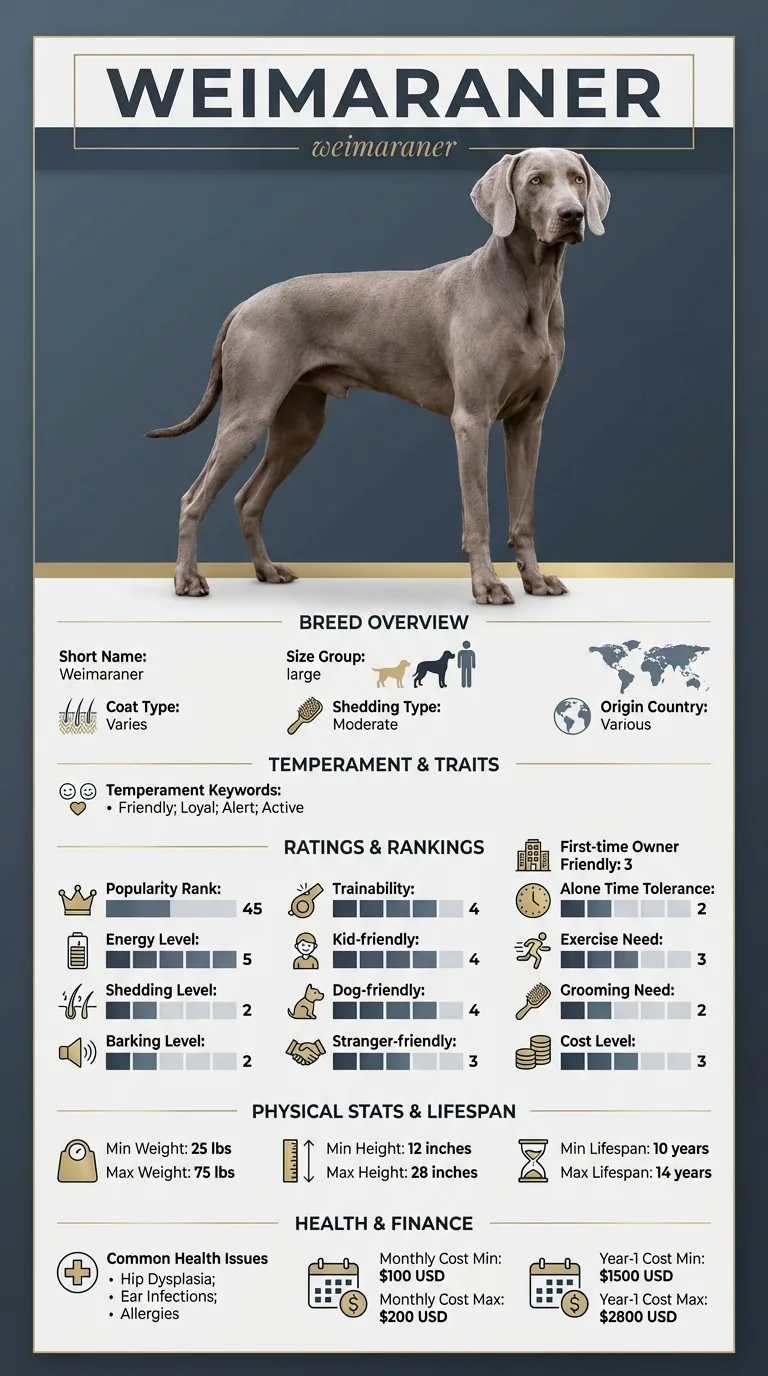
Weimaraner owners who've read about this muscle-stiffness disorder in a general list of inherited dog diseases, or who noticed their own dog looking briefly stiff after a nap, and want to know whether it's actually relevant to this breed.
This guide is not medical advice. If your dog shows pain, sudden behavior change, or worsening symptoms, consult a licensed veterinarian.
Some links may be affiliate links. We may earn a commission at no extra cost to you. We only suggest products we believe are helpful for dog owners.
We research and check what we publish, but we do not warrant that any figure, date, price, or statement is accurate, complete, or current, and we accept no liability for any loss, cost, injury, or other harm arising from the use of this site. Use it as one reference among several. You remain responsible for your own decisions and for your dog's care - confirm anything that matters with a licensed veterinarian or another qualified professional before you act on it. Full disclaimer.
Myotonia congenita is a well-documented inherited muscle-stiffness disorder in Miniature Schnauzers and Chow Chows, caused by a chloride channel mutation, but it isn't established as occurring in Weimaraners. For a Weimaraner showing real stiffness or gait changes, hip dysplasia and, in puppies, hypertrophic osteodystrophy are far more likely and far more relevant explanations.
Myotonia congenita is rare even within Miniature Schnauzers and Chow Chows, the breeds where it's actually documented, and it has no recognized occurrence in Weimaraners at all. Hip dysplasia, by contrast, is a genuinely common finding in Weimaraner orthopedic screening and is the condition actually worth tracking in this breed.
The mutation responsible for myotonia congenita has been mapped in Miniature Schnauzer research lines and separately described in Chow Chows, with no identified counterpart in Weimaraner genetics. This breed's documented inherited risks instead center on hip joint conformation, a bleeding disorder in von Willebrand disease, and a bone-growth condition in puppies in hypertrophic osteodystrophy, none of which share a mechanism with a muscle chloride channel defect.
Because this condition isn't relevant to Weimaraner genetics, there are no environmental triggers worth discussing for it in this breed. The environmental factors actually worth managing are the ones tied to the breed's real risks: growth rate and diet during puppyhood for hypertrophic osteodystrophy, and feeding practices and activity timing around meals for bloat prevention.
See a vet for stiffness that persists beyond a day or two, worsens, or comes with reluctance to bear weight, swelling, or fever, since these point toward hip dysplasia, hypertrophic osteodystrophy, or another orthopedic issue relevant to this breed. Any sudden collapse or abdominal distension needs emergency care regardless of a stiffness question.
Myotonia congenita's genetics are specific to the breeds where it's been studied, so applying it to a Weimaraner usually leads owners in the wrong direction. Here's where that goes wrong.
See all Weimaraner health problems, which breeds are prone to myotonia congenita, or the full Weimaraner breed guide for temperament, exercise needs and ownership costs.
Because myotonia congenita isn't a relevant condition for this breed, there's no disease timeline to track for it. If real stiffness turns out to be hip dysplasia or hypertrophic osteodystrophy instead, your vet can lay out a realistic management or treatment timeline specific to that diagnosis.
Success here means redirecting concern toward the Weimaraner's actual documented risks: hip health, growth-related bone conditions, bloat prevention, and von Willebrand status, rather than tracking symptoms of a muscle disorder that doesn't affect this breed. A Weimaraner moving comfortably through normal daily activity, with any real stiffness properly diagnosed, is the practical goal.
When a Weimaraner does show real stiffness, hip dysplasia is the far more likely explanation, especially in a dog past middle age or one diagnosed with joint laxity as a puppy. It typically shows up as reluctance to jump, a bunny-hopping gait, or slowness rising after rest, and it's driven by the joint itself rather than the muscle.
In a growing puppy between roughly three and eight months old, hypertrophic osteodystrophy is a separate and genuinely documented Weimaraner concern that can also produce a stiff, painful gait along with swollen leg bones and sometimes fever. It's an inflammatory bone condition, not a muscle disorder, and it usually needs veterinary diagnosis through X-rays rather than a wait-and-see approach.
A Weimaraner's high activity level also means ordinary exercise soreness after an unusually long run or hunt session is common and not a sign of any inherited disease. The distinguishing feature across all of these is that none of them involve the delayed muscle relaxation and follow-through stiffness that defines myotonia congenita in the breeds where it's actually been characterized.

A Weimaraner that's persistently stiff, reluctant to rise, or showing an altered gait for more than a day or two should be examined regardless of what the underlying cause turns out to be. Hip dysplasia, hypertrophic osteodystrophy, and even early signs of a joint injury all warrant a vet visit rather than a guess based on an unrelated breed's genetic disease.
Sudden collapse, especially after exertion, or a distended, painful abdomen are separate emergencies, with the latter raising concern for bloat, a genuine and serious risk for this deep-chested breed that needs immediate care. None of these presentations point toward myotonia congenita, and a vet working up a stiff or uncomfortable Weimaraner won't be looking for it.
The practical takeaway mirrors other breed-mismatch topics: don't dismiss real stiffness or gait changes, but expect the diagnostic focus to stay on the conditions this breed is actually known for.

When Priya's eight-month-old Weimaraner started walking stiffly after naps, a late-night search in Tucson turned up myotonia congenita and its description in Miniature Schnauzers, and she spent an evening worried she'd found an untreatable genetic disease in her own dog. Her vet's exam pointed somewhere else entirely: mildly swollen, warm long bones consistent with hypertrophic osteodystrophy, a condition genuinely seen in growing Weimaraners of that age. X-rays confirmed it, and the plan was pain management and monitoring through the growth phase rather than anything related to a muscle channel disorder. Within a few weeks, as her puppy's growth plates matured, the stiffness and swelling resolved on their own, exactly as expected for hypertrophic osteodystrophy.
Key takeaway: A muscle-stiffness disorder documented in small terriers and Chow Chows wasn't the answer for Priya's Weimaraner puppy; the breed's own well-documented growth-related bone condition was, and that's where the useful diagnostic and treatment attention belonged.
It's an inherited disorder where a mutation affecting muscle chloride channels keeps skeletal muscles contracted longer than normal after voluntary movement, causing a stiff, stilted gait. It's well documented in Miniature Schnauzers and has also been described in Chow Chows.
No, it hasn't been established as occurring in Weimaraners. The breed's own documented health concerns are bloat, hip dysplasia, hypertrophic osteodystrophy, von Willebrand disease, and separation anxiety, and myotonia congenita isn't among them.
Almost certainly not; brief stiffness after rest that eases within a few steps is common and usually unrelated to any inherited muscle disorder. If the stiffness is severe, persistent, or worsening, hip dysplasia is a far more likely and far more relevant explanation for this breed.
There's no validated myotonia congenita mutation identified in Weimaraners to test for, so a panel built for other breeds wouldn't give a meaningful answer. Money and attention are better spent on the hip and bleeding-disorder screening actually relevant to this breed.
Hip dysplasia is the most common cause of persistent stiffness in adult Weimaraners, while hypertrophic osteodystrophy is a documented cause of painful stiffness in growing puppies. Ordinary exercise soreness from this breed's high activity level is also common and self-resolving.
No, reputable Weimaraner breeders focus health screening on hip evaluations and von Willebrand disease testing, since those are the conditions with documented prevalence in the breed. Myotonia congenita isn't part of the relevant screening picture here.
Expect an orthopedic exam and possibly hip X-rays first, since joint laxity is the far more probable cause in this breed. In a young puppy, they'll also consider hypertrophic osteodystrophy before entertaining anything as rare and breed-mismatched as myotonia congenita.
No, it's characterized in Miniature Schnauzers and Chow Chows, not established in Weimaraners.
Hip dysplasia in adults and hypertrophic osteodystrophy in puppies are the documented causes of stiffness in this breed.
No validated test exists for this breed, so that money is better spent on hip and von Willebrand screening.
Brief stiffness that eases within a few steps of walking is normal and unrelated to any inherited muscle disorder.
No, since it isn't a relevant condition for this breed, it has no bearing on training or exercise planning.
A one-page prep sheet for this condition: the signs, the questions to ask, what to get priced. Unlocks here.
You get: Vet visit prep sheet
No spam. One-click unsubscribe. See our privacy policy.
See a sample page before you decide.
Early access list
The free prep sheet covers the same-day warning signs, a symptom log and the questions to ask. We are considering a fuller kit that adds a cost worksheet for the usual tests and treatments (US price ranges with their sources) and a plain-English guide to ways of covering the bill. It is not built yet; this list tells us whether it is worth building.
One email, no spam, unsubscribe anytime. Information only, not veterinary advice.