Living
Which is bigger?
The Weimaraner, at up to 90 lbs versus the Vizsla's 65 lb max.

Quick answer
Which is bigger?
The Weimaraner, at up to 90 lbs versus the Vizsla's 65 lb max.
Vizsla or Weimaraner? On paper they differ most on barking, and on the scales Weimaraner is the heavier at 55–90 lbs. Here is how the two compare on everything that shapes an ordinary week.
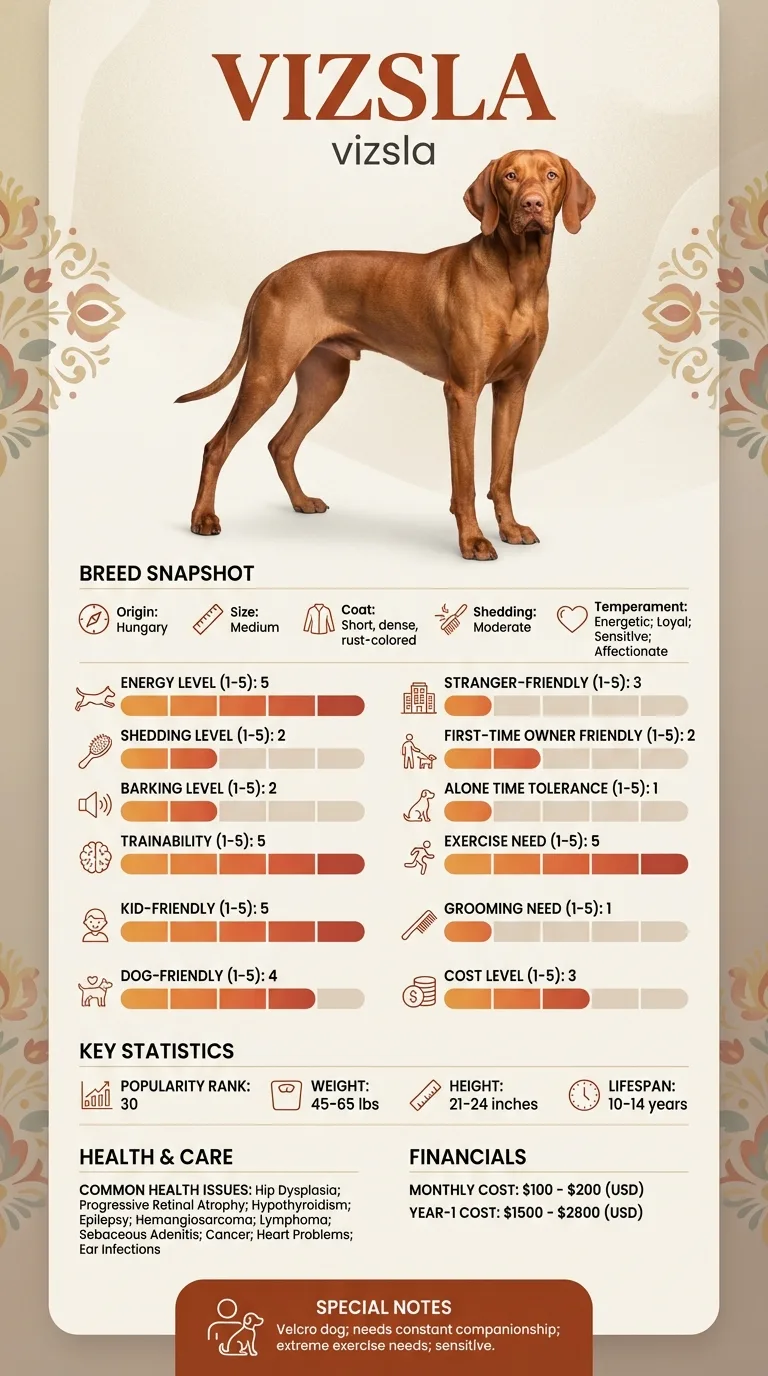
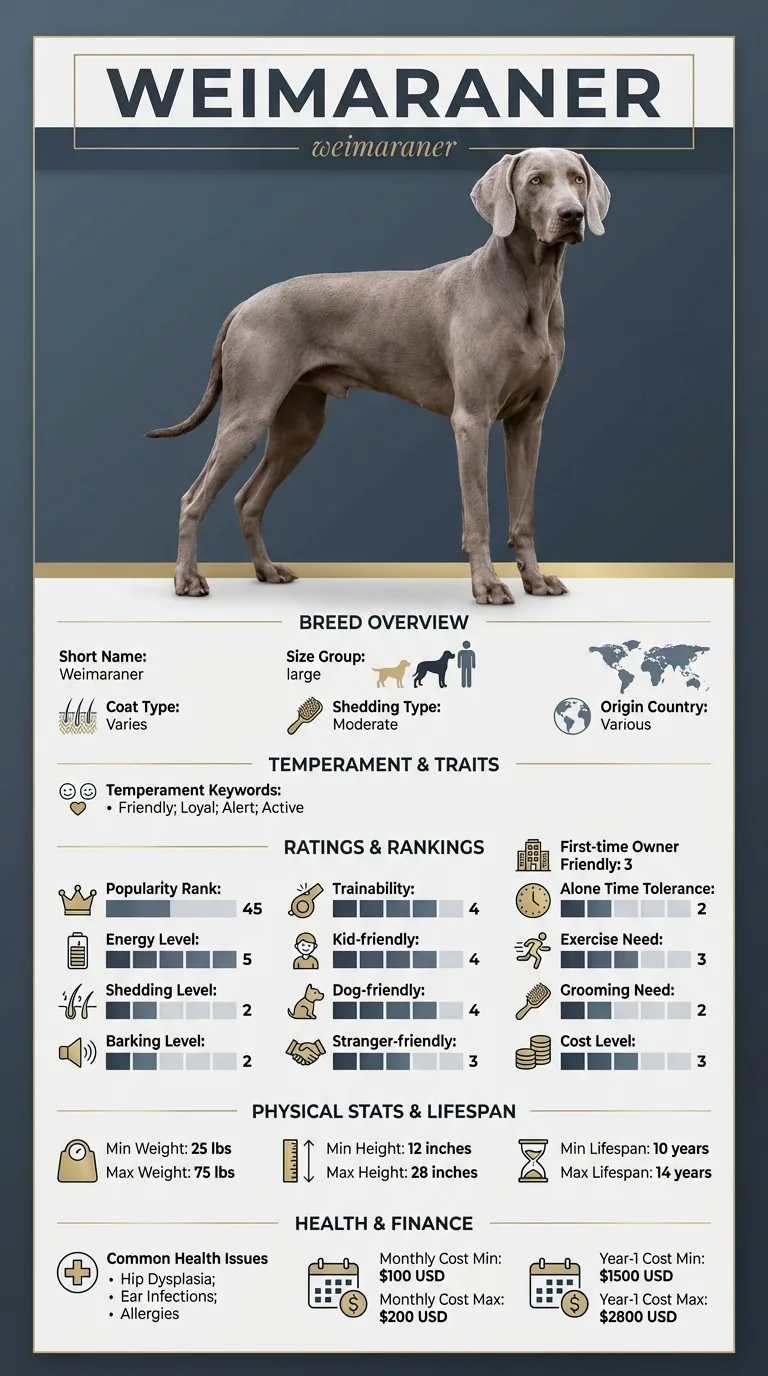
This is for someone already down to Vizsla and Weimaraner and deciding between them. Because the two are so evenly matched, the page works through every axis rather than leading with one. Both rate 1/5 for flats, so housing does not settle this one. The focus throughout is on daily consequences rather than breed background.
Between Vizsla and Weimaraner, they are closer than most pairings, and the choice comes down to temperament; neither is the lower-effort dog overall.
Choose Vizsla if there are young children at home, you already have another dog and you want a dog that picks up training quickly.
Choose Weimaraner if its temperament and look are what you want; on the measurable axes it gives up nothing to the other.
| Feature | vizsla | weimaraner | Winner |
|---|---|---|---|
| Size class | medium | large | Equal |
| Weight | 45–65 lbs | 55–90 lbs | Equal |
| Height | 21–24 in | 23–27 in | Equal |
| Lifespan | 10–14 years | 10–13 years | vizsla |
| Exercise need | Very high (5/5) | Very high (5/5) | Equal |
| Grooming need | Very low (1/5) | Very low (1/5) | Equal |
| Shedding | Low (2/5) | Low (2/5) | Equal |
| Energy level | Very high (5/5) | Very high (5/5) | Equal |
| Barking | Low (2/5) | Moderate (3/5) | vizsla |
| Apartment suitability | Very low (1/5) | Very low (1/5) | Equal |
| Good for first-time owners | Low (2/5) | Low (2/5) | Equal |
| Tolerates being alone | Very low (1/5) | Very low (1/5) | Equal |
| Trainability | Very high (5/5) | High (4/5) | vizsla |
| Good with kids | Very high (5/5) | High (4/5) | vizsla |
| Good with other dogs | High (4/5) | Moderate (3/5) | vizsla |
| Friendly to strangers | Moderate (3/5) | Moderate (3/5) | Equal |
| Cost level | Moderate (3/5) | Moderate (3/5) | Equal |
| Coat | Short, dense, rust-colored | Short and sleek | Equal |
| Origin | Hungary | Various | Equal |
| Typical monthly cost | $100–$200 | $110–$240 | Equal |
| Typical first-year cost | $1,500–$2,800 | $1,700–$3,200 | Equal |
These two sporting breeds sit close on the size spectrum but not identical: the Vizsla runs 45-65 lbs and 21-24 inches, while the Weimaraner runs larger at 55-90 lbs and 23-27 inches, up to 25 pounds heavier at the top end. Both are lean, athletic hunting dogs built for endurance rather than bulk, and both carry short coats that hug a visibly muscular frame. The Weimaraner's silver-grey coat and larger size give it a more imposing presence, while the Vizsla's rust-colored coat and slightly smaller frame earn it the nickname Velcro dog for how closely it shadows its owner despite the size.
This is as close to a dead heat as this site gets: both breeds rate Very high (5/5) for exercise need and Very high (5/5) for energy level. Both were bred as versatile hunting dogs expected to work all day, and both carry the Energetic tag in their temperament profile. The difference isn't quantity of exercise needed but relationship style, the Vizsla's Sensitive and Affectionate nature means it often wants to exercise alongside its person rather than independently, while the Weimaraner's Alert, Headstrong streak can make it a bit more assertive about setting its own pace. Either way, a sedentary household should look elsewhere entirely.
Grooming and shedding both tie here: Very low (1/5) grooming need and Low (2/5) shedding for both breeds. Neither the Vizsla's short, dense, rust-colored coat nor the Weimaraner's short, sleek coat requires more than an occasional brush and bath. This is one of the few sections on this comparison where the choice genuinely comes down to preference rather than practical difference, both are close to wash-and-go breeds, a rarity among larger, high-energy dogs, and neither will demand grooming appointments or leave the kind of fur drift that double-coated breeds do.
Apartment suitability ties at Very low (1/5) for both breeds, and both tolerate being alone at Very low (1/5) as well, neither is remotely suited to small-space, long-hours living. Barking is the one point of separation: the Vizsla rates Low (2/5) against the Weimaraner's Moderate (3/5), meaning the Weimaraner is somewhat more vocal when bored or anxious. Given that both breeds share Very high exercise needs and near-zero alone tolerance, this section really underscores that these are yard-and-activity dogs meant for a household with space, time, and consistent companionship, apartment living isn't realistic for either.
The Vizsla edges ahead on trainability, Very high (5/5) against the Weimaraner's still-strong High (4/5), reflecting its long history as a pointing and retrieving dog bred for close cooperation with hunters. Both tie at Low (2/5) for first-time-owner suitability, though, high intelligence paired with high energy and sensitivity (Vizsla) or headstrong assertiveness (Weimaraner) makes both breeds demanding for someone new to dog ownership. An experienced handler will likely find either breed rewarding to train, but the Vizsla's slight edge in raw trainability, combined with its sensitive nature, means training methods matter, harsh correction tends to backfire with this breed.
The Vizsla leads modestly across the social categories: Very high (5/5) with kids against the Weimaraner's High (4/5), and High (4/5) with other dogs against Moderate (3/5). Both tie at Moderate (3/5) friendliness to strangers. The temperament lists reveal the underlying character difference, the Vizsla's Loyal, Sensitive, Affectionate profile suggests a dog that bonds deeply and reads emotional tone closely, while the Weimaraner's Devoted, Alert, Headstrong mix points to a dog equally loyal but more independently minded and protective. Households with a lot of gentle affection to give may find the Vizsla's sensitivity a natural match.
The Vizsla holds a slight lifespan edge, 10-14 years versus the Weimaraner's 10-13. Their health profiles diverge meaningfully: the Vizsla's list is heavy on cancer-related risk, Hemangiosarcoma, Lymphoma, and Cancer alongside Heart Problems and Sebaceous Adenitis, while the Weimaraner's shorter list centers on structural and emergency risks, led by Bloat (GDV), Hypertrophic Osteodystrophy, and the bleeding disorder Von Willebrand Disease. Both share Hip Dysplasia. Vizsla owners should stay current on veterinary cancer screening, while Weimaraner owners should learn bloat prevention strategies given how serious and sudden that condition can be.
Cost level ties at Moderate (3/5) for both breeds, though the typical figures lean slightly cheaper for the Vizsla: $100-$200 monthly and $1,500-$2,800 first-year, against the Weimaraner's $110-$240 monthly and $1,700-$3,200 first-year. The gap likely traces to the Weimaraner's larger average size driving up food volume and gear costs. Neither breed carries heavy grooming expenses given their shared Very low (1/5) grooming need, so the ongoing cost difference comes down almost entirely to size-driven expenses like food, medication dosing, and larger-breed veterinary care rather than any structural difference in upkeep.
Vizsla weighs 45–65 lbs and lives 10–14 years; Weimaraner weighs 55–90 lbs and lives 10–13 years. No rated axis separates them by more than a single point, which makes this one of the closer pairings on the site. They are level on tolerates being alone, apartment suitability and cost level, so those cannot decide it. The table below marks a winner only where one breed is genuinely easier for a typical owner; size and origin are facts rather than merits and stay level. Ratings come from one source applied to both breeds, so they are meaningful against each other rather than as absolute scores.

Very similar in build and energy, both rate Very high (5/5) for exercise need, Very low (1/5) for grooming, and Very low (1/5) for apartment suitability, but they diverge in temperament, with the Vizsla more Sensitive and Affectionate and the Weimaraner more Alert and Headstrong.
The Vizsla, rated Very high (5/5) trainability versus the Weimaraner's High (4/5), though both require experienced, consistent handling.
The Vizsla, rated Very high (5/5) with kids against the Weimaraner's High (4/5), both are strong family choices, but the Vizsla edges ahead.
No, both rate Very low (1/5) for apartment suitability and Very low (1/5) for tolerating being alone, making them a poor fit for small-space or high-hours-away living.
The Vizsla carries a heavier cancer-related risk profile (Hemangiosarcoma, Lymphoma, Cancer), while the Weimaraner's risks center on Bloat (GDV) and a bleeding disorder, Von Willebrand Disease.
The Weimaraner, rated Moderate (3/5) versus the Vizsla's Low (2/5).
The Vizsla, slightly, its $100-$200 monthly range and $1,500-$2,800 first-year cost both undercut the Weimaraner's $110-$240 and $1,700-$3,200.
The Weimaraner, at up to 90 lbs versus the Vizsla's 65 lb max.
The Vizsla, rated Very high (5/5) versus the Weimaraner's High (4/5).
The Vizsla, rated Low (2/5) versus the Weimaraner's Moderate (3/5).
The Vizsla, at 10-14 years versus the Weimaraner's 10-13 years.
Secure checkout on Stripe. We never see your card.
7-day money-back guarantee. Instant access.


Health information here is general and is not veterinary advice. If your dog shows pain, sudden behaviour change, or worsening symptoms, consult a licensed veterinarian.
Some links on this site are affiliate links. We may earn a commission at no extra cost to you, and we only suggest products we believe are helpful for dog owners.
We research and check what we publish, but we do not warrant that any figure, date, price, or statement is accurate, complete, or current, and we accept no liability for any loss, cost, injury, or other harm arising from the use of this site. Use it as one reference among several. You remain responsible for your own decisions and for your dog's care - confirm anything that matters with a licensed veterinarian or another qualified professional before you act on it. Full disclaimer.
Match your lifestyle to the right dog.
Take quizNot sure which breed is right for you? Take our 2-minute quiz to find out.
Take the quiz