Health
Is there an obesity gene documented in Weimaraners?
No, that specific mutation is documented in Labrador and Flat-Coated Retrievers, not this breed.

Quick answer
Is there an obesity gene documented in Weimaraners?
No, that specific mutation is documented in Labrador and Flat-Coated Retrievers, not this breed.
It's easy to assume a breed built for all-day running is somehow immune to weight gain, but a Weimaraner whose exercise drops due to injury, a busier owner's schedule, or simple aging can put on weight surprisingly fast, precisely because its calorie needs were calibrated for a much higher activity level.
This affects owners whose Weimaraner's activity level has recently dropped, whether from a joint injury, a lifestyle change, or the natural slowdown of the senior years, and owners who assumed a naturally lean-looking breed didn't need close weight monitoring.
This guide is not medical advice. If your dog shows pain, sudden behavior change, or worsening symptoms, consult a licensed veterinarian.
Some links may be affiliate links. We may earn a commission at no extra cost to you. We only suggest products we believe are helpful for dog owners.
Weight gain risk in Weimaraners isn't driven by a documented obesity gene the way it is in some retriever breeds; instead, it comes from a mismatch between this breed's high calorie needs, calibrated for a very active lifestyle, and any drop in actual activity level that isn't matched by a reduction in food.
Weight gain is a common, practical risk for this breed specifically because owners often underestimate it, assuming a naturally lean, athletic-looking dog doesn't need close weight monitoring, when in fact any drop in this breed's high activity level can lead to weight gain fairly quickly.
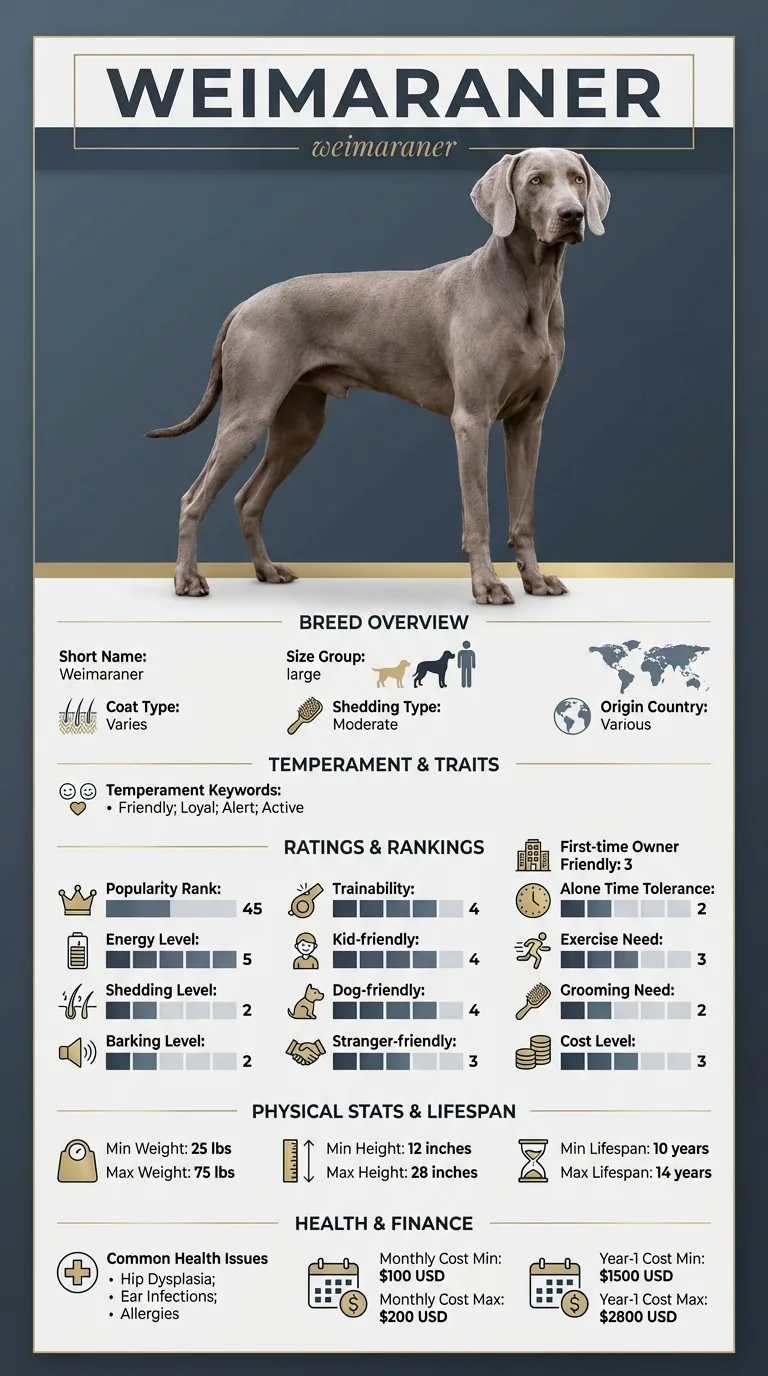
Weimaraners have an exercise need at the top of the scale, meaning their calorie requirements are calibrated for a genuinely high activity level. There is no documented genetic mutation driving increased appetite in this breed the way there is in some retrievers; the risk here is behavioral and situational rather than a confirmed inherited appetite driver.
Any reduction in activity, from injury, a busier household, or aging, without a corresponding reduction in food intake is the primary driver of weight gain in this breed. Frequent treat use during training, common in a breed this trainable and food-motivated, can also add unaccounted calories.
Bring up weight at every routine visit, and specifically if you notice ribs becoming harder to feel or the waist disappearing. If weight gain is rapid or unexplained despite no change in diet or activity, mention this too, since it can occasionally point to an underlying issue like a metabolic change.
See all Weimaraner health problems, which breeds are prone to genetic predisposition to obesity, or the full Weimaraner breed guide for temperament, exercise needs and ownership costs.
Weight gain from an activity drop can happen within a few weeks to a couple of months if food isn't adjusted. Weight loss, once addressed through diet and exercise changes, typically takes a similar timeframe of steady progress rather than a quick fix.
Success is a stable, healthy body condition maintained through matching food intake to actual activity level, adjusted proactively whenever that activity level changes rather than reactively after weight gain is already visible.
Some specific genetic mutations linked to increased appetite and obesity risk have been identified in certain breeds, most notably in Labrador and Flat-Coated Retrievers. Weimaraners are not documented among the breeds carrying that specific mutation, so there's no confirmed genetic appetite driver unique to this breed the way there is in those retrievers.
What is a genuine risk factor for Weimaraners is almost the opposite kind of problem: this breed's calorie needs are calibrated for a very high activity level, given its exercise need rating at the top of the scale. When that activity level drops, whether from an orthopedic injury, a busier owner, or the natural slowdown that comes with age, the dog's calorie intake often doesn't get adjusted to match, and weight can climb faster than an owner expects from a breed they think of as naturally lean and athletic.
Extra weight isn't a cosmetic issue for this breed specifically; it adds direct mechanical load to joints already carrying some documented risk (hip dysplasia is a known breed issue), increases strain during exactly the high-impact activity this breed loves, and can worsen the odds of a cruciate ligament injury. The stakes for staying on top of weight are higher here than in a naturally low-energy breed.
Because this breed's baseline appearance is lean and muscular, weight gain can be underestimated until it's already become significant.

After Django, Petra's five-year-old Weimaraner, tore his cruciate ligament and needed two months of strict rest during recovery, Petra kept feeding him the same amount he'd always eaten during his usual daily runs. By the time he was cleared for normal activity again, he'd put on a noticeable amount of weight, which surprised her given how lean he'd always looked. Her vet helped her recalculate his food portions based on his actual activity level during recovery, going forward, and pointed out that his old cruciate injury made the extra weight even more of a concern for his joints. Petra now reassesses his food any time his routine changes significantly, and his weight has stayed stable since.
Key takeaway: Petra assumed a breed known for being lean and athletic didn't need careful portion tracking, until an injury-driven activity drop proved otherwise. Matching food to actual activity level, not the dog's usual reputation, is what kept his weight in check afterward.
No, that specific mutation has been documented in Labrador and Flat-Coated Retrievers, not Weimaraners. This breed's weight risk comes more from a mismatch between its high calorie needs and reduced activity, not an inherited appetite-driving gene.
Because this breed's calorie needs are calibrated for a very active lifestyle, any drop in activity, from injury, a busier schedule, or aging, without a corresponding reduction in food, can lead to weight gain faster than owners expect.
You should be able to easily feel the ribs without pressing hard, and there should be a visible waist when looking down at the dog from above. If ribs are hard to feel or the waist has disappeared, it's worth reassessing food and exercise.
Yes, because Weimaraners already carry documented hip dysplasia risk and are prone to activity-related injuries like cruciate ligament tears, extra weight adds mechanical stress that can worsen both.
Reduce daily portions proportionally to the activity reduction, and reassess again after a few weeks using a hands-on body condition check rather than guessing.
Yes, treats used frequently during training can add up to a significant portion of daily calories without owners realizing it, especially in a breed that's often in active training given its intelligence and energy.
Prevention through diet and exercise management is essentially free beyond normal food costs, while treating weight-related joint problems down the line, like arthritis or a cruciate injury, can be considerably more expensive.
No, that specific mutation is documented in Labrador and Flat-Coated Retrievers, not this breed.
Their calorie needs are calibrated for high activity; when activity drops without a food adjustment, weight gain follows.
You should easily feel the ribs without pressing hard, and see a visible waist from above.
Yes, it adds mechanical stress that can worsen this breed's existing hip dysplasia and cruciate injury risk.
Yes, reduce food proportionally to the activity drop rather than waiting until weight gain becomes visible.
A one-page prep sheet for this condition: the signs, the questions to ask, what to get priced. Unlocks here.
You get: Vet visit prep sheet
No spam. One-click unsubscribe. See our privacy policy.
Preview page 1 before you decide.